

The label may seem to explain a painful co-parenting dynamic, but it cannot tell you what your child needs next. If you’re wondering how to co-parent with a narcissist in the UK, start with specific behaviours, clear boundaries and your child’s wellbeing, rather than trying to prove a diagnosis.
It’s understandable to want a name for behaviour that feels controlling, dismissive or lacking in empathy. Narcissistic Personality Disorder is a recognised mental health condition, but behaviour that seems narcissistic does not, by itself, establish that someone has the condition. Keeping this distinction in mind can help you respond to what is happening without letting a label drive important decisions.
This guide explains what narcissism can mean, how to keep communication with schools and healthcare providers focused on your child, and how to support your child without speaking badly about their other parent. It also covers practical boundaries, written communication and legal options to consider in the UK, with a focus on safety, stability and your child’s experience.
Key Takeaways
- Keep messages to practical matters about your child, and use written communication to create a clearer record.
- Protect children from adult conflict by listening without asking them to take sides, and notice when they may need extra support.
- Focus on specific behaviour rather than relying on a diagnosis when considering boundaries or legal options.
- Choose support that fits the need, whether that means guidance for you, relationship counselling or therapy for your child.
Communicating with schools and healthcare providers directly
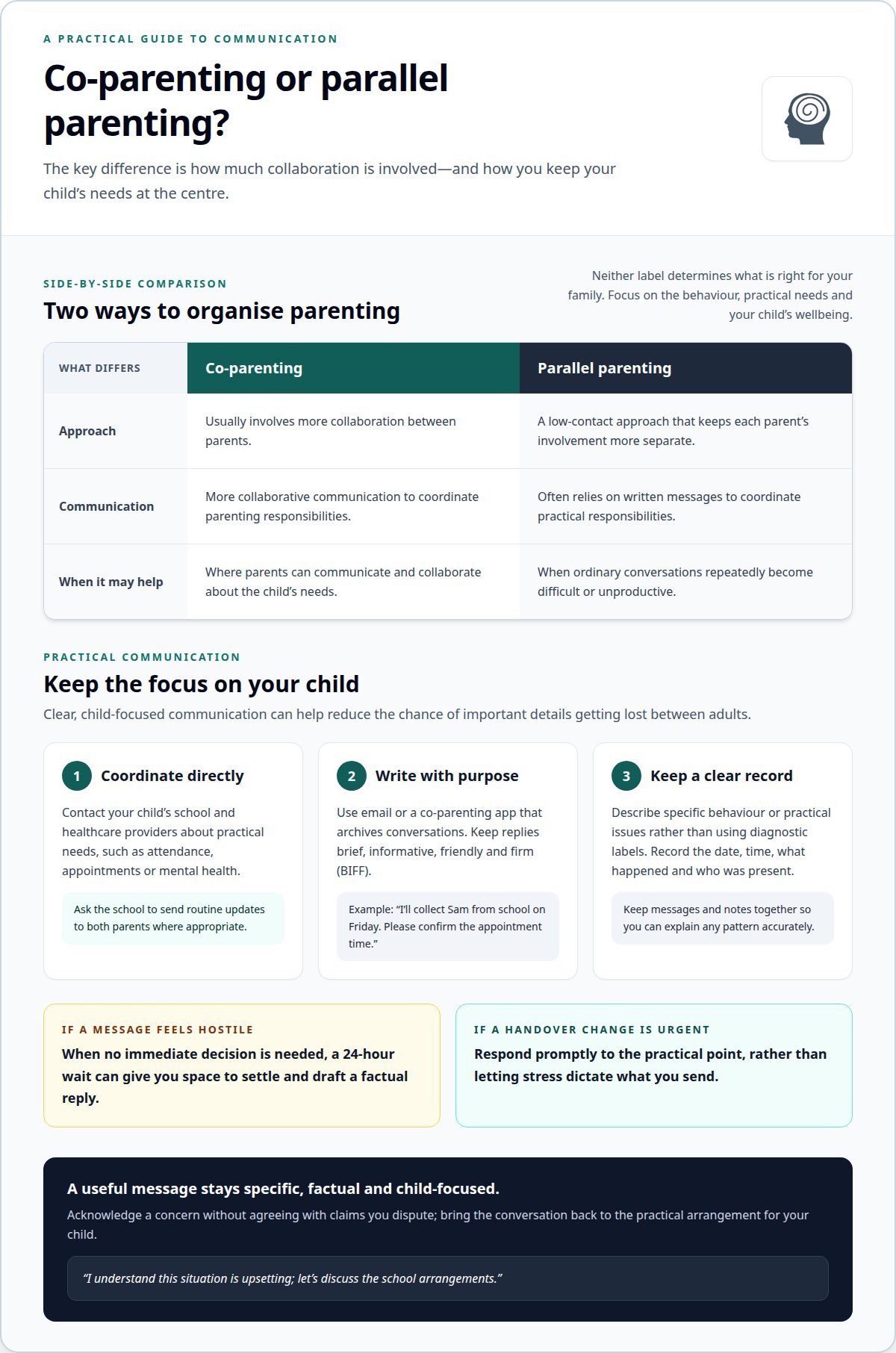
Contact your child’s school and healthcare providers directly about practical needs. Share relevant details about attendance, appointments or mental health clearly, and ask the school to send routine updates to both parents where appropriate. This can reduce the risk of important information being lost between adults.
Parallel parenting is a low-contact approach that often relies on written communication to coordinate responsibilities. Unlike co-parenting, which usually involves more collaboration, it keeps each parent’s involvement more separate. If you’re considering how to co-parent with a narcissist in the UK, this approach may help when ordinary conversations repeatedly become difficult or unproductive.
Keep messages in writing, using email or a co-parenting app that archives conversations. A brief, informative, friendly and firm (BIFF) reply can keep the focus on your child. For example: “I’ll collect Sam from school on Friday. Please confirm the appointment time.” Acknowledge the other parent’s concern without agreeing with claims you dispute. You might say, “I understand this situation is upsetting; let’s discuss the school arrangements.”
Write as though a teacher or clinician might need to understand the message later. Instead of using labels such as “narcissistic personality disorder,” describe the specific behaviour or practical issue. Record each incident with the date, time, what happened and who was present. Keep messages and notes together so you can explain any pattern accurately.
Learning how to co-parent with a narcissist in the UK can also mean choosing when to respond. If a message feels hostile, pause when no immediate decision is needed. A 24-hour wait can give you space to settle and draft a factual reply. For an urgent handover change, respond to the practical point promptly. This helps you communicate deliberately, rather than letting stress dictate what you send.
Protecting children without speaking badly about the other parent
Keep conversations with your co-parent brief and focused on your child’s practical needs, such as school, health or activities. Don’t ask your child to carry messages or report on the other household. If an exchange becomes accusatory, return to the immediate decision: “Jamie needs their PE kit on Monday.” This helps keep adult tension from spilling into your child’s everyday relationship with either parent.
Children shouldn’t be asked to take sides or soothe a parent’s hurt feelings. Avoid negative comments about their other parent, even when you feel angry. If your child repeats something painful, listen without demanding details or asking them to retract it. Children aged 6, 7 or 8 may repeat harmful statements they have heard. You might say, “You can love both of us, and you don’t need to solve this.”
Notice changes in your child’s behaviour, such as nightmares, regression or mood swings. These may be reasons to seek child counselling, where they can explore family changes safely. At home, help them name a feeling, try a calming activity or identify a trusted adult. A predictable bedtime routine or regular time together can also offer stability when family arrangements feel uncertain.
Strengthen your bond through ordinary moments: listen to a story about school, share a meal or follow through on a promised activity. If your child acts out, respond to the behaviour rather than labelling their character. For example: “Throwing toys isn’t safe; let’s find another way to show your frustration.” Keep their safety central, and seek child-focused support if their distress persists or affects daily life.
Considering legal orders to address harassment or repeated court applications
In England and Wales, the child’s welfare is the court’s paramount concern. A co-parent’s diagnosis does not determine arrangements; evidence about behaviour, safety and the child’s needs matters. Keep written records of missed handovers, harassment or breaches, noting the dates and what happened. This can help you explain a pattern clearly to a family solicitor.
Mediation may be considered before applying, but exemptions can apply, including when domestic abuse makes mediation unsuitable. The process depends on the UK jurisdiction and the type of application. A solicitor can explain how the rules relate to your circumstances, particularly if there are safety concerns or previous court proceedings.
In England and Wales, apply to the family court for a child arrangements order when arrangements need a formal decision. The court considers the child’s welfare and evidence about their needs. Court fees and legal costs depend on the application and whether you instruct a solicitor, so consider them separately before proceeding.
Where an ex-partner repeatedly makes vexatious applications, a section 91 (14) barring order may be relevant. A Prohibited Steps Order can prevent specified actions, while a Non-Molestation Order may address harassment through communication. These orders address different concerns, so set out the behaviour and the protection sought rather than relying on labels such as narcissistic personality disorder.
Follow existing court orders and keep written evidence of any breach. If communication becomes abusive, don’t engage with negative or provocative messages beyond practical matters concerning your child. Seek advice from a family solicitor if harassment continues, applications are repeated, or you need to understand your options during divorce or separation. Report abusive behaviour to the police; if a child faces immediate danger, prioritise urgent safeguarding help. A clear legal strategy can support safer arrangements without unnecessarily escalating conflict.
Limitations of labeling a co-parent a narcissist
Narcissistic Personality Disorder (NPD) is a recognised mental health condition, not a synonym for selfishness or hurtful conduct. The DSM-5-TR, published by the American Psychiatric Association in 2022, describes criteria requiring at least five listed behaviours. Yet a co-parent’s difficult conduct, even when repeated, does not prove they have NPD. A label based on one relationship cannot establish a clinical diagnosis.
Behaviour towards a former partner may not reflect how someone behaves in other relationships. For example, a parent might dismiss your concerns during handovers, while friends describe a different experience of them. That contrast doesn’t erase your experience, but it shows why diagnosis from the outside is unreliable. Focus on what happens, how it affects your child and what needs to change.
Labels can also make conversations with a school, clinician or court less clear. “My ex is a narcissist” describes your interpretation; “they changed the agreed collection time without telling me” describes an event. The second statement gives others something concrete to discuss. A useful approach is to name the action, its impact on your child and the practical response you’re seeking.
Notice whether trying to prove a label increases your stress or keeps you emotionally tied to your former partner. You don’t need to settle a diagnosis to set a boundary or protect your child. Try replacing “They’re a narcissist” with “I need handover changes confirmed in writing.” That shift may help you respond more steadily, while leaving the other parent responsible for their own behaviour. The clearest takeaway is to respond to repeated behaviours and their effects, not an unverified label.
Tracy Kimberg
Tracy Kimberg supports adults and teenagers affected by painful relationship dynamics and family change. If co-parenting conflict is leaving you overwhelmed, Therapy for Adults can give you space to explore your reactions, strengthen boundaries and consider what you need to feel steadier. This support focuses on your wellbeing, not on diagnosing your former partner or replacing legal advice.
When a teenager is struggling with separation or tension between parents, Therapy for Teenagers offers a therapeutic space to explore their feelings. It may help them talk about loyalty conflicts, anger or uncertainty without being asked to take sides. Their needs and readiness should guide whether therapy feels like the right next step.
Relationship Counselling and Coaching for Couples can help partners examine communication patterns and relationship dynamics. It may be relevant when both people want to work on their relationship, rather than as a way to compel cooperation in co-parenting. For couples facing ongoing rupture, structured therapeutic programmes offer a focused pathway towards relationship recovery. The right fit depends on the difficulty you want to address and whether you are seeking individual or shared support.
Separation can bring grief, anger and difficult decisions alongside parenting responsibilities. Tracy Kimberg’s conscious approach to divorce and separation can support reflection on the emotional and relational experience of that transition. Therapy and relationship support don’t determine legal arrangements, but they can help you understand your feelings and make decisions with greater care.
You don’t need to arrive with a diagnosis or a complete plan. It may be enough to name what feels hardest, such as managing conflict, supporting your teenager or recovering your sense of self. If you’d like to explore what support may suit your situation, contact Tracy Kimberg for a conversation.
Frequently Asked Questions
What does narcissistic behaviour look like in a co-parenting relationship?
The behaviour may involve repeated entitlement, manipulation or little apparent empathy during parenting discussions. For example, a co-parent might dismiss a child’s needs while insisting that arrangements always suit them. These behaviours can make cooperation difficult, but they don’t establish narcissistic personality disorder. Focus on observable actions and their effects on your child, rather than treating a label as a diagnosis.
How can you communicate with a high-conflict co-parent using BIFF or parallel parenting?
Use BIFF to keep each reply brief, informative, friendly and firm. For example: “The school meeting is Tuesday at 3pm. I’ll attend; please send any questions by Monday.” Parallel parenting reduces direct discussion and keeps coordination to essential child-related matters, often in writing. It may suit situations where joint decisions regularly become arguments, while still allowing each parent to focus on the child.
How do you set boundaries and keep records when co-parenting with a narcissist?
Make boundaries specific and practical. For example, ask for handover changes in writing rather than discussing them during your child’s visit. Keep a dated record of relevant messages, missed arrangements and what happened. Note who was present and retain the original communication. This gives you a clearer account if you later need to explain a pattern to a solicitor or the family court.
How can you protect children from parental conflict and avoid putting them in the middle?
Keep adult disagreements away from children, and don’t ask them to carry messages or choose between parents. If your child asks why plans changed, give a calm, age-appropriate explanation without blaming their other parent. Invite them to describe their feelings, and listen without pressing for details. If they show distress through nightmares, mood swings or regression, consider whether support from a child therapist could help.
What UK child arrangements can a family court order, and how are they decided?
A child arrangements order can set out arrangements for a child and may specify handover details, such as a default time and location. The child’s welfare is the court’s paramount concern. The court considers the child’s needs and the circumstances presented, rather than deciding on the basis of a parent’s label. The relevant process and orders can differ across UK jurisdictions.
What should you do if a co-parent breaches a child arrangements order or uses contact to harass you?
Keep a clear record of any breach, including the date, what the order required and what happened. Follow the existing order, and discuss repeated breaches with a family solicitor to understand possible next steps. If communication is being used to harass you, a Non-Molestation Order may be relevant. Report abusive behaviour to the police, and seek urgent safeguarding help if anyone faces immediate danger.

Article by
Tracy Kimberg
Tracy Kimberg is a Relationship Expert, Couples Therapist and Coach with a dedicated focus on helping couples and individuals rebuild connection, trust and emotional safety in their relationships. Drawing on the research of John and Julie Gottman, the relational insights of Esther Perel, and years of hands-on therapeutic experience, Tracy offers a warm, non-judgemental and deeply compassionate approach to modern relationships.
Based in Dorset, Tracy works with couples navigating communication breakdowns, betrayal, intimacy challenges, separation, family dynamics and life transitions. Known for creating a safe and grounded therapeutic space, she combines practical tools with emotional depth to help clients move beyond survival patterns and towards meaningful, lasting change.
With a reputation for empathy, professionalism and dedication to her clients’ growth, Tracy is passionate about helping people feel seen, understood and empowered — both within their relationships and within themselves.
Disclaimer
Disclaimer:
The information shared in this article is intended for educational and informational purposes only and should not be considered a substitute for professional therapeutic, psychological, medical or legal advice. Every individual and relationship is unique, and the perspectives offered are based on general therapeutic principles, research and professional experience.
Reading this article does not establish a therapist-client relationship with Tracy Kimberg. If you are experiencing significant emotional distress, relationship crisis, trauma, or mental health concerns, it is important to seek support from a qualified professional appropriate to your individual circumstances.
All content remains the intellectual property of Tracy Kimberg and may not be reproduced or distributed without permission.