

What if the person you call your “best friend” is actually the person quietly dismantling your marriage? It is a confronting question, especially when you have always valued the support of a close confidant. You might find yourself caught in a confusing middle ground, feeling a deep sense of guilt over a connection you tell yourself is harmless, whilst simultaneously noticing a growing emotional disconnect with your spouse. If you have been wondering about the difference between an emotional affair vs friendship, you aren’t being “crazy” or oversensitive; you are responding to a subtle shift in the energy of your primary relationship.
We understand how isolating this uncertainty feels. You deserve to move through life with a clear heart and a secure partnership. This article will help you discover the psychological markers that distinguish a healthy, transparent friendship from the secrecy of emotional infidelity. We will provide a compassionate framework to help you discuss these boundaries without defensiveness and offer actionable steps to protect your relationship and rebuild the intimacy you might feel is slipping away. By the end, you will have the tools to navigate these complex emotional landscapes with confidence and grace.
Key Takeaways
- Learn to identify the subtle shift from platonic support to romantic substitution by understanding the core differences between an emotional affair vs friendship.
- Explore the psychological drivers behind external connections, viewing them as a search for self-regulation or a quest to rediscover a lost version of your own identity.
- Discover how to assess the “direction” of your intimacy, identifying whether an external bond is energising your marriage or quietly siphoning energy away from it.
- Master the “Softened Start-up” technique to initiate honest, non-defensive conversations about boundaries and emotional safety without triggering conflict.
- Gain a clear roadmap for healing through a structured recovery process that focuses on the essential stages of atonement, attunement, and attachment.
Understanding the Nuance Between Close Friendships and Emotional Infidelity
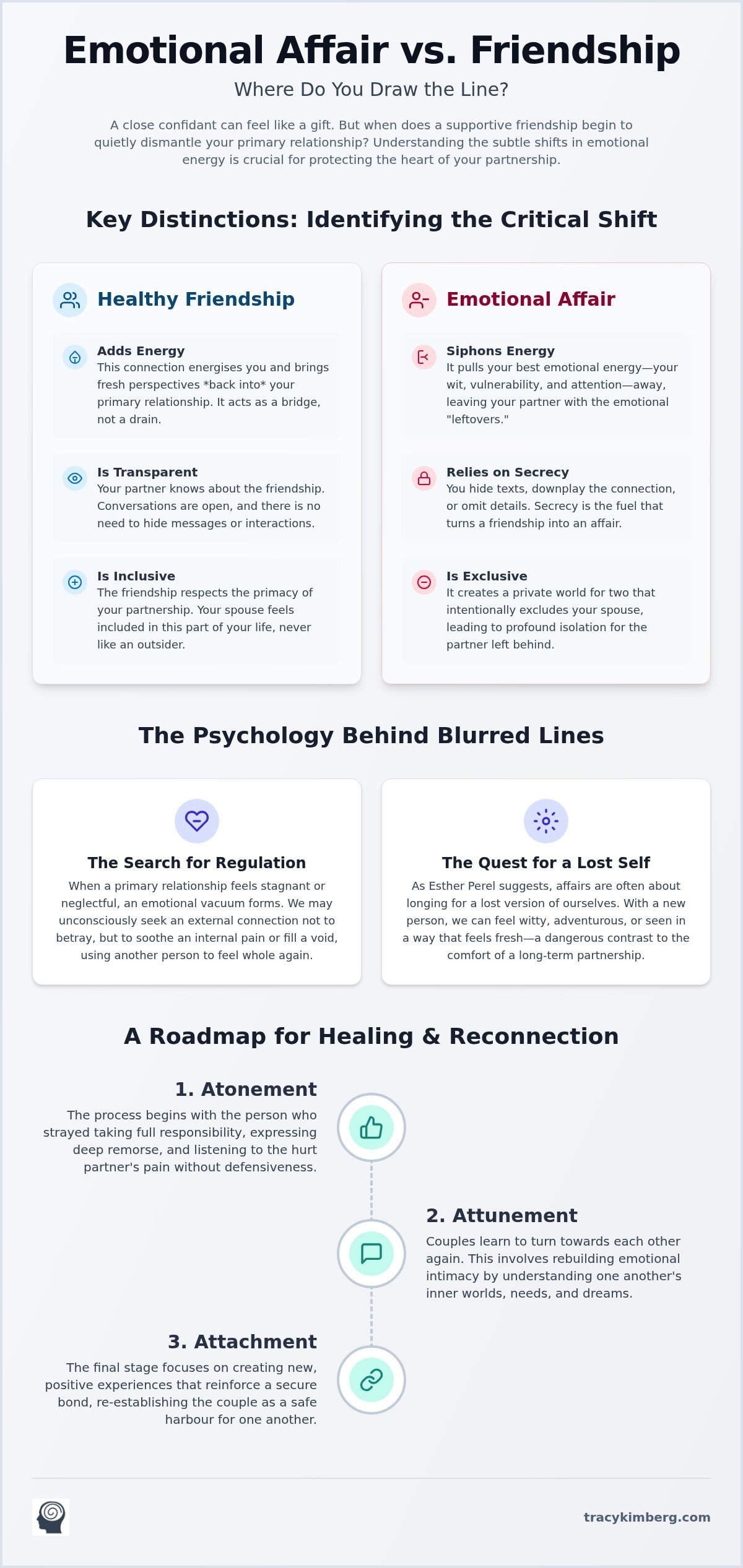
Relationships are built on a foundation of shared energy and exclusive emotional space. When we talk about the boundary of an emotional affair vs friendship, we are looking at where that energy flows. A healthy friendship is a bridge that connects you to the world, often bringing fresh perspectives back into your marriage. In contrast, an emotional affair acts like a siphon. It pulls your attention, your wit, and your deepest vulnerabilities away from your spouse, leaving them with the “leftovers” of your day whilst your confidant gets the best version of you.
The “we’re just friends” defence is often a subconscious shield. It’s a way to protect a connection that feels good without having to face the reality of the betrayal. I often see this in my work; people aren’t usually looking to hurt their partners. Instead, they’re seeking something they feel is missing. However, the difference between a support network and an emotional “third” in the room is the impact on your primary bond. If your friendship makes your spouse feel like an outsider in their own life, the line has likely been crossed.
The Definition of an Emotional Affair
An emotional affair is a connection where intimacy, secrecy, and chemistry converge to bypass the primary partner. It often begins with what researchers call “micro-cheating,” which involves small, seemingly insignificant actions like hiding a text message or sharing an inside joke that you wouldn’t share with your spouse. If you are trying to understand what is an emotional affair, it’s vital to recognise that physical contact isn’t a requirement for betrayal. Trust is broken when the emotional exclusivity of the relationship is handed to someone else, creating a deep psychological breach that can be just as damaging as a physical encounter.
The Role of Secrecy in Emotional Cheating
Transparency is the hallmark of a platonic bond. In a healthy friendship, your partner knows the person, hears about your conversations, and feels included in that part of your life. Secrecy, however, is the fuel that turns a friendship into an affair. When you find yourself thinking, “I didn’t tell you because you wouldn’t understand,” you’ve already created a private world that excludes your partner. This hidden landscape creates a “we” that doesn’t include your spouse, leading to a profound sense of isolation for the person left behind. This shift in the emotional affair vs friendship dynamic is rarely about the other person; it’s about the secret intimacy that thrives in the dark.
The Psychology of Connection: Why the Line Gets Blurred
Understanding the psychology of an affair requires us to look beyond the surface level of “bad choices”. Gabor Maté suggests that we often seek external regulation to soothe internal pain. When a primary relationship feels stagnant or emotionally neglectful, it creates a vacuum. This void isn’t necessarily a sign of a “bad” partner, but it can be a fertile ground for an external connection to take root. We aren’t just looking for another person; we are often looking for a way to feel whole again.
The transition from a platonic bond to something more is rarely a sudden leap. It’s a slow drift. In the delicate balance of an emotional affair vs friendship, the shift occurs when we begin to outsource our emotional needs. What starts as a shared interest or a supportive ear can evolve into a primary source of validation, leaving the spouse on the periphery of our inner world. This “friendship-to-affair” pipeline is often paved with innocent intentions, but it’s the direction of the intimacy that determines the outcome.
Longing vs. Betrayal: The Perel Perspective
Esther Perel famously notes that affairs are often less about the other person and more about a quest for a lost version of oneself. In the domestic sphere, we are parents, bill-payers, and partners. With a “friend,” we might feel witty, adventurous, or seen in a way that feels fresh. This “eroticism of the mind” thrives on the absence of mundane reality. It’s easy to be your best self when you don’t have to decide whose turn it is to take the rubbish out. However, when a friendship crosses the line, that “newness” becomes a dangerous contrast to the predictability of a long-term partner, making the primary bond feel like a burden rather than a sanctuary.
Trauma and Attachment in Relational Dynamics
Our history often dictates our present connections. Those with insecure attachment styles might subconsciously seek “back-up” emotional support as a safety net against perceived abandonment. This “emotional hunger” can lead us to starve our primary bond whilst overfeeding an external one. There is also a vital distinction between healthy venting and “triangulation.” Venting involves seeking advice to improve your marriage; triangulation involves using a third party to avoid dealing with your partner directly. If you feel your relationship is caught in this painful cycle, relationship counselling can provide a safe, professional space to untangle these complex threads and restore your connection.
10 Key Differences: Friendship vs Emotional Affair
The line between a platonic bond and a romantic substitution is often invisible until you’ve already stepped over it. To understand the transition of an emotional affair vs friendship, we can use the “Windows and Walls” metaphor. In a secure partnership, you keep a window open to your spouse, sharing your deepest thoughts and vulnerabilities, whilst maintaining a protective wall around the couple to keep outside influences at a distance. When an affair begins, those structures flip. You build a wall against your partner, shutting them out of your inner world, and open a window to a friend. You are no longer looking at your partner; you are hiding from them.
This shift in direction is the most profound indicator of a problem. A healthy friendship acts as a resource that enriches your life and, by extension, your marriage. An emotional affair, however, acts as a competitor. It creates a “third” in the room, even if that person is only present through a screen. It isn’t just about the time spent; it’s about the quality of the emotional energy being diverted away from the person you’ve promised to love.
The Secrecy Test: Would You Say It in Front of Your Partner?
Transparency is the ultimate litmus test for defining the line between friendship and emotional cheating. In a true friendship, you’d happily recount your lunch conversation to your spouse without editing the details. If you find yourself “sanitising” your stories, deleting text messages, or changing a contact name to avoid “misunderstandings,” you’ve already moved into the territory of secrecy. Ask yourself the “Video Test”: would you feel comfortable if your partner watched a recording of your interaction with this person? If the thought makes you wince, the chemistry has likely shifted from platonic support to a romantic substitution.
The Comparison Framework
Another key distinction lies in the “direction” of your intimacy. Does your connection with this person lead you back to your partner with more patience, or does it draw you away? Consider these core differences:
- Support vs Substitution: A friend encourages you to talk to your partner; an affair partner becomes the “safe haven” where you complain about them.
- Energy Levels: After seeing a friend, you feel energised to be a better spouse. After seeing an affair partner, your spouse feels like a burden or an obstacle to your happiness.
- Sexual Tension: Friendships are comfortable and predictable; affairs often have a “charge” or a lingering tension that you feel the need to hide.
- Mental Space: You think about a friend when it’s relevant; an affair partner occupies your daydreams and idle thoughts throughout the day.
Ultimately, a friendship is an addition to your life, whilst an emotional affair is a replacement for the intimacy that belongs in your marriage. Recognising this distinction is the first step toward protecting your primary bond.
Navigating the Conversation: What to Do if the Line is Blurred
When the boundary between an emotional affair vs friendship begins to feel hazy, the instinct is often to retreat into silence or erupt in accusation. Neither path leads to the clarity you need. Instead, we must look at how to open a dialogue that invites connection rather than defensiveness. John Gottman’s research suggests that the first three minutes of a conversation determine its outcome. Using a “Softened Start-up” allows you to raise a concern without inviting the “Four Horsemen” of criticism or contempt into the room. It’s about speaking from your own vulnerability whilst keeping the safety of the relationship at the centre of the talk.
The goal is simple: to protect the “we”. This requires a shift from “You are doing something wrong” to “I am feeling a disconnect and I miss you.” By focusing on the emotional vacuum that has been created, you address the root cause of the anxiety rather than just the external friendship itself. This approach mirrors the trauma-informed perspectives of Gabor Maté, recognising that we often seek external regulation when our primary bond feels frayed.
For the Partner Feeling Uneasy
If you are the one sensing a shift, your role is to identify “sliding door moments.” These are the small opportunities where you can choose to turn toward your partner instead of turning away in resentment. Rather than attacking the friend, express your longing for emotional presence. You might say: “I’ve noticed I feel a bit lonely lately when you’re on your phone, and I’d love to find our way back to the closeness we once shared by creating more space for just the two of us tonight.” This invites your partner back into your emotional world without making them the enemy. It focuses on the shared goal of intimacy rather than the mechanics of the outside bond.
For the Person in the Friendship
If you are the one in the friendship, radical honesty with yourself is the first step. Ask yourself: “Is this person fulfilling a need my partner can’t or won’t fill?” This isn’t about blaming your partner, but about recognising your own emotional hunger. De-escalating a friendship whilst maintaining a support system is possible, but it requires firm boundaries and, often, a period of “no contact” if the line has been significantly crossed. You must decide if the secrecy of the bond is worth the slow erosion of your marriage. True healing requires radical transparency; you must be willing to let your partner see the very things you’ve been hiding.
If you find that these conversations are becoming circular or too painful to navigate alone, seeking professional guidance can provide the structure you need. Our Relationship Counselling and Coaching for Couples offers a safe, non-judgemental environment to untangle these complex dynamics and begin the process of rebuilding trust.
Rebuilding Intimacy and Trust After an Emotional Breach
The discovery that the line between an emotional affair vs friendship has been crossed often feels like a bereavement. You aren’t just losing the version of your partner you thought you knew; you are losing the safety of your shared history. However, this crisis doesn’t have to be the end of your story. In the words of Esther Perel, your first marriage is over. The question now is: would you like to start a second one together? This transition from infidelity recovery to conscious connection requires more than just time; it requires a structured, research-based map to guide you through the wreckage.
We utilise John Gottman’s revitalisation framework, which focuses on three essential pillars: Atonement, Attunement, and Attachment. Atonement involves the partner who strayed taking full, non-defensive accountability for the breach. Attunement is the slow, deliberate work of relearning each other’s inner worlds, whilst Attachment is the final phase where you rebuild your bond on a firmer foundation. Trying to simply “forget about it” rarely works. It leaves the underlying emotional hunger unaddressed, often leading to a cycle of resentment and further disconnect.
The 12-Week Relationship Recovery Process
Our Signature 12-Week Relationship Recovery Process provides a safe, non-judgemental environment to manage the emotional rollercoaster of betrayal. Rather than navigating this pain in isolation, this programme offers a proactive and positive adventure toward healing. Through targeted masterclasses and professional coaching, we help you dismantle long-standing dynamics that may have contributed to the emotional drift. We move beyond surface-level fixes, focusing on the deep-seated attachment needs that underpin every healthy partnership.
Creating a New Relational Agreement
Recovery isn’t about returning to how things were; it’s about creating something better. This involves establishing a new relational agreement with boundaries that both partners feel safe with. We focus on fostering “conscious intimacy,” a state where the hunger for external validation diminishes because the primary bond is so richly fed. By choosing to turn toward each other in every “sliding door moment,” you protect the “we” from future breaches and build a partnership that is more resilient than before.
If you are ready to move from the pain of betrayal to a place of renewed trust and deeper connection, we are here to guide you. Book a consultation to start your 12-Week Relationship Recovery journey and begin the transformational work of rebuilding your life together.
Turning Toward a Future of Shared Intimacy
Recognising the shift from a supportive bond to a romantic substitution is a brave first step. Throughout this guide, we have explored how secrecy acts as a wall against your partner and how emotional hunger often drives us toward external regulation. Identifying the subtle markers of an emotional affair vs friendship allows you to stop the drift and begin the vital work of repair. Relationships don’t just break; they erode. However, they can also be rebuilt with more resilience than before. By choosing radical transparency and turning toward your partner’s needs, you create a sanctuary that no outside connection can replicate.
I specialise in helping couples navigate infidelity and emotional disconnect through safe, non-judgemental online and face-to-face therapy. Inspired by the research-based methods of John Gottman and Esther Perel, I offer a clear, structured path back to each other. You don’t have to walk this landscape alone. Healing is a powerful and manageable adventure when you have the right guide to support your progress.
Begin your 12-Week Relationship Recovery Process with Tracy Kimberg and transform this crisis into a new, conscious relational agreement. There is always hope for a second, deeper marriage with the same person.
Frequently Asked Questions
What is the “window and wall” theory in relationships?
The window and wall theory describes the architectural boundaries of intimacy within a partnership. In a healthy relationship, you keep a window open to your spouse whilst maintaining a protective wall against outsiders. An emotional affair reverses this structure; you build a wall against your partner and open a window to someone else. This shift creates a private world that excludes your spouse, effectively siphoning the vital energy needed to sustain your primary bond.
Can a friendship turn into an emotional affair without me realising it?
Yes, a friendship can evolve into an emotional affair through a series of small, unconscious choices. It often begins with “micro-cheating,” where you share minor secrets or vulnerabilities that belong to your marriage. Because there is no physical contact, you might tell yourself the connection is harmless. However, once you start hiding the depth of your interaction or sanitising your conversations, the line between an emotional affair vs friendship has already been crossed.
Is an emotional affair as damaging as a physical one?
Research indicates that emotional infidelity can be just as damaging, if not more so, than a physical breach. Whilst men often report more distress over sexual infidelity, 73% of women find emotional betrayal more traumatic. This is because it involves a transfer of the heart and mind, breaking the primary attachment bond. The discovery often leads to symptoms consistent with post-traumatic stress, including significant anxiety and depression for the betrayed partner.
What are the first signs that a friendship has become an emotional affair?
The earliest signs often involve a shift in your internal focus and the direction of your intimacy. You might find yourself daydreaming about the other person, sharing your best news with them first, or feeling a “charge” of sexual tension that you hide from your spouse. Another red flag is the comparison trap; if your partner begins to feel like a burden whilst your friend feels like a sanctuary, the friendship has likely shifted.
How do I tell my partner I think they are having an emotional affair?
Approach the conversation using a “Softened Start-up” to avoid triggering immediate defensiveness. Instead of leading with accusations, express your own feelings of disconnect. You might say: “I’ve been feeling a bit lonely lately and I’ve noticed a change in our closeness that makes me uneasy.” This invites your partner to turn toward you rather than away. Focus on the emotional vacuum you feel rather than attacking the specific friend or their behaviour.
Can a relationship truly survive after an emotional affair?
Relationships can absolutely survive and even thrive after emotional infidelity, provided both partners are committed to the work. Statistics show that with professional therapy, 60-75% of marriages survive infidelity. It requires a structured process of atonement, attunement, and rebuilding attachment. This crisis often acts as a catalyst for deeper honesty, allowing couples to create a “second marriage” with the same person, built on much firmer and more transparent foundations.
Is it possible to stay friends with someone after an emotional affair?
Staying friends with the person involved is almost never possible if you want to save your marriage. To rebuild trust, the betrayed partner needs to feel safe, which usually requires a period of “no contact” with the third party. Maintaining the friendship keeps the “window” open to the affair and the “wall” up against your spouse. True healing requires you to reinvest all that diverted emotional energy back into your primary relationship.
How long does it take to rebuild trust after emotional infidelity?
Rebuilding trust is a gradual process that typically takes between eighteen months and two years. It isn’t a linear journey; it often involves an emotional rollercoaster of progress and setbacks. Using a structured approach like our 12-Week Relationship Recovery Process can help manage this timeline by providing clear milestones. Consistency, radical transparency, and professional guidance are essential to ensure the healing is deep and permanent rather than just a temporary fix.

Article by
Tracy Kimberg
Tracy Kimberg is a Relationship Expert, Couples Therapist and Coach with a dedicated focus on helping couples and individuals rebuild connection, trust and emotional safety in their relationships. Drawing on the research of John and Julie Gottman, the relational insights of Esther Perel, and years of hands-on therapeutic experience, Tracy offers a warm, non-judgemental and deeply compassionate approach to modern relationships.
Based in Dorset, Tracy works with couples navigating communication breakdowns, betrayal, intimacy challenges, separation, family dynamics and life transitions. Known for creating a safe and grounded therapeutic space, she combines practical tools with emotional depth to help clients move beyond survival patterns and towards meaningful, lasting change.
With a reputation for empathy, professionalism and dedication to her clients’ growth, Tracy is passionate about helping people feel seen, understood and empowered — both within their relationships and within themselves.
Disclaimer
Disclaimer:
The information shared in this article is intended for educational and informational purposes only and should not be considered a substitute for professional therapeutic, psychological, medical or legal advice. Every individual and relationship is unique, and the perspectives offered are based on general therapeutic principles, research and professional experience.
Reading this article does not establish a therapist-client relationship with Tracy Kimberg. If you are experiencing significant emotional distress, relationship crisis, trauma, or mental health concerns, it is important to seek support from a qualified professional appropriate to your individual circumstances.
All content remains the intellectual property of Tracy Kimberg and may not be reproduced or distributed without permission.