

What if the most significant cost to your relationship isn’t the therapy itself, but the price of remaining stuck in the same painful patterns? It’s completely understandable to feel anxious about the financial commitment, especially when you’re already drained by emotional distance or recurring conflict. You’re likely asking how much does couples therapy cost UK wide because you need to know that your investment will lead to a genuine transformation rather than just another monthly expense.
I recognise that you aren’t just looking for a price list; you’re looking for a way to rebuild your emotional infrastructure. This guide will help you understand the true financial and emotional investment of relationship support in 2026. We’ll explore the practical differences between London and regional rates, the efficacy of online versus face-to-face sessions, and how a structured recovery programme provides a focused alternative to open-ended talking. By the end, you’ll have the clarity needed to choose a path that respects both your budget and your future together.
Key Takeaways
- Understand the 2026 landscape for private practice fees and how factors like specialist expertise and geographic demand influence the price you pay.
- Discover the true answer to how much does couples therapy cost UK wide when comparing standard 50-minute hours against more intensive, results-driven sessions.
- Reframe your financial commitment as ‘relational insurance’, comparing the investment in healing with the significant financial and emotional toll of a legal separation.
- Learn why a structured 12-Week Relationship Recovery Process can be more cost-effective than open-ended therapy by providing a clear, goal-oriented roadmap.
- Find out how to audit your shared well-being budget to ensure your partnership receives the professional care it deserves.
The Landscape of Couples Therapy Costs in the UK (2026)
Understanding the financial side of healing is often the first step in demystifying the process. When couples ask how much does couples therapy cost UK wide, they usually find a spectrum rather than a single price tag. In 2026, the standard range for private sessions generally sits between £70 and £160. This variation isn’t arbitrary; it reflects the deep intersection of a therapist’s years in practice, their specific specialisations, and the local demand for their expertise. To grasp the foundation of these services, it’s helpful to look at What is Couples Therapy? and how its principles have evolved from simple mediation to complex clinical interventions.
In the capital, you’ll find a ‘London Premium’ where rates frequently start at £100 per hour due to higher operational costs and the concentration of senior practitioners. Whilst private practice represents the most direct route to specialised care, some charity-led organisations and community non-profits offer sliding-scale fees based on household income. However, for those seeking immediate access to research-based methods that target specific relational traumas or patterns of disconnect, the private sector remains the primary choice for tailored support.
Average Session Rates by Region
Postcodes still influence your investment. Whilst London and the South East remain the most expensive areas, regional centres in Northern England or the Midlands often offer lower price points, sometimes falling toward the £70 mark. However, the rapid adoption of online therapy has effectively levelled the playing field. It allows you to prioritise clinical expertise over your physical location, ensuring that your postcode doesn’t limit the quality of care you receive. Choosing a therapist based on their specific skill set rather than their proximity is often the most cost-effective way to ensure progress.
The Difference Between Counselling and Coaching Fees
There’s a distinct shift in how we price ‘talk’ versus ‘transformation’. General counselling often follows an hourly model focused on providing a safe space for ongoing support. In contrast, relationship coaching or specialised recovery programmes often reflect a different investment structure. These specialist services are designed for couples seeking a goal-oriented roadmap with clear milestones rather than open-ended, weekly sessions. A value-based approach views relationship health not as a recurring cost to manage, but as a vital asset to protect and grow. This shift from hourly thinking to outcome-based thinking helps couples move from a state of crisis to one of conscious connection more efficiently.
Key Factors That Influence Your Financial Investment
When you look at how much does couples therapy cost UK wide, you’re really looking at the depth of the therapist’s toolkit. A practitioner who has invested years in mastering the Gottman Method or systemic therapy will naturally command a higher fee. This isn’t just about a title; it’s about the precision of the intervention. Research-based methods often lead to faster, more sustainable breakthroughs, which can actually reduce your total investment over time. With the median cost of a private session in the UK sitting at £85 as of August 2026, understanding why some specialists charge £150 or more becomes essential for your planning.
The structure of your sessions also plays a role. Whilst the traditional 50-minute ‘therapeutic hour’ remains common, many couples find that 90-minute intensive sessions allow for deeper exploration of complex emotional landscapes. If you are dealing with specialised challenges like infidelity recovery or conscious separation support, these longer sessions provide the space needed to address trauma without feeling rushed. It’s about finding a rhythm that fits your specific needs, whether that’s a weekly deep dive or a bi-weekly maintenance model.
Qualifications and Accreditations
I always advise couples to look for therapists registered with bodies like the BACP or UKCP. These accreditations ensure a standard of ethical practice and ongoing professional development. Falling into the ‘cheap’ trap with unaccredited support often leads to a cycle of endless talking without resolution. Investing in a specialist who understands the annual cost of family breakdown, which impacts families and the state to the tune of billions, helps you see therapy as a proactive safeguard for your shared future.
Online vs. Face-to-Face: Cost and Value
Online therapy has transformed how we access support. It eliminates the ‘hidden’ costs of relationship work: the petrol, the train fares, and the childcare. For many, the comfort of their own sofa allows for a level of vulnerability that’s hard to replicate in a clinical office. When weighing up how much does couples therapy cost UK couples in the long term, the convenience of digital support often tips the scales toward consistency and better outcomes.
However, some couples still find that the physical presence of a therapist in a face-to-face setting adds a layer of containment they value. Digital platforms also allow for more flexible support. If you’re looking for a structured path, my Relationship Counselling and Coaching services offer both the convenience of online sessions and the depth of traditional work. This flexibility ensures that your recovery fits into your life, rather than becoming another source of stress.
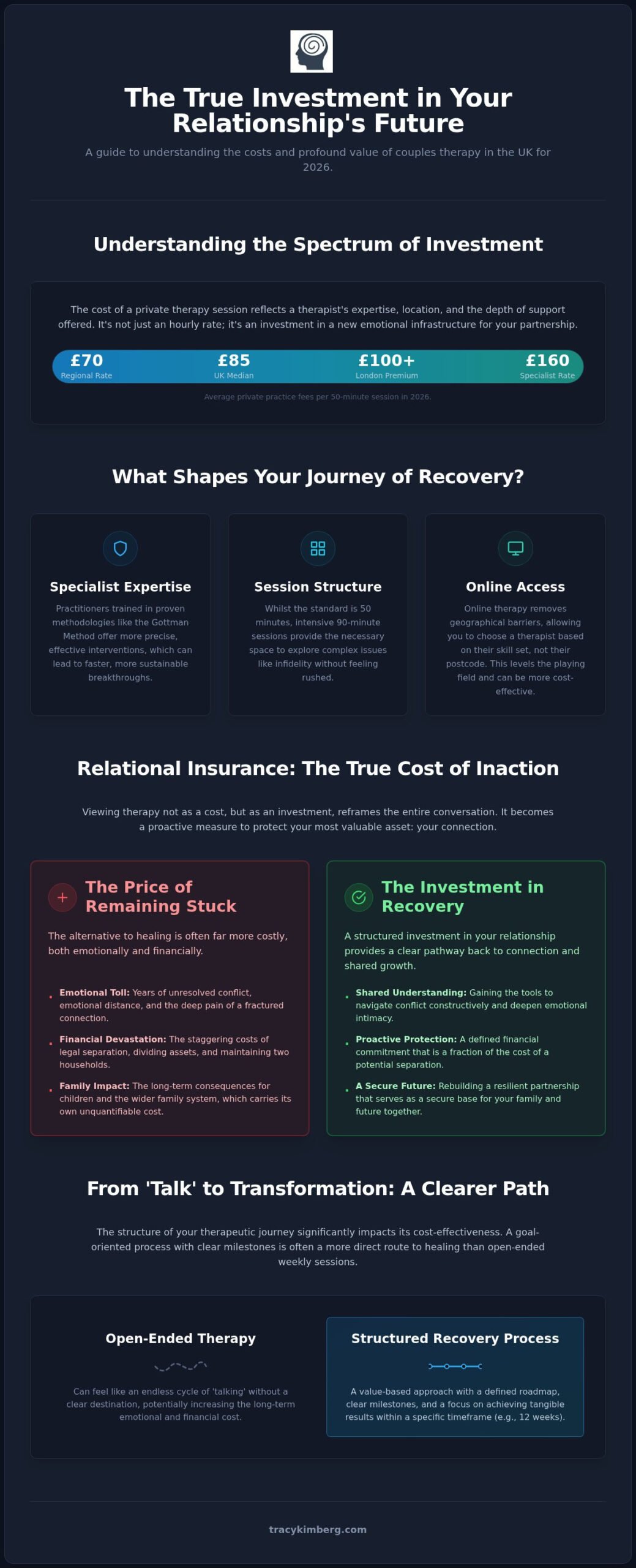
The True Cost of Relational Breakdown: A Comparison
We often view therapy as a luxury or an emergency expense, yet it’s more accurate to see it as relational insurance. When asking how much does couples therapy cost UK couples, the answer must be weighed against the alternative. The financial reality of a divorce is staggering. Between legal fees, the division of assets, and the logistical nightmare of establishing two separate households, the cost of a breakdown is often a hundred times the price of a structured recovery programme. Proactive investment is a choice to protect your shared wealth and your future security.
The weight of staying in a state of disconnect carries a heavy toll on your physical and mental health. Chronic stress from a fractured partnership often manifests as lowered immunity, poor sleep, and reduced productivity at work. This emotional tax isn’t just felt by the couple. Children absorb the atmosphere of their home like sponges. Proactive investment is always cheaper than reactive crisis management. It’s the difference between routine maintenance on a home and trying to rebuild it after the foundation has completely crumbled.
The Cost of ‘Wait and See’
Research by Dr John Gottman indicates that the average couple waits six years after a problem begins before seeking professional help. This delay is expensive. Every year of avoided conflict adds layers of resentment that take more time and more sessions to peel back. Emotional compound interest is the phenomenon where unvoiced needs and minor betrayals gather weight over time, turning a simple misunderstanding into a mountain of relational debt that eventually feels impossible to pay off without significant clinical intervention.
Conscious Separation: A Different Kind of Investment
Sometimes, the most compassionate outcome isn’t staying together, but ending well. In these cases, the investment shifts from saving the marriage to protecting the individuals involved. Professional support through Conscious Approached Divorce and separation is a strategic choice that can save thousands in legal mediation fees. By avoiding the adversarial nature of the courts, you preserve both your finances and your dignity. The psychological saving for your children is immeasurable. When parents separate with clarity and respect, they protect their children’s sense of security, which is a legacy far more valuable than any shared asset.
How to Budget for Your Relationship Recovery
Budgeting for emotional health requires a shift in perspective. Instead of viewing therapy as a drain on your monthly income, consider it a reallocation of your joint ‘well-being’ funds. Many couples find that by temporarily pausing non-essential luxuries, such as weekend breaks or high-end dining, they can easily accommodate the investment in their partnership. When you investigate how much does couples therapy cost UK wide, you’ll see that the median rate of £85 per session is often less than the cost of a single night out, yet its impact lasts a lifetime.
The ‘Initial Assessment’ phase is your most vital investment. This first meeting isn’t just a formality; it’s a diagnostic deep dive that determines if the therapist’s style resonates with your unique dynamic. Finding the right fit early prevents the frustration of ‘therapist hopping’, which can be both emotionally draining and financially wasteful. I always encourage couples to view this first hour as the foundation upon which their entire recovery will be built.
5 Steps to Financial Planning for Therapy
- Determine your relational goals: Are you seeking a quick reset or a deep overhaul of long-standing patterns? Clarity here helps you choose the right level of support.
- Research specialists: Look for practitioners who specialise in your specific pain points, such as infidelity or emotional disconnect, rather than generalists.
- Compare models: Evaluate the total cost of a structured 12-week programme against the uncertainty of indefinite weekly sessions.
- Check insurance: Many private health providers, including Vitality and Bupa, may cover individual components of your care.
- Book a discovery call: Use this time to ask direct questions about fees, cancellation policies, and what’s included in the price.
Maximising the Value of Every Session
To get the highest return on your investment, the work must continue outside the therapy room. Engaging deeply with ‘homework’ and exercises between meetings accelerates your progress and can often reduce the total number of sessions required. Supplementing your journey with masterclasses or digital resources allows you to maintain momentum without always needing a live session. Approaching each appointment with a clear intention and a willingness to be vulnerable ensures that not a single minute of your investment is wasted. If you’re ready to start this journey with a clear roadmap, you can explore my Relationship Recovery Process to see how a structured approach provides both financial predictability and emotional results.
Beyond the Hourly Rate: The 12-Week Relationship Recovery Process
While individual session rates help you understand the immediate budget, the real question when exploring how much does couples therapy cost UK wide is: what is the cost of staying exactly where you are? Traditional therapy can sometimes feel like an open-ended voyage without a map, leading to a sense of ‘therapeutic fatigue’. In contrast, a structured 12-Week Relationship Recovery Process provides a defined beginning, middle, and end. This approach isn’t just about ‘talking through things’; it’s a rigorous, goal-oriented framework inspired by the research of experts like John Gottman and Esther Perel. It’s designed for couples who are ready to move from crisis to connection within a specific timeframe.
This signature process includes a blend of intensive sessions, bespoke resources, and a recovery framework that addresses the root causes of disconnect, such as the delicate interplay between intimacy and autonomy. By moving away from a ‘pay-as-you-go’ mindset, you invest in a comprehensive solution that prioritises transformation over simple maintenance. It’s the premium choice for those who recognise that their relationship deserves more than just a weekly check-in; it requires a proactive adventure in healing. Tracy Kimberg’s approach acts as a structural anchor, providing the specialised care needed to navigate adult life transitions with calm optimism.
Is a Structured Programme Right for You?
There is a profound difference between ‘venting’ and ‘rebuilding’. Many couples find themselves trapped in a cycle of reporting their weekly arguments to a therapist, which provides temporary relief but rarely changes the underlying behaviour. A 12-week lens shifts the focus toward active skill-building and systemic change. For those navigating deep-seated issues like infidelity or long-term neglect, the roadmap offers essential psychological safety. You aren’t wandering in the dark; you’re following a proven path with a Wise Guide who knows exactly where the journey leads, ensuring your emotional investment yields a tangible return.
Taking the First Step Toward Your Future
The transition from feeling like roommates back to rediscovering your spark as partners can happen in as little as 90 days when you have the right support. When weighing up how much does couples therapy cost UK, consider the long-term value of a 90-day transformation versus years of unresolved tension. It begins with a discovery call to assess your needs and ensure this high-level programme is the right fit for your dynamic. Investing in this process means you aren’t just paying for an hour of someone’s time; you’re investing in a legacy of emotional health and intimacy that will serve you for decades to come. Discover how the 12-Week Relationship Recovery Process can transform your bond.
Investing in Your Shared Future
Choosing to address the fissures in your relationship is a profound act of courage. Whilst you initially asked how much does couples therapy cost UK wide, I hope you now see that the most significant value lies in the emotional infrastructure you build together. We have explored how specialist expertise and structured roadmaps provide a faster, more sustainable path to healing than open-ended talking alone. By reframing this as an investment in your long-term stability, you move from a place of anxiety to one of calm optimism.
If you are ready to transition from roommates back to partners, my signature 12-Week Relationship Recovery Process offers a research-based journey inspired by the Gottman Method and systemic therapy. Whether you are navigating the aftermath of infidelity or a growing emotional disconnect, expert support provides the containment you need to heal. I invite you to book your initial consultation with Tracy Kimberg today. Your relationship is a proactive and positive adventure; let’s begin the next chapter with clarity and hope.
Frequently Asked Questions
Is couples therapy more expensive than individual therapy in the UK?
Couples therapy is generally more expensive than individual work because it requires a therapist to manage the complex interplay between two distinct personalities. Whilst an individual session might have a median cost of £85, couples work often ranges between £85 and £120. This reflects the specialised training needed to navigate systemic dynamics and ensure both partners feel heard and supported without the therapist taking sides.
Can I get couples therapy on the NHS for free?
You can access free support through NHS Talking Therapies, though it is often specifically focused on “Couple Therapy for Depression”. This service is designed for couples where one partner is struggling with a mental health condition that impacts the relationship. Whilst it is a vital resource, waiting lists can be significant, and the focus is often more clinical than the growth-oriented approach found in private practice.
Does private health insurance cover relationship counselling?
Coverage for relationship work varies significantly amongst providers like Bupa or Vitality. Most private health insurance policies prioritise individual mental health treatments rather than relational growth. However, if your therapy is part of a clinical treatment plan for a diagnosed condition like anxiety or depression, you may find that certain components are covered. It’s always best to check your specific policy wording before starting.
How many sessions of couples therapy will we actually need?
Most couples find they need between 8 and 20 sessions to achieve lasting change, though a structured 12-week programme offers a more predictable roadmap. When considering how much does couples therapy cost UK wide, remember that the number of sessions depends on the depth of the issues. Proactive couples often see results faster, whilst those unpicking years of resentment may require a longer commitment to build new patterns.
Is online couples therapy cheaper than face-to-face sessions?
Online therapy is often more cost-effective when you factor in the total investment. Whilst the hourly fee might be similar to face-to-face work, you save on travel, parking, and childcare. Many couples find the digital format less intimidating, allowing them to open up more quickly from the safety of their own home. This efficiency can sometimes lead to a shorter overall course of treatment.
What happens if my partner refuses to pay for therapy?
Financial friction is often a symptom of deeper relational issues regarding trust and safety. If your partner is hesitant, try reframing the conversation from a “cost” to an “investment” in your shared future. I often suggest starting with a discovery call together so they can experience the clinical authority and warmth of the process. Sometimes, seeing the therapist’s expertise first-hand helps demystify the value of the spend.
Is there a ‘London premium’ for relationship experts?
There is a visible ‘London premium’ due to the higher operational costs and concentration of specialised experts in the capital. Therapists in central London typically charge 20-30% more than those in cities like Leeds or Birmingham. If you’re looking for world-class expertise without the capital’s price tag, online therapy allows you to access top-tier specialists regardless of where you are physically located in the UK.
What is the cost of a 12-week relationship recovery programme?
A 12-week relationship recovery programme is priced as a comprehensive package rather than an open-ended hourly rate. This model provides financial predictability and ensures you have access to a complete framework of sessions and resources. When calculating how much does couples therapy cost UK couples in the long run, a structured programme often proves more economical by providing a clear ‘start and end’ to the initial recovery phase.

Article by
Tracy Kimberg
Tracy Kimberg is a Relationship Expert, Couples Therapist and Coach with a dedicated focus on helping couples and individuals rebuild connection, trust and emotional safety in their relationships. Drawing on the research of John and Julie Gottman, the relational insights of Esther Perel, and years of hands-on therapeutic experience, Tracy offers a warm, non-judgemental and deeply compassionate approach to modern relationships.
Based in Dorset, Tracy works with couples navigating communication breakdowns, betrayal, intimacy challenges, separation, family dynamics and life transitions. Known for creating a safe and grounded therapeutic space, she combines practical tools with emotional depth to help clients move beyond survival patterns and towards meaningful, lasting change.
With a reputation for empathy, professionalism and dedication to her clients’ growth, Tracy is passionate about helping people feel seen, understood and empowered — both within their relationships and within themselves.
Disclaimer
Disclaimer:
The information shared in this article is intended for educational and informational purposes only and should not be considered a substitute for professional therapeutic, psychological, medical or legal advice. Every individual and relationship is unique, and the perspectives offered are based on general therapeutic principles, research and professional experience.
Reading this article does not establish a therapist-client relationship with Tracy Kimberg. If you are experiencing significant emotional distress, relationship crisis, trauma, or mental health concerns, it is important to seek support from a qualified professional appropriate to your individual circumstances.
All content remains the intellectual property of Tracy Kimberg and may not be reproduced or distributed without permission.