

What if the sudden distance and erratic behaviour you’re witnessing isn’t the beginning of the end, but a messy, necessary invitation for your relationship to evolve? It’s deeply painful to feel like a stranger to your own partner, and the anxiety of potential abandonment can leave you feeling utterly depleted. You’re likely exhausted from walking on eggshells, wondering when the person you love will return to themselves. Learning how to cope with a partner’s midlife crisis requires a delicate balance of profound compassion for their internal transition and a fierce commitment to your own emotional health.
I understand how isolating this season of life feels, but you don’t have to navigate this turbulence alone. In this guide, we’ll explore how to protect your well-being whilst strengthening your bond through this systemic shift. You’ll discover practical scripts for high-stakes communication, strategies to maintain your personal stability, and a clear roadmap for relational recovery. Whether you’re seeking a path back to intimacy or exploring a conscious approach to separation, we’ll provide the professional insight needed to transform this crisis into a proactive adventure toward healing and long-term emotional health.
Key Takeaways
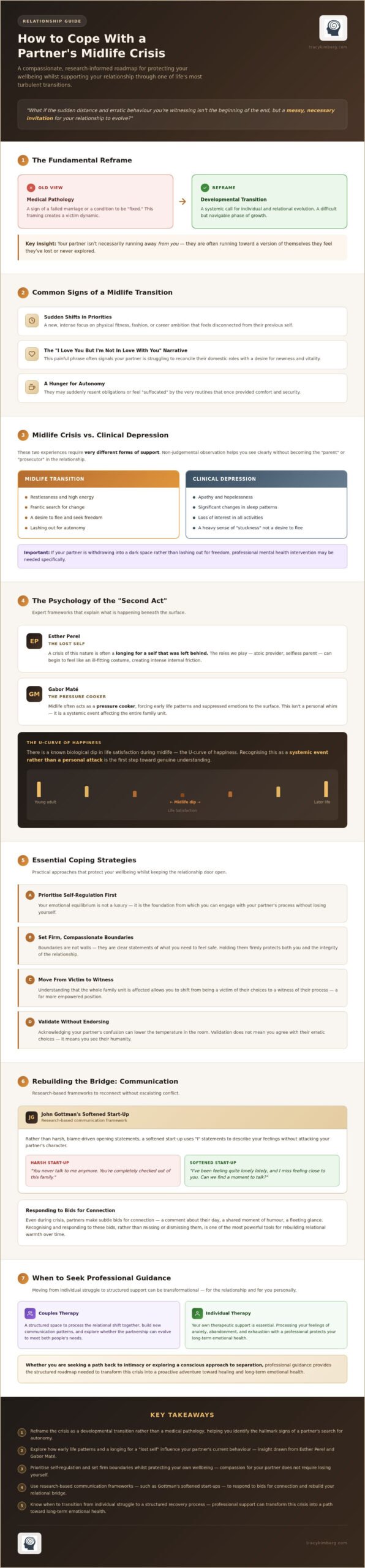
- Reframe the crisis as a developmental transition rather than a medical pathology, helping you identify the hallmark signs of a partner’s search for autonomy.
- Gain psychological insight into the “Second Act” by exploring how early life patterns and a longing for a “lost self” influence your partner’s current behaviour.
- Master practical techniques on how to cope with a partner’s midlife crisis by prioritising self-regulation and setting firm boundaries whilst protecting your own well-being.
- Utilise research-based communication frameworks, such as softened start-ups, to respond to subtle bids for connection and rebuild your relational bridge.
- Learn when to transition from individual struggle to a structured recovery process that fosters transformational change and long-term emotional health.
Recognising the Shift: Is it a Midlife Crisis or Something Else?
When the person you’ve built a life with suddenly begins to feel like a stranger, the ground beneath your feet can feel incredibly unstable. You might notice a sharp shift in their energy, a sudden questioning of long-held values, or a restless desire for a life that looks nothing like the one you share. It is helpful to reframe this experience. Instead of viewing it as a medical pathology or a sign of a failed marriage, we can see the midlife crisis as a profound developmental transition. It is a systemic call for individual and relational evolution that often arrives when the roles we’ve played for decades no longer fit our internal reality.
This period is frequently marked by a search for authenticity. Your partner isn’t necessarily running away from you; they are often running toward a version of themselves they feel they’ve lost or never explored. Validating this experience doesn’t mean you have to agree with their erratic choices, but acknowledging their confusion can lower the temperature in the room. Understanding the “why” behind the shift is a vital part of learning how to cope with a partner’s midlife crisis whilst maintaining your own emotional equilibrium.
Common Symptoms of a Midlife Transition
The “identity crisis” at the heart of this phase is usually a search for meaning. You might observe significant changes in their behaviour that seem out of character. These often include:
- Sudden shifts in priorities: A new, intense focus on physical fitness, fashion, or career ambition that feels disconnected from their previous self.
- The “I love you but I’m not in love with you” narrative: This painful phrase often signals that your partner is struggling to reconcile their domestic roles with a desire for newness and vitality.
- A hunger for autonomy: They may suddenly resent obligations or feel “suffocated” by the very routines that once provided comfort.
The Difference Between Crisis and Depression
It is essential to distinguish between a midlife transition and clinical depression, as the support required for each is quite different. Whilst a crisis is often characterised by restlessness, high energy, or a frantic search for change, depression typically manifests as apathy and hopelessness. Clinical indicators of depression often include significant changes in sleep patterns, a loss of interest in all activities, and a heavy sense of “stuckness” rather than a desire to flee. If you observe your partner withdrawing into a dark space rather than lashing out for freedom, professional intervention may be needed to address their mental health specifically. Approaching these patterns with non-judgemental observation allows you to see the situation clearly without becoming the “parent” or the “prosecutor” in the relationship.
The Psychology of the “Second Act”: Understanding Your Partner’s Internal World
To understand what is happening inside your partner, we must look beyond the surface-level changes. Gabor Maté suggests that midlife often acts as a pressure cooker, forcing early life patterns and suppressed emotions to the surface. The roles your partner has played for decades, such as the stoic provider or the selfless parent, may suddenly feel like an ill-fitting costume. This internal friction isn’t just a personal whim; it’s often a biological dip in life satisfaction known as the U-curve of happiness. Recognising this as a systemic event rather than a personal attack is the first step in learning how to cope with a partner’s midlife crisis.
By viewing the situation through a lens of curiosity, you can begin to see the “Second Act” not as a disaster, but as a difficult evolution. If you’re struggling to bridge the gap, exploring relationship communication strategies can provide a starting point for dialogue that doesn’t end in conflict. Understanding that the whole family unit is vibrating with this change allows you to move from being a victim of their choices to a witness of their process.
The Search for a Lost Self
Esther Perel often argues that a crisis of this nature is a longing for a self that was left behind. When we marry and build families, we often trade our sense of adventure for stability. Over time, that trade-off can lead to a sense of erasure. Your partner might look for excitement elsewhere, not because they hate your life together, but because they are desperate to feel “alive” again. Ultimately, the crisis is an attempt to reclaim vitality, not necessarily to destroy the family unit.
The Fear of Limitations and Mortality
As we reach midlife, the horizon of our lives begins to feel closer. This realisation of mortality creates a “now or never” urgency that drives impulsive decisions. When the future feels like it’s shrinking, your partner may experience a frantic need to change everything before it’s too late. This fear often manifests as irritability, withdrawal, or a sudden obsession with new hobbies. It’s a defensive reaction to the weight of their own ageing process. If you feel lost in this storm, engaging with specialised relationship coaching can help you find your bearings whilst your partner navigates their internal turbulence.
Essential Strategies for Coping Whilst Maintaining Your Own Sanity
When your world feels like it’s tilting, your natural instinct is to grab hold of your partner to steady yourself. Yet, in the context of a midlife transition, this often has the opposite effect. Discovering how to cope with a partner’s midlife crisis often starts with a radical act of self-preservation. You must learn to let go of the need to control their journey so you can focus on your own stability. This isn’t about being passive. It’s about becoming an anchor in a storm that you didn’t create but are nonetheless required to navigate.
One of the most difficult concepts to grasp is the “Space Paradox”. When a partner is lashing out for autonomy, chasing them with questions or pleading for reassurance usually drives them further away. By reclaiming your own interests and social life, you signal that your happiness is not entirely dependent on their current state of flux. This shift in energy can sometimes be the very thing that allows a partner to stop running and start looking back at what they are risking.
Putting on Your Own Oxygen Mask
You cannot support a partner through a developmental shift if you are running on empty. Engaging in Therapy for Adults provides a vital, confidential space where you can process your own grief and anxiety without the fear of triggering your partner’s defensiveness. It’s essential to organise a support network that doesn’t revolve solely around your marriage. Friends, hobbies, and physical exercise are not mere distractions; they are proactive tools for resilience. When you prioritise your own self-care, you move from a state of reactive exhaustion to one of grounded strength.
The Do’s and Don’ts of Crisis Management
Managing the daily friction requires a clear set of internal boundaries. You must protect your peace whilst remaining open to the possibility of reconciliation. Consider these guidelines:
- Don’t label or “fix”: Avoid telling them they are “having a crisis”. Labelling their behaviour often feels like an attack on their new-found search for authenticity.
- Do observe without absorbing: You can witness their emotional volatility without taking it into your own body. Practice being a calm observer of the weather rather than the person caught in the rain.
- Don’t use guilt as a weapon: Pleading for love or highlighting their failures usually reinforces their desire to escape.
- Do set firm boundaries: Whilst you can be compassionate toward their internal struggle, you must not tolerate destructive behaviour such as financial recklessness or verbal abuse.
By maintaining a centre of calm within the household, you provide a safe harbour. If your partner eventually chooses to return to the relationship, they need to find a person who is still whole, not a person who has been shattered by their transition.
Rebuilding the Bridge: Communication Frameworks for Connection
Transitioning from survival to connection requires a shift in how you speak to one another. John Gottman’s research suggests that the way a conversation begins determines its success nearly every time. This is why a “Softened Start-up” is essential when learning how to cope with a partner’s midlife crisis. Instead of leading with blame or “you” statements, lead with your own feelings and a clear, positive need. For example, saying “I’ve been feeling a bit lonely lately, and I’d love to spend an hour together tonight” is far more effective than “You never spend time with me anymore.”
You should also look for “Bids for Connection”, those small, often subtle attempts your partner makes to get your attention or interest. They might point out something in a book or offer a brief comment about their day. When you “Turn Towards” these bids rather than ignoring them, you begin to bank emotional credit. Even in the height of a midlife transition, identifying the “Dream within the Conflict” is vital. Behind their restless behaviour is often a deep-seated desire for meaning or vitality that they don’t yet know how to express in a healthy way.
Navigating Difficult Conversations
Curiosity is your greatest ally during this phase. Instead of making assumptions about their motives, try asking open-ended questions that invite them to share their internal world. You might ask, “What does this new interest represent for you?” or “What do you feel is missing from your life right now?” Using scripts that express your own needs whilst acknowledging their struggle can lower defensiveness. You could say, “I want to support your growth, but I also need to feel secure in our partnership.” Emotional intimacy is the shared exploration of these midlife fears, where both partners feel safe enough to be vulnerable about their changing internal landscapes.
Avoiding the Four Horsemen
To keep the bridge from collapsing, you must identify and eliminate the “Four Horsemen”: Criticism, Contempt, Defensiveness, and Stonewalling. Contempt is the most destructive, as it involves looking down on your partner or using sarcasm to belittle their experience. You can counter this by consciously replacing contempt with appreciation for the history you’ve built together. Maintaining a “culture of fondness” means actively looking for what is going right, even whilst the relationship is under significant strain. If these patterns feel too entrenched to shift alone, our Relationship Counselling and Coaching for Couples offers a structured environment to practice these frameworks effectively.
When to Seek Professional Guidance: Moving from Crisis to Transformation
There comes a point where the tools you’ve used to manage the day-to-day friction are no longer enough. You might find that the “walking on eggshells” has become the permanent floor of your home, or that the emotional disconnect has grown into a vast, silent canyon. Knowing how to cope with a partner’s midlife crisis often involves recognising when the transition has moved beyond a personal search and into a full relational breakdown. This is not a sign of failure. It is a signal that the old ways of relating have been outgrown and a new framework is required.
A relationship coach acts as a neutral guide, providing a safe and non-judgemental environment where the “unsayable” can finally be spoken. We don’t view this work as a cold business transaction or a repair shop for the broken. Instead, we frame the therapeutic process as a powerful, proactive adventure. It is an invitation to look at the systemic patterns that have brought you to this crossroads and to decide, together or individually, how you wish to move forward into your next chapter.
The Power of Structured Recovery
When you are lost in the emotional fog of a partner’s transition, you need a map. Our 12-Week Relationship Recovery Process offers exactly that. This structured programme is designed to stabilise the relationship by moving you away from reactive cycles and toward intentional connection. It is a research-based path that helps you process the grief of what has changed whilst building the skills needed for what comes next. For many couples, this process becomes the foundation for a “second marriage” with the same partner, one built on authenticity rather than historical roles. The accessibility of online therapy means you can engage in this transformational work from the comfort of your own home, ensuring that your long-term emotional health remains a priority amongst the chaos of daily life.
Conscious Separation as a Healthy Path
We must also hold space for the possibility that your paths may truly diverge. If the internal shifts are so profound that the partnership can no longer contain them, we offer a “Conscious Separation” approach. This is a healthy, trauma-informed alternative to the traditional, adversarial ending. The goal here is to ensure the emotional health of the family unit remains the priority, allowing both partners to move forward with dignity and clarity. Whether you are rebuilding your bond or choosing to part ways, you deserve a guide who understands the complexities of adult life transitions. Explore how my 12-Week Relationship Recovery Process can guide you toward the healing and positive outcomes you both deserve.
Moving Forward with Clarity and Connection
Navigating this season of life requires more than just patience; it demands a fundamental shift in how you view your partnership and yourself. By reframing the current turbulence as a developmental transition rather than a disaster, you create the space needed for genuine evolution. You’ve learned that understanding how to cope with a partner’s midlife crisis involves balancing deep compassion with firm boundaries, ensuring your own well-being remains a priority whilst you hold a safe harbour for the relationship.
Whether you choose to rebuild your bridge through softened start-ups or explore a conscious approach to separation, you don’t have to walk this path alone. I provide warm, non-judgemental professional support as a specialist in relational breakdown and emotional disconnect. Utilising Gottman-inspired, research-based methodology, I can help you transform this crisis into a proactive adventure toward healing. If you’re ready to move from exhaustion to emotional stability, book a consultation to start your 12-Week Relationship Recovery Process. There is a path through this storm, and it leads toward a more authentic, resilient future for you both.
Frequently Asked Questions
Is it a midlife crisis or have they simply fallen out of love with me?
Distinguishing between falling out of love and a midlife crisis requires looking at the source of the discontent. Often, a partner isn’t running away from you, but from the life they’ve built and the roles that no longer feel authentic. If the behaviour is erratic and driven by a frantic search for vitality, it’s likely a developmental shift. Deeply human connection can still exist under the surface of this restless transition.
How long does a typical partner’s midlife crisis last?
There is no fixed timeline for this transition, as it is a developmental phase rather than a medical condition. Some individuals navigate the turbulence in a few months, whilst others may take several years to integrate their new sense of identity. The duration often depends on their willingness to engage in self-reflection and the support available. Focus on your own stability during this time rather than counting the days until it ends.
Should I give my partner space if they ask for a separation during a midlife crisis?
Giving space is often necessary, but it must be done with clear boundaries. Chasing a partner who is lashing out for autonomy usually triggers the “Space Paradox,” driving them further away. If a separation becomes unavoidable, a “Conscious Separation” approach ensures the emotional health of the family remains the priority. This structured path allows both partners to navigate the distance with dignity rather than reacting from a place of panic.
What are the biggest mistakes to avoid when a partner is in crisis?
The biggest mistakes involve trying to “fix” their feelings or labelling their experience as a “crisis” to their face. Pleading for love or using guilt as a weapon usually reinforces their desire to escape the relationship’s pressure. Avoiding these pitfalls is central to learning how to cope with a partner’s midlife crisis. Instead, maintain a centre of calm and focus on your own growth to avoid becoming a “parent” figure.
Can a marriage truly survive a midlife crisis and be stronger afterwards?
Many marriages do not just survive; they transform into something far more authentic. This period acts as a systemic call for evolution, allowing couples to shed outdated roles and build a “second marriage” with the same person. By utilising a research-based approach like the Gottman Method, you can use this friction as a catalyst for deeper intimacy. The crisis becomes a proactive adventure toward a more resilient and honest bond.
How do I know if my partner’s behaviour is a midlife crisis or clinical depression?
Clinical depression is typically marked by apathy and hopelessness, whilst a midlife transition is characterised by restlessness and a search for change. If your partner is withdrawing into darkness and losing interest in everything, they may need individual therapy for adults to address depression. A crisis, conversely, often looks like a high-energy pursuit of new hobbies, fitness, or career ambitions in an attempt to feel “alive” once again.
What if my partner refuses to go to relationship counselling?
If your partner refuses counselling, you can still create significant change by engaging in individual therapy yourself. Systemic therapy principles suggest that when one person in a relationship shifts their behaviour, the entire dynamic must adjust. Focusing on your own self-regulation and boundaries provides a powerful model for health. You don’t need their permission to begin your own 12-Week Relationship Recovery Process to find clarity and long-term emotional stability.
How can I protect my own mental health whilst my partner is going through this?
Protecting your mental health requires you to “put on your own oxygen mask” first. Organise a support network that doesn’t revolve around your marriage and engage in activities that reclaim your personal interests. Learning how to cope with a partner’s midlife crisis effectively means staying grounded in your own reality whilst they are in flux. Prioritising self-care isn’t a distraction; it’s a proactive tool that prevents you from being shattered by their transition.

Article by
Tracy Kimberg
Tracy Kimberg is a Relationship Expert, Couples Therapist and Coach with a dedicated focus on helping couples and individuals rebuild connection, trust and emotional safety in their relationships. Drawing on the research of John and Julie Gottman, the relational insights of Esther Perel, and years of hands-on therapeutic experience, Tracy offers a warm, non-judgemental and deeply compassionate approach to modern relationships.
Based in Dorset, Tracy works with couples navigating communication breakdowns, betrayal, intimacy challenges, separation, family dynamics and life transitions. Known for creating a safe and grounded therapeutic space, she combines practical tools with emotional depth to help clients move beyond survival patterns and towards meaningful, lasting change.
With a reputation for empathy, professionalism and dedication to her clients’ growth, Tracy is passionate about helping people feel seen, understood and empowered — both within their relationships and within themselves.
Disclaimer
Disclaimer:
The information shared in this article is intended for educational and informational purposes only and should not be considered a substitute for professional therapeutic, psychological, medical or legal advice. Every individual and relationship is unique, and the perspectives offered are based on general therapeutic principles, research and professional experience.
Reading this article does not establish a therapist-client relationship with Tracy Kimberg. If you are experiencing significant emotional distress, relationship crisis, trauma, or mental health concerns, it is important to seek support from a qualified professional appropriate to your individual circumstances.
All content remains the intellectual property of Tracy Kimberg and may not be reproduced or distributed without permission.