

What if healing from an anxious attachment style isn’t about becoming someone who never needs reassurance? Anxious attachment can change: with awareness, self-soothing and open communication, you can move towards greater security without judging yourself for wanting closeness.
If uncertainty in a relationship brings a rush of worry, or you find yourself looking for signs that someone still cares, those feelings can be intense. They aren’t a personal failing, and you don’t have to work towards greater security alone. A partner or family member’s response can help create space for connection and reassurance.
This guide explores what it means to move towards earned security, how self-soothing can help when attachment fears surface, and how to recognise when a conversation may be more helpful than managing the feeling alone. You’ll also learn how loved ones can offer support without dismissing your needs, and how therapy can help you understand relationship patterns and practise new ways of relating.
Key Takeaways
- Notice the relationship patterns that surface when you feel uncertain, and explore how therapy can help you understand their triggers.
- Learn how self-soothing, healthy boundaries and self-advocacy can support steadier connections.
- Discover how adults can build greater security, including through the ways caregivers model repair and emotional responsiveness.
- Find practical ways partners and family can respond to anxiety with care while making space for honest conversations.
Overcoming anxious attachment or moving towards secure?
Anxious attachment can shift towards greater security; the aim isn’t to stop needing closeness. Healing from an anxious attachment style can start with noticing how triggers shape relationships and exploring new responses in therapy.
-
Recognise anxious signs and relational patterns with professional support
In therapy, map what happens when connection feels uncertain. You might notice repeated reassurance-seeking, distress while waiting for a reply, or interpreting a change in tone as rejection. In an avoidant-anxious dynamic, one partner may pursue contact as the other withdraws, deepening conflict. Therapy can help identify triggers and recurring patterns without making either person the problem.
-
Balance self-soothing with relationship conversations in therapy
Work with a therapist to distinguish a moment for self-soothing from one that calls for conversation. If a delayed reply sparks fear, pause before deciding what you need. If the concern continues, try saying, “I felt disconnected when we didn’t speak; can we talk?” Healing from an anxious attachment style can include learning to regulate your feelings whilst making room for mutual reassurance and repair.
-
Consider therapy and other support
Attachment-focused therapy offers a place to notice how trust, closeness and conflict feel in real time. Seek professional support if relationship anxiety repeatedly disrupts daily life, fuels distressing conflict or feels difficult to manage alone. Anxious attachment describes a relationship pattern; an anxiety disorder is a clinical diagnosis assessed by a qualified professional. They aren’t interchangeable.
For further learning, The New Rules of Attachment was published in 2024. Journalling can help you track a trigger, your response and what you needed; mindful breathing is another exercise to explore. These resources can support reflection, while therapy provides a space to examine patterns with professional support.
What Is Self-Regulation or Self-Soothing of the Anxious Attachment Style?
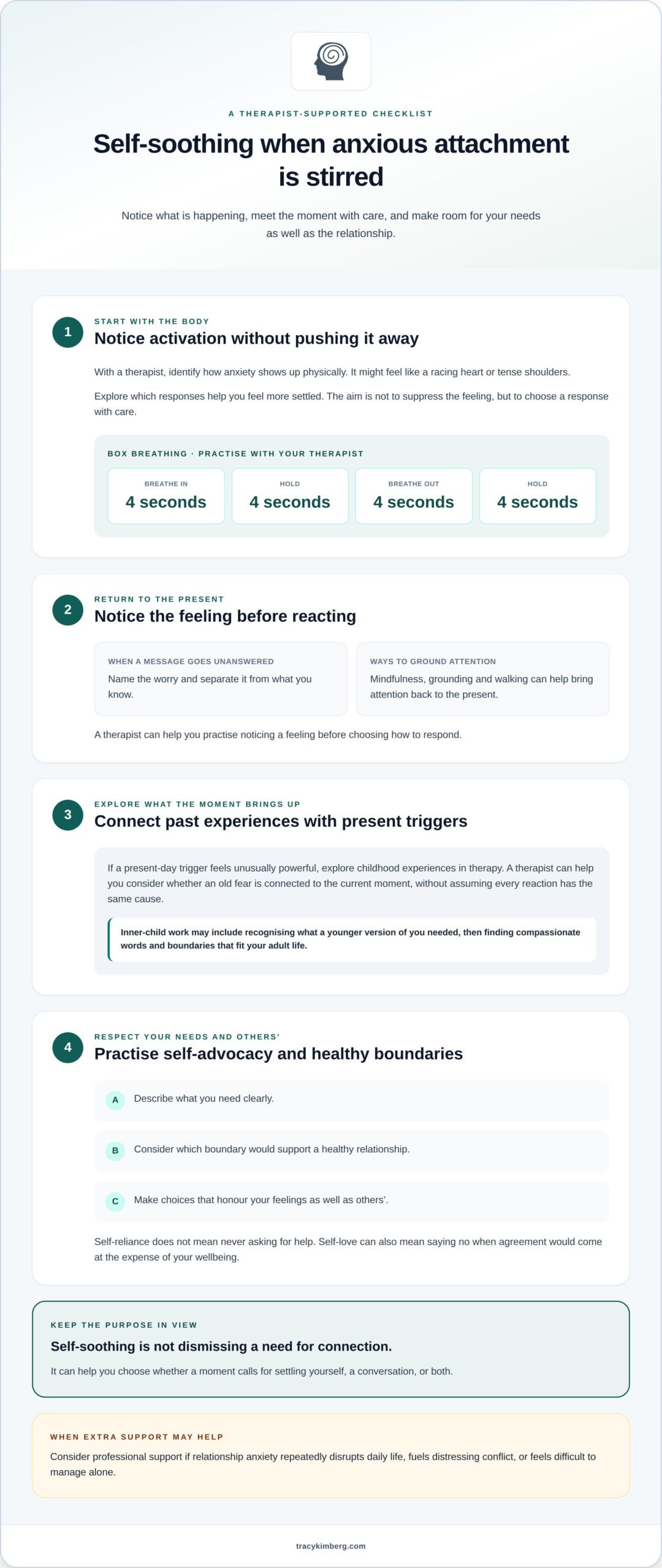
In therapy, self-soothing means noticing emotional activation and choosing a response that supports you. The steps below show how a therapist can help develop this capacity.
-
Regulate the nervous system with professional support
Ask your therapist to help identify how anxiety feels in your body, such as a racing heart or tense shoulders. Together, you can explore which responses help you feel more settled, rather than pushing feelings away. A therapist may practise box breathing with you: breathe in for 4 seconds, hold for 4, breathe out for 4, then hold for 4.
-
Develop mindfulness and emotional self-regulation with a therapist
Work with your therapist to notice a feeling before reacting to it. For example, when a message goes unanswered, name the worry and separate it from what you know. Mindfulness, grounding and walking can become ways to return attention to the present. The aim isn’t to dismiss a need, but to choose a response with greater care.
-
Explore inner-child work for self-soothing in therapy
Explore childhood experiences in therapy when present-day triggers feel unusually powerful. A therapist can help you connect an old fear with a current moment, without assuming every reaction has the same cause. Inner-child work may involve recognising what a younger version of you needed, then finding compassionate words and boundaries that fit your adult life.
-
Build self-love and self-reliance with therapeutic support
Use therapy to practise self-advocacy: describe what you need clearly, then consider what boundary would support a healthy relationship. Self-reliance doesn’t mean never asking for help; it means making choices that honour your feelings as well as others’. With effort, self-love can include saying no when agreement would come at the expense of your wellbeing.
Earned secure attachment and adult change
Therapy can support change step by step: map relationship patterns, explore their origins, practise secure responses and reflect on new experiences. Healing from an anxious attachment style involves learning to meet connection, conflict and difficult feelings with greater steadiness.
-
Build earned security through therapeutic support
Explore a recurring relationship pattern, such as fearing distance when a partner asks for space. Together, you can notice what the pattern protects and how earlier experiences may shape the present. Stay curious about your feelings rather than treating them as proof that someone will leave. Therapy can help you recognise the choices available to you now.
Notice how connection feels in the therapeutic relationship. For example, expressing disagreement and exploring what happens next can help you learn to trust, express needs and remain yourself with another person.
-
Practise secure responses with a therapist
Rehearse a response before using it in a close relationship. You might name your feeling, make a direct request, then listen to the other person’s perspective. A therapist can help you reflect on what happened, including whether you felt heard and what you might change. Healing from an anxious attachment style doesn’t mean hiding your needs or accepting hurtful behaviour.
Instead, practise responding to the dynamic with openness and self-respect. A clear request followed by a thoughtful conversation can create space for connection without assuming rejection.
- In parenting, model repair by returning to a child after conflict, acknowledging your part and reconnecting. This shows that disagreement need not end closeness. In adult intimacy, secure sexuality also involves communicating honestly about desire, comfort and boundaries. Discussing what feels welcome, uncertain or unwanted helps partners make room for each other’s experience, rather than performing closeness out of fear.
Ways partners and family can be guided to offer support
Support isn’t about removing every trigger or taking responsibility for someone else’s emotions. A partner or relative can respond with care, consistency and clear limits, making room for both connection and individual needs.
- Ask what the anxiety is saying. When your partner fears abandonment or rejection, avoid dismissing the feeling with “You’re overthinking.” Try, “What feels most difficult right now?” This invites a deeper conversation about the trigger without assuming you know its cause. Listen first, then ask what kind of support would help.
- Offer reassurance you can genuinely sustain. If a change of plans sparks anxiety, explain what has changed and when you expect to reconnect. A clear, realistic message can feel more dependable than a promise you can’t keep. Consistency matters, but it shouldn’t require you to be constantly available or set aside your own boundaries.
- Agree how to handle moments of distress. Discuss together whether a particular trigger calls for quiet time, reassurance or a conversation. For example, you might say, “I can see this has unsettled you. Would listening or taking a pause help?” This helps your partner feel considered without treating every anxious thought as proof of rejection.
- Make space for a focused conversation. Ask your partner to spend 20 minutes talking when disconnection is weighing on them. Use that time to hear each other, describe what happened and identify one next step. Keep the conversation specific: “I felt distant after we cancelled our plans” is easier to respond to than blame about the whole relationship.
- Support without becoming the sole source of steadiness. Family members can show care while encouraging someone to express needs, respect boundaries and draw on support beyond one relationship. If conflict repeats, discuss the pattern together rather than casting one person as the cause. A supportive response combines empathy with mutual responsibility.
Tracy Kimberg
If anxious attachment is affecting your relationships or sense of connection, Tracy Kimberg offers a supportive setting to explore what happens when closeness feels uncertain, understand recurring responses and consider new ways of relating. You can seek support individually or as a couple.
Relationship Counselling and Coaching for Couples can help partners understand how their relationship dynamic affects both people. Couples can explore communication, conflict and emotional distance together, rather than locating the difficulty in one person alone. This may be helpful when attachment fears shape how partners seek reassurance, respond to each other or repair after a difficult moment.
For couples working through significant relationship strain, the structured 12-Week Relationship Recovery Process offers a focused programme for addressing relationship difficulties. It may be worth considering when you and your partner want a clearer process for working on the relationship, rather than approaching each conflict as an isolated event.
Therapy for Adults offers individual space to explore attachment experiences and how they influence present-day relationships. Therapy for Teenagers supports young people facing emotional or relationship challenges. In either case, therapy can help make sense of feelings and patterns without defining a person by them.
Choosing support is a personal decision. You might consider therapy when anxiety around closeness is affecting your wellbeing, communication or ability to feel secure in relationships. If you’d like to explore the next step, contact Tracy Kimberg at a pace that feels right for you.
Frequently Asked Questions
How can therapy help partners or family members support someone with anxious attachment?
Therapy can help loved ones understand how their responses affect the relationship, without making them responsible for managing someone else’s feelings. Partners can explore how they handle cancelled plans, requests for reassurance or disagreements. A therapist can help each person express needs clearly, listen without blame and agree on supportive responses that respect both people’s boundaries.
How does anxious attachment form in childhood?
Anxious attachment may develop in the context of early relationships where care or emotional availability feels inconsistent. A child might become especially alert to a caregiver’s attention, seeking closeness when unsure it will be there. These experiences can shape expectations of connection, but they don’t determine how someone will relate throughout life. Later relationships and therapy can offer new experiences to learn from.
How long does it typically take to see improvements with anxious attachment counselling?
There isn’t one timeline that fits everyone; progress depends on what brings someone to counselling and what they want to change. A useful sign may be noticing a familiar reaction sooner or finding it easier to explain what you need after a disagreement. You and your therapist can review these changes together and adjust the focus as your circumstances and goals develop.
What is anxious attachment style and what causes it?
Anxious attachment is a relationship pattern involving heightened concern about closeness, reassurance or the possibility of losing connection. It can be shaped by early experiences of care and by later relationships, rather than by one cause alone. It isn’t a diagnosis or a fixed identity. Understanding when the pattern appears can help you make sense of its influence on present relationships.
What are common signs of anxious attachment in adult relationships?
Common signs can include worrying about a partner’s commitment, seeking frequent reassurance or reading distance into a brief message. Someone may find waiting for a reply difficult or feel unsettled after a change of plans. These experiences vary, and one behaviour alone doesn’t define a person’s attachment style. Consider whether similar concerns recur across close relationships and situations.
What therapy approaches help with anxious attachment, such as attachment-based therapy or CBT?
Attachment-focused therapy explores how experiences of closeness and trust shape current relationships. Cognitive behavioural therapy, or CBT, focuses on how thoughts, feelings and actions influence one another. The approaches differ, and a therapist can discuss which framework fits the concerns being explored. Therapy may also draw on more than one perspective, depending on the person’s needs and goals.

Article by
Tracy Kimberg
Tracy Kimberg is a Relationship Expert, Couples Therapist and Coach with a dedicated focus on helping couples and individuals rebuild connection, trust and emotional safety in their relationships. Drawing on the research of John and Julie Gottman, the relational insights of Esther Perel, and years of hands-on therapeutic experience, Tracy offers a warm, non-judgemental and deeply compassionate approach to modern relationships.
Based in Dorset, Tracy works with couples navigating communication breakdowns, betrayal, intimacy challenges, separation, family dynamics and life transitions. Known for creating a safe and grounded therapeutic space, she combines practical tools with emotional depth to help clients move beyond survival patterns and towards meaningful, lasting change.
With a reputation for empathy, professionalism and dedication to her clients’ growth, Tracy is passionate about helping people feel seen, understood and empowered — both within their relationships and within themselves.
Disclaimer
Disclaimer:
The information shared in this article is intended for educational and informational purposes only and should not be considered a substitute for professional therapeutic, psychological, medical or legal advice. Every individual and relationship is unique, and the perspectives offered are based on general therapeutic principles, research and professional experience.
Reading this article does not establish a therapist-client relationship with Tracy Kimberg. If you are experiencing significant emotional distress, relationship crisis, trauma, or mental health concerns, it is important to seek support from a qualified professional appropriate to your individual circumstances.
All content remains the intellectual property of Tracy Kimberg and may not be reproduced or distributed without permission.