

What if managing anger doesn’t mean silencing it, but understanding what it’s trying to protect? Learning how to manage anger in a relationship can help you hear the hurt, fear or unmet need beneath the heat, while still taking responsibility for how your words and actions affect your partner. Anger can carry important information, but it doesn’t have to steer the conversation.
If arguments escalate before either of you feels heard, or leave you regretting what you said and carrying unresolved tension, you’re not alone. A pause doesn’t mean your needs don’t matter. It can create room to express them more clearly, without attacking your partner or shutting down.
This guide explores what may fuel anger, how to calm the moment without dismissing yourself, and ways to talk about hurt, needs and boundaries more constructively. You’ll also learn how to recognise recurring conflict patterns and when relationship counselling could help you understand them together.
Key Takeaways
- Recognise anger as a feeling, and notice what may be underneath it before reacting.
- Learn how to manage anger in a relationship by spotting early signs of escalation and agreeing on a pause before continuing the conversation.
- Regulating your emotions doesn’t mean hiding your feelings or taking responsibility for everything.
- After an argument, look for recurring triggers and choose one practical step to repair the connection.
- When the same conflicts keep escalating, couples counselling can help you understand the pattern and practise new ways of responding.
How anger takes hold in a relationship and what it may be signalling
Anger is an emotion, not a verdict on your character or your relationship. It can rise when something feels threatening, unfair or painful. What matters is how you respond: feeling angry is different from insulting, intimidating or punishing your partner. Understanding what sparked the feeling can explain your reaction, but it doesn’t erase its impact.
Anger is often the feeling that arrives first and loudest, while more vulnerable emotions are harder to name. Hurt, fear, frustration or a sense of being dismissed may sit close beneath it. Consider a familiar moment: one partner raises a concern about household chores, and the other hears, “You never do enough.” A tense body, faster speech or defensive reply can follow before either person has checked what the other meant.
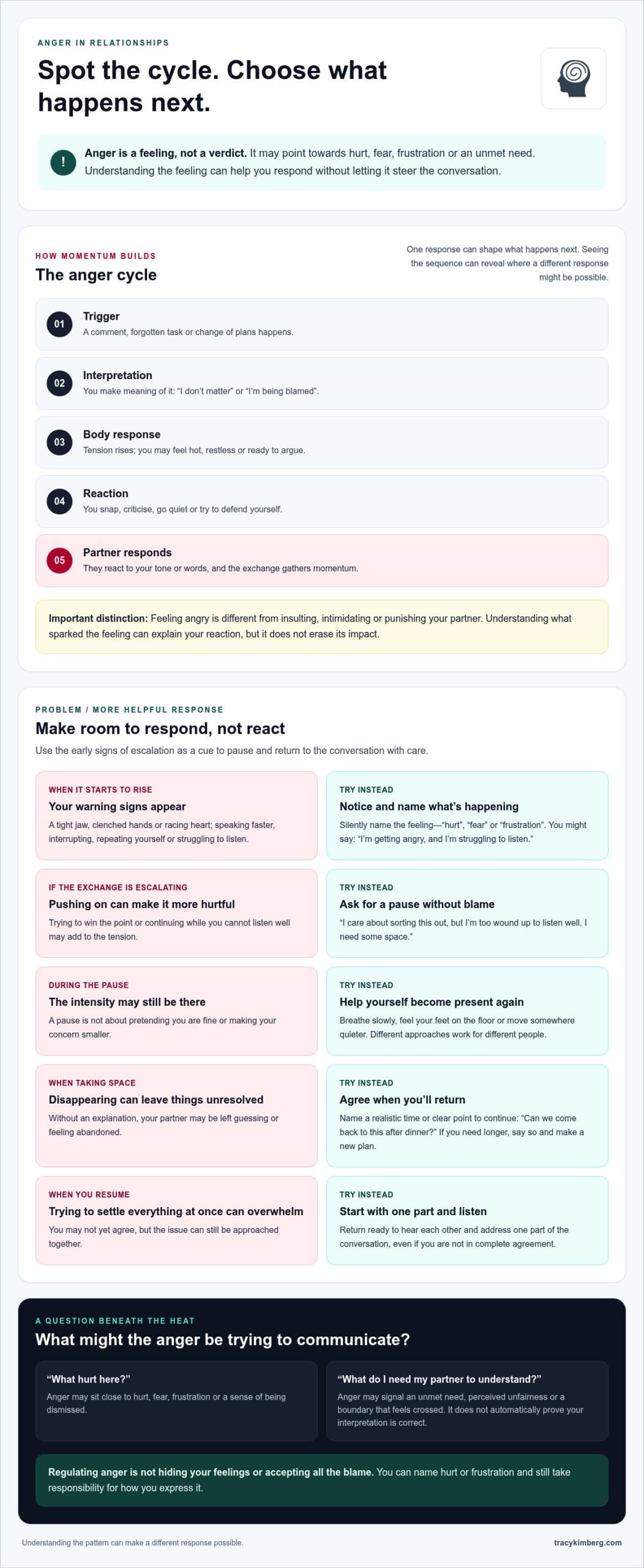
To trace what happened, notice five links:
- Trigger: Something happens, such as a comment, a forgotten task or a change of plans.
- Interpretation: You make meaning of it: “I don’t matter” or “I’m being blamed.”
- Body response: Tension rises; you may feel hot, restless or ready to argue.
- Reaction: You snap, criticise, go quiet or try to defend yourself.
- Partner response: They react to your tone or words, and the exchange gathers momentum.
Seeing this sequence can help you find the point where a different response might be possible. The aim isn’t to decide who started it. It’s to understand how each person’s response shapes what happens next, a useful starting point for conflict resolution strategies.
What might anger be trying to communicate?
Anger may signal an unmet need, perceived unfairness or a boundary that feels crossed. It doesn’t automatically prove your interpretation is correct, and it can mean different things to each partner. Once the first surge has passed, ask yourself: “What hurt here?” or “What do I need my partner to understand?” That curiosity can help you express the concern without treating anger as the whole story.
Why do small disagreements sometimes become bigger arguments?
A minor disagreement can take on greater meaning when either partner assumes criticism, rejection or bad intent. One person’s defensive explanation may sound dismissive; the other’s sharper tone may then seem to confirm the original fear. Neither person has to be the villain for the pattern to hurt. The anger cycle is a trigger interpreted as a threat, followed by a reaction that draws a protective response from the other person.
Learning how to manage anger in a relationship starts with noticing that cycle, not blaming yourself for having feelings. You can take responsibility for your behaviour while staying curious about the need or fear beneath it.
How to calm anger during a relationship argument without shutting down
When you notice the conversation speeding up, the aim isn’t to win the point or pretend you’re fine. It’s to create enough space to choose what happens next. Your warning signs may be physical, such as a tight jaw, clenched hands or a racing heart, or conversational: speaking faster, interrupting, repeating yourself or struggling to take in what your partner is saying.
Try this sequence:
- Notice: Name what’s happening to yourself: “I’m getting angry, and I’m struggling to listen.”
- Pause: Ask to step away before the exchange becomes more hurtful.
- Regulate: Breathe slowly, feel your feet on the floor or move somewhere quieter. Different approaches work for different people; choose what helps you become present again.
- Agree when to return: Name a realistic time or point to continue, rather than leaving your partner to guess.
- Resume: Come back ready to hear each other and address the issue, even if you’re not yet in complete agreement.
How can you pause before anger takes over?
Putting a word to the feeling can interrupt the rush from emotion to reaction. Silently name “hurt”, “fear” or “frustration”, then notice what might help your body settle. A few slower breaths or a quieter space may help. These steps aren’t meant to erase anger or make your concern smaller; they offer room to respond with intention. The Mayo Clinic also shares practical suggestions to tame your temper.
How do you take space and return to the conversation?
Explain the pause without blame or threats. For example: “I care about sorting this out, but I’m too wound up to listen well. I need some space. Can we come back to this after dinner?” Agree on a time or clear point that feels realistic for both of you. If you need longer, say so and make a new plan. Taking space can help; disappearing without explanation may leave your partner feeling abandoned and the issue unresolved.
When you return, begin with one part of the conversation rather than trying to settle everything at once. If you’re working out how to manage anger in a relationship but keep getting pulled into the same escalation, relationship counselling for couples can offer a supportive space to understand the pattern and practise new ways of responding together.
Does managing anger mean accepting blame or hiding how you feel?
No. Regulating anger isn’t the same as suppressing it, agreeing with your partner or taking responsibility for everything that went wrong. Your feelings matter, as does the way you express them. You can name your hurt or frustration and still take responsibility for insults, intimidation or threats. A valid feeling doesn’t make every behaviour acceptable, and harmful behaviour doesn’t mean the underlying concern should be ignored.
In a difficult exchange, separate three things: what happened, how it affected you and what you need now. You might say, “When our plans changed and I wasn’t told, I felt unimportant. I need us to let each other know sooner.” This gives your partner something specific to respond to, rather than a judgement about their character.
How can you express anger without attacking your partner?
Speak from your own experience. Describe one event and its impact without assuming you know your partner’s intentions. “I felt hurt when you walked away while I was speaking” is clearer than “You never care about me.” Then make a request, such as asking to finish the conversation later. Your partner may see the moment differently; making room for their response doesn’t mean withdrawing your own account or demanding immediate agreement.
Both partners can acknowledge their impact without reducing the whole relationship pattern to one person’s fault. You might recognise that your raised voice made it harder for your partner to listen, while still explaining that the issue you raised matters. Accountability isn’t a contest over who is more to blame. It creates room to understand what each person contributed and what needs to change.
When is anger part of a harmful or unsafe pattern?
Repeated insults, intimidation, threats or behaviour that leaves you afraid deserve serious attention. These aren’t simply signs of a disagreement that needs better communication. Coercion and violence shouldn’t be framed as an ordinary conflict pattern, and no one is responsible for preventing another person’s threatening behaviour by finding the perfect words.
If you feel at risk, prioritise your safety over continuing the discussion. Move towards a safer place if you can, and seek appropriate support from someone you trust or a relevant local support service. If danger is immediate, contact emergency services. You don’t have to settle the relationship issue in that moment.
Learning how to manage anger in a relationship means making room for honest feelings while holding clear boundaries around harmful conduct. Understanding each person’s perspective can support repair, but safety and respect are essential for that conversation.
How to prevent repeat anger cycles and repair after an argument
After an argument, it’s tempting to focus on the sentence that hurt most or to settle who was right. A more useful conversation can begin once you’re both calm enough to reflect. The aim isn’t to build a case against each other. It’s to notice what repeatedly sets the conflict in motion and what might help you meet that moment differently next time.
What can you learn from a recurring argument?
Each partner can note what happened just before the disagreement, what they thought it meant and when the exchange began to escalate. Include the context: were you tired, rushed or already carrying tension from another issue? Then compare observations with curiosity. One person may have heard a request as criticism; the other may have felt ignored. Neither interpretation has to be the whole truth for both to matter.
Look for patterns, not a scorecard. Ask, “What did I assume?” and “What did I need in that moment?” Discuss what you notice when you can both listen, rather than trying to solve the pattern in the heat of another argument. This reflection can help you recognise the early turning point next time.
How can couples make repair feel genuine?
Repair begins by acknowledging the impact of your behaviour before explaining your intention. “I interrupted you and raised my voice. I can see that made it harder for you to share what you were feeling. I’m sorry.” This names what happened without adding a defence such as “but you made me angry”. An apology doesn’t require you to abandon your concern; it shows you’re willing to take responsibility for how you expressed it.
Then listen to your partner’s experience without rushing to correct their version. You might ask, “What would help you feel heard if this comes up again?” Share your own answer too. Perhaps you agree to raise a sensitive topic when you have time to talk, or to ask what the other person meant before assuming the worst. Choose one practical next step you can each try. Small, specific agreements are easier to return to than broad promises to “never fight like this again”.
If contempt, such as mocking or treating a partner with disdain, has become part of your exchanges, it may help to explore how it affects connection and conflict. If repeated anger cycles feel difficult to shift alone, explore relationship counselling for couples. A supportive, collaborative space can help you understand the pattern, hear what each partner is protecting and practise more constructive responses.
When relationship counselling can help you manage anger together
Consider support when arguments keep escalating, resentment lingers after an apology or attempts to repair don’t change what happens next. You don’t need to wait until the relationship is at breaking point. If you’re both willing to understand the pattern, counselling can offer a place to slow it down and explore what each of you experiences during conflict.
Learning how to manage anger in a relationship together isn’t about deciding which partner is the problem. It means looking at the interaction between you: what sparks tension, how each person responds and how those responses affect the other. This can be especially helpful when you keep circling the same disagreement but struggle to talk about the hurt or disconnection beneath it.
What can couples counselling help you explore?
In relationship counselling and coaching, each partner can describe their experience and consider how the pattern develops between them. You might explore communication habits, emotional disconnection, unresolved relationship strain or how anger affects closeness and trust. Tracy Kimberg’s research-based approach draws inspiration from John Gottman and Esther Perel, with an emphasis on understanding the relationship dynamic and finding practical ways to respond differently.
The work is collaborative: both partners can identify what they need, take responsibility for their own actions, and practise listening and speaking in ways that keep difficult conversations more constructive. Counselling can support reflection and change, but it can’t promise a particular outcome or replace immediate safety support. If there are threats, violence or fear, prioritise safety rather than treating the situation as a communication problem.
How can you take a first step towards support?
Start by naming one concern you’d like help addressing. It could be, “We keep getting stuck in the same argument,” or “I want us to talk about anger without shutting each other out.” You don’t need a complete explanation to begin. A clear starting point can help you explore the pattern together. Relationship support with Tracy Kimberg is available online and face to face.
If you’re ready to explore a more supported way forward, Explore relationship counselling with Tracy.
Build a calmer way forward together
Anger can point towards hurt, fear or an unmet need, but it doesn’t have to dictate what you say or do. A pause can help you return to a difficult conversation with more care, while honest repair means recognising the impact of your actions without dismissing your own feelings. These shifts can help couples move from repeating the same argument towards understanding what’s happening between them.
Learning how to manage anger in a relationship is a process, not a demand to get every conversation right. If conflict keeps escalating or emotional distance is growing, relationship counselling and coaching can give you space to explore your patterns together and practise new responses. Tracy Kimberg’s research-based approach is inspired by John Gottman and Esther Perel, with support available online and face to face.
Explore relationship counselling with Tracy and take a considered next step towards greater understanding. Change can begin with one conversation approached differently.
Frequently Asked Questions
Can anger be healthy in a relationship?
Yes, anger is a normal emotion and doesn’t by itself mean a relationship is unhealthy. It may signal hurt, frustration or a boundary that matters to you. What counts is how it’s expressed and what happens next. Naming the feeling and its impact can open a more honest conversation. Insults, intimidation, threats or repeated hurtful behaviour shouldn’t be excused as simply being angry.
How do I calm down when I am angry at my partner?
First notice what’s happening in your body, then pause before responding. You might slow your breathing, feel your feet on the floor or move somewhere quieter. Tell your partner you need space and want to return to the conversation, then agree when to pick it up again. These steps can help you choose a more considered response, rather than avoid the issue or dismiss what matters to you.
What should I say when I need a break from an argument?
Be clear and reassuring: “I’m getting overwhelmed and need a pause. I want to come back to this. Can we talk after dinner?” Choose a realistic time together, then follow through. Avoid using the break as a threat or leaving without explanation, as your partner may be unsure whether the conversation will resume. A pause can create room to settle, but the concern still deserves attention afterwards.
How can I express anger without hurting my partner?
Describe what happened and how it affected you, rather than labelling your partner. For example, “I felt hurt when our plans changed and I wasn’t told. I’d like us to let each other know sooner.” Make space for your partner’s perspective, even if you see things differently. If your words or actions caused harm, acknowledge their impact without adding a justification. You can express your feelings and take responsibility at the same time.
What if my partner gets angry whenever I raise a concern?
If it feels safe, choose a calmer moment to explain what happens for you and what you’d like to change. You can take responsibility for how you communicate, but you can’t control your partner’s behaviour. If their anger involves threats, intimidation or fear, prioritise your safety and seek appropriate support. This is more than a routine disagreement about communication, and you don’t have to continue a conversation that feels unsafe.
Can couples counselling help with anger in a relationship?
Yes, couples counselling can provide a supported space to explore recurring conflict, how each partner experiences it and what happens between you as tension rises. You can work on communication, understand the impact of emotional disconnection and practise more constructive ways to respond and repair. Tracy Kimberg offers relationship counselling and coaching for couples, informed by a research-based approach inspired by John Gottman and Esther Perel. Support is available online and face to face.

Article by
Tracy Kimberg
Tracy Kimberg is a Relationship Expert, Couples Therapist and Coach with a dedicated focus on helping couples and individuals rebuild connection, trust and emotional safety in their relationships. Drawing on the research of John and Julie Gottman, the relational insights of Esther Perel, and years of hands-on therapeutic experience, Tracy offers a warm, non-judgemental and deeply compassionate approach to modern relationships.
Based in Dorset, Tracy works with couples navigating communication breakdowns, betrayal, intimacy challenges, separation, family dynamics and life transitions. Known for creating a safe and grounded therapeutic space, she combines practical tools with emotional depth to help clients move beyond survival patterns and towards meaningful, lasting change.
With a reputation for empathy, professionalism and dedication to her clients’ growth, Tracy is passionate about helping people feel seen, understood and empowered — both within their relationships and within themselves.
Disclaimer
Disclaimer:
The information shared in this article is intended for educational and informational purposes only and should not be considered a substitute for professional therapeutic, psychological, medical or legal advice. Every individual and relationship is unique, and the perspectives offered are based on general therapeutic principles, research and professional experience.
Reading this article does not establish a therapist-client relationship with Tracy Kimberg. If you are experiencing significant emotional distress, relationship crisis, trauma, or mental health concerns, it is important to seek support from a qualified professional appropriate to your individual circumstances.
All content remains the intellectual property of Tracy Kimberg and may not be reproduced or distributed without permission.