

Could saying “no” help protect the closeness you’re trying so hard not to lose? If you’ve agreed to something to avoid an argument, only to feel resentful or unheard afterwards, raising a boundary can feel risky. Learning how to set healthy boundaries in a relationship isn’t about shutting your partner out or deciding what they’re allowed to do. It’s about being honest about what you need and taking responsibility for the choices that protect your wellbeing.
That distinction matters: a clear limit invites understanding, while control tries to manage another person. In this guide, you’ll explore how to recognise a boundary rooted in a genuine need, express it in respectful, specific language and stay steady if it’s challenged. You’ll also learn how to keep listening and make room for dialogue, so a difficult conversation doesn’t have to become a choice between self-respect and connection. Boundaries can build trust by clarifying where each person’s responsibility begins and how care for the relationship can grow.
Key Takeaways
- A boundary is a limit around your own needs, choices and participation, not a way to control your partner.
- Notice recurring discomfort, resentment or exhaustion, then consider whether time, privacy, affection, emotional conversations or shared responsibilities need attention.
- Learning how to set healthy boundaries in a relationship starts with separating a genuine personal limit from a demand that dictates or monitors your partner’s behaviour.
- Prepare what you want to say, choose a calm moment, explain your limit in first-person language, listen and follow through consistently.
- If boundary conversations keep becoming the same conflict, Couples Therapy can help you explore the pattern and understand each other’s needs.
What does a healthy boundary in a relationship actually mean?
Asking for space or a change in how you relate can feel surprisingly vulnerable. You may worry your partner will hear rejection when you’re trying to express a need, especially when closeness matters deeply. Yet staying quiet can leave you feeling unseen. A boundary gives language to what helps you feel respected and able to stay present in the relationship.
A healthy boundary is a limit you set around your own needs, choices and participation. It identifies what you can accept and what you will do if a situation doesn’t work for you. It isn’t a rule that gives you authority over your partner’s decisions. A boundary describes how you will care for yourself; control tries to dictate what your partner must do.
This distinction can make how to set healthy boundaries in a relationship feel less like issuing an ultimatum and more like being honest about your part in a shared dynamic. For example, you can decide to pause a conversation when you feel overwhelmed and return to it when you’re ready. You can’t make your partner feel or think a particular way. The idea of personal boundaries includes limits around emotional and physical space, as well as individual choices.
How boundaries protect both closeness and individuality
Intimacy doesn’t require two people to have identical needs or perspectives. A boundary can help each partner remain an individual while staying emotionally engaged. You can make room for your own feelings and still care about how your choices affect the person you love. Mutual consideration means both people’s needs count.
Imagine you need quiet time after work before you’re ready to talk. Taking some space may help you reconnect with more attention later. If you routinely ignore that need to avoid disappointing your partner, the cost may show up as exhaustion or resentment. The aim isn’t distance for its own sake. It’s connection that doesn’t depend on one person repeatedly abandoning themselves.
Boundaries, requests and agreements: what is the difference?
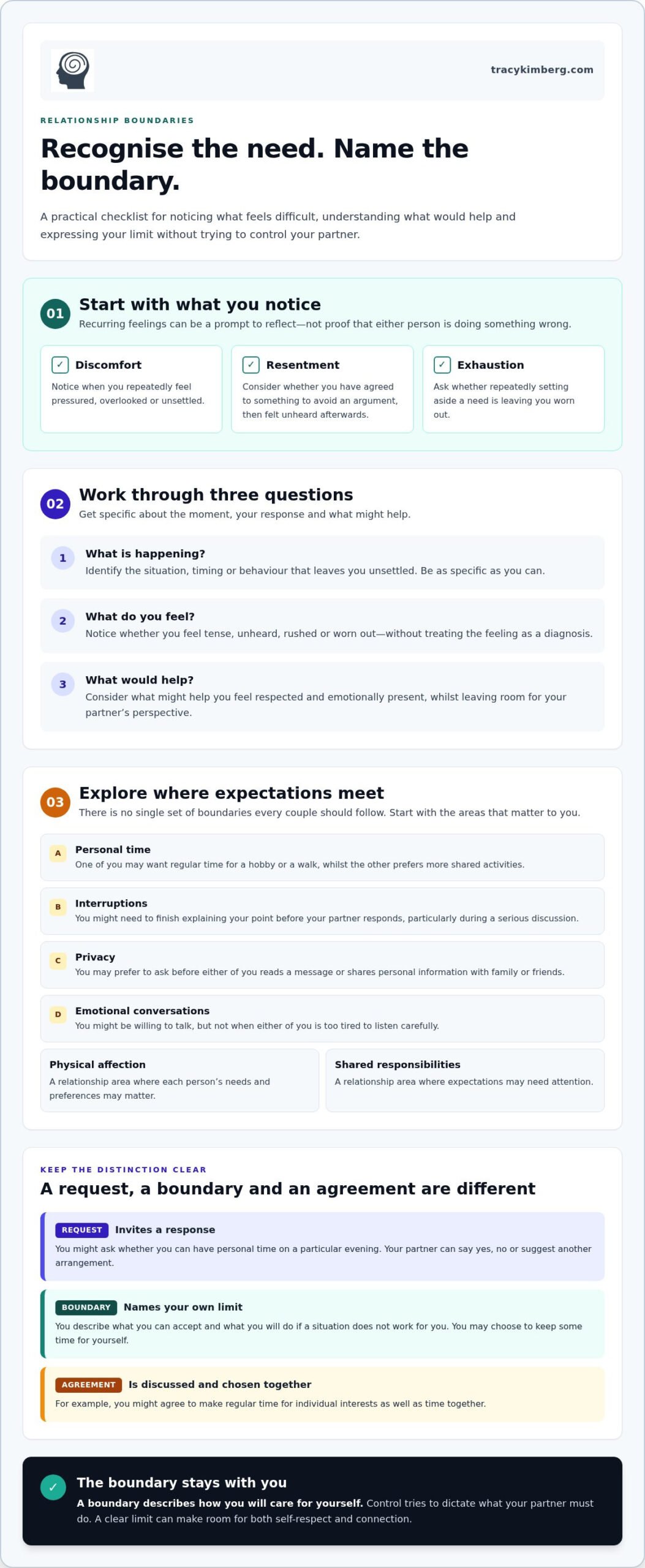
A request invites your partner’s response. You might ask whether you can have some personal time on a particular evening. Your partner can say yes, no or suggest another arrangement. A boundary, by contrast, names your own limit: you may choose to keep some time for yourself, even if your partner would prefer to spend that time together.
An agreement is different again. It’s an expectation you discuss and choose together, rather than one person imposing it. For instance, you might agree to make regular time for individual interests as well as time together. Requests, boundaries and agreements can all support a relationship, but they work best when each person’s agency is respected. A boundary can be clear without closing the door to discussing how you both meet your needs.
Which relationship boundaries matter most, and how do you recognise your needs?
There isn’t one set of boundaries every couple should follow. One partner may enjoy sharing details about their day, whilst the other needs time to process before talking. Preferences can also shift with stress, health, work or changes in a relationship. Feeling uncomfortable, resentful or exhausted can be a prompt to reflect, not proof that either person is doing something wrong. A useful boundary starts with naming your own need, rather than deciding what your partner’s behaviour says about their character.
It can help to consider areas where expectations often meet: personal time, privacy, emotional conversations, physical affection and shared responsibilities. Resources such as HelpGuide’s guide to setting healthy boundaries in relationships also explore how limits can differ between people. The aim isn’t to find a universal rule, but to understand what helps you feel respected and able to take part in the relationship.
Recognising a boundary need before resentment builds
Notice when you repeatedly feel pressured, overlooked or depleted. Rather than labelling your partner as inconsiderate, describe the moment as specifically as you can. Is it difficult to finish a thought when you’re interrupted? Do you feel drained when a serious conversation starts just as you’re trying to sleep? Specifics help you get closer to the need beneath the frustration.
- What is happening? Identify the situation, timing or behaviour that leaves you unsettled.
- What do you feel? Notice whether you’re tense, unheard, rushed or worn out, without treating that feeling as a diagnosis.
- What would help? Consider what might allow you to feel respected and emotionally present, while leaving room for your partner’s perspective.
Examples of boundaries couples may discuss
Boundaries are personal, not a checklist of rules for every couple. Your preferences may differ, and you can talk together about arrangements that respect both people.
- Alone time: You may want regular time for a hobby or a walk, whilst your partner prefers more shared activities.
- Interruptions: You might need to finish explaining your point before your partner responds, particularly during a serious discussion.
- Privacy: You may prefer to ask before either of you reads a message or shares personal information with family or friends.
- Difficult conversations: You might be willing to talk, but not when either of you is too tired to listen carefully.
- Affection and responsibilities: Comfort with physical affection and expectations around household tasks can also be discussed and revisited as circumstances change.
If it’s hard to identify what you need beneath recurring frustration, reflecting on it with support may help. Couples Therapy with Tracy offers a space to explore differing needs and the patterns that make them difficult to discuss.
Are boundaries selfish or controlling? How to tell the difference
If you’re afraid a boundary will hurt your partner or push them away, it can be tempting to call your own need selfish before you’ve expressed it. But a respectful limit isn’t automatically a rejection of the relationship. It can help you stay involved without ignoring your wellbeing. The distinction lies partly in the focus: are you describing what you’ll do to care for yourself, or trying to control your partner’s choices?
Tone and intention matter, but they aren’t the whole picture. A calm voice can still carry a demand, and a firm limit can be expressed with care. Ask whether your words leave your partner with agency and whether you’re prepared to take responsibility for your own next step. This can bring clarity to how to set healthy boundaries in a relationship without turning either person into the problem.
A boundary or an ultimatum: what changes?
Compare the focus of each statement. A boundary is about your own participation: “If we start shouting, I’ll pause the conversation and return to it when I can listen.” An ultimatum tries to force agreement: “You must do exactly what I say, or I’ll make you regret it.” The first names a limit and an action you control; the second uses threat or punishment to steer your partner.
Consequences aren’t inherently punitive. They are clearer and fairer when they describe what you will choose, rather than what you’ll do to teach your partner a lesson. For example, you might leave a conversation that has become insulting rather than retaliating with insults of your own. The purpose is to protect your ability to participate with self-respect, not to make your partner comply through fear.
Try asking yourself:
- Is this about what I need or what I want my partner to be?
- Am I naming an action I can take, rather than demanding an outcome I can’t control?
- Would I still consider this limit reasonable if my partner disagreed with it?
Why guilt and fear can make a healthy limit feel wrong
Setting a limit can bring up fear of conflict, rejection or disappointing someone you love. Those feelings deserve attention. If you’ve often kept the peace by putting your own needs aside, speaking differently may feel uncomfortable at first. That discomfort doesn’t prove your boundary is unfair. It may simply show that you’re changing a familiar pattern.
Give yourself room to examine the need without rushing to condemn it or defend it. Does the limit support respect and emotional safety for both of you? Is there space to hear your partner’s feelings, even if you don’t abandon the boundary to soothe them? Compassion isn’t the same as saying yes to everything. You can acknowledge that a limit is difficult for your partner and still take your own needs seriously. If you notice yourself using a boundary to monitor, punish or shut down discussion, pause and reflect rather than labelling either of you. A more open conversation can help you understand what each person is trying to protect.
How do you communicate and maintain a boundary with your partner?
Raising a boundary is a conversation, not a test your partner has to pass. You can be clear about what you need and still stay curious about how they experience the situation. A boundary is easier to understand when it is specific and calm. That doesn’t mean your partner will agree straight away, or that you can prevent every difficult feeling. It gives you both a clearer place to begin.
Try this sequence, adapting it to your circumstances:
- Prepare. Identify what’s happening, how it affects you and what action you’re willing to take. Keep the focus on your need rather than building a case against your partner.
- Choose a calm moment. Look for a time when you can both give the conversation attention. An active argument is rarely the easiest moment to explain something important.
- State the limit. Use first-person language to name your experience and the action you’ll take. For example: “When I say I need to pause and the conversation continues, I feel overwhelmed. I’m going to step away and come back to this when I’m ready to talk.”
- Listen. Give your partner room to describe what they heard or what the boundary brings up for them. Listening helps you understand each other; it doesn’t require you to debate away your need.
- Follow through. If the situation arises again, take the action you described as steadily and respectfully as you can. Consistency makes the limit easier to understand over time.
A calm way to raise a boundary
Keep the wording concise: describe the situation, name its effect on you, then explain your limit. You don’t need to justify every detail or predict how your partner should respond. If either of you becomes too upset to listen, it may be better to pause and return to the subject later. A thoughtful opening can support dialogue, but it can’t guarantee that conflict won’t arise.
What to do when a boundary is challenged
If your partner pushes back, briefly restate what you need and the action you’ll take. Then follow through without turning the moment into a debate about whether you’re allowed to have the limit. They may initially misunderstand what you mean or feel surprised, leaving room for clarification. If the same boundary is repeatedly dismissed, notice that pattern and consider what support or further conversation may help, without assuming you know your partner’s intent.
If you feel afraid or unsafe, prioritise your immediate safety and seek appropriate support rather than trying to manage the situation through a joint conversation. If you both want to understand a repeated cycle of boundary conflict, talk with Tracy about Couples Therapy and explore the relationship dynamics together.
When can couples therapy help with relationship boundaries?
Some differences about space, privacy or shared responsibilities can be worked through in everyday conversation. Couples Therapy may help when the same boundary discussion keeps ending in withdrawal, escalation or confusion, and you both leave without understanding what the other needs. The aim isn’t to decide who is right or assign blame. It’s to notice the pattern between you: what happens when one person raises a need, how the other responds, and what makes it difficult to find a way forward together.
You might recognise that one partner raises an issue, the other hears criticism, and the conversation quickly shifts from the original need to defending intentions. Or perhaps one person stops bringing things up because they expect an argument, whilst the other experiences the silence as distance. Looking at this cycle can help both partners understand how their responses affect the relationship, without reducing either person to a label.
Not every disagreement calls for therapy. But if one or both of you feel unable to speak openly, or you’ve tried to discuss a limit several times without reaching shared understanding, support can offer space to slow the conversation down. Together, you can explore what each boundary means, how you communicate needs and what makes it harder to hear one another. Learning how to set healthy boundaries in a relationship can involve understanding not only the limit itself, but also the feelings and expectations that gather around it.
Signs a boundary conversation may need more support
Pay attention to the repeated shape of the conversation, rather than judging either partner. Does it regularly end with someone withdrawing, voices escalating or the same misunderstanding unresolved? Do you find yourself holding back needs to avoid conflict, or struggling to listen once a limit is raised? These patterns don’t mean your relationship is beyond repair. They can be a reason to seek help understanding what’s happening between you.
Exploring support with Tracy Kimberg
Tracy offers Couples Therapy and one-to-one Online Sessions for couples worldwide. Face-to-Face Sessions are available for local couples in Dorchester. Her approach is caring and non-judgemental, giving partners room to explore needs, communication and relationship dynamics without assuming one person is at fault. Trusted by over 266 Couples & Teenagers along with their parents, worldwide, since 2005.
Therapy doesn’t require you to arrive with the perfect words or a shared account of the problem. You can begin with the fact that these conversations feel difficult and a wish to understand each other better. If boundary discussions keep leaving you stuck, start a conversation with Tracy about Couples Therapy.
Make room for a more honest kind of closeness
You don’t have to get every word right before you begin. A useful next step may be to notice one moment this week when you feel yourself agreeing automatically, then pause and ask what you genuinely want to say. That small moment of awareness can help you approach how to set healthy boundaries in a relationship as a continuing practice, rather than a single conversation that must resolve everything.
After you speak, give the relationship room to respond. You may learn something about your own needs, your partner’s experience or what still feels hard to discuss. Progress can start with curiosity, even when the conversation is imperfect. If you’d value a supportive space to explore what’s happening between you, talk with Tracy about relationship support. A more connected way forward can begin with one honest step.
Frequently Asked Questions
What are some examples of healthy boundaries in a relationship?
Healthy boundaries can shape everyday decisions as well as emotionally charged conversations. For example, you might agree not to commit both of you to weekend plans until you’ve checked your calendars. Another option is agreeing that either partner can leave a social event early, with a plan for getting home. The phrase how to set healthy boundaries in a relationship can start with small, practical choices that make shared life feel more considered.
Is it normal to feel guilty after setting a boundary with your partner?
Guilt can be a cue to check your conduct, rather than a verdict on your limit. Ask yourself: did I break a promise, speak unkindly or avoid taking responsibility for something I agreed to? If so, you can acknowledge that specific action and make amends. If you were honest and respectful, the guilt may instead reflect how unfamiliar it feels to act differently. Separate the two questions before deciding what to do next.
Can boundaries change during a relationship?
Yes, and an updated boundary doesn’t necessarily mean your partner has done something wrong. If an arrangement no longer fits, explain what has changed for you and what you’d like to do differently from now on. For example, if a shared commitment is becoming difficult to manage, discuss a transition rather than changing plans without warning. Giving each other notice can make an adjustment easier to understand and put into practice.
How do you set boundaries in a long-distance relationship?
Talk about communication expectations that work across your routines and time zones. You could agree which evenings you’ll usually have a longer call, and clarify that a delayed reply during work or sleep isn’t automatically a sign of trouble. It can also help to decide what counts as urgent and how you’ll reach one another in that case. Treat the arrangement as a shared plan, not a test of commitment.
How can I set boundaries around privacy in a relationship?
Consider your digital footprint together. You might be comfortable with a partner sharing a photo of you privately but not posting it publicly or tagging you without asking. Discuss what each of you is happy to have shared online, including personal news about the relationship. Consent can be specific: being comfortable with one post doesn’t mean agreeing to every post. Revisit the understanding if your preferences about social media change.
What happens if my partner and I have different boundaries?
Start by separating plans that affect one person from decisions that affect you both. If one of you enjoys going to social events together and the other prefers to attend some separately, you might choose which occasions matter to share and leave room for individual plans too. Not every difference needs one identical preference. The useful question is whether you can make arrangements that honour both people without either feeling pressured to pretend they’re comfortable.

Article by
Tracy Kimberg
Tracy Kimberg is a Relationship Expert, Couples Therapist and Coach with a dedicated focus on helping couples and individuals rebuild connection, trust and emotional safety in their relationships. Drawing on the research of John and Julie Gottman, the relational insights of Esther Perel, and years of hands-on therapeutic experience, Tracy offers a warm, non-judgemental and deeply compassionate approach to modern relationships.
Based in Dorset, Tracy works with couples navigating communication breakdowns, betrayal, intimacy challenges, separation, family dynamics and life transitions. Known for creating a safe and grounded therapeutic space, she combines practical tools with emotional depth to help clients move beyond survival patterns and towards meaningful, lasting change.
With a reputation for empathy, professionalism and dedication to her clients’ growth, Tracy is passionate about helping people feel seen, understood and empowered — both within their relationships and within themselves.
Disclaimer
Disclaimer:
The information shared in this article is intended for educational and informational purposes only and should not be considered a substitute for professional therapeutic, psychological, medical or legal advice. Every individual and relationship is unique, and the perspectives offered are based on general therapeutic principles, research and professional experience.
Reading this article does not establish a therapist-client relationship with Tracy Kimberg. If you are experiencing significant emotional distress, relationship crisis, trauma, or mental health concerns, it is important to seek support from a qualified professional appropriate to your individual circumstances.
All content remains the intellectual property of Tracy Kimberg and may not be reproduced or distributed without permission.