

What if saying what you really think could bring you closer, rather than push your partner away? If you’re wondering how to stop being a people pleaser in relationships, you may recognise the pattern: agreeing when you mean no, hiding a preference, then feeling drained or resentful afterwards. It makes sense that you’d want to protect the relationship, especially if honesty feels likely to lead to conflict or distance. But having needs doesn’t make you selfish. Expressing them gently can make room for a more mutual connection.
People-pleasing can become a way to keep the peace, sometimes shaped by earlier experiences of feeling that disagreement wasn’t safe. The response may be understandable, but you don’t have to abandon your own feelings to care for someone else. This guide explores what can keep the pattern going and offers practical ways to notice your preferences, say no with care and stay present when tension arises. Small, honest moments can build trust and help you relate with warmth without carrying unspoken resentment.
Key Takeaways
- Notice when you’re choosing genuine compromise and when you’re agreeing mainly to avoid disapproval or tension.
- Recognise how unspoken feelings can leave both partners feeling less understood, even when one person is trying to keep the peace.
- A respectful no can express a boundary without cancelling your care or commitment.
- Explore how to stop being a people pleaser in relationships through small steps: pause, notice what you feel, name your need, communicate it and reflect.
- If the pattern feels hard to shift alone, relationship counselling can offer space to understand the dynamic together.
How people-pleasing shows up in a relationship, and what it may be protecting
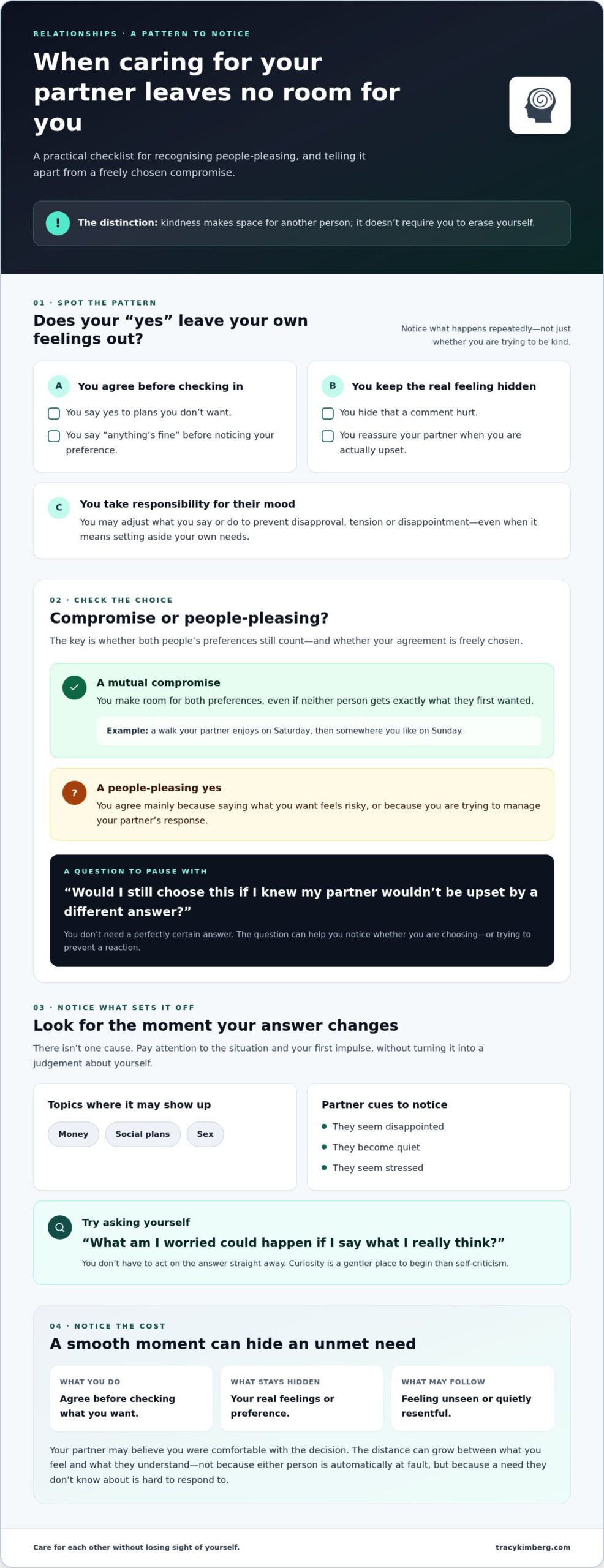
People-pleasing in a relationship is a repeated habit of setting aside your preferences, feelings or needs to avoid disapproval, tension or someone else’s disappointment. It can look considerate from the outside: you say yes to plans you don’t want, hide that a comment hurt, or take responsibility for your partner’s mood. The key isn’t whether you’re being kind. It’s whether your care leaves room for you, too.
Over time, automatic agreement can make it harder to know what you genuinely want. You might say “anything’s fine” before checking how you feel, or reassure your partner when you’re actually upset. These responses aren’t proof that something is wrong with you. They’re patterns worth noticing, especially if they leave you feeling unseen or quietly resentful.
Kindness makes space for another person; it doesn’t require you to erase yourself. That distinction can help you explore how to stop being a people pleaser in relationships without treating your care as a fault. The term Understanding Sociotropy and People-Pleasing offers one lens on how a strong investment in relationships and social acceptance may shape behaviour. It isn’t a diagnosis or a complete explanation of anyone’s choices.
Is compromise the same as people-pleasing?
Healthy compromise makes room for both partners’ preferences, even when neither gets exactly what they first wanted. If you’re choosing weekend plans, you might agree to a walk your partner enjoys on Saturday, then suggest visiting somewhere you like on Sunday. The adjustment is freely chosen, and your preference still counts. People-pleasing is more likely when you agree mainly because saying what you want feels risky.
Try asking yourself: “Would I still choose this if I knew my partner wouldn’t be upset by a different answer?” You don’t need a perfectly certain answer. The question can help you tell whether you’re making a genuine choice or trying to manage someone else’s response.
What might people-pleasing be trying to prevent?
For some people, automatic agreement may be an attempt to prevent conflict, rejection or disapproval. For others, it may be linked to learned ways of keeping closeness or avoiding tension. There isn’t one cause, and noticing a pattern doesn’t mean you need to label yourself. Instead, pay attention to moments when your answer changes before you’ve had time to consider it.
Does it happen around particular topics, such as money, social plans or sex? Is it stronger when your partner seems disappointed, quiet or stressed? Noticing the situation and your first impulse can offer useful information. You might pause and ask, “What am I worried could happen if I say what I really think?” You don’t have to act on the answer straight away. Curiosity is a gentler place to begin than self-criticism.
Why people-pleasing can create distance between partners
People-pleasing can ease a tense moment, but the relief may not last. A familiar cycle can take shape: you anticipate your partner’s disappointment, agree before checking what you want, then keep your real feelings to yourself. Perhaps you tell yourself it’s not worth raising, or that you’ll feel differently later. If this happens repeatedly, you may begin to feel unseen or resentful, while your partner may believe you were genuinely comfortable with the decision.
This doesn’t mean either person is at fault. Your partner can’t respond to a need they don’t know about, and a reluctant yes can be difficult to distinguish from an enthusiastic one. The distance grows in the gap between what you feel and what your partner understands. Avoiding tension in the moment can also mean missing opportunities to be known more fully, including through the small preferences that make everyday life feel shared.
Unspoken needs can quietly weaken trust, because each partner is left responding to an incomplete picture of the other.
How resentment can build when needs stay unspoken
Resentment can be information about a repeated imbalance, not proof that you or your partner have a bad character. Imagine agreeing to host your partner’s family because you don’t want to seem difficult. As the day approaches, you feel overwhelmed and frustrated that your partner hasn’t noticed how much you’re taking on. They may think you’re happy to host, because that’s what you said.
Rather than waiting until irritation becomes the only signal, try to identify what sits underneath it. Would you rather not host? Do you need help, or would you like plans to be discussed together? Naming the preference to yourself is a useful start. Sharing it calmly gives your partner a chance to understand what your agreement didn’t show.
How the pattern can affect both partners
If one person’s honest input is missing, the other may end up making choices for the couple without realising it. That doesn’t automatically mean they’re taking advantage. They may be working with the information they’ve been given, while you carry the effort of keeping things smooth and concealing the cost.
Mutual understanding grows when both partners can express preferences and respond to them with curiosity. That might mean revisiting a decision, asking what each person would prefer, or acknowledging that a yes sounded clearer than it felt. These conversations don’t need to settle everything at once. They help replace guessing with a more accurate sense of each other.
If the pattern feels difficult to shift together, relationship counselling for couples can offer space to explore how it works between you. Learning how to stop being a people pleaser in relationships isn’t about assigning blame; it’s about making room for both people’s feelings and choices.
Will saying no damage the relationship? Rethinking boundaries and conflict
If you’re used to agreeing, even a gentle no can feel loaded. You might worry your partner will hear it as rejection or a sign that you care less. But a respectful no usually communicates a limit, preference or need, not an absence of love. It gives your partner a more honest picture of what you can offer, rather than asking them to interpret an agreement that doesn’t feel true.
That doesn’t mean every conversation will feel easy. Your partner may be surprised, particularly if you’ve often agreed before. A change in the pattern can take time to understand, and your partner may need a moment to adjust. Discomfort, a pause or a difference of opinion doesn’t automatically mean the relationship is in danger. You can be caring and clear at the same time.
What a boundary can sound like in a close relationship
A boundary is a way of communicating what you can agree to and what you need. It describes your position; it isn’t a punishment, an accusation or a demand that your partner behave exactly as you wish. For example: “I care about this, and I need time before deciding.” You’re being direct about your limit while leaving room for a conversation.
Keep the focus on your experience and what you can do. “I can’t take that on tonight” is clearer than “You always expect too much”. A boundary doesn’t guarantee your partner will like the answer, and it isn’t a tool for controlling their response. It helps you speak honestly about your own choices.
How to respond when a partner feels surprised
If your partner says they didn’t expect your answer, you can acknowledge that without taking back your preference: “I can see this is surprising. I still need us to make a different plan.” Then listen to what the change brings up for them whilst keeping your own feelings in view. Understanding their reaction doesn’t require you to say yes after all.
Try to stay with the specific issue rather than turning the moment into a verdict on your whole relationship. You could ask what they understood you to mean, explain what you meant, and look for a next step that respects both perspectives. They may respond warmly, need time or feel frustrated. You can’t control that, but you can speak with care and clarity.
There’s an important exception: if saying no could lead to intimidation, threats or retaliation, prioritise your safety rather than practising a boundary in that moment. Consider reaching out to someone you trust or suitable support. You deserve to express your needs without fear of being harmed.
Learning how to stop being a people pleaser in relationships can involve tolerating the uncertainty of a new conversation, not forcing yourself to be fearless. If you and your partner feel stuck in the same responses, relationship counselling for couples can provide space to explore the pattern together.
How to stop being a people pleaser in relationships: five small practices
You don’t need to change every habit at once. Start with one low-stakes moment, such as choosing what to watch or suggesting where to go for a walk. The aim isn’t to become less caring; it’s to let your own experience enter the conversation too. These five practices offer a simple sequence to try at a pace that feels manageable.
- Pause. Before answering, notice whether you feel a quick rush to agree, a tight chest or a sinking feeling. You could say, “Let me think about that and get back to you.” Taking time to decide is different from going silent to punish your partner. If you say you’ll come back to the conversation, try to do so.
- Notice. Ask yourself what you’d choose if you weren’t trying to predict or manage your partner’s reaction. You might realise you’re tired, would prefer a quiet evening or have a different view. You don’t need to justify the preference to yourself before it’s allowed to count.
- Name. Put the preference into a clear sentence, even if you’re only practising privately at first. “I’d rather stay in tonight” is more specific than “I don’t know” when you do have an idea. Naming what you want helps you separate your own feelings from the answer you think will keep everyone comfortable.
- Communicate. Use first-person language and make one specific request. For example: “I’m feeling tired, and I’d like us to have a quiet evening. How would that feel for you?” This shares your experience without accusing your partner or expecting them to guess what you need. Then listen to their perspective and make room for an honest exchange.
- Reflect. Afterwards, give yourself a moment to review the interaction rather than grading it as a success or failure. Ask: “What did I want, what did I say, and what felt difficult?” Notice whether you expressed yourself clearly, how your partner responded and what you might try next time.
Let change feel unfamiliar
An honest answer can feel uncomfortable simply because it’s new. You may feel guilty even when you’ve spoken with care, or want to take your words back as soon as your partner pauses. Try to measure the practice by whether you showed up honestly, not only by whether you got the answer you hoped for. Small moments of clear communication can help you learn that a preference can be spoken, heard and discussed.
If practising together feels difficult, explore relationship counselling for couples to work through the pattern with support.
When support could help you change the relationship pattern
Sometimes noticing the pattern is enough to begin shifting it. At other times, you keep trying to speak more openly but find yourselves returning to the same conflict, withdrawing, or struggling to say what you need. Extra support may help if you feel stuck despite your efforts, or if expressing a preference regularly brings up fear, guilt or confusion. You don’t have to wait until a relationship is at breaking point to seek space for reflection.
Counselling isn’t a verdict on either partner or proof that someone is to blame. It can be an invitation to understand what happens between you: how one person’s automatic agreement and the other’s assumptions may reinforce a pattern neither intended. Seeing the interaction together can make it easier to consider different responses. Each person can reflect on their own part without taking responsibility for everything that happens in the relationship.
What relationship counselling can offer when a pattern feels stuck
In relationship counselling and coaching, partners can explore what makes honesty difficult, what each person understands from the other’s words, and how needs might be expressed more clearly. The aim isn’t to promise a particular outcome or decide who is right. It’s to create room for a fuller conversation, where both partners’ experiences can be heard and considered.
Even if your partner isn’t ready to join a conversation, you can begin by reflecting on your own responses: what you feel, what you tend to hold back, and what you might want to communicate differently. This isn’t about putting the whole pattern on your shoulders. It’s a way to find a starting point within your own choices.
Choosing a first step that feels manageable
You might begin with one honest conversation about a small, current preference, or take a few minutes to write down what you need before raising it. If you’d like support to understand the pattern together, Tracy Kimberg offers relationship counselling and coaching for couples, with one-to-one online sessions for couples worldwide and face-to-face sessions for couples local to Dorchester. Her practice also serves clients in Bournemouth, Poole, Christchurch, Weymouth, London & beyond through online sessions.
If that feels like a useful next step, Let’s talk about what feels difficult. Or begin gently today: write down one thing you’ve wanted to say, then consider a kind, clear way to express it. You don’t need to solve the whole pattern in one conversation.
Make room for a more honest kind of closeness
You don’t have to become a different person to make more room for yourself in a relationship. Your warmth can stay. The shift is allowing your care to include your own inner life, so your partner has the chance to know you more fully. That kind of honesty can begin with a single sentence, spoken when you feel ready.
Learning how to stop being a people pleaser in relationships is a gradual practice, not a test you pass by always getting the words right. If you’d like a thoughtful space to explore what feels difficult, Tracy Kimberg offers relationship counselling and coaching for couples. She has been practising since 2005 and is trusted by over 266 Couples & Teenagers along with their parents, worldwide.
Take a first step towards more mutual connection. You can begin with one honest conversation, or explore the pattern with support. There’s room to move forward gently, without losing the kindness that matters to you.
Frequently Asked Questions
Is people-pleasing in a relationship always unhealthy?
No. A single act of accommodation doesn’t tell you much on its own. Look at the pattern across different areas of life: do you still know your own likes, make decisions independently and feel able to revisit an arrangement that no longer works? For example, helping your partner prepare for a busy week may feel satisfying, whilst routinely cancelling your own plans may leave you disconnected from parts of your life.
Can I stop being a people pleaser without becoming selfish?
Yes. You can stay attentive whilst being more deliberate about what you offer. Before taking on an extra task, consider what you’ve already committed to and whether you can follow through without neglecting something important. If you can’t, explain your capacity and, if it feels genuine, offer a realistic alternative. Being clear about your limits can make your support more dependable, because your partner knows what you can actually give.
How do I say no to my partner without starting an argument?
You can’t guarantee that a difficult subject won’t lead to disagreement, but you can avoid making the conversation harder than it needs to be. Keep to one issue, and don’t attach a list of older grievances to your answer. If either of you becomes too upset to listen, suggest returning to the subject later. A pause can help you continue more thoughtfully, provided you agree when to pick it up again.
What causes people-pleasing in relationships?
Its roots can differ from person to person, and the behaviour may be specific to one relationship or situation. For instance, you might find it harder to disagree when decisions are made quickly, or when your partner is already under pressure. That context can matter as much as personal history. Notice when the pattern appears and when it doesn’t; comparing those situations may help you understand what influences your response.
What happens if my partner reacts badly when I set a boundary?
First, consider what “badly” means in the moment. Disappointment or needing time to think is different from repeatedly mocking, punishing or pressuring you for expressing a limit. You could return to the conversation later and explain how the response affected you, then notice whether your partner can hear that. If you feel threatened or unsafe, focus on your safety and speak with someone you trust or suitable support.
Can couples counselling help with people-pleasing?
It may help if conversations keep circling around the same issue and you’re unsure how to change the interaction. Before a session, each partner could note one recent disagreement: what happened beforehand, what each person did next, and what they wish the other had understood. This gives you something specific to explore, rather than needing to arrive with a complete explanation or a shared account of the problem.
How can I practise being more honest with my partner?
Try writing down a thought before a conversation, especially if you tend to lose track of what you mean once emotions rise. Keep the note brief: what happened, how you felt and what you’d like your partner to understand. You might begin with something appreciative as well as something difficult, so honesty includes the full range of your experience. Afterwards, consider what helped you stay present and what you’d adjust next time.

Article by
Tracy Kimberg
Tracy Kimberg is a Relationship Expert, Couples Therapist and Coach with a dedicated focus on helping couples and individuals rebuild connection, trust and emotional safety in their relationships. Drawing on the research of John and Julie Gottman, the relational insights of Esther Perel, and years of hands-on therapeutic experience, Tracy offers a warm, non-judgemental and deeply compassionate approach to modern relationships.
Based in Dorset, Tracy works with couples navigating communication breakdowns, betrayal, intimacy challenges, separation, family dynamics and life transitions. Known for creating a safe and grounded therapeutic space, she combines practical tools with emotional depth to help clients move beyond survival patterns and towards meaningful, lasting change.
With a reputation for empathy, professionalism and dedication to her clients’ growth, Tracy is passionate about helping people feel seen, understood and empowered — both within their relationships and within themselves.
Disclaimer
Disclaimer:
The information shared in this article is intended for educational and informational purposes only and should not be considered a substitute for professional therapeutic, psychological, medical or legal advice. Every individual and relationship is unique, and the perspectives offered are based on general therapeutic principles, research and professional experience.
Reading this article does not establish a therapist-client relationship with Tracy Kimberg. If you are experiencing significant emotional distress, relationship crisis, trauma, or mental health concerns, it is important to seek support from a qualified professional appropriate to your individual circumstances.
All content remains the intellectual property of Tracy Kimberg and may not be reproduced or distributed without permission.