

What if the most helpful thing you can do for an anxious partner isn’t to make the anxiety disappear, but to stay connected while they move through it? If you’re wondering how to support a partner with anxiety, you may already know how hard it is to find the right words. You might worry that reassurance will become a cycle, that suggesting support will sound like criticism, or that you’re somehow responsible for keeping your partner calm.
Those worries make sense. Anxiety can shape how couples communicate, handle uncertainty and reach for closeness, but it doesn’t mean your relationship has failed. You can offer compassion without taking over, and care for your partner without losing sight of your own needs.
This guide will help you listen with empathy, ask what kind of support would feel useful and respond without reinforcing patterns that leave either of you feeling stuck. We’ll also explore how to protect connection during difficult moments, set healthy boundaries and recognise when individual therapy or couples counselling could help.
Key Takeaways
- To learn how to support a partner with anxiety, pause, listen, ask what would help and agree on one manageable next step.
- Validate your partner’s feelings without dismissing them or promising that nothing difficult will happen.
- Talk together during a calmer moment about reassuring words, practical help, privacy and when either of you needs a pause.
- Offer support without taking over every responsibility. Caring for your own needs helps protect the relationship too.
- Individual therapy can offer space to explore personal concerns, while couples counselling can help you address shared relationship patterns.
How anxiety can affect your partner and your relationship
Caring for someone who feels anxious can leave you unsure whether to listen, offer reassurance or give them space. You may also feel stretched if plans change often or conversations circle around the same fears. That uncertainty doesn’t mean you’re failing as a partner. It can be hard to know what’s happening inside someone else, especially when anxiety affects each person differently.
In everyday language, anxiety is a state of worry or unease about what might happen, sometimes accompanied by a sense of alertness that makes it difficult to feel settled. Worry is part of being human; having worries doesn’t, by itself, mean someone has an anxiety disorder. For a general overview of understanding anxiety, including how it differs from fear, see this reference.
Anxiety may influence how someone communicates, makes decisions, seeks reassurance or experiences closeness. One person might want to talk through every possibility; another might go quiet or need time alone. Neither response tells the whole story. Compassionate support means offering care while respecting your partner’s agency. Taking responsibility means treating their feelings as yours to manage or resolve. That distinction is central to how to support a partner with anxiety while keeping the relationship a shared space.
What anxiety may feel like from your partner’s side
Your partner may describe worry that keeps returning, feeling overwhelmed by uncertainty, or finding it hard to settle even when things appear fine. These are possible experiences, not fixed traits or a complete explanation of who they are. The same person may feel more capable in one situation and more unsettled in another. Outward behaviour alone can’t tell you what’s happening internally: quietness might mean overwhelm, but it might mean something else. Rather than interpreting for them, try asking, “What’s this feeling like for you?” Curiosity leaves room for their own account.
How anxiety can enter the relationship dynamic
Worry can affect ordinary shared life: deciding whether to attend an event, making plans that involve uncertainty, or having a conversation about the future. If one partner repeatedly seeks reassurance, the other may explain, check or change plans to ease the moment. That response can become a familiar cycle, particularly if reassurance brings only brief relief and the same question returns. It doesn’t make either person the problem. Noticing the pattern together can help you talk about what each of you needs, rather than turning a difficult moment into blame.
Try to separate the feeling from the response: “I can see this is unsettling” acknowledges distress without deciding what it means or taking over the next choice. That small distinction can create more room for an honest conversation. It also helps both partners see anxiety as something affecting the relationship dynamic, rather than as the whole story of either person or the partnership.
How to support a partner with anxiety in the moment
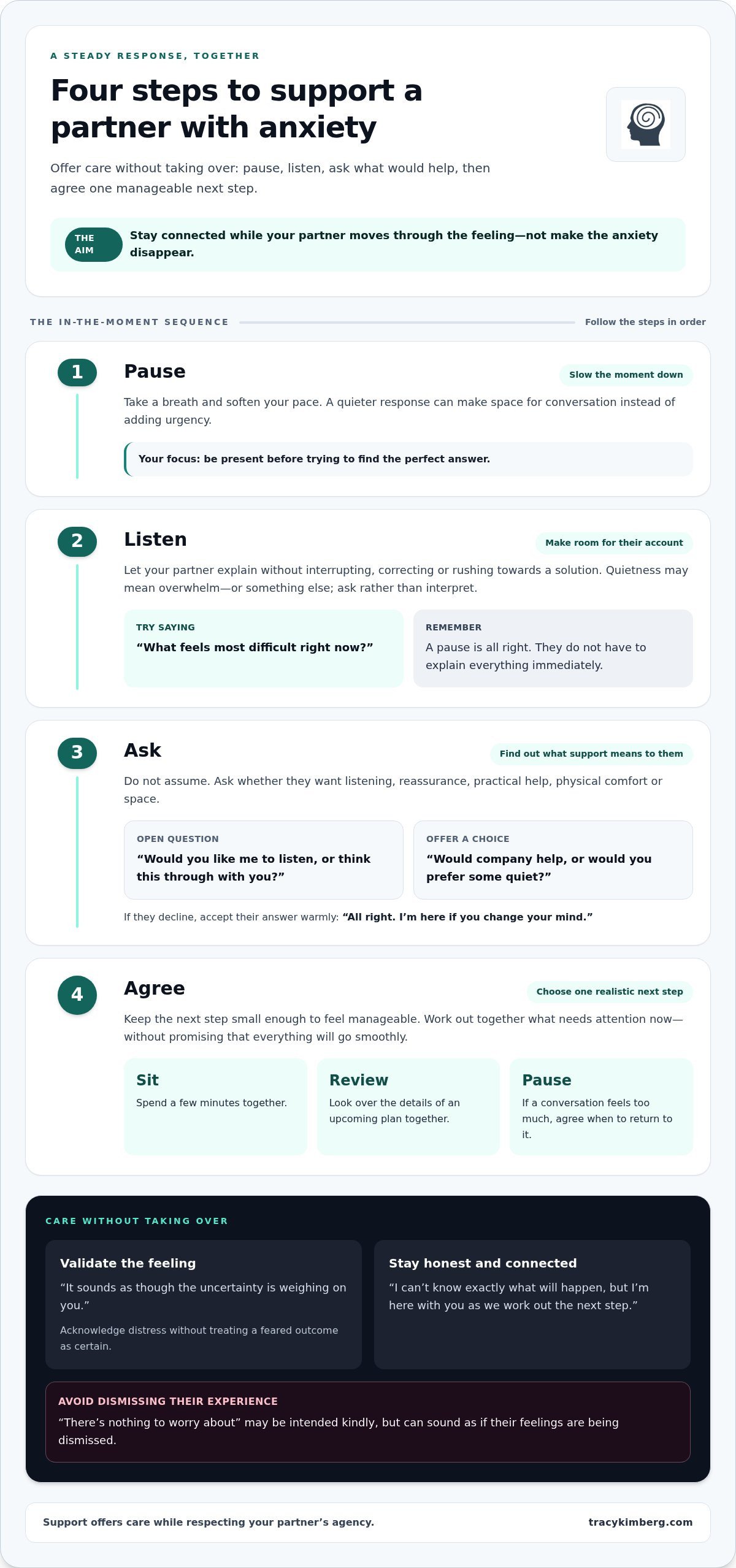
When anxiety rises, it can be tempting to find the perfect answer straight away. Quick solutions may leave your partner feeling unheard, while repeated reassurance can pull you both into trying to settle something neither of you can control. A steadier response is simpler: pause, listen, ask what would help, then agree on one manageable next step. You’re offering care, not taking responsibility for making the feeling disappear.
Try this sequence:
- Pause. Take a breath and soften your pace. A quieter response can make space for conversation instead of adding urgency.
- Listen. Let your partner explain without interrupting, correcting or rushing towards a solution.
- Ask. Find out whether they want listening, reassurance, practical help, physical comfort or space.
- Agree. Choose one realistic action for now, such as sitting together for a few minutes or deciding what needs attention first.
What to say when your partner feels anxious
Open questions invite your partner to describe their experience in their own words. You might ask, “What feels most difficult right now?” or “Would you like me to listen, or think this through with you?” Reflect what you hear: “It sounds as though the uncertainty is weighing on you.” This recognises distress without treating a feared outcome as certain. Let there be a pause; your partner doesn’t have to explain everything immediately.
Try not to compare their experience with your own or insist they look on the bright side. “There’s nothing to worry about” may be meant kindly, but can sound as if their feelings are being dismissed. You can be honest and caring at once: “I can’t know exactly what will happen, but I’m here with you as we work out the next step.”
Offer practical help without taking over
Before doing something on your partner’s behalf, ask what kind of support would feel useful. “Would company help, or would you prefer some quiet?” is more respectful than assuming. You could offer to handle one practical task, sit nearby, or give them room and check in later. If they decline, accept their answer warmly: “All right. I’m here if you change your mind.”
Keep the next step small enough to feel manageable. If an upcoming plan feels overwhelming, you might agree to review the details together rather than promising that everything will go smoothly. If a conversation becomes too much, ask whether a short pause would help and agree on when to return to it. These choices allow both partners to stay involved without turning support into control.
You won’t always know what to say. You don’t have to remove anxiety to be a caring partner; a calm presence, a respectful question and one agreed action can help you stay alongside each other. If you’d like support with the patterns anxiety creates between you, relationship counselling for couples can offer a space to explore them together.
Reassurance, boundaries and the fear of getting it wrong
You don’t have to find the perfect words every time your partner feels anxious. A loving response isn’t measured by whether you can make their worry vanish; it’s shown in your willingness to stay present, be honest and keep listening. You can acknowledge how hard something feels without agreeing that the feared outcome will happen. “I can hear how worried you are” offers connection. “Nothing bad will happen” promises certainty you may not be able to give.
Caring support does not require becoming your partner’s therapist. You can be close and compassionate while recognising that their feelings, choices and growth remain their own. That balance is part of how to support a partner with anxiety without making yourself solely responsible for keeping them calm.
When reassurance becomes a repeated cycle
It’s understandable to seek reassurance when uncertainty feels difficult. A partner might ask the same question several times, while the other keeps answering in the hope that one more promise will bring lasting relief. If the worry returns, both can end up strained: one still unsettled, the other feeling that nothing they say is enough. This doesn’t mean reassurance is always unhelpful, or that your partner should stop asking. It may be a cue to look together at what could help beyond repeating the same answer.
You might say, “I hear that this is still worrying you. Do you want me to listen, help you think through what you know, or stay with you while the feeling passes?” The question acknowledges distress without treating the feared outcome as fact. If you can’t offer certainty, say so gently: “I can’t promise how it will turn out, but I care about you and we can take this one step at a time.”
How to set a caring boundary
A boundary is a clear, kind limit, not a punishment or withdrawal of affection. It can protect your capacity to listen and help keep a hard conversation from becoming hurtful. Pair the limit with care and a specific way to reconnect. For example:
- “I want to understand, and I’m getting tired. Can we pause and talk after dinner?”
- “I can stay with you for a while, but I can’t keep checking the same thing tonight. Let’s decide what would help you next.”
- “I’m feeling overwhelmed by this conversation. I love you, and I’d like us to return to it when we’re both calmer.”
Make the reconnection concrete where you can. A clear plan to resume the conversation is less likely to feel like abandonment than walking away without explanation. At a calmer time, talk about whether the limit felt fair, what each of you needed and how you might handle a similar moment. Boundaries may need adjusting as you learn what supports closeness without exhausting either person. The aim isn’t to get every moment right; it’s to make room for both care and honest limits.
Create a shared plan for conversations, routines and support
It’s easier to talk about what helps when neither of you is in the middle of a difficult moment. Choose a calm time and make the conversation collaborative: you’re not writing rules for one partner to follow, but learning how to stay connected when anxiety affects your shared life. Preferences can differ and may change. The aim is a useful starting point, not a perfect script.
Talk about what support feels helpful
Ask open questions: “When you feel anxious, what would you like me to do?” “Is there anything I do that makes it harder, even though I mean well?” Share your side too: “What helps me stay present is knowing whether you want me to listen or help problem-solve.” If your preferences don’t match, get curious about what each response means rather than deciding one is right.
Include practical details that can be hard to negotiate under pressure. You might discuss whether your partner wants you to check in before offering advice or physical comfort, what they’d like kept private, and how either of you can ask to pause a conversation. Agree on how you’ll reconnect afterwards, so a pause doesn’t feel as if the subject has been abandoned.
Keep connection alive in everyday life
Make room for ordinary moments together that aren’t focused on anxiety: sharing a meal, chatting about something you both enjoy or taking a relaxed walk. Small gestures of affection and interest can nurture closeness without being treated as a technique or a cure. Shared routines may feel grounding for some couples, but they should suit both of you and remain manageable, rather than becoming another obligation.
A flexible plan might sound like this: “If you’re feeling overwhelmed, I’ll ask whether you want listening, practical help or some space. If I need a pause, I’ll say so kindly and suggest when we can pick up the conversation. We’ll keep our usual evening catch-up when it works for us, and check in about this plan if it stops feeling helpful.” The words matter less than the shared understanding behind them.
Revisit the plan when you’re both settled. Ask what felt supportive, what didn’t, and whether either of you needs a different approach now. This isn’t a performance review; it’s a chance to keep responding to the people you are today. Planning together can make it easier to talk about how to support a partner with anxiety while leaving room for each person’s needs, boundaries and independence.
If anxiety is affecting how you connect, explore relationship counselling for couples as a collaborative space to understand your patterns and strengthen communication.
When to seek support for anxiety or its effect on your relationship
There may come a point when anxiety feels difficult to manage alone, or its effects make everyday life and connection harder. Seeking professional support can be a constructive step, not proof that your partner has failed or that your relationship is broken. It offers space to understand what’s happening and consider what might help, without making you solely responsible for finding the answers.
Support can focus on your partner’s own experience, the patterns between you, or both. The right starting point depends on what feels most pressing. Your partner can explore individual support even if you’re not ready to attend together, and couples counselling can help when both of you want to work on shared dynamics.
How individual and couples support differ
Individual therapy gives a person space to explore their feelings, concerns and needs in their own right. Tracy offers individual therapy for adults experiencing anxiety and other concerns. Couples counselling, by contrast, focuses on how you communicate and relate to one another, including the ways anxiety may affect closeness or contribute to recurring tension. Tracy also offers relationship counselling and coaching for couples. Neither format is universally better, and couples work doesn’t require one partner to be labelled as the problem.
As you consider what might fit, ask what you’re hoping to understand or change. Is your partner looking for room to explore their anxiety privately? Are you both feeling caught in a pattern that affects the relationship? It’s also possible to begin with one kind of support and later reconsider what would be useful. The choice is personal, not a test of commitment.
Recognise when immediate safety matters
If there’s an immediate risk of harm, seek urgent local emergency or crisis support. Take direct statements about immediate danger seriously, and don’t try to manage the situation alone. Therapy can support ongoing personal or relationship concerns, but it isn’t emergency care.
For partners, this distinction can bring clarity: you can listen, care and encourage support, but you don’t have to carry a situation beyond your capacity by yourself. If you’re concerned about safety, focus on getting immediate help rather than trying to resolve everything through a conversation between the two of you.
If you’re weighing up how to support a partner with anxiety, professional help can be part of a thoughtful, shared response. Tracy’s individual therapy for adults and relationship counselling offer options for concerns that feel mainly personal or relational. You can explore support with Tracy at a pace that feels right; beginning the conversation doesn’t commit you to a particular path or promise a specific outcome.
Take one thoughtful step towards support
You don’t need to have every answer before you begin a new conversation. A useful next step might be asking your partner what they’d like to explore, or noticing what you need in order to stay present without carrying everything alone. Small, honest steps can make room for more understanding over time.
If you’d like a supportive space to explore what’s happening, Tracy offers individual therapy for adults and relationship counselling and coaching for couples, with online and face-to-face options. The focus can be on your partner’s personal concerns, the patterns you’re experiencing together, or what feels most relevant to you. Choosing to seek support isn’t a verdict on either person or your relationship. It’s a way to approach the next part with care.
Learning how to support a partner with anxiety is not about becoming an expert in their feelings. It’s about making space for connection while recognising that you, too, deserve support. Explore therapy and relationship support with Tracy, and take the next step at a pace that feels right for you.
Frequently Asked Questions
Can I make my partner’s anxiety worse by saying the wrong thing?
A comment can feel hurtful, but one imperfect response doesn’t define your relationship. If you say something like “You’re overreacting” and notice your partner withdraw, pause and acknowledge the impact: “I’m sorry, that sounded dismissive. I want to understand what you’re feeling.” Then give them room to respond rather than defending your intention. Repair isn’t about finding flawless words; it’s a chance to learn what helps your partner feel heard.
Should I reassure my partner every time they feel anxious?
You can reassure your partner, but you don’t have to repeat a promise you can’t know is true. If they ask whether a meeting will go badly, for example, you could recognise the concern and ask whether they’d like help preparing or simply want you to listen. This makes room for comfort and practical support without treating uncertainty as something either of you must eliminate before carrying on.
What should I do if my partner refuses professional help?
You can raise your concern, but the decision to seek individual support belongs to your partner. Choose a calm moment and describe a specific change you’ve noticed, such as plans being cancelled more often, then explain how it affects you without presenting it as evidence against them. Ask what feels uncomfortable about getting help and listen. If they’re not ready, you can still seek support for your own wellbeing and think through what boundaries you need.
Can anxiety affect a relationship even when my partner is not talking about it?
It can influence how you interact, but a change in communication or plans doesn’t prove anxiety is the cause. There may be other explanations, so avoid interpreting silence or distance on your partner’s behalf. You could say, “I’ve noticed we’ve had less time together lately, and I miss you. How has it felt for you?” This shares your experience and invites theirs, rather than turning an observation into an accusation.
How can I support my partner without becoming their therapist?
You can be a caring partner without taking on a clinician’s role. That means sharing your own perspective and offering companionship, not diagnosing your partner, directing their choices or monitoring their feelings. If you’re unsure how to support a partner with anxiety, ask what kind of help they want and be honest about what you can offer. Support can be loving and practical without making you responsible for managing their wellbeing.
What if my partner’s anxiety is affecting my own wellbeing?
Your wellbeing deserves attention too. Notice whether you’re regularly setting aside your own needs or avoiding honest conversations to prevent tension. You might identify one change you need, such as keeping a personal commitment even if your partner feels worried, and discuss it with care. Talking with someone you trust or seeking individual support can help you reflect on your experience. Caring for yourself doesn’t mean you care less about your partner.

Article by
Tracy Kimberg
Tracy Kimberg is a Relationship Expert, Couples Therapist and Coach with a dedicated focus on helping couples and individuals rebuild connection, trust and emotional safety in their relationships. Drawing on the research of John and Julie Gottman, the relational insights of Esther Perel, and years of hands-on therapeutic experience, Tracy offers a warm, non-judgemental and deeply compassionate approach to modern relationships.
Based in Dorset, Tracy works with couples navigating communication breakdowns, betrayal, intimacy challenges, separation, family dynamics and life transitions. Known for creating a safe and grounded therapeutic space, she combines practical tools with emotional depth to help clients move beyond survival patterns and towards meaningful, lasting change.
With a reputation for empathy, professionalism and dedication to her clients’ growth, Tracy is passionate about helping people feel seen, understood and empowered — both within their relationships and within themselves.
Disclaimer
Disclaimer:
The information shared in this article is intended for educational and informational purposes only and should not be considered a substitute for professional therapeutic, psychological, medical or legal advice. Every individual and relationship is unique, and the perspectives offered are based on general therapeutic principles, research and professional experience.
Reading this article does not establish a therapist-client relationship with Tracy Kimberg. If you are experiencing significant emotional distress, relationship crisis, trauma, or mental health concerns, it is important to seek support from a qualified professional appropriate to your individual circumstances.
All content remains the intellectual property of Tracy Kimberg and may not be reproduced or distributed without permission.