

What if your husband’s refusal to attend counselling reflects fear or uncertainty, rather than proof that he doesn’t care about the relationship? Knowing what to do if my husband refuses counselling can feel overwhelming, especially when you’re already carrying the worry of how to repair things. His response may have many possible reasons. You don’t have to guess at them or take responsibility for changing his mind.
You can’t choose counselling for your husband, but you can choose a thoughtful next step for yourself and the relationship. A calm conversation may help you understand what feels difficult about getting support, while respecting that the decision is his. If he isn’t ready to come with you, individual therapy can still help you clarify your needs and choices. It isn’t a way to control or diagnose him.
This guide explores concerns that may sit behind a refusal, how to raise the subject without pressure, and what meaningful steps are available whether or not he joins you. His answer today doesn’t have to decide the whole future of your marriage.
Key Takeaways
- Explore possible concerns behind his refusal, such as fear of blame or discomfort with vulnerability, without assuming you know his reasons.
- To decide what to do if my husband refuses counselling, begin with a calm conversation that shares your experience and invites his perspective.
- Individual therapy can help you understand your feelings, needs and choices without making you responsible for changing both partners.
- Readiness for couples counselling may develop over time. A first conversation doesn’t have to resolve every question about your relationship.
- Couples counselling can help partners explore recurring patterns and consider possible ways forward together.
Husband Refuses Counselling: Start With Your Feelings
When your husband declines counselling, the silence afterwards can feel heavy. You may feel lonely, anxious about what happens next, or frustrated that you’re the one trying to find a way forward. It can also stir up a painful question: if he won’t come with me, does that mean he doesn’t care? His refusal is real, and your feelings about it deserve attention. But the meaning of his decision isn’t yet clear.
Wanting support isn’t an admission that your marriage has failed. It can be a response to feeling stuck, unheard or caught in the same difficult exchange again and again. Counselling offers space to understand relationship patterns and consider different ways to respond. It isn’t a place to decide who is to blame. That distinction matters: asking for help is not the same as accusing your partner.
Couples therapy can take different approaches, but its focus is generally on the relationship and the ways partners interact. Understanding Couples Therapy offers an overview of its history and approaches. Knowing that counselling isn’t one fixed process may help you put words to what you hope for, without assuming what your husband expects it to be.
Why his refusal can feel so personal
A refusal may land as rejection, especially if asking for counselling took courage. You might hear, “I don’t want to work on us,” even if all he said was, “I’m not going.” Those meanings can feel identical in the moment, but they aren’t the same fact. Before raising the subject again, notice what came up for you: hurt, anger, fear, or perhaps a sense of being alone with the problem.
That pause isn’t about dismissing your needs or making excuses for him. It gives you a chance to understand what you want to express, rather than speaking from the sharpest point of pain. You can care deeply about the relationship without taking on the responsibility of repairing it for both of you.
What his decision does and does not tell you
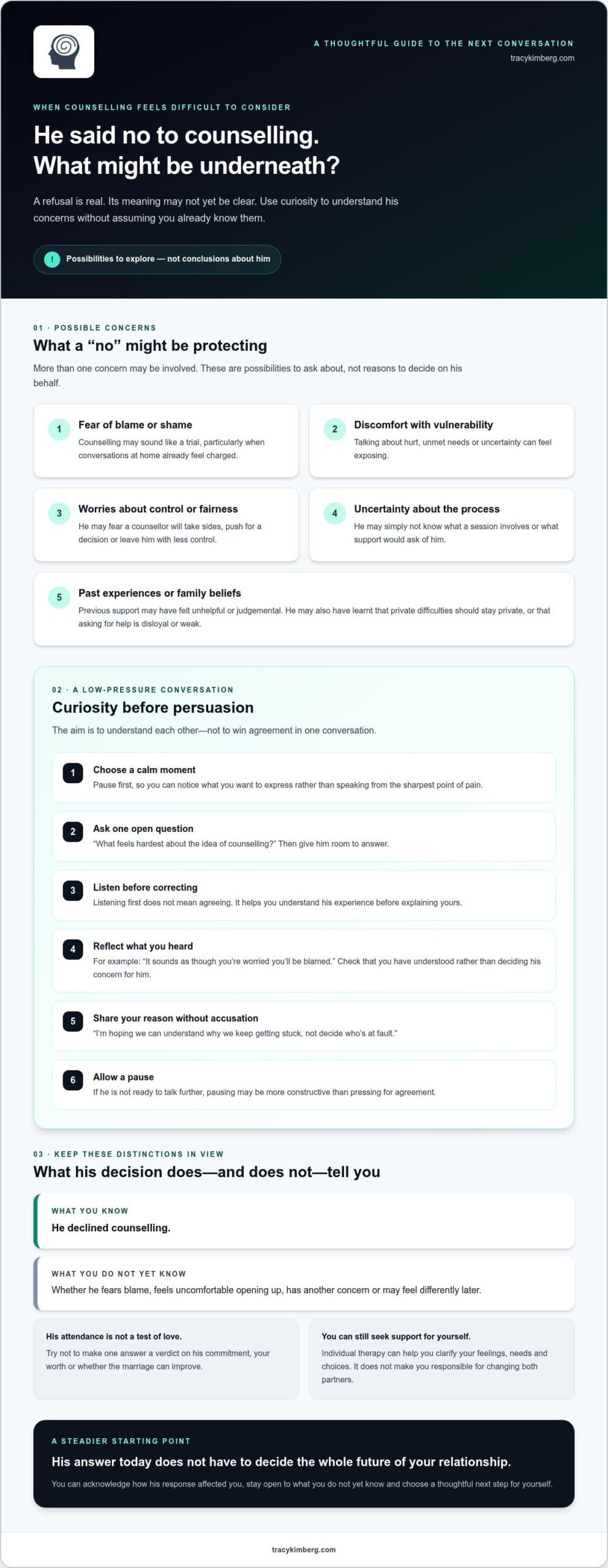
For now, the observable fact is that he declined counselling. You don’t yet know whether he fears being blamed, feels uncomfortable opening up, or has another reason. Guessing may turn into a fixed story before you’ve heard his perspective. His answer also doesn’t tell you whether he’ll feel differently later. Partners can be at different levels of readiness to talk about painful patterns.
Try not to turn attendance into a test of love, commitment or whether the marriage can improve. The question of what to do if my husband refuses counselling can feel urgent, but you don’t have to settle the future of the relationship based on one answer. First, let yourself register the impact. Then decide what you need to say, ask or seek for yourself, without making his choice a verdict on your worth or the whole marriage.
Why a husband may refuse relationship counselling, and how to understand his concerns
A refusal can have more than one meaning. It may reflect worries about what counselling will ask of him, what it might reveal, or what could happen to the relationship afterwards. Those are possibilities, not conclusions about your husband. Curiosity can help you learn what his “no” is protecting, without treating it as a problem you must solve for him.
Fear of blame or shame may make a session sound like a trial, especially if conversations at home already feel charged. Vulnerability can be daunting too: speaking about hurt, unmet needs or uncertainty may feel exposing. Some people worry that a counsellor will take sides, push for a decision, or leave them with less control over what happens next. Others simply don’t know what a session involves.
Common worries behind a no
Past experiences can shape those expectations. Perhaps he has seen someone close to him feel judged in therapy, or has tried support before and found it unhelpful. Family beliefs may also matter: if he grew up with the idea that private difficulties should stay private, asking for help might feel disloyal or weak. These influences can affect anyone. Reluctance isn’t proof that men avoid emotions, nor does it tell you what your husband is feeling.
It may help to distinguish hesitation from hopelessness: “A reluctance to try counselling can be understandable without proving that a relationship cannot change.” The purpose isn’t to talk yourself out of your concern; it’s to stay open to what you don’t yet know. A person may be wary of the process while still caring about the relationship, or may need time to understand what support could involve.
Curiosity before persuasion
Choose a calm moment and ask one open question, such as, “What feels hardest about the idea of counselling?” Then give him room to answer. Try not to correct his assumptions straight away, even if you believe counselling could help. Listening first isn’t agreement; it’s a way to understand his experience before explaining yours.
You can reflect what you heard in neutral language: “It sounds as though you’re worried you’ll be blamed.” Check that you’ve understood, rather than deciding his concern for him. Then share your own reason: “I’m hoping we can understand why we keep getting stuck, not decide who’s at fault.” If he isn’t ready to talk further, a pause may be more constructive than trying to win agreement in one conversation.
If you’re considering what to do if my husband refuses counselling, this kind of exchange can offer useful information, even if it doesn’t change his answer today. You might explore your own perspective with individual therapy with Tracy, a space to clarify what you need and how you want to move forward, without trying to diagnose or manage his response.
How to talk about counselling when your husband says no
A useful conversation doesn’t have to end with a yes. Its first purpose is to help you speak honestly and hear one another, without turning counselling into a demand or a referendum on your marriage. Choose a moment when neither of you is already upset or rushing. If emotions rise, you can pause and return to the subject later.
Try this sequence:
- Choose a calm moment. Ask if he’s open to talking, rather than beginning the conversation in the middle of an argument.
- Describe your experience. Use “I” language and a specific observation, such as, “I’ve noticed we keep having the same argument, and I’m feeling distant from you.”
- Invite his view. Ask what he thinks is happening between you, or what feels uncomfortable about counselling.
- Pause and listen. Give him time to answer. You don’t need to fill every silence or persuade him straight away.
Choose words that invite connection
Keep the focus on what you feel and hope to understand, rather than on a label or accusation. “You never listen” can prompt a defence; “I miss feeling understood when we talk” makes room for a different response. A non-blaming opening might be: “I care about us, and I’d like support to understand why we keep getting stuck, not to decide who’s at fault.”
You could then make the invitation manageable: “Would you be willing to talk about what kind of support might feel acceptable?” Open questions help you learn about his experience without implying there’s one right answer. For example: “What worries you most about counselling?” or “Would it feel easier to start by finding out what a first conversation involves?” The aim is a conversation, not an immediate commitment.
Respond calmly if he repeats his refusal
If he says no again, acknowledge it without pretending you’re not disappointed: “I hear that you’re not ready to go.” You might add, “I won’t keep pushing, but I’d like us to be able to revisit this if you choose.” Repeating the request in the same moment can turn an invitation into a contest over who gets to decide. Respecting his answer doesn’t mean hiding your own needs.
Before you speak, consider what you most need him to understand: that you feel lonely, that the current pattern is hurting you, or that you want to explore ways to communicate differently. Say that clearly, without making a threat you don’t mean or promising to wait indefinitely. If you want support preparing for a difficult conversation, relationship counselling with Tracy offers a space to explore relationship patterns and possible next steps.
If you’re unsure what to do if my husband refuses counselling, you don’t have to resolve everything in one exchange. A steady, honest conversation can make your position clear while leaving room for his choice.
What you can do for yourself when your husband will not attend
His decision doesn’t have to be the only place where movement can begin. Individual therapy can give you room to understand your emotional responses, needs and choices, including what you want to communicate and what you can no longer carry alone. The work is about your wellbeing and perspective, not a strategy for diagnosing your husband or changing him from a distance.
You might use that space to ask yourself: What do I need more of in this relationship? Which parts of our current pattern are affecting me most? What is within my control, and what isn’t? Thinking these questions through can help you distinguish a boundary from an attempt to make your partner behave differently. For example, a boundary might be deciding to pause a conversation when it becomes hurtful, rather than demanding that he agree with your view.
Be gentle with yourself as you reflect. You don’t need to reach a final decision about the marriage before seeking support. Individual therapy for adults with Tracy can help you explore these questions at your own pace. Explore individual therapy with Tracy if you’d like support clarifying what you need and how you want to move forward.
Can individual counselling help if only one partner attends?
Yes, it can be useful even when your husband doesn’t take part. You can work on coping with distress, recognising what happens for you during conflict and considering the choices available to you. That may affect how you show up in the relationship, but it can’t guarantee that he will change or that the marriage will be repaired. You are responsible for your own actions and decisions, not for doing the emotional work of two people.
It may help to bring a specific moment to a session: perhaps an argument that leaves you feeling shut out, or a recurring disagreement you’re unsure how to approach. Rather than focusing only on what he should do, you can explore what you feel, what matters to you, and what response would align with your values. Clarity is valuable in its own right, whatever your husband chooses.
Know when relationship conversations need a safety-first approach
Disagreement can be painful without making it unsafe to speak. But if you feel afraid of your partner, are being intimidated or controlled, or worry that raising concerns could lead to harm, that’s different from an ordinary conflict. If you can’t speak freely without fearing consequences, joint sessions may not be a safe first step. Don’t treat couples counselling as a default in these circumstances.
Prioritise your immediate safety. Consider speaking privately with someone you trust or contacting a local domestic abuse support service to discuss options. If you’re in immediate danger, contact local emergency services. You don’t have to prove that your situation is “serious enough” before seeking help. Your safety and ability to make choices matter, regardless of whether your husband attends counselling.
When your husband is ready: exploring relationship counselling together
Readiness doesn’t always arrive as a sudden change of heart. Your husband may first become willing to talk about what counselling involves, or agree to explore support without knowing what he wants from it yet. A first conversation doesn’t have to settle every question about your marriage. It can simply help you both understand what you hope might feel different and what you’re unsure about.
Couples counselling offers a structured space to notice recurring patterns: perhaps one partner reaches for conversation whilst the other withdraws, leaving both feeling misunderstood. Rather than treating either person as the problem, the work can help you understand how each of you responds and what happens between you. From there, you can explore possible ways forward. Counselling can support reflection and change, but it can’t promise reconciliation or a particular outcome.
What a first conversation about support can cover
Before beginning, talk about what you’d each like help understanding. You might say, “I want us to talk about how we handle conflict,” whilst he may want to know what sessions involve or whether he’ll be expected to make an immediate decision. Both hopes and reservations belong in the conversation. You don’t need identical goals to start exploring support, but each partner should have room to speak and ask questions.
It may help to agree on a modest first step, such as learning about the counselling process together or naming one pattern you’d like help changing. Notice whether you can discuss the idea with some openness, even if you still feel uncertain. That exchange can help you decide whether joint support feels like a shared choice, rather than something one person has been persuaded into.
A next step that respects where you both are
If you’re both willing, Tracy offers relationship counselling and coaching for couples, with online and face-to-face options. Her structured 12-Week Relationship Recovery Process is another way to engage with relationship support. The right next step depends on what you’re both ready to explore; the process is an opportunity to understand your relationship, not a guarantee of a specific result.
If your husband remains unsure, you can continue with individual therapy to gain support and perspective for yourself. That choice doesn’t close the door on counselling together later, and it doesn’t make you responsible for bringing him around. If you’re still considering what to do if my husband refuses counselling, you can honour his pace while deciding what support feels right for you.
If you’re both ready to explore working together, Explore relationship counselling with Tracy as a possible next step.
Choose one next step that feels true to you
You don’t need to have the whole path mapped out before you move. For now, choose one step that reflects what matters to you: make space to think, speak honestly about what you need, or consider what would help you feel more grounded. Your husband’s willingness may change, or it may not. Either way, your own choices remain yours.
If you’re still asking what to do if my husband refuses counselling, try shifting the question from “How can I make him agree?” to “What support or clarity would help me take care of myself?” That change doesn’t dismiss the relationship. It brings your attention back to the part of the situation you can influence, without demanding that you decide everything today.
When you feel ready to explore support, Tracy offers a compassionate space to consider what comes next, together or on your own. Explore support for your relationship with Tracy.
You’re allowed to take this one step at a time. A thoughtful next move can begin with listening to yourself.
Frequently Asked Questions
Is it normal for a husband to refuse counselling?
Yes, a husband may refuse counselling, and that response alone doesn’t explain what he thinks or feels about the relationship. He might have concerns about privacy, cost, being judged or simply not know what to expect. Rather than treating his answer as a verdict, you could ask what makes the idea difficult for him. His reason may be different from what you expect, and listening can give you clearer ground for deciding what to do next.
Can I make my husband go to couples counselling?
No, you can’t make another adult participate willingly in counselling. Pressuring him may get him into the room, but it can also make the process feel like an obligation rather than a shared choice. You can be clear about why support matters to you and what you need in the relationship. If he still declines, consider what support or boundaries would help you, rather than taking responsibility for his decision.
Can couples counselling work if one partner is reluctant?
It may still be possible to have a useful first conversation if both partners are willing to attend and can speak honestly, even with different levels of enthusiasm. Reluctance doesn’t automatically prevent participation, but neither partner should be pushed into it. You might agree on a limited aim for the first session, such as explaining what each of you hopes to understand, then decide together whether to continue.
What if my husband agrees to counselling and then changes his mind?
If he changes his mind, try to find out whether something specific shifted, such as anxiety about what will be discussed or uncertainty about the process. You could ask whether he wants to talk through that concern, without treating his earlier agreement as a promise he must keep. If he decides not to attend, avoid booking joint work on his behalf. You can still seek support for your own perspective and choices.
Should I tell my children that their father refuses counselling?
Usually, children don’t need to be told which parent declined counselling or asked to take sides. If they notice tension or ask questions, offer a calm, age-appropriate explanation, such as, “We’re working out how to handle some grown-up problems.” Reassure them that the difficulties aren’t their fault and they don’t need to fix them. Keep adult details between adults, and consider individual support if you’re unsure how to talk with them.
How long should I wait for my husband to agree to counselling?
There’s no universal waiting period. Rather than putting your life on hold for an open-ended yes, decide what you can accept and when you’ll review that decision. For example, you might choose to raise the subject again after you’ve both had time to reflect, while continuing to seek support for yourself. If you’re asking what to do if my husband refuses counselling, your next step can be based on your needs, not a deadline for changing his mind.

Article by
Tracy Kimberg
Tracy Kimberg is a Relationship Expert, Couples Therapist and Coach with a dedicated focus on helping couples and individuals rebuild connection, trust and emotional safety in their relationships. Drawing on the research of John and Julie Gottman, the relational insights of Esther Perel, and years of hands-on therapeutic experience, Tracy offers a warm, non-judgemental and deeply compassionate approach to modern relationships.
Based in Dorset, Tracy works with couples navigating communication breakdowns, betrayal, intimacy challenges, separation, family dynamics and life transitions. Known for creating a safe and grounded therapeutic space, she combines practical tools with emotional depth to help clients move beyond survival patterns and towards meaningful, lasting change.
With a reputation for empathy, professionalism and dedication to her clients’ growth, Tracy is passionate about helping people feel seen, understood and empowered — both within their relationships and within themselves.
Disclaimer
Disclaimer:
The information shared in this article is intended for educational and informational purposes only and should not be considered a substitute for professional therapeutic, psychological, medical or legal advice. Every individual and relationship is unique, and the perspectives offered are based on general therapeutic principles, research and professional experience.
Reading this article does not establish a therapist-client relationship with Tracy Kimberg. If you are experiencing significant emotional distress, relationship crisis, trauma, or mental health concerns, it is important to seek support from a qualified professional appropriate to your individual circumstances.
All content remains the intellectual property of Tracy Kimberg and may not be reproduced or distributed without permission.