

What if the most transformative moment of your relationship isn’t the resolution of a long-standing argument, but the quiet, courageous decision to finally face it together? It’s a heavy step to take, particularly when you consider that the average couple waits six years after problems begin before seeking professional support. As you begin the process of preparing for our first couples therapy session, you likely feel a complex cocktail of hope mixed with the fear of being blamed or the anxiety of reopening old wounds. It’s completely natural to feel sceptical that simply talking can shift deep-seated behaviours that have felt stuck for so long.
I want you to know that your hesitation doesn’t mean the relationship is failing; it means you care enough to be nervous. This guide is designed to help you soften your heart, organise your thoughts, and approach that first hour with the clarity needed for a lasting transformation. We’ll move beyond the fear of being attacked and provide a clear plan for your initial session, ensuring you feel prepared to be vulnerable in a safe environment. By shifting your focus from building a case against one another to understanding the unique dynamic of your partnership, you can begin a proactive adventure toward genuine healing and connection.
Key Takeaways
- Reframe your pre-session anxiety as a profound sign of your commitment to the relationship, turning a clinical appointment into a “brave space” for connection.
- Shift your mindset from “winning the argument” to building mutual understanding when preparing for our first couples therapy session.
- Organise your thoughts using simple reflection tools that help you identify your favourite shared memories alongside your most pressing pain points.
- Demystify the therapeutic process by learning what happens during joint storytelling and why individual check-ins are a vital part of the assessment.
- Discover how a structured, research-based approach can provide more clarity and progress than traditional, unstructured talking therapy.
Understanding the Threshold: Why Preparation Matters for Your Relationship
Stepping across the threshold of a therapist’s office often feels like a silent admission of defeat. We’ve been fed a cultural narrative that love should be effortless, and that the “Honeymoon Phase” is the natural state of a healthy union. When the magic fades or the arguments become circular, we feel like we’ve failed. However, I invite you to view this first appointment not as a clinical interrogation, but as a “brave space.” It’s a dedicated environment where the messy, unpolished parts of your connection are welcomed with compassion rather than judgement.
If you feel a knot of anxiety in your stomach, please listen to it. That nervousness isn’t a sign that your relationship is over; it’s a sign of deep value. You care enough about your partner to be afraid of what might surface. To gain a broader perspective on the history and various methodologies of this practice, you might find it helpful to explore What is Couples Therapy? before we begin. Taking the time for preparing for our first couples therapy session allows you to shift from a defensive posture to one of curiosity. We aren’t here to find a “winner” and a “loser.” Instead, we focus on the “Third Entity”—the relationship itself. In this room, the relationship is the actual client, and we are all on its side.
Moving Beyond the Stigma of Marriage Counselling
In Britain, we often grapple with the “stiff upper lip” tradition, a cultural habit of keeping our struggles private. This can lead couples to wait until they are in a state of total exhaustion before seeking help. I prefer to frame our work as proactive relationship coaching. It’s about learning the mechanics of your intimacy whilst you still have “gas in the tank.” Waiting until the final hour makes the climb much steeper. By arriving early, you’re choosing to invest in your future rather than just performing an autopsy on your past.
The Goal of the First Sixty Minutes
The primary objective of our initial hour is to establish a sense of safety and rapport. We aren’t going to solve a decade of conflict in one sitting. Instead, we’ll start identifying “The Cycle”—those repetitive, predictable argument patterns where you both get stuck. You’ll begin to see that your partner isn’t the enemy; the Cycle is. By creating a shared vocabulary for your emotional disconnect, we can start to de-escalate the tension and find a way back to each other.
Shifting Your Mindset: From ‘Winning’ to ‘Understanding’
The most common anxiety I hear from couples is the fear that the therapist will take sides. It’s a valid concern; nobody wants to feel ganged up on in a room full of strangers. However, Shifting Your Mindset away from the idea of a courtroom is essential for success. When preparing for our first couples therapy session, we must remember that the goal isn’t to win an argument. It’s to understand the landscape of your shared life. John Gottman speaks often of “shared meaning.” This involves looking at the rituals, goals, and values that hold you together, rather than just the friction that pulls you apart.
Esther Perel often observes that the story we tell about our partner becomes the house we live in. If your story is that your partner is intentionally hurtful, every action they take will be filtered through that lens. Preparation involves a gentle softening of these rigid narratives. It means moving from “You always neglect the housework” to “I feel overwhelmed and lonely when the chores pile up.” This shift from accusation to vulnerability is where the real work begins. If you find this transition difficult, exploring Relationship Counselling and Coaching for Couples can provide the framework to navigate these complex emotional shifts safely.
Abandoning the Role of the Prosecutor
It’s tempting to arrive with a mental list of your partner’s “sins” from the last six months. Whilst this feels like building a strong case, it actually builds a wall. Preparing for our first couples therapy session isn’t about gathering evidence; it’s about opening a door. Effective preparation requires looking inward at your own contributions to the dynamic. Relational accountability is the courageous act of owning your part in the dance, regardless of what your partner is doing. This isn’t about accepting blame; it’s about claiming the power to change the steps.
When One Partner is Reluctant to Attend
Sometimes, one person is ready to dive in whilst the other feels “dragged along.” If you’re the reluctant partner, your scepticism is welcome here. It’s often a protective mechanism against the fear of being attacked or misunderstood. If you’re the initiator, try to reduce the pressure. Suggest a “trial period” of three sessions rather than a lifetime commitment. This makes the threshold feel less like a trap and more like a collaborative experiment in curiosity.
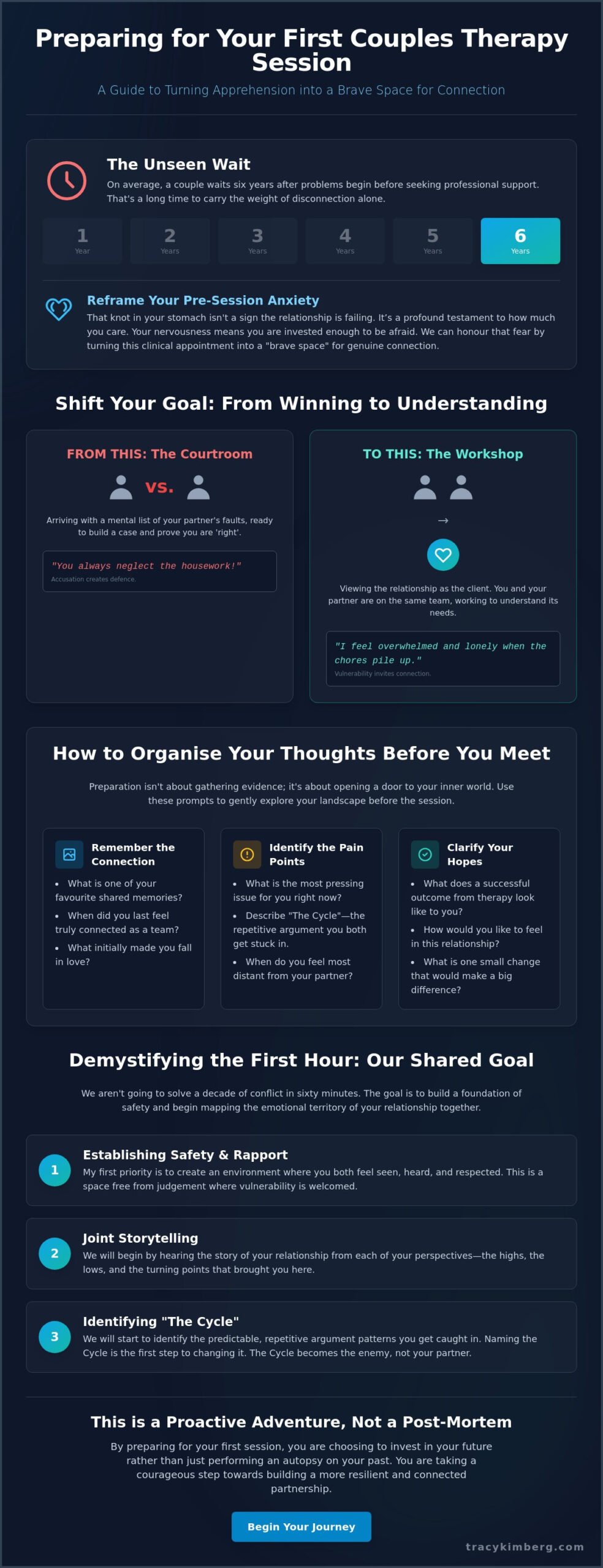
Practical Steps to Organise Your Thoughts Before You Meet
Action often follows intention. Once you have begun the internal work of softening your heart, the next stage of preparing for our first couples therapy session involves gathering the threads of your shared story. This isn’t about creating a clinical dossier, but rather about identifying the patterns that have brought you to this threshold. When you arrive with organised thoughts, you reduce the pressure to remember everything in the heat of the moment, allowing you to breathe and be present. Consider these five practical steps to ground yourselves before we meet:
- Reflect on the duality of your bond: Spend ten minutes individually noting your favourite shared memories alongside your current pain points. We need to see the light of your history to understand the depth of the shadows.
- Define two or three specific goals: Move beyond vague desires like “to be happy.” Instead, aim for concrete outcomes such as “learning to resolve disagreements without withdrawing” or “reigniting our physical intimacy.”
- Map your life transitions: Note significant shifts like job losses, house moves, or the birth of a child. These systemic pressures often act as catalysts for relational distress.
- Finalise the logistics: Decide together whether online therapy or face-to-face therapy suits your lifestyle best. Consistency is the bedrock of progress.
- Create a post-session ritual: Agree on how you will spend the hour after our meeting. Whether it is a quiet walk or a shared cup of tea, this ritual protects the vulnerability you’ve just shared.
Identifying Your Relationship History
In our first hour, I will ask you to narrate the “biography” of your partnership. We will look at how you met, what drew you together, and where the first cracks appeared. If you have sought help before, it is helpful to discuss what worked and what felt unhelpful. For those seeking couples therapy for infidelity, we will specifically focus on the narrative of trust and the events surrounding the breach. This history provides the context I need to see you as a whole system rather than just two people in conflict.
Setting Realistic Expectations for the First Hour
It’s vital to remember that the first session is primarily an assessment. We are laying the foundations, which means we might spend more time on “history taking” than on immediate, deep healing. You won’t fix years of resentment in sixty minutes, and that’s okay. Be prepared for what I call the “emotional hangover.” Opening old wounds can leave you feeling raw or exhausted. This is why preparing for our first couples therapy session must include a commitment to being gentle with yourselves and each other once the laptop closes or you leave the office.
What to Expect in the Room: Demystifying the Process
Whilst you have spent time preparing for our first couples therapy session, the actual experience often feels different once the door is closed and the conversation begins. The first hour is a structured blend of storytelling and safety-building. We typically begin with a joint session where you both share your perspective on the current distress. This is followed by individual check-ins. These private moments aren’t for keeping secrets, but for understanding the “ghosts in the nursery”—the personal histories and traumas that each of you brings into the relationship dynamic.
We also establish a “therapeutic contract” during this phase. This covers the logistical foundations: how often we meet, our boundaries, and our cancellation policies. These aren’t just administrative details; they create the container of safety required for deep work. I often use the 12-week relationship recovery framework as an assessment tool. This structure helps us move beyond “chat therapy” and toward a clear, actionable path for your relational health. If you are ready to begin this journey, you can explore my Relationship Counselling and Coaching for Couples to see how we can tailor this process to your needs.
The Role of the Therapist as a Neutral Centre
In this space, I act as a neutral centre. My role is to hold the balance, ensuring that both voices are heard with equal weight, regardless of who is more vocal or expressive. Modern relationship coaching relies on a “No Secrets” policy. This means that anything shared in individual sessions that is vital to the health of the partnership will eventually be brought into the joint space. This transparency prevents the therapist from becoming a repository for hidden burdens, which only serves to further the disconnect between you.
When Communication Breaks Down Mid-Session
It’s perfectly normal for arguments to flare up during our time together. When “flooding” occurs—that state where your nervous system is too overwhelmed to process logic—I will intervene. We will learn to “pause” the argument, not to silence you, but to look at the raw emotion pulsing beneath the surface. Understanding when communication breaks down is often the first step toward building it back up. By de-escalating the conflict in real-time, we can start to replace defensive reactions with genuine, vulnerable connection.
Navigating the Path Forward with Tracy Kimberg
Choosing a guide for your relational journey is a deeply personal decision. My approach is rooted in the research-based methods of John Gottman and the systemic insights of Esther Perel, ensuring that our work together is both psychologically profound and practically grounded. Unlike traditional “chat therapy,” where sessions can sometimes feel like a repetitive cycle of venting without resolution, I focus on a structured path toward progress. This is the essence of coaching for progress; we aren’t just looking at what went wrong, but actively building the skills needed to create a different future. By preparing for our first couples therapy session with this forward-facing mindset, you’re already beginning the work of transformation.
I provide a safe, non-judgemental environment for all types of couples, regardless of where you are in your life transition. Whether you are navigating the pressures of new parenthood or seeking to rediscover intimacy after years of distance, my role is to act as your compassionate expert. I see the relationship as a living thing that requires specific nutrients to thrive: trust, curiosity, and accountability. My goal is to help you move beyond the weight of your problems and into a state of calm optimism, where healing feels not just possible, but manageable.
The 12-Week Relationship Recovery Process
For couples who feel stuck in deep-seated patterns, I offer the 12-Week Relationship Recovery Process. This time-bound programme is designed to provide a clear container for your work, helping you stay committed whilst navigating the messy middle of repair. We move through a logical sequence from initial assessment and history-taking to active skill-building and long-term maintenance. This structure is particularly effective because it prevents the “drift” that can happen in open-ended therapy. Transitioning from your first session into this programme allows us to maintain the momentum you’ve already built by simply showing up.
Taking the First Step Today
The average couple waits six years too long to seek help, but your story doesn’t have to follow that statistic. Healing even the deepest wounds is possible when both partners are willing to step into the “brave space” of the therapeutic room. I encourage you to book your initial consultation whilst the desire for change is fresh in your mind. Preparing for our first couples therapy session is the hardest part; once you are in the room, we can carry the weight together. Begin your journey to reconnection with Tracy Kimberg today.
Your Journey to Relational Health Begins Now
Taking the time for preparing for our first couples therapy session is perhaps the most significant act of love you can perform for your partnership. By reframing your initial anxiety as a sign of commitment and shifting your focus from individual grievances to the health of the “Third Entity,” you’ve already begun to soften the rigid patterns that keep you apart. You now understand that this isn’t a courtroom, but a safe, non-judgemental environment where both of your voices are heard with equal weight.
Using research-based frameworks like the Gottman and Perel methods, we can move beyond surface-level conflict to address the core of your emotional disconnect. Whether you choose the intensive 12-Week Relationship Recovery Process or a more flexible pace, the goal remains the same: a profound, lasting transformation of how you relate to one another. There is a deep, quiet power in choosing to face your challenges together rather than alone. When you’re ready to turn these insights into action, I’m here to guide you through the complexities of your shared story. Book your initial couples consultation with Tracy Kimberg and take that first, courageous step toward a more connected future. It’s time to build a relationship that feels like home again.
Frequently Asked Questions
How do we choose between online and face-to-face therapy?
Choose the format that creates the least friction for your daily schedule whilst maintaining a sense of emotional safety. Face-to-face therapy offers a physical “neutral ground” and allows for the observation of subtle body language cues. Online therapy provides the comfort of your own home and eliminates travel stress. Both are equally effective if you can ensure a private, uninterrupted space for the duration of our time together.
What if my partner refuses to come to the first session?
You can still attend the session alone to explore your own role in the relationship dynamic. Whilst couples therapy is most effective with both partners present, individual coaching can help you gain clarity and shift your own behaviours. Often, when one partner begins to change the “dance,” the other becomes more curious and willing to join the process at a later stage.
Is it normal to feel worse after the first few sessions?
Yes, it is common to experience a temporary increase in tension as suppressed emotions and “old wounds” come to the surface. Preparing for our first couples therapy session involves accepting that the path to repair often requires walking through discomfort first. This “raw” feeling is a sign that you are finally addressing the root issues rather than just managing the symptoms.
How many sessions will we need before we see an improvement in our behaviour?
Most couples begin to notice a shift in their communication patterns within the first four to six sessions. However, deep-seated behavioural change usually requires a more sustained commitment. My 12-Week Relationship Recovery Process provides a structured timeline that helps couples move from initial distress to tangible, lasting repair by focusing on consistent, weekly progress and accountability.
Should we talk about the session on the car ride home?
I generally recommend a “cooling-off” period before diving into a deep analysis of what was discussed. Your nervous systems may be “flooded” and vulnerable immediately after a session. Agree on a simple ritual, like listening to music or a podcast, and wait until the following day to discuss your reflections when you both feel more regulated and grounded.
What is the difference between relationship coaching and traditional therapy?
Relationship coaching is typically more goal-oriented and focused on the “here and now” compared to traditional psychotherapy. Whilst we still explore the past to understand current triggers, coaching prioritises building actionable skills and future-focused strategies. It is a proactive adventure designed to help you navigate specific life transitions and improve your relational health through structured intervention.
Can therapy help if we have already decided to separate?
Yes, therapy can facilitate a “conscious approach” to divorce and separation. It provides a structured environment to untangle your lives with dignity, especially when children are involved. By addressing the emotional residue of the partnership, you can transition into a healthy co-parenting relationship and avoid the high-conflict cycles that often accompany a split.
What should we bring with us to the first appointment?
You don’t need to bring physical documents, but you should arrive with an open mind and a willingness to be curious about your partner’s experience. When preparing for our first couples therapy session, some couples find it helpful to have a few brief notes on their primary goals. The most important thing to bring is your presence and a shared commitment to the process.

Article by
Tracy Kimberg
Tracy Kimberg is a Relationship Expert, Couples Therapist and Coach with a dedicated focus on helping couples and individuals rebuild connection, trust and emotional safety in their relationships. Drawing on the research of John and Julie Gottman, the relational insights of Esther Perel, and years of hands-on therapeutic experience, Tracy offers a warm, non-judgemental and deeply compassionate approach to modern relationships.
Based in Dorset, Tracy works with couples navigating communication breakdowns, betrayal, intimacy challenges, separation, family dynamics and life transitions. Known for creating a safe and grounded therapeutic space, she combines practical tools with emotional depth to help clients move beyond survival patterns and towards meaningful, lasting change.
With a reputation for empathy, professionalism and dedication to her clients’ growth, Tracy is passionate about helping people feel seen, understood and empowered — both within their relationships and within themselves.
Disclaimer
Disclaimer:
The information shared in this article is intended for educational and informational purposes only and should not be considered a substitute for professional therapeutic, psychological, medical or legal advice. Every individual and relationship is unique, and the perspectives offered are based on general therapeutic principles, research and professional experience.
Reading this article does not establish a therapist-client relationship with Tracy Kimberg. If you are experiencing significant emotional distress, relationship crisis, trauma, or mental health concerns, it is important to seek support from a qualified professional appropriate to your individual circumstances.
All content remains the intellectual property of Tracy Kimberg and may not be reproduced or distributed without permission.