
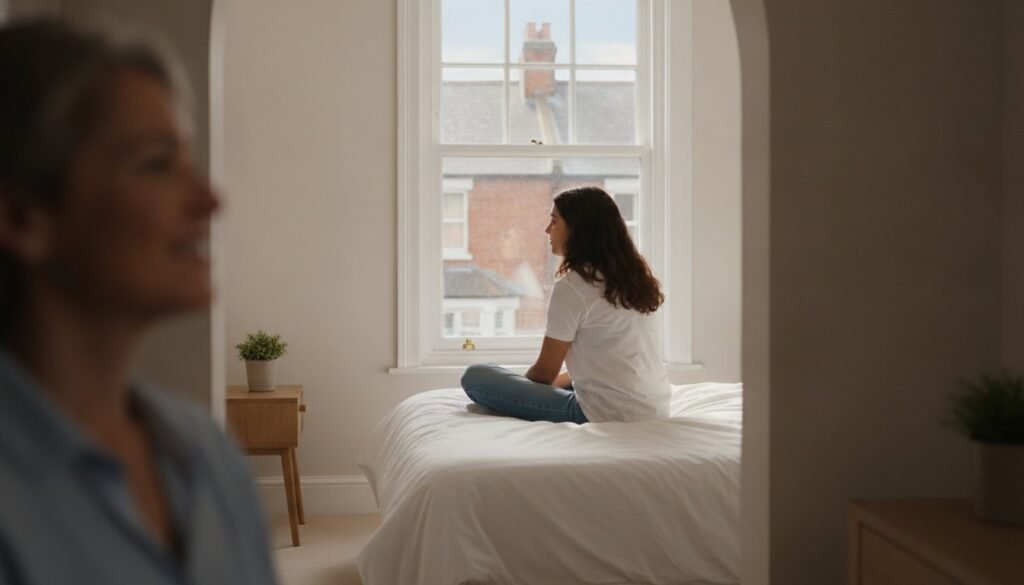
With more than one in four children and young people in the UK now facing a probable mental health disorder, the silence in your home might feel louder than ever. It is heartbreaking to watch your child retreat into their bedroom, missing out on the milestones that define growing up. If you are feeling helpless while navigating the reality of social anxiety in teenagers UK, you are certainly not alone. You might be exhausted by the search for answers or feeling frustrated by the years-long waiting lists for NHS and CAMHS support.
I understand the weight of that fear and the quiet desperation of wanting your child back. This guide is here to help you move from a place of worry to one of proactive connection. We will explore how to distinguish between typical teenage shyness and a clinical social phobia, providing you with practical tools to support your child at home. I will also walk you through private therapy options that offer a faster, more personal path to healing, so your teen can start feeling like themselves again.
Key Takeaways
- Learn to distinguish between typical adolescent shyness and the more debilitating symptoms of social anxiety in teenagers UK to ensure your child receives the specific care they need.
- Understand how shame and an over-vigilant nervous system create a sense of “social unsafety,” and discover how to rebuild your teen’s internal security through deep connection.
- Gain insight into how the UK’s academic pressures and digital culture contribute to emotional burnout, allowing you to better advocate for your child’s mental health.
- Master practical strategies like “Emotion Coaching” and gentle micro-challenges to validate your teenager’s experience whilst encouraging them to step back into the world at their own pace.
- Discover how specialised therapy for teenagers can offer a faster, more personal alternative to long waiting lists, providing a safe environment for your child to find their voice.
Understanding Social Anxiety in Teenagers: More Than Just Shyness
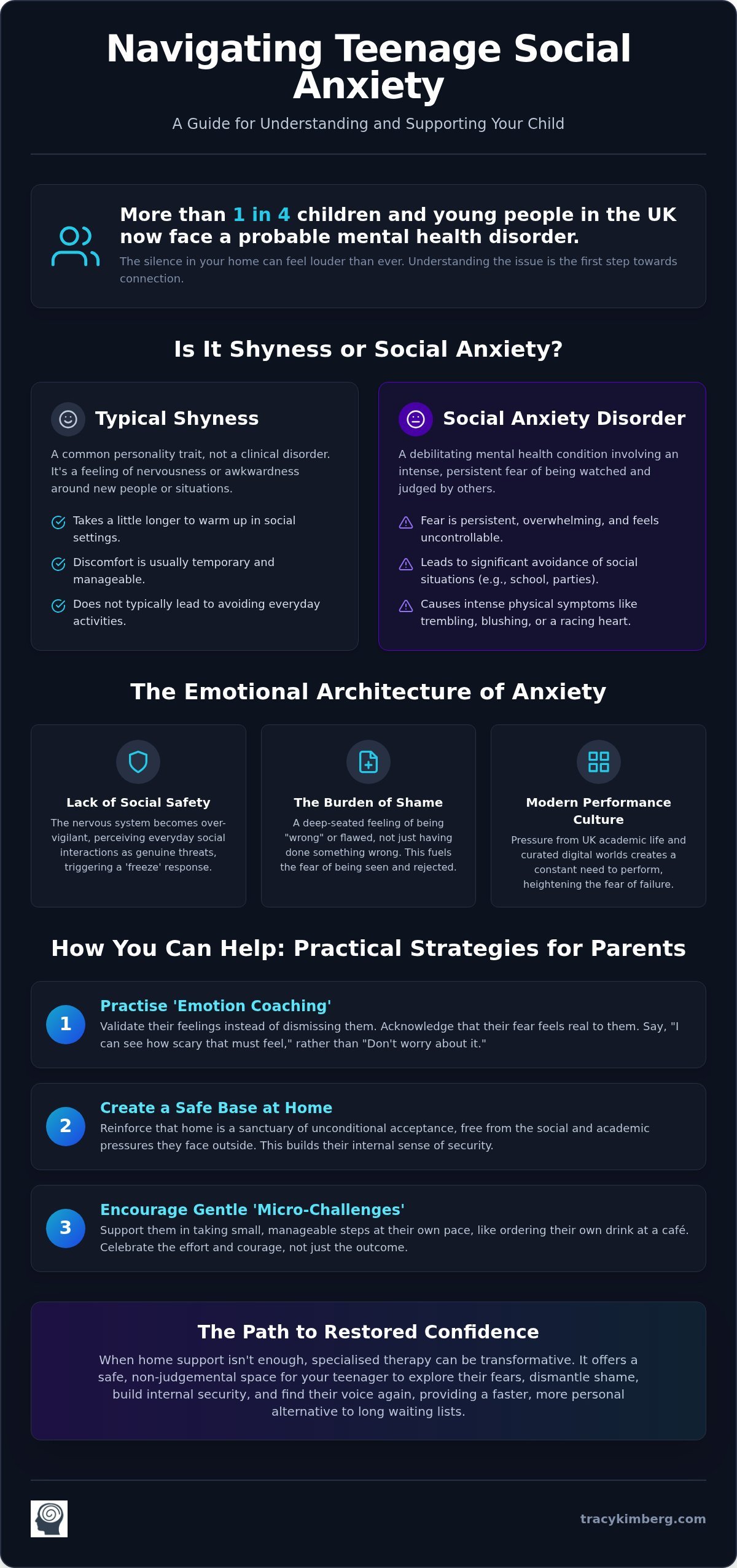
It is common to hear parents describe their child as just a bit shy. However, there is a profound difference between a child who takes a little longer to warm up and the debilitating experience of Social Anxiety Disorder (SAD). While shyness is often a gentle personality trait, social anxiety is a persistent, overwhelming fear of being judged or scrutinised. For those struggling with social anxiety in teenagers UK, the world can feel like a stage where every move is being critiqued by a harsh audience.
This condition manifests in the body long before it’s spoken aloud. You might notice your teen’s face flush or their hands tremble when they are asked a question in class. This is the “freeze” response, a biological survival mechanism that kicks in when the social environment feels hostile. Paradoxically, this anxiety often masks a deep-seated desire for belonging and acceptance. Your teen isn’t withdrawing because they don’t want friends; they are withdrawing because the risk of rejection feels like a threat to their very safety.
The Red Flags: Recognising the Signs Early
Identifying the shift from nerves to a disorder requires looking at patterns of avoidance. Watch for a sudden reluctance to engage in everyday activities, like eating in the school lunchroom or answering the phone. You may also notice “anticipatory anxiety,” where a simple social event or school presentation causes visible distress weeks in advance. After the event, the struggle continues through “post-event processing.” This is where the teen obsessively critiques their own performance, replaying every perceived stumble in an exhausting loop of self-reproach.
Why the Teenage Years are a Critical Window
The adolescent brain is uniquely wired for this struggle, as it becomes hyper-sensitive to social feedback and peer opinion during these years. It’s a time when the quest for identity is at its peak, making the fear of “getting it wrong” feel existential rather than just embarrassing. This sensitivity is a natural part of development, yet for some, the volume is turned up too high. Social anxiety is a biological signal of perceived social threat. When we understand this, we can stop seeing their behaviour as a choice and start seeing it as a nervous system trying to protect itself from a world that feels unsafe.
The Emotional Architecture: Why Teens Struggle with Social Safety
Social anxiety is rarely just about a fear of people; it is about a lack of internalised social safety. When a teen’s nervous system becomes over-vigilant, every glance in the school corridor can feel like a threat. Gabor Maté suggests that anxiety is often a coping mechanism for underlying stress or an emotional disconnect. If a teenager does not feel a secure sense of belonging, their brain perceives social interactions as dangerous territory. This hyper-awareness is an attempt to protect themselves, even if it leads to painful isolation.
Attachment styles also play a quiet but significant role here. The way a child learns to connect with their primary caregivers often forms the blueprint for their teenage social bonds. If early experiences felt unpredictable, a teen might struggle to trust that peers will accept them. They enter the social arena with a shield already raised, scanning for signs of rejection before they have even said hello. If you are noticing the signs of social anxiety in teenagers UK, it’s helpful to look beneath the surface behaviour to find the root of this protective response.
Shame and the Fear of Disconnection
At the heart of this struggle lies the heavy burden of shame. Unlike guilt, which says “I did something wrong,” shame whispers “I am wrong.” This feeling creates a protective wall designed to prevent the pain of being seen and subsequently cast out. An inner critic begins to dominate their internal monologue, especially when they feel they do not fit a specific cultural or social mould. Because shame thrives in secrecy, it grows stronger when it is hidden. Bringing these feelings into the light is the first step toward healing. For many families, engaging in therapy for teenagers provides that vital, safe space where shame can be dismantled through compassionate understanding.
The Impact of “Performance Culture” on Young Minds
Our modern environment demands that young people perform a perfect version of themselves at all times. In both physical and digital spaces, the pressure to curate a flawless identity is immense. Esther Perel often discusses the fundamental human tension between the need for security and the need for self-expression. For many teens, this balance is broken. The fear of being cancelled or excluded for a single misstep creates a state of constant high alert. According to the YoungMinds guide to anxiety, this persistent pressure can turn ordinary socialising into a high-stakes performance. When the stakes are this high, it is no wonder the nervous system chooses to retreat rather than risk the spotlight.
Navigating the UK Landscape: School Pressure and Digital Belonging
The UK education system often feels like a high-pressure cooker. From the moment students begin their GCSEs, they are told their entire future rests on a series of results. For a child dealing with social anxiety in teenagers UK, this academic weight is compounded by a relentless social gaze. In 2023-24, referrals to NHS services for anxiety in young people reached over 204,000; this figure is more than double the pre-pandemic rate. This surge reflects a generation struggling to find its footing in an environment that often prioritises performance over emotional well-being.
Amongst those struggling with social anxiety in teenagers UK, school refusal has become a significant concern. It is a biological signal that the environment has become overwhelming. When the classroom becomes a site of potential humiliation or intense scrutiny, the nervous system chooses to retreat. This isn’t defiance; it’s a plea for a more manageable world. The “always-on” nature of social media exacerbates this, as the fear of missing out (FOMO) keeps teens tethered to a digital world that offers a “safe” but ultimately isolating alternative to face-to-face connection.
The Digital Paradox: Connection vs. Comparison
Digital spaces offer a seductive alternative to face-to-face interaction. For a socially anxious teen, the screen provides a “safe” distance where they can control the narrative. They can find their “tribe” online, yet this often comes at a cost. The digital world is built on a currency of likes and shares, which can distort a teen’s internal sense of value. They aren’t just connecting; they are constantly comparing their internal mess to everyone else’s highlight reel. Helping them differentiate between this digital performance and authentic, messy human connection is vital for their emotional recovery.
UK School Systems: When the Environment Becomes the Trigger
Large, impersonal secondary schools can easily become triggers for those who feel vulnerable. The “Ofsted-driven” academic culture often creates a baseline of stress that filters down from teachers to students. To support your teen, it’s essential to collaborate with the school to create “safe harbours.” These are quiet spaces where the nervous system can reset when the “freeze” response takes hold. The goal is to move toward the government’s 2026 ambition of having Mental Health Support Teams in 60% of schools, creating a network of care that acknowledges the student as a person, not just a grade.
Supporting Your Teenager: Practical Strategies for Parents
When you see your child suffering, your instinct is often to jump in and fix the problem. However, addressing social anxiety in teenagers UK requires a shift from being a “fixer” to being a “Wise Guide.” This means acting as a secure base where your teen feels safe to retreat, whilst also gently encouraging the healthy risks necessary for growth. It is a delicate dance of empathy and encouragement. You must also be mindful of your own emotional state; if you are radiating worry, your teen will likely absorb that stress through emotional contagion. Staying calm is one of the kindest things you can do for them.
The Power of Validation: Listening Without Fixing
Validation is the cornerstone of John Gottman’s “Emotion Coaching.” For many families dealing with social anxiety in teenagers UK, the goal is to acknowledge the emotion before attempting to change the behaviour. When a teen expresses fear, telling them “there is nothing to be afraid of” or “don’t be silly” often backfires. It sends the message that their internal reality is wrong, which only increases their shame. Instead, try “turning towards” their bids for connection with empathetic responses. You might say, “I can see how much courage that took for you,” or “It makes sense that you feel overwhelmed right now.” This doesn’t mean you agree that the situation is dangerous, but you are agreeing that their feeling is real. Once they feel heard, their nervous system can begin to settle.
Rather than pushing for “flooding”, which involves forcing them into the very situations they fear, encourage “micro-challenges.” This involves gradual exposure to social settings in small, manageable doses. Perhaps they agree to stay at a gathering for twenty minutes rather than the whole evening. These small wins build a sense of agency. They prove to the brain that social discomfort is survivable.
Creating a “Low-Demand” Environment at Home
Your home must be a sanctuary, a place where the teen does not feel the need to perform or meet social expectations. You can foster this through “side-by-side” communication. Activities like cooking, walking the dog, or driving often feel safer for an anxious teen because the lack of direct eye contact lowers the emotional intensity. It allows for a more natural, flowing conversation where they can share their thoughts without feeling interrogated. Setting healthy boundaries around technology is also important, but it should be done through trust rather than control. If you feel you need more structured support to bridge this gap, you might consider therapy for teenagers to help navigate these complex relational dynamics.
Professional Support: How Therapy Can Restore Confidence
While the NHS remains a vital pillar of care, the reality of seeking help for social anxiety in teenagers UK often involves navigating significant hurdles. With CAMHS waiting lists stretching into months or even years, many families find themselves in a painful limbo. Private therapy offers a different path, providing immediate and consistent support that focuses on the relational roots of distress. In this space, the goal isn’t just to manage symptoms, but to build a safe, non-judgemental alliance where your teen feels truly seen and heard. This connection is often the very thing that has been missing in their external social world.
As the therapeutic relationship strengthens, the focus often shifts from the individual to the wider family system. Improving parent-child dynamics is a core part of the healing process. When parents learn to adjust their own responses, the home environment becomes a laboratory for new, healthier ways of relating. For many young people, the thought of sitting in a room with a stranger is the biggest barrier to starting. This is where the flexibility of online therapy becomes a powerful tool. It allows a teen to begin their journey from the safety of their own bedroom, lowering the initial “threat” level and making the first step toward recovery feel manageable.
Moving Beyond the “Broken” Narrative
One of the most transformative aspects of therapy is the shift in identity. Many teenagers arrive at their first session feeling “broken” or fundamentally different from their peers. Through a compassionate lens, we help them reframe their anxiety as a protective part of themselves, rather than their entire identity. We work together to discover their inherent strengths and build a practical toolkit for social resilience. Therapy is an investment in a teen’s long-term emotional health. It provides them with the self-awareness and relational skills they will carry into adulthood, long after their school years have passed.
Working with Tracy Kimberg: A Path to Connection
My approach is grounded in empathy and informed by the research-based frameworks of experts like John Gottman and Esther Perel. I believe that social anxiety in teenagers UK is best addressed by looking at the whole person and the family system they belong to. By creating a space that is both professional and warmly accessible, I help bridge the emotional gap that anxiety often creates between parents and their children. This process is not a clinical necessity but a proactive adventure in healing. If you are ready to help your teenager find their voice again, I encourage you to take that first step by booking an initial consultation to explore how we can work together.
Reclaiming Connection and Confidence
Moving from the helplessness of watching your child suffer to becoming their Wise Guide is a journey of profound connection. We have explored how social anxiety in teenagers UK is often a protective response to a world that feels unsafe, whether that is due to the “exam factory” culture or the digital pressures of comparison. By shifting your focus from fixing the problem to validating your teen’s internal reality, you begin to dismantle the walls of shame that keep them isolated. It’s about showing them that their feelings are survivable and that they aren’t alone in the dark.
You don’t have to navigate this complex emotional landscape alone. Recovery is an active, evolving experience that involves the whole family system. I provide specialised therapy for teenagers in a safe, non-judgemental environment, using a research-based approach inspired by the work of Gottman and Perel. These sessions are available online or face-to-face across the UK, offering the immediate support that waiting lists often delay.
Take the first step toward a brighter, more connected future for your family. Please book a consultation with Tracy Kimberg to support your teenager today. Healing is a proactive adventure, and your child’s confidence is waiting to be rediscovered.
Frequently Asked Questions
How do I know if my teenager has social anxiety or is just going through a phase?
You can distinguish social anxiety from a phase by observing the duration and intensity of the distress. While typical adolescent self-consciousness fluctuates, social anxiety in teenagers UK involves a persistent fear of judgement that prevents them from engaging in life. If your teen consistently avoids social situations for more than six months or experiences physical symptoms like trembling before school, it is likely more than just a passing stage of development.
Can social anxiety in teenagers go away on its own without treatment?
It is unlikely that clinical social anxiety will simply disappear without intervention. While some teens develop better coping skills as they mature, untreated anxiety often becomes more ingrained, leading to a restricted life and potential depression. Early support helps them understand the emotional roots of their fear. By addressing the nervous system’s “threat” response now, you prevent the anxiety from defining their adult identity and future relational health.
What is the difference between social anxiety and autism in teenagers?
While they can overlap, the core difference lies in the “why” behind social challenges. Social anxiety is driven by a fear of being scrutinised or rejected, whereas autism involves differences in how the brain processes social information and communication. A socially anxious teen often knows the social “rules” but is too terrified to use them. An autistic teen may find the rules themselves confusing or overwhelming due to sensory or cognitive processing styles.
How can I help my teenager with school-related social anxiety in the UK?
You should start by requesting a meeting with the school’s Special Educational Needs Coordinator (SENCO) or the Designated Safeguarding Lead. Discuss creating a “safe harbour” or a quiet space where your teen can retreat when overwhelmed. Many UK schools are now integrating Mental Health Support Teams (MHSTs) to provide early intervention. You can also ask for reasonable adjustments, such as allowing them to leave class five minutes early to avoid crowded corridors.
What should I do if my teenager refuses to go to therapy?
If your teen refuses therapy, try to avoid making it a power struggle. Offer them autonomy by letting them choose between online or face-to-face sessions, or suggest a one-off “meet and greet” to see if they click with the therapist. Sometimes, the best first step is for you to engage in parent coaching. By changing your own relational dynamics at home, you can create a shift that eventually makes the teen feel safe.
How long does therapy for social anxiety usually take for a teenager?
Every teenager’s journey is unique, so there is no fixed timeline for healing. Some young people see significant shifts within a few months, whilst others benefit from longer-term support as they navigate different life transitions. My structured therapeutic approach is designed to create a solid foundation for emotional health. The goal is to build a sustainable toolkit of social resilience that they can use for the rest of their lives.
Is online therapy as effective as face-to-face counselling for anxious teens?
Research shows that online therapy is just as effective as face-to-face counselling for treating anxiety. For a teen with social phobia, the screen can actually act as a helpful buffer, making the initial sessions feel far less daunting. It allows them to engage from the safety of their own bedroom, which can speed up the process of building trust. Once they feel secure, the transition to face-to-face work becomes much easier.
What are the main triggers for social anxiety in UK secondary schools?
Common triggers include unstructured times like lunch breaks in crowded halls or the intense scrutiny of oral presentations. The UK’s “exam factory” culture also plays a massive role, as the pressure of GCSEs can heighten a teen’s baseline stress level. Corridors during lesson changes are often overwhelming due to the sensory overload and the perceived gaze of peers. These environments frequently activate the “freeze” response in those struggling with social anxiety in teenagers UK.

Article by
Tracy Kimberg
Tracy Kimberg is a Relationship Expert, Couples Therapist and Coach with a dedicated focus on helping couples and individuals rebuild connection, trust and emotional safety in their relationships. Drawing on the research of John and Julie Gottman, the relational insights of Esther Perel, and years of hands-on therapeutic experience, Tracy offers a warm, non-judgemental and deeply compassionate approach to modern relationships.
Based in Dorset, Tracy works with couples navigating communication breakdowns, betrayal, intimacy challenges, separation, family dynamics and life transitions. Known for creating a safe and grounded therapeutic space, she combines practical tools with emotional depth to help clients move beyond survival patterns and towards meaningful, lasting change.
With a reputation for empathy, professionalism and dedication to her clients’ growth, Tracy is passionate about helping people feel seen, understood and empowered — both within their relationships and within themselves.
Disclaimer
Disclaimer:
The information shared in this article is intended for educational and informational purposes only and should not be considered a substitute for professional therapeutic, psychological, medical or legal advice. Every individual and relationship is unique, and the perspectives offered are based on general therapeutic principles, research and professional experience.
Reading this article does not establish a therapist-client relationship with Tracy Kimberg. If you are experiencing significant emotional distress, relationship crisis, trauma, or mental health concerns, it is important to seek support from a qualified professional appropriate to your individual circumstances.
All content remains the intellectual property of Tracy Kimberg and may not be reproduced or distributed without permission.