

What if the distance between two homes isn’t a sign of a failing marriage, but the very space needed to save it? Many couples view a pause in cohabitation as “divorce-lite,” a slow-motion slide towards an inevitable end that leaves them feeling anxious and adrift. However, establishing clear trial separation rules for success transforms this period from a terrifying limbo into a strategic, healing retreat. It’s about trading reactive conflict for intentional breathing room, allowing both partners to lower their defences and listen to what their relationship truly needs.
It’s completely natural to feel overwhelmed by the logistics, especially whilst wondering how to explain things to your children or how much contact is too much. You want clarity, not more confusion. In this guide, we’ll explore a psychologically-informed framework designed to help you navigate this transition with grace and purpose. We’ll cover how to set healthy boundaries, manage family dynamics, and use this time to either reconnect more deeply or part with conscious respect. You’ll discover that with the right structure, a trial separation becomes a proactive adventure in emotional health rather than a clinical necessity.
Key Takeaways
- Understand why a three to six-month timeline provides the necessary emotional space to gain clarity without losing the connection entirely.
- Learn how to establish specific trial separation rules for success regarding communication frequency and boundaries to prevent the “drifting apart” effect.
- Discover practical co-parenting strategies, such as “birdnesting,” that prioritise your children’s stability whilst you and your partner navigate this transition.
- Explore how individual therapy can help you address underlying attachment styles and personal trauma, turning this pause into a period of profound self-discovery.
- Gain insight into the 12-Week Relationship Recovery Process as a structured framework to move from separation back into a resilient, healthy partnership.
Understanding Trial Separation: A Strategic Pause, Not a Prelude to Divorce
A trial separation is a structured, time-limited agreement where a couple lives apart to evaluate their future. It isn’t a slow-motion exit or a sign that the relationship has already failed; it’s a deliberate, intentional pause. When we ask, What is a trial separation, we’re looking for a psychological container that holds the relationship whilst the individuals find the room they need to breathe. Without specific trial separation rules for success, this period often collapses into “drifting apart,” where silence breeds resentment rather than reflection. By contrast, a Conscious Separation honours the years you’ve spent together, treating the breakdown as a crossroads that requires deep, focused attention rather than an immediate end.
It’s entirely normal to feel a confusing cocktail of emotions right now. You might feel a sudden, light sense of relief at the lack of daily friction, followed immediately by a sharp terror of the unknown. These feelings are valid. They’re signs that you’re finally stepping out of the reactive “fight or flight” cycle and into a space where real observation can happen. You’re moving from a place of survival to a place of strategy.
The Purpose of a Strategic Break
The primary goal of this break is to lower the volume of daily conflict. When you’re constantly reacting to a partner’s tone, habits, or presence, you lose the ability to hear your own inner voice. This distance creates what Esther Perel describes as “erotic space,” the mystery and healthy distance necessary for desire to resurface. It allows you to test-drive independence whilst remaining tethered to the relationship’s safety. You aren’t just leaving; you’re creating a laboratory for the soul to see who you are outside of the “we,” which is often the first step in deciding if you want to choose that “we” again.
Trial vs. Legal Separation in the UK
In the UK, it’s vital to distinguish between a therapeutic trial and a formal legal separation. This guide focuses on the therapeutic journey, which is about emotional health and relational clarity. Whilst legal separations involve solicitors and court-sanctioned financial splits, a therapeutic agreement focuses on psychological safety. Often, setting clear trial separation rules for success prevents the need for legal intervention altogether. It allows you to organise your lives around healing rather than litigation. This ensures that whether you eventually reconnect or choose to part, you do so with a sense of peace and conscious intention rather than through a lens of legal conflict.
The Essential Framework: 5 Trial Separation Rules for Success
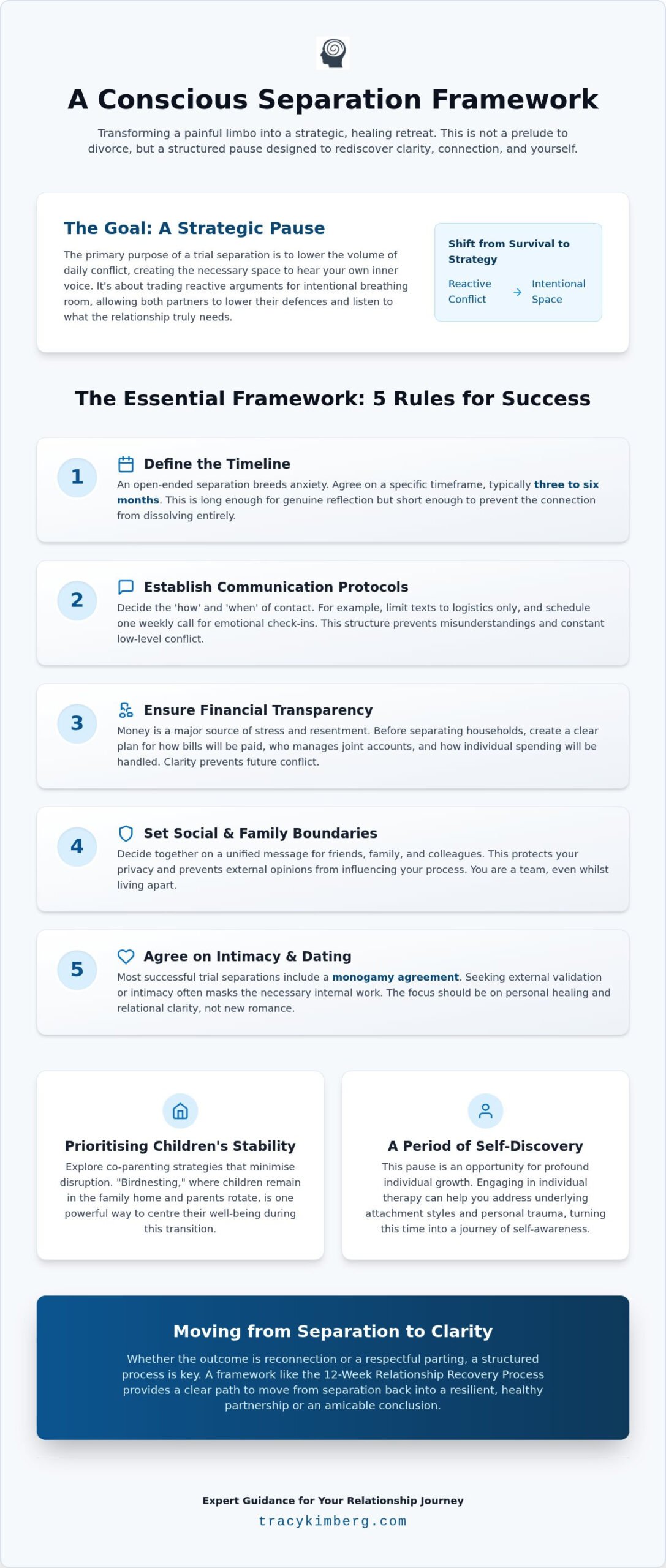
Structure isn’t a cage; it’s a safety net. Without a clear set of boundaries, a separation quickly becomes a chaotic drift that leaves both partners feeling abandoned or confused. Establishing specific trial separation rules for success provides the scaffolding needed to hold your relationship whilst you decide how to rebuild it. Research-based rules for a successful trial separation suggest that clarity is the ultimate antidote to the anxiety of living apart. To make this time count, you must agree on these five core pillars:
- Rule 1: Define the Timeline. An open-ended separation is a recipe for resentment. Aim for three to six months to allow enough time for reflection without losing the sense of partnership.
- Rule 2: Establish Communication Protocols. Decide how often you’ll speak and which medium you’ll use. Is it a weekly check-in call or daily texts for logistics?
- Rule 3: Financial Transparency. Resentment often starts in the bank account. Agree on how bills are organised and how joint funds are managed before you move out.
- Rule 4: Social and Family Boundaries. Decide together what you’ll tell parents, friends, and colleagues to protect your privacy whilst you heal.
- Rule 5: Intimacy and Dating. Most successful trial separations include a “monogamy agreement.” Seeking external validation usually masks the internal work required to save the marriage.
Setting the Timeline and Objective
Ambiguity is the enemy of healing. When a separation has no end date, it feels like a slow-motion divorce. You should agree on a specific “check-in” date to re-evaluate your rules and progress. Before you start, write down a single sentence defining your primary goal. Is it “To decide if we can rebuild trust” or “To find our individual voices again”? Having a North Star keeps you focused when the initial relief fades and loneliness sets in. If navigating these initial steps feels overwhelming, engaging in a structured relationship recovery process can provide the guidance you need.
The “No-Dating” Clause and Emotional Fidelity
A trial separation is a laboratory for your relationship, not a holiday from it. Bringing new people into the mix creates a “triangulation” that prevents you from facing the core issues between you and your partner. True emotional fidelity during this time means honouring the space you’ve created for the relationship to breathe. It’s about doing the hard, individual work of looking at your own attachment styles and trauma rather than seeking a temporary dopamine hit from someone new. Saving a marriage requires you to be fully present in the silence of your own company.
Navigating the Emotional Landscape Whilst Living Apart
Living apart is a profound psychological shift. It’s the moment the “noise” of the other person stops, and you’re left with the echo of your own thoughts. Whilst your trial separation rules for success provide the external structure, the real work happens within the silence of your own space. This period isn’t just a waiting room; it’s a classroom for self-discovery. Gabor Maté often reminds us that our adult relational struggles are frequently rooted in unresolved childhood trauma and attachment wounds. Use this time to ask: “Is my anger a reaction to my partner, or is it a protective shield for a younger version of myself?”
Managing “loneliness spikes” is perhaps the hardest part of being apart. You might feel a sudden urge to call or text, impulsively breaking the protocols you agreed upon. These are often “protest behaviours,” which are desperate attempts to re-establish a sense of safety when we feel disconnected. Recognising these moments as symptoms of anxiety rather than genuine needs for communication allows you to pause. Self-compassion is your best ally here. Acknowledge the pain of the transition without letting it dictate your actions. Following 8 tips for a trial separation can help you stay grounded when the emotional waves feel overwhelming.
Individual Growth and the Gottman “Sound Relationship House”
In the Gottman framework, a healthy partnership requires a solid foundation of trust. Whilst apart, you have a unique opportunity to work on the “self-soothing” level of your own emotional house. By identifying which of the Four Horsemen – Criticism, Contempt, Defensiveness, or Stonewalling – you tend to invite into your interactions, you can begin to dismantle them in isolation. If you’re prone to defensiveness, for example, use this time to practice taking responsibility for your own emotional states. Individual coaching acts as a vital bridge during this phase, ensuring that you return to the relationship with a more regulated, less reactive presence.
The Esther Perel Influence: Reclaiming Your Identity
Esther Perel famously speaks about the paradox of intimacy: we need distance to feel the pull of desire. When couples are too close for too long, they can become fused, losing the “I” in the “We.” Reclaiming your identity during a separation isn’t about moving on; it’s about becoming a person your partner can actually miss. Focus on the hobbies, friendships, and interests that existed before the relationship became your entire world. By rediscovering who you are outside the role of “spouse,” you create the mystery and autonomy that fuel long-term connection. This isn’t just about saving a marriage; it’s about saving yourself within it.
The Logistics of Success: Children, Money, and Practical Boundaries
Whilst your emotional processing happens in the quiet hours, your logistical agreements provide the external proof that you still respect one another. Managing the practicalities of two households requires a shift in communication style. You must trade the heat of marital conflict for a “business-like” tone when discussing the fridge, the mortgage, or the school run. Establishing clear trial separation rules for success in these areas prevents the daily friction that often leads to a permanent breakdown. It’s about creating a predictable world whilst your internal world feels anything but stable.
One increasingly popular option for families is “birdnesting,” where the children remain in the family home whilst the parents rotate in and out. This prioritises the children’s routine over the parents’ convenience, though it requires a high level of co-operation. If you choose separate residences, consistency across both households is the priority. Children need to know that the fundamental rules of their lives haven’t vanished. When it comes to shared social events like weddings or birthdays, agree in advance on how you will attend. If being together feels too raw, it is better to attend separately than to perform a “happy family” act that creates confusion or tension for everyone involved.
What to Tell the Children
Children are incredibly sensitive to the emotional “weather” of the home. Gabor Maté often highlights that a child’s sense of safety is tied to the emotional availability of their parents. When explaining the separation, use a gentle, age-appropriate script. You might say, “Mum and Dad are taking some time to learn how to be better friends and better parents.” It is vital to reassure them, repeatedly, that this is an adult decision and never their fault. By managing your own anxiety through professional support, you prevent your children from becoming your emotional caretakers. They need to see that you are still a team, even if you are playing on different fields for a while.
Financial Fairness and the “Separation Budget”
Money is frequently used as a blunt instrument for emotional hurt, but “financial punishment” only breeds long-term resentment. The goal of a “separation budget” is to maintain the status quo as much as possible. This reduces the sense of panic and allows both partners to focus on the relationship rather than survival. Decide exactly how joint accounts will be used and how household bills will be organised before the physical move happens. If these conversations feel too loaded, involving a neutral third party can help keep the dialogue focused on facts rather than feelings. For those who need help navigating these complex transitions, you can book a session for conscious separation coaching to find a path forward that protects your family’s future.
Moving from Separation to Clarity: The Role of Relationship Coaching
The conclusion of a separation shouldn’t be a sudden collision back into shared life. Many couples find that whilst their trial separation rules for success helped them survive the time apart, they feel unequipped for the vulnerability of moving back in. “Doing it alone” often means returning to the same kitchen, the same arguments, and the same emotional triggers without new tools. Without a bridge, you risk falling back into the very patterns that made you leave in the first place. This is where a structured, neutral framework becomes essential for a lasting transformation.
The 12-Week Relationship Recovery Process serves as that bridge. It moves you beyond the logistics of living apart and into the deeper work of rebuilding trust and intimacy. A neutral expert acts as a mirror, helping you decode the insights you gained whilst living in separate spaces. They help you translate the “rules of separation” into a new set of “rules for reconnection,” ensuring that the progress you made in isolation survives the return to the “we.”
Deciding the Next Step: Reconcile or Consciously Part?
Success isn’t always defined by staying together; it’s defined by clarity. You’ll know the separation has worked when you see signs of “softened start-ups” in your conversations, a genuine curiosity about your partner’s internal world, and increased empathy for their perspective. However, if the silence of being apart has brought a persistent peace that you don’t want to break, or if contempt remains a constant companion, it may be time to move toward a conscious divorce. Whether you choose to reunite or part, a “re-entry” plan is vital to avoid a “honeymoon-then-crash” cycle. This plan ensures that the changes you’ve made are sustainable and grounded in reality rather than just temporary relief.
The Transformational Power of Coaching
Navigating these high-stakes decisions requires a safe, non-judgemental environment. Whether through online therapy or face-to-face sessions, professional coaching provides the containment needed to explore the underlying emotional disconnect. By addressing the root causes of the relational breakdown, you can move forward with confidence rather than fear. This process isn’t just about fixing a problem; it’s about a proactive and positive adventure into the next chapter of your life. You don’t have to carry the weight of these decisions alone. To find your path forward, book a discovery call with Tracy Kimberg to navigate your separation with clarity.
Choosing a Path of Clarity and Healing
A trial separation is not the end; it’s a brave invitation to look at your relationship with fresh eyes. By establishing clear trial separation rules for success, you move from a place of reactive conflict into a structured space where healing can actually happen. You’ve seen that defining a timeline, maintaining financial fairness, and protecting your children’s stability are the pillars that hold this experience together. More importantly, distance allows you to reclaim the individual identity that makes a partnership vibrant whilst you decide on your next steps.
Navigating this emotional landscape requires more than just good intentions; it requires a specialist who understands the intricacies of human connection. I offer a safe and non-judgemental environment where we use Gottman and Perel-inspired techniques to focus on transformational healing. You don’t have to walk this path alone. Begin your 12-Week Relationship Recovery Process with Tracy Kimberg to move from uncertainty toward a future built on genuine clarity and trust. Your relationship deserves this proactive adventure.
Frequently Asked Questions
Do trial separations actually work to save a marriage?
Trial separations work effectively when they are used as a strategic pause rather than an avoidant escape. Success rates improve significantly when couples follow a structured framework, such as a 12-Week Relationship Recovery Process. This time apart allows the nervous system to settle, moving you from reactive “fight or flight” behaviours into a state of reflective clarity. It isn’t just about the distance; it’s about what you do with the space to address underlying emotional disconnects.
How long should a trial separation last for the best results?
Most relationship experts agree that three to six months is the “sweet spot” for a therapeutic separation. Anything shorter than three months often doesn’t provide enough time for the initial “noise” of conflict to subside and for individual growth to take root. Conversely, staying apart for more than six months can lead to a permanent sense of detachment, making it harder to bridge the gap back to a shared life and intimacy.
Is it okay to date other people during a trial separation?
Seeking external validation from new partners whilst separated usually stalls the healing process. A “no-dating” clause is a foundational rule for most couples who genuinely want to save their marriage. Dating others creates “triangulation,” which acts as a distraction from the uncomfortable internal work required to understand your own attachment styles. True emotional fidelity during this time means protecting the space you’ve created for the relationship to breathe and potentially recover.
Should we still have sex whilst we are trial separated?
Continuing a sexual relationship whilst living apart can often blur the lines and prevent the clarity you’re seeking. Esther Perel suggests that desire needs mystery and distance to thrive. If you’re using sex as a way to avoid difficult conversations or to soothe anxiety, it might be better to pause. Agreeing on physical boundaries allows you to focus on emotional intimacy and the structural issues of the partnership without the temporary “dopamine hit” of physical contact.
What are the most important rules for a successful separation?
Establishing specific trial separation rules for success is the most critical factor in determining the outcome. These rules must cover five core areas: a clear timeline, communication frequency, financial transparency, social boundaries with family, and an agreement on monogamy. Without these guardrails, the separation often dissolves into confusion or resentment. Clear boundaries provide the safety needed for both partners to explore their feelings without fear of abandonment or betrayal whilst living apart.
How do we tell our children about the trial separation?
Children need a simple, honest script that prioritises their emotional safety. You might explain that “Mum and Dad are taking some time to learn how to be better friends and parents.” Following Gabor Maté’s perspective, it’s vital to reassure them that this is an adult decision and never their fault. Maintain consistent routines across both living spaces to reduce their anxiety, ensuring they feel held and protected whilst you navigate this transition together.
Can we live in the same house whilst being trial separated?
Whilst physical distance is usually more effective for gaining clarity, some couples choose an “in-house separation” due to financial or logistical constraints. This requires very strict boundaries regarding sleeping arrangements, shared meals, and household chores. However, living in the same house often makes it difficult to lower the volume of daily conflict. If you must stay under one roof, you’ll need even more discipline to respect each other’s emotional and physical space during the pause.
What happens if one partner wants to reconcile but the other doesn’t?
This is a painful but common reality that requires a shift toward a conscious approach to separation. If one partner is ready to reconcile but the other isn’t, the focus must move to individual therapy and processing the loss. Forcing reconciliation often leads to further contempt. In these cases, coaching helps you navigate the end of the relationship with emotional awareness, ensuring that you part with respect and clarity rather than enduring a cycle of pursuit and withdrawal.

Article by
Tracy Kimberg
Tracy Kimberg is a Relationship Expert, Couples Therapist and Coach with a dedicated focus on helping couples and individuals rebuild connection, trust and emotional safety in their relationships. Drawing on the research of John and Julie Gottman, the relational insights of Esther Perel, and years of hands-on therapeutic experience, Tracy offers a warm, non-judgemental and deeply compassionate approach to modern relationships.
Based in Dorset, Tracy works with couples navigating communication breakdowns, betrayal, intimacy challenges, separation, family dynamics and life transitions. Known for creating a safe and grounded therapeutic space, she combines practical tools with emotional depth to help clients move beyond survival patterns and towards meaningful, lasting change.
With a reputation for empathy, professionalism and dedication to her clients’ growth, Tracy is passionate about helping people feel seen, understood and empowered — both within their relationships and within themselves.
Disclaimer
Disclaimer:
The information shared in this article is intended for educational and informational purposes only and should not be considered a substitute for professional therapeutic, psychological, medical or legal advice. Every individual and relationship is unique, and the perspectives offered are based on general therapeutic principles, research and professional experience.
Reading this article does not establish a therapist-client relationship with Tracy Kimberg. If you are experiencing significant emotional distress, relationship crisis, trauma, or mental health concerns, it is important to seek support from a qualified professional appropriate to your individual circumstances.
All content remains the intellectual property of Tracy Kimberg and may not be reproduced or distributed without permission.