

What if your teenager’s prickly silence or sudden outbursts aren’t actually a sign of rejection, but a desperate, unspoken request for a safe harbour? It is a painful irony that when our children need us most, they often push us away with the greatest force. You might find yourself lying awake at night, wondering if your parenting style or the crushing weight of academic expectations triggered this change. If you are searching for help for anxious teens, it’s vital to remember that anxiety isn’t a “glitch” to be fixed. It is a signal from an overwhelmed nervous system that is simply trying to find its way back to safety.
We understand the quiet desperation of watching your child struggle whilst feeling powerless to intervene. You want to protect their future, yet you’re terrified of saying the wrong thing and making the distance between you even wider. This psychologically-informed guide offers a roadmap to move from conflict to connection. We will explore practical tools to de-escalate emotional storms at home and provide a clear checklist to help you decide when to step in and when to give them space. By the end of this article, you’ll have the insight needed to restore your bond and support your teen’s healing journey.
Key Takeaways
- Learn to decode “difficult” behaviours and physical symptoms as the subtle language of an anxious nervous system trying to find safety.
- Understand how the developing teenage brain and modern academic pressures create a biological “perfect storm” for emotional overwhelm.
- Use our side-by-side framework to determine if your child is experiencing normal developmental angst or requires more specific help for anxious teens.
- Acquire practical communication tools to offer a non-anxious presence and validate your teenager’s feelings without dismissing their reality.
- Recognise the specific indicators that suggest it is time to transition from home-based support to professional therapeutic intervention.
Recognising the Whisper: A Checklist of Subtle Anxiety Signs in Teenagers
Anxiety is a master of disguise. It rarely arrives with a clear label; it chooses instead to manifest as a series of confusing, often contradictory behaviours that can leave even the most attentive parent feeling bewildered. Whilst we might expect a child to appear fearful or tearful, the reality of adolescent distress is often much noisier. It shows up as a slammed door, a sharp retort, or a sudden, inexplicable obsession with a minor detail. When you are looking for help for anxious teens, the first step is learning to translate these actions back into the emotional language they were born from.
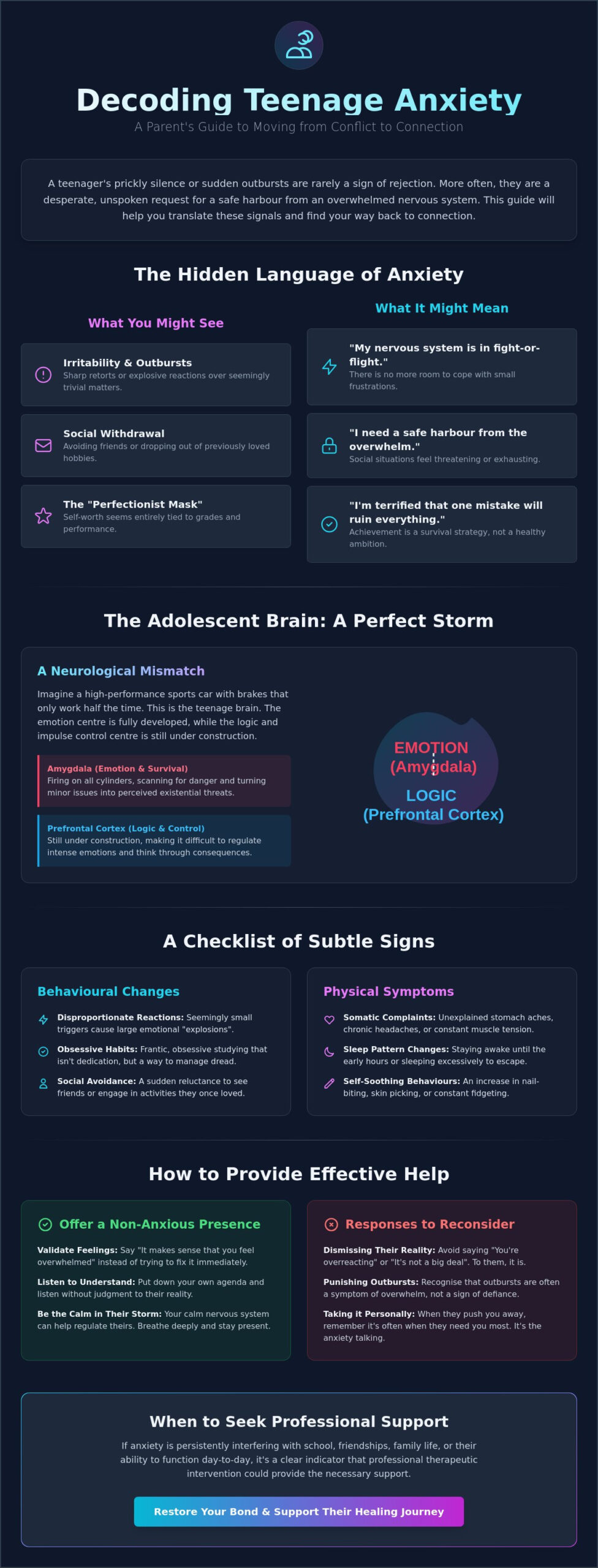
We often misinterpret a teen’s irritability as defiance or “bad” behaviour. However, from a systemic perspective, these outbursts are frequently the external pressure valve for an internal system under siege. A teenager’s nervous system doesn’t always have the vocabulary to say, “I feel overwhelmed by the social hierarchy at school.” Instead, it triggers a fight-or-flight response. This is foundational to understanding anxiety disorders and how they manifest during these transitional years. If your child seems “prickly” or prone to explosive reactions over seemingly trivial matters, they may not be testing your boundaries. They might simply be out of room to breathe.
There is also the “Perfectionist Mask” to consider. This is particularly common amongst high achievers who appear to be thriving. On the surface, they are organised, diligent, and successful. Beneath that veneer, however, lies a crushing fear that one mistake will cause their entire world to unspool. This high-functioning anxiety is often missed because it looks like a “model student” behaviour. If your teen’s self-worth seems entirely tethered to their grades or performance, their drive may be a survival strategy rather than a healthy ambition.
The Behavioural Checklist: Red Flags to Watch For
Keep a gentle eye on shifts in their daily rhythm. A sudden withdrawal from a favourite hobby or a reluctance to see friends they once adored isn’t always “just a phase.” It can be a sign of social avoidance. You might notice an increase in “explosive” moments where their emotional reaction is vastly disproportionate to the event. Conversely, look for obsessive studying habits that border on the frantic. If they cannot put the books down, it isn’t always dedication; it’s often a way to manage the dread of the unknown.
The Physical Toll: How the Body Speaks for the Mind
The body often keeps the score long before the mind is ready to acknowledge the weight of anxiety. Somatic complaints are a primary way that help for anxious teens becomes visible. Unexplained stomach aches, chronic headaches, or constant muscle tension in the shoulders are real physical manifestations of emotional distress. You might observe changes in sleep patterns, such as staying awake until the early hours or, alternatively, sleeping excessively to escape the day’s demands. Repetitive self-soothing behaviours, like nail-biting or constant fidgeting, are often the body’s attempt to discharge excess nervous energy.
The Stormy Brain: Understanding Why Your Teenager Feels Overwhelmed
Imagine a house where the electrical wiring is being completely replaced whilst the occupants are still trying to live their daily lives. This is the reality of the adolescent brain. It is a biological work in progress, characterised by a profound mismatch between different regions of the mind. Whilst the amygdala, the ancient centre for raw emotion and survival, is firing on all cylinders, the prefrontal cortex, responsible for logic and impulse control, is still under construction. This neurological gap is often where anxiety takes root, turning a minor social slight or a looming exam into a perceived existential threat.
When you are looking for help for anxious teens, it’s vital to recognise that their “explosive” reactions are rarely a choice. Their nervous system is simply scanning for danger more frequently than it did in childhood. By understanding common mental health warning signs, we can begin to see these behaviours as a cry for regulation rather than a lack of discipline. Your teen is essentially driving a high-performance sports car with brakes that only work half the time. They aren’t trying to be difficult; they are trying to survive the intensity of their own internal world.
Neurological Development: The Prefrontal Cortex Gap
The lag between emotional impulse and logical regulation makes the phrase “just calm down” biologically impossible for an anxious teenager to follow. When the amygdala is hijacked by fear, the logical brain goes offline. This sensitivity can be even more pronounced if a child has experienced early life stress or trauma, which can leave their nervous system in a state of permanent “high alert.” In these moments, they don’t need a lecture on logic. They need a “secure base,” a calm, non-judgmental presence that helps them navigate back to a state of safety. If you feel the emotional distance between you is growing, exploring specialised therapy for teenagers can provide the bridge needed to reconnect.
Modern Stressors: The British Academic and Social Landscape
We cannot ignore the unique “pressure cooker” culture that defines the British adolescent experience. The weight of GCSEs and A-Levels is often framed as the sole determinant of a child’s future, creating a persistent “future-fear” that keeps the body in a state of chronic stress. This academic burden is compounded by an “always on” digital culture. Smartphones have effectively removed the “off switch” for social comparison. In previous generations, home was a sanctuary from peer judgment. Today, the 24/7 comparison loop of social media means that “social death” is a threat that follows them into their bedrooms, leaving no room for true mental decompression.
Is it a Phase or an Anxiety Disorder? A Framework for Parents
Every parent has heard the well-meaning refrain: “It’s just a phase.” Whilst adolescence is naturally a time of turbulent emotions and identity shifts, there is a point where “typical angst” crosses the threshold into a clinical concern. Differentiating between the two requires us to look past the surface-level drama and examine the frequency, intensity, and duration of the distress. Normal teenage angst is like a summer storm; it is intense and perhaps a bit loud, but it passes relatively quickly. Clinical anxiety, however, is more like a persistent fog that refuses to lift, obscuring your child’s ability to see a path forward.
If you are looking for help for anxious teens, your most powerful tool is your own parental intuition. You know the “baseline” of your child better than any diagnostic manual ever could. When the light in their eyes seems to have dimmed for an extended period, or when their world starts shrinking, it is time to pay closer attention. Trusting your gut feeling that “something isn’t right” is often more accurate than waiting for a crisis to validate your concerns. We must move away from the idea that we are overreacting and instead see our vigilance as a form of proactive care.
The Duration and Intensity Test
To determine if your teen’s struggle requires professional intervention, ask yourself if their worry persists for more than two weeks without a clear, external trigger. Does an upcoming school presentation lead to a week of sleepless nights rather than just a few hours of nerves? We also need to look at their “bounce-back” rate. A teenager experiencing healthy stress might feel upset after a falling out with a friend but can eventually find a way to re-engage. An anxious teen may remain trapped in a loop of rumination, unable to regulate their nervous system back to a state of calm.
Assessing Daily Functioning and Avoidance
The hallmark of a growing anxiety problem is avoidance. It is a seductive trap; by avoiding the thing that causes fear, the teenager feels immediate relief, which then reinforces the urge to avoid it again next time. This can manifest as refusing to attend school, socialising only through a screen, or withdrawing from family life entirely. We must also look for “maladaptive” coping mechanisms, such as using substances or excessive gaming to numb the internal noise. Functional impairment in an adolescent context refers to a persistent inability to engage with the essential social, academic, and personal tasks of daily life due to emotional distress. When the “tools” they are using to cope actually make their world smaller, it is a clear signal that they need a different kind of support.
The Parent’s Response Checklist: How to Provide Effective Help for Anxious Teens
Anxiety often feels like an individual burden, but in reality, it lives within the delicate ecosystem of the family. When your teenager is caught in an emotional storm, they don’t need you to jump into the waves with them. They need you to be the lighthouse. This “Wise Guide” approach is about maintaining a non-anxious presence. Your own nervous system has the profound power to regulate theirs through a process called co-regulation. If you remain calm, steady, and grounded, you provide the “secure base” they need to find their way back to safety. By holding a space of calm optimism, you signal that whilst the storm is intense, it is also manageable.
Effective help for anxious teens begins with mastering the art of validation. As parents, our instinct is to fix. We often rush to say “you’ll be fine” or “there’s nothing to worry about.” Whilst these phrases are intended to comfort, they often act as a dismissal of your child’s internal reality. To a teen in the grip of panic, these words suggest you don’t truly see their struggle. Instead, try acknowledging the weight of their experience. Validation doesn’t mean you agree that the threat they perceive is real; it means you agree that their feeling is real. This simple shift can de-escalate a conflict before it even begins. If circular arguments have become the soundtrack of your home, exploring improving parent-child relationship dynamics through attunement and repair can offer the research-based tools needed to move from disconnect to deep connection.
Setting healthy boundaries is also crucial for long-term healing. Anxiety can become an intrusive “third person” in your relationship, demanding constant reassurance or total control over family schedules. You can provide a safe harbour whilst still maintaining the structure your child needs to grow. It is about finding that delicate balance between offering compassionate space and ensuring they don’t drift too far into the shadows of isolation. If you find the emotional landscape of your home becoming too complex to navigate alone, seeking professional therapy for teenagers can offer a structured path toward restoring your connection.
The Communication Checklist: Phrases That Open Doors
Communication during a crisis should be about connection, not interrogation. Replacing “What’s wrong?” with “I can see you’re carrying a lot right now” shifts the focus from a problem to be solved to a person to be supported. Silence is also a powerful tool. Often, we feel the need to fill the quiet with advice or logic. By simply sitting with them and allowing space, you signal that you are available without being intrusive. Use “I” statements, such as “I feel concerned because I love you,” to keep the conversation person-centred rather than sounding like an accusation. If every interaction seems to end in conflict, learning how to communicate with your teenager in a compassionate, reconnecting way can give you the practical language needed to break through the silence.
Practical Grounding Tools to Use Together
When anxiety peaks, the logical brain is temporarily offline. You need physical “hacks” to reset the nervous system. The 5-4-3-2-1 technique is a brilliant way to anchor a teen in the present moment by naming five things they can see, four they can touch, three they can hear, two they can smell, and one they can taste. Box breathing, where you inhale, hold, exhale, and hold for four counts each, can physically lower the heart rate. Finally, prioritise “Green Time” over “Screen Time.” Spending time in nature as a family allows for a natural decompression that digital environments simply cannot provide.
Navigating the Path Forward: When to Seek Professional Support
There comes a moment in every parent’s journey where the tools in your own kit feel insufficient to quiet the storm. Admitting that you need external help for anxious teens isn’t a sign of failure; it’s an act of profound courage and attunement. It signals to your child that their internal world is significant enough to deserve specialised care. When anxiety begins to dictate the rhythm of your home, or when your teenager’s world starts shrinking despite your best efforts to expand it, seeking professional guidance becomes the next logical step in their healing journey.
Choosing the right support involves looking at the family as an interconnected system. Whilst individual therapy offers your teen a private sanctuary, a structured 12-week recovery process can provide the roadmap needed to navigate the complexities of adolescent distress. We must also recognise that the parent’s own emotional state is the foundation of the home’s “emotional climate.” Sometimes, the most effective way to support a struggling child is for the parent to engage in individual relationship counselling. By working on your own triggers and responses, you transform the partnership you have with your child, creating a more stable environment for them to heal.
The Therapeutic Safe Space
Therapy provides a neutral, non-judgemental outlet that the family dynamic often cannot replicate. For a teenager, the therapist is a “wise stranger” who holds no history of their childhood mistakes or academic pressures. This confidentiality is the bedrock of the process. It allows them to voice fears they might hide from you out of a desire to protect your feelings or avoid your disappointment. If your teen objects to “talking to a stranger,” remind them that this very strangeness is what makes the space safe. It is the only place where they can be entirely themselves without the weight of expectation.
Reclaiming the Family Safe Harbour
The principles we use to ask can your relationship be saved are just as relevant to the parent-child bond as they are to romantic partnerships. Repair is always possible, provided there is a willingness to see the “other” with fresh eyes. Moving from a home defined by “crisis mode” to one defined by “connection” requires patience and a shift in perspective. You are moving away from being a fixer and toward being a companion. Anxiety is a challenging chapter in your family’s story, but it doesn’t have to be the whole book. With the right support, you can restore the emotional connection and turn your home back into a true safe harbour.
Restoring Your Connection and Finding the Path to Healing
Adolescence is a season of profound transformation, and whilst the emotional storms can feel overwhelming, they are also an invitation to deepen the bond with your child. By shifting from a “fixing” mindset to one of compassionate witnessing, you provide the safety your teen needs to regulate their nervous system. We’ve looked at decoding subtle signals and understanding the biological gap in the teenage brain. Now, the path forward is about consistent, small steps toward regulation and repair. You are the primary architect of their emotional safety.
If you feel the distance between you is growing despite your best efforts, remember that you don’t have to navigate this landscape alone. I offer professional therapeutic support for teens and adults in a safe, non-judgemental environment, with both online and face-to-face sessions available. Seeking specialised help for anxious teens is a proactive way to ensure this chapter leads to resilience rather than isolation. Book a discovery call to support your teenager’s mental health today and let’s begin the journey of restoring your family’s safe harbour together. You have the strength to guide them through this, and healing is entirely possible.
Frequently Asked Questions
How can I tell if my teenager has anxiety or is just being lazy?
Laziness is typically a choice to avoid effort, whilst anxiety is a biological “freeze” response where the teen feels incapable of moving forward. If your child seems unmotivated, look for signs of distress like irritability, sleep changes, or physical aches. Anxiety often looks like a lack of care because the teen is too overwhelmed to engage. It is usually a case of “can’t” rather than “won’t.”
What is the best way to help a teen having a panic attack?
The most effective response is to remain a calm, non-anxious presence. Your nervous system acts as an anchor for theirs. Avoid telling them to “calm down,” as this can increase their sense of failure. Instead, sit with them and model slow, deep breathing. Use grounding techniques like naming objects in the room to help pull their focus away from the internal storm and back into the safety of the present moment.
Should I let my anxious teen stay home from school?
Whilst an occasional “mental health day” can offer temporary relief, persistent avoidance often feeds the anxiety cycle. Staying home provides immediate comfort but makes the return to school feel even more daunting the next day. It is often better to work with the school to create a “soft landing” or a reduced timetable. This keeps them engaged with their social and academic world whilst acknowledging their need for extra support.
Can my own anxiety be making my teenager more anxious?
Children are often the barometers of the family’s emotional climate. Through a process called emotional contagion, teens can pick up on a parent’s unspoken stress or hyper-vigilance. This isn’t about blaming yourself, but rather recognising that your own well-being is a vital part of the help for anxious teens. When you work on your own regulation and boundaries, you provide a blueprint for your child to find their own sense of internal safety.
How do I get my teen to go to therapy if they refuse?
Forcing a teenager into therapy often creates a wall of resistance that is difficult to break. Instead, try offering them autonomy by letting them choose between online or face-to-face sessions. Frame the first meeting as a “consultation” rather than a permanent commitment. You might also suggest that the therapy is a way to help you understand them better, which shifts the focus away from them being “the problem” to be fixed.
What are the most common triggers for teen anxiety in the UK?
The UK “pressure cooker” culture around GCSEs and A-Levels is a primary trigger for many adolescents. The high-stakes nature of these exams creates a persistent fear of future failure. Additionally, the transition between key stages and the navigating of complex social hierarchies are significant stressors. Financial pressures within the household can also trickle down, leaving teens feeling a sense of instability about their home life and their place in the world.
Is social media the main cause of help for anxious teens?
Social media is rarely the sole cause, but it acts as a powerful accelerant for existing vulnerabilities. It creates a 24/7 comparison loop where teens are constantly measuring their “behind-the-scenes” against everyone else’s “highlight reel.” This prevents the brain from reaching a state of true decompression. Whilst it provides connection, the quality of that connection often lacks the nervous system regulation that comes from face-to-face, empathetic human interaction.
Can diet and exercise really help with teenage anxiety?
Diet and exercise are essential pillars that support the biological foundation of mental health. Physical activity helps the body “burn off” excess adrenaline and cortisol produced by the stress response. Similarly, stable blood sugar levels prevent the mood swings and irritability that can mimic or worsen anxious feelings. These lifestyle factors aren’t a replacement for therapy, but they provide the somatic stability required for help for anxious teens to be truly effective.

Article by
Tracy Kimberg
Tracy Kimberg is a Relationship Expert, Couples Therapist and Coach with a dedicated focus on helping couples and individuals rebuild connection, trust and emotional safety in their relationships. Drawing on the research of John and Julie Gottman, the relational insights of Esther Perel, and years of hands-on therapeutic experience, Tracy offers a warm, non-judgemental and deeply compassionate approach to modern relationships.Based in Dorset, Tracy works with couples navigating communication breakdowns, betrayal, intimacy challenges, separation, family dynamics and life transitions. Known for creating a safe and grounded therapeutic space, she combines practical tools with emotional depth to help clients move beyond survival patterns and towards meaningful, lasting change.With a reputation for empathy, professionalism and dedication to her clients’ growth, Tracy is passionate about helping people feel seen, understood and empowered — both within their relationships and within themselves.
Disclaimer
Disclaimer:The information shared in this article is intended for educational and informational purposes only and should not be considered a substitute for professional therapeutic, psychological, medical or legal advice. Every individual and relationship is unique, and the perspectives offered are based on general therapeutic principles, research and professional experience.Reading this article does not establish a therapist-client relationship with Tracy Kimberg. If you are experiencing significant emotional distress, relationship crisis, trauma, or mental health concerns, it is important to seek support from a qualified professional appropriate to your individual circumstances.All content remains the intellectual property of Tracy Kimberg and may not be reproduced or distributed without permission.