

What if the most daunting hour of your week actually became the one place where you finally felt heard? Many couples arrive at my door feeling like they’re living with a stranger or trapped in a courtroom where no one wins. You might worry that your relationship is beyond repair or feel anxious that a therapist will judge your behaviour. Understanding couples therapy what to expect is the first step in lowering that wall of anxiety and moving toward genuine healing.
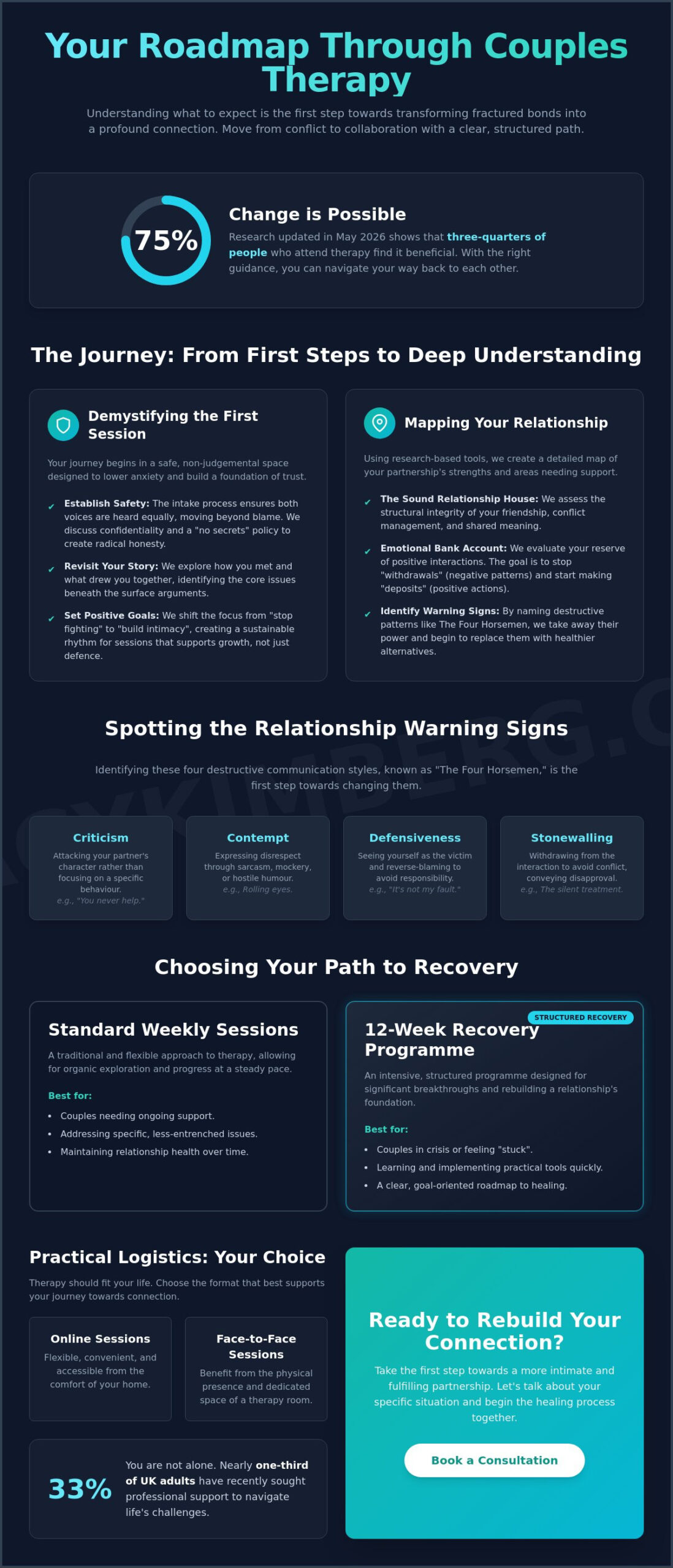
I’m Tracy, and I’ve seen how a structured environment can transform even the most fractured bonds. Research updated in May 2026 indicates that 75% of people who attend therapy find it beneficial, proving that change is possible when you have the right guide. In this article, I’ll show you exactly how we move from that first awkward hello to the profound breakthroughs that reshape your connection. We’ll explore the roadmap for recovery, the practical tools to end the “roommate phase”, and how to create a safe space for the emotions you’ve been too afraid to voice.
Key Takeaways
- Learn how the initial intake process moves beyond blame to establish a foundation of psychological safety where both voices carry equal weight.
- Discover how research-based assessments, such as the Sound Relationship House, help you map your partnership’s unique landscape and hidden strengths.
- Gain professional insight into couples therapy what to expect by comparing traditional weekly sessions with a structured 12-week relationship recovery programme.
- Master the art of “Relational Intelligence” through practical tools like the softened start-up to de-escalate conflict and foster deeper intimacy.
- Decide whether the physical presence of a therapy room or the flexible convenience of online sessions best supports your journey toward connection.
Demystifying the First Session: Your Initial Steps into a Safe Space
Walking into a therapy room for the first time often feels like stepping onto a stage without a script. You might feel a tightness in your chest or a sudden urge to defend your behaviour before the conversation even begins. It’s vital to understand that the first session is an intake process designed to build a foundation of safety. You can expect a warm, non-judgemental environment where both voices are heard equally, ensuring neither partner feels sidelined or ignored. Understanding couples therapy what to expect involves a shift in perspective; it’s a collaborative exploration of relational dynamics rather than a search for a villain.
Trust is the currency of our work together. To protect the integrity of the process, we’ll discuss confidentiality and the “no secrets” policy often used in modern practice. This means that whilst I provide a safe container for individual thoughts, I won’t hold secrets that undermine the relationship’s growth. It’s about creating an atmosphere of radical honesty where Couples therapy can actually take root and flourish. By removing the fear of being “found out” or “ganged up on”, we create the space needed for real vulnerability.
The “Getting to Know You” Phase
We start by revisiting your origin story. I want to know how you met and what originally drew you to one another amongst the noise of the world. This helps us identify the “presenting problem”, like a recent recurring argument, whilst acknowledging the deeper undercurrents that drive your reactions. We’ll look at your individual histories and how they colour your current interactions. Research from the BACP in May 2026 shows that nearly 33% of UK adults have sought professional support recently, often to untangle these very threads of personal history and shared pain that impact their current partnerships.
Setting Intentions and Goals
When considering couples therapy what to expect, our focus will eventually move from “we want to stop fighting” to “we want to build intimacy”. This shift is essential because it moves the relationship from a state of defence to one of growth. We’ll recognise that goals often evolve as the therapy progresses and you become more comfortable with the process. We’ll also establish a rhythm for your sessions that fits your lifestyle, ensuring the journey feels sustainable. Whether we meet weekly or follow a more intensive programme, the structure is designed to support your specific needs and emotional pace.
The Assessment Phase: Mapping Your Relationship’s Unique Landscape
Mapping a relationship isn’t about identifying who is at fault; it’s about understanding the terrain you’ve been navigating together. During this phase, we use research-based tools like the Gottman Method to look at your “Sound Relationship House”. We’re looking for the structural integrity of your friendship, how you manage conflict, and how you create shared meaning. It’s helpful to read about What to Expect When You Go to Couples Therapy to understand how these scientific frameworks provide a safety net for your conversations. This period is less of a clinical test and more of a collaborative discovery. We’re evaluating your “emotional bank account”, which is the reserve of positive interactions you’ve built over time. If your account is overdrawn, every small disagreement feels like a bankruptcy. Knowing couples therapy what to expect means recognising that we must first stop the “withdrawals” before we can begin making “deposits” again.
A core part of this mapping involves identifying the “Four Horsemen”: Criticism, Contempt, Defensiveness, and Stonewalling. These behaviours act as early warning signs that the relationship is under significant stress. For example, if one partner uses contempt, it’s often a sign of long-simmering resentment that has curdled. By naming these patterns, we take away their power. If you’re ready to see how these dynamics play out in your own lives, let’s talk about your specific situation and how we can begin the healing process.
Individual vs. Joint Sessions
I often see partners separately for one or two sessions during this initial assessment. It’s not about keeping secrets; it’s about honouring your individual history. Your “attachment style”, often formed in your family of origin, dictates how you respond to intimacy and conflict today. One partner might have a “preoccupied” style, whilst the other is “avoidant”. Understanding these personal blueprints allows us to see why you react the way you do without the pressure of your partner’s immediate presence. We ensure these individual moments don’t lead to hidden agendas but instead enrich the joint work we do later.
Identifying the “Cycle” of Conflict
Most couples get stuck in a repetitive loop. You might recognise the “pursuer-distancer” dynamic, where one person pushes for connection whilst the other retreats to find safety. In this room, we learn to see the argument as the enemy, not your partner. We map the triggers, the emotional escalations, and the eventual shutdowns. Mapping this cycle is the first step toward breaking it; it allows you to step outside the dance and choose a different move. This perspective shift is profound because it replaces blame with a shared mission to protect the relationship from the cycle itself.
Beyond the Arguments: What You Will Actually Learn in the Room
When you sit on the sofa, the air can feel heavy with things unsaid. You might wonder if I’ll point a finger or if your partner will “win” the session. This isn’t how the process works. Beyond the surface-level bickering, couples therapy what to expect involves a deep dive into the architecture of your connection. We look at the unwritten rules you’ve both been following without knowing it. My role is that of a neutral Wise Guide; I’m here to advocate for the health of the relationship itself, not to act as a judge or jury. This neutral stance provides Key Insights into Couples Therapy, ensuring that the room remains a sanctuary for both of you.
We’ll explore the art of the “softened start-up”. It’s a simple yet profound shift in how you initiate difficult conversations to prevent immediate escalation. We also tackle the paradox of intimacy: how to maintain a sense of self whilst remaining deeply bonded. As Esther Perel often suggests, we need a certain amount of distance to feel desire, yet we crave the safety of the hearth. We’ll work on navigating this tension between security and autonomy, ensuring your partnership feels like a choice rather than a cage.
The Language of Vulnerability
Most arguments are just “secondary emotions” like anger or frustration masking “primary emotions” like fear or sadness. We’ll practice moving from “You always ignore me” to “I feel lonely when we don’t talk after work”. This shift isn’t just about semantics; it’s about the courage to be seen in your rawest form. You’ll learn active listening techniques that go beyond nodding. You’ll learn to make your partner feel truly witnessed, which is the most potent antidote to resentment I’ve found in my practice.
Rebuilding Intimacy and Desire
Many couples come to me suffering from “roommate syndrome”, where the passion has been replaced by domestic logistics. Intimacy isn’t just physical; it’s the courage to be known. We’ll use intentional reconnection exercises to bridge the gap between you. If you’re wondering if your bond can still be saved, it’s helpful to understand how to build emotional intimacy through consistent, small acts of vulnerability. We’ll transform your home from a place of co-existence into a laboratory for rediscovering why you fell in love amongst the challenges of daily life.
Practical Logistics: Online vs. Face-to-Face Therapy in the UK
Deciding where to hold your sessions is a choice that should feel as supportive as the therapy itself. In the UK, we’ve seen a significant shift toward flexible, hybrid models that cater to busy lives. Whether you prefer the physical sanctuary and neutral ground of a therapy room in London or Dorchester, or the accessibility of your own living room, the clinical depth remains unchanged. When exploring couples therapy what to expect, the most critical factor is your therapist’s professional standing. You should look for practitioners on voluntary registers accredited by the Professional Standards Authority, such as the BACP or UKCP. These organisations, which collectively represent over 72,000 members as of May 2026, ensure your guide meets rigorous ethical and training standards, providing you with peace of mind as you begin this vulnerable work.
The choice between formats often comes down to your personal dynamic. A face-to-face session offers a dedicated space away from the triggers of home, whilst online therapy provides a unique “window” into your natural environment. This can be incredibly useful for identifying how physical spaces in your house might contribute to certain patterns of behaviour. Regardless of the setting, the goal is to create an environment where you both feel safe enough to be honest.
Is Online Therapy Effective for Couples?
Research updated in May 2026 confirms that online sessions are just as potent as face-to-face relationship coaching. Many of my clients find that the digital format allows for more authentic expression because they’re in a familiar space. To ensure success, I recommend setting up a “sacred space” at home for your Zoom or Skype calls. This means finding a private room where you won’t be interrupted by children or pets, ensuring you can speak freely without fear of being overheard. Whilst technical hitches like a flickering connection can occur, we handle them with patience. The focus remains on the emotional flow between you, not the perfection of the technology.
Frequency and Commitment
I usually recommend weekly sessions during the first six to eight weeks of our work together. This rhythm builds a steady momentum and prevents you from slipping back into old, defensive habits between appointments. A vital part of our time together involves “home-play”, which are intentional exercises you carry out between sessions to anchor new behaviours. These might include a ten-minute daily “appreciation dialogue” or a structured walk where you practice active listening. It’s important to understand that therapy is a journey of rediscovery, not a quick-fix plaster for a deep wound. If you’re ready to find a format that fits your lifestyle, start your journey here and let’s explore how to transform your connection.
Choosing Your Path: From Standard Sessions to the 12-Week Relationship Recovery
Every relationship has its own tempo, and the vessel you choose for your healing should reflect that. When considering couples therapy what to expect, you’ll find that the structure of the work can be just as important as the content of the sessions. Traditional counselling offers a fluid, open-ended space that allows us to explore issues as they arise. This is wonderful for couples who want to maintain their connection over the long term. However, for those who feel they are “circling the drain” or stuck in a repetitive crisis, a more intensive approach is often necessary. I offer a 12-Week Relationship Recovery Process that acts as a goal-oriented roadmap, providing a clear alternative to the “wait and see” nature of standard therapy.
Sometimes, the journey of discovery leads to the realisation that the partnership has reached its natural conclusion. If the path leads toward an ending, I provide amicable separation guidance to ensure the transition is handled with dignity and conscious care. This process is about honouring the history you’ve built whilst creating a healthy foundation for your separate futures. For those navigating life after a relationship ends, understanding the process of moving on after separation and reclaiming your identity can be an essential part of rebuilding a fulfilling life beyond the partnership. If you have children, this transition also calls for careful, compassionate communication, and understanding how to tell kids about separation in an age-appropriate way can protect their long-term emotional resilience. To supplement our one-on-one work, I also offer masterclasses that provide specific tools for communication and intimacy, allowing you to deepen your learning at your own pace.
The 12-Week Structured Advantage
This programme provides a clear beginning, middle, and end to the “crisis” phase of your journey. We don’t just talk; we move through specific themes each week, from rebuilding shattered trust to future-proofing your partnership against old triggers. It’s a potent intervention designed for couples who need to see tangible progress quickly. By focusing on a structured roadmap, we move away from the “roommate phase” and back into a dynamic, intimate connection. This focused approach ensures that couples therapy what to expect is not a mystery, but a series of manageable, transformative steps.
Starting Your Journey Here
The first phone call is often the biggest hurdle you’ll face. My “Let’s talk” approach is designed to be a low-pressure, human connection rather than a cold business transaction. If you’re dealing with a reluctant partner, try inviting them to a single session as a “consultant” on your own experience, rather than a “problem” to be fixed. Frame it as a safe environment to express difficult emotions without judgement. Research indicates that 75% of people who attend therapy benefit from it, but that healing only begins when you decide to show up. Book your initial consultation with Tracy Kimberg today and let’s start the work of rediscovering your “happy” outcome.
Take the First Step Toward a New Narrative
Your relationship is a living, breathing entity that occasionally needs a safe container for repair and growth. We’ve explored how moving beyond the initial anxiety of couples therapy what to expect allows you to map your unique landscape and replace old cycles of conflict with relational intelligence. Whether you choose the flexibility of online sessions or the physical presence of a room in London or Dorset, the goal remains the same: a partnership built on vulnerability and trust. You’ve seen that the “roommate phase” doesn’t have to be your permanent reality.
I specialise in a 12-Week Relationship Recovery Process that uses research-based tools inspired by the work of experts like Gottman and Perel. This structured roadmap provides the clinical accuracy you need with the deeply human execution you deserve. You don’t have to navigate these complex emotional landscapes alone. My practice offers a non-judgemental space where transformational change isn’t just a hope, but a tangible outcome. Start Your Journey Here: Book a Discovery Call with Tracy and let’s talk about the future you want to build together. Healing is a proactive adventure, and it begins with the courage to reach out.
Frequently Asked Questions
Is couples therapy worth it if we are already considering divorce?
Yes, therapy is incredibly valuable even when separation feels inevitable. It provides a structured environment for “conscious closure”, ensuring that if you do part ways, you do so with minimal trauma and maximum clarity. For many, this process actually reveals a path back to connection that was previously obscured by resentment. It’s about making an informed choice rather than a reactive one.
What if my partner refuses to come to therapy with me?
You can still begin the journey of relationship coaching on your own. When one person in a system changes their behaviour and responses, the entire dynamic is forced to shift. By working on your own relational intelligence and attachment patterns, you often create a new “invitation” for your partner to join the process later. I frequently work with individuals to help them navigate these complex partnership waters.
How many sessions of couples therapy will we need before we see a change?
Most couples begin to notice a tangible shift in their communication patterns after 6 to 8 sessions of consistent work. Whilst every partnership is unique, understanding couples therapy what to expect involves committing to a rhythm that allows new behaviours to take root. For those in high distress, my 12-week relationship recovery process offers a more intensive, time-bound roadmap that prioritises immediate stabilisation and emotional safety.
Can a therapist tell us if we should stay together or break up?
No, a therapist’s role is to be a Wise Guide, not a judge who decides the fate of your marriage. My job is to hold the mirror up to your relationship, helping you see the patterns and possibilities clearly. The ultimate decision to stay or go belongs entirely to you. I provide the tools and the safe space for you to reach that conclusion with confidence and peace.
What happens if we start arguing during the therapy session?
Arguments in the room are actually useful “data” that help me understand your unique conflict cycle. Rather than letting the fire spread, I will intervene to de-escalate the tension and help you look at what’s happening beneath the surface. We move from the “secondary emotion” of anger to the “primary emotions” of fear or sadness. This transforms a painful spat into a profound moment of learning.
Will the therapist tell me if I am the one “in the wrong”?
Therapy is not a courtroom, and I don’t look for a villain to blame. Instead, we look at the “dance” between you both. Usually, both partners are contributing to a cycle that neither of them likes. By moving away from “right” and “wrong”, we can focus on what is “effective” and “ineffective” for the health of your connection. This non-judgemental approach is essential for true healing.
How do we choose between a counsellor, a coach, and a therapist?
Choosing the right professional depends on your current goals. A counsellor often focuses on listening and support, whilst a coach provides future-oriented strategies. As a relationship expert, I blend these approaches to offer both clinical insight and actionable tools. Always ensure your practitioner is listed on a PSA-accredited register, such as the BACP, which has over 60,000 members as of May 2026, to guarantee professional standards.
What is the difference between traditional counselling and a 12-week recovery programme?
Traditional counselling is often open-ended and led by the issues you bring to the room each week. In contrast, the 12-week relationship recovery process is a structured, goal-oriented roadmap designed for couples in crisis. It follows a specific curriculum to move you from disconnection to intimacy in a set timeframe. This is ideal for those who want to see couples therapy what to expect laid out in a clear, predictable plan.

Article by
Tracy Kimberg
Tracy Kimberg is a Relationship Expert, Couples Therapist and Coach with a dedicated focus on helping couples and individuals rebuild connection, trust and emotional safety in their relationships. Drawing on the research of John and Julie Gottman, the relational insights of Esther Perel, and years of hands-on therapeutic experience, Tracy offers a warm, non-judgemental and deeply compassionate approach to modern relationships. Based in Dorset, Tracy works with couples navigating communication breakdowns, betrayal, intimacy challenges, separation, family dynamics and life transitions. Known for creating a safe and grounded therapeutic space, she combines practical tools with emotional depth to help clients move beyond survival patterns and towards meaningful, lasting change. With a reputation for empathy, professionalism and dedication to her clients’ growth, Tracy is passionate about helping people feel seen, understood and empowered — both within their relationships and within themselves.
Disclaimer
Disclaimer: The information shared in this article is intended for educational and informational purposes only and should not be considered a substitute for professional therapeutic, psychological, medical or legal advice. Every individual and relationship is unique, and the perspectives offered are based on general therapeutic principles, research and professional experience. Reading this article does not establish a therapist-client relationship with Tracy Kimberg. If you are experiencing significant emotional distress, relationship crisis, trauma, or mental health concerns, it is important to seek support from a qualified professional appropriate to your individual circumstances. All content remains the intellectual property of Tracy Kimberg and may not be reproduced or distributed without permission.