

What if the person you hire to save your relationship isn’t meant to be a neutral observer, but a skilled architect of your shared future? Many partners sit on the sofa fearing a therapist who might take sides or, worse, provide “talk therapy” that leads to no real change. If you’re researching how to find a couples therapist UK, you’re likely feeling the weight of 18.5-month NHS waiting lists or the confusion surrounding the BACP SCoPEd framework changes that took effect in February 2026.
You want more than a place to vent; you want a path back to intimacy and connection. I promise that this guide will provide the clarity you need to choose a specialist who understands the delicate dance of partnership and vulnerability. We’ll explore the vital differences between coaching and counselling, explain the new accreditation categories, and give you a clear roadmap to ensure you find the expert support your relationship deserves.
Key Takeaways
- Understand why the therapeutic alliance is the single most important predictor of success and learn how to find a couples therapist UK who resonates with your unique relationship dynamic.
- Decipher the complexities of UK accreditations like BACP and UKCP to ensure your support is grounded in the highest professional standards and ethical practice.
- Learn a practical five-step vetting process to move beyond general search engines and identify a specialist who aligns with your specific goals, such as healing from infidelity or intimacy building.
- Discover gentle ways to invite a hesitant partner into the process by reframing the journey as a proactive relationship check-up rather than a search for who is “wrong.”
- Explore the benefits of a structured 12-week relationship recovery process for achieving the profound, lasting change that open-ended talk therapy often misses.
Navigating the Search: Why Finding the Right Couples Therapist in the UK Matters
Admitting that your relationship is struggling takes immense courage. It often starts with a heavy silence at the dinner table or a recurring argument that feels like a dead end. When you begin researching how to find a couples therapist UK, you’re not just looking for a professional; you’re looking for a lifeline. The vulnerability required to invite a stranger into your most intimate conflicts is significant, yet it is the first step toward a more conscious way of loving.
The most critical factor in your success won’t be the therapist’s office location or even their specific degree. It is the therapeutic alliance. This concept refers to the quality of the bond between the couple and the practitioner. Research consistently identifies this alliance as the number one predictor of positive change. Within the context of Couples therapy, this means both partners must feel equally seen, heard, and respected without the fear that the therapist is taking sides. Without this foundation of trust, even the most advanced psychological techniques will struggle to take root.
The UK landscape for relationship support has shifted dramatically. With NHS psychotherapy waiting times reaching an average of 18.5 months in some regions as of December 2024, many couples are turning to private specialists. Whether you’re seeking a high-end clinic in London or the flexibility of online sessions, the choice is vast. However, general “talk therapy” often falls short for couples. Whilst a generalist might listen, a specialised relationship coach acts as a relational architect, providing the structure and tools needed to dismantle old patterns and build something more resilient.
The Difference Between Individual and Couples Therapy
In my practice, I always emphasise that in couples work, the “client” isn’t you or your partner. The client is the relationship itself. Seeing an individual therapist for marriage issues can sometimes increase the drift between partners, as the therapist only hears one side of the story. If you feel you need to work on your own triggers first, individual relationship counselling is a powerful way to explore how your personal history impacts your current dynamic.
When to Start Your Search
Many couples wait until a crisis, like infidelity, before seeking help. By then, the “disease burden” on the relationship is heavy. It’s often more effective to start your search during the “Roommate Phase,” when you feel a loss of intimacy but still have mutual respect. With mental health referrals up 39% since 2019, being proactive is essential. Viewing therapy as a “Relationship Check-up” rather than an emergency surgery makes the process an investment in your family’s future emotional health.
Understanding UK Accreditations and Modalities: From BACP to the Gottman Method
When you’re exploring how to find a couples therapist UK, it’s easy to get lost in a sea of letters and acronyms. Whilst these certifications are vital for safety, they don’t tell you how a therapist will actually interact with your pain. Accreditation is the baseline; it ensures your practitioner is ethical, insured, and accountable. To maintain these high standards, many dedicated professionals seek specialised coaching and training from Martin Hogg (Private Practice Success). However, the modality is the engine of change. It’s the specific psychological lens through which your therapist views your relationship and guides you toward healing.
Research-based approaches provide the structure many couples crave. The Gottman Method, for instance, offers a scientific framework for understanding why some partnerships thrive and others fail. Others might use Systemic Therapy to look at the “dance” you and your partner perform, or a Psychodynamic perspective to explore how your childhood histories are showing up in your current arguments. These specialised approaches have been refined through decades of clinical study, proving that generic talk therapy is rarely enough for high-stakes recovery.
A trauma-informed lens is equally essential in modern practice. It moves the conversation from “what is wrong with you?” to “what happened to you?”, allowing for a deeper sense of compassion and vulnerability. This is where the work becomes truly potent. It’s not just about resolving a single argument; it’s about healing the underlying wounds that trigger the conflict in the first place. Understanding these layers helps you move beyond surface-level fixes toward a more profound, lasting connection.
The Gottman Method and Perel-Inspired Coaching
The Gottman Method uses the “Sound Relationship House” theory to measure the health of your connection through observable behaviours and data. This structured approach is incredibly reassuring for couples who feel they’ve been talking in circles for years. When you work with an expert influenced by Esther Perel, you also bring erotic intelligence and the paradoxes of intimacy into the room. This blend of science and soul requires an expert presence to navigate safely, ensuring the “potency” of the sessions leads to growth rather than overwhelm.
Decoding the Alphabet Soup (BACP vs UKCP)
The BACP is the primary UK body for counselling and psychotherapy, setting the standard for ethical practice across the country. As of February 2026, the new SCoPEd framework has aligned membership categories to ensure clarity for the public. You’ll see therapists listed as Registered (Column A), Accredited (Column B), or Senior Accredited (Column C). Always check for current accreditation and evidence of Continuing Professional Development (CPD) to ensure your therapist remains at the cutting edge of relationship science. To begin this process with specialised support, you might choose to talk with a relationship expert who can guide you through these complexities.
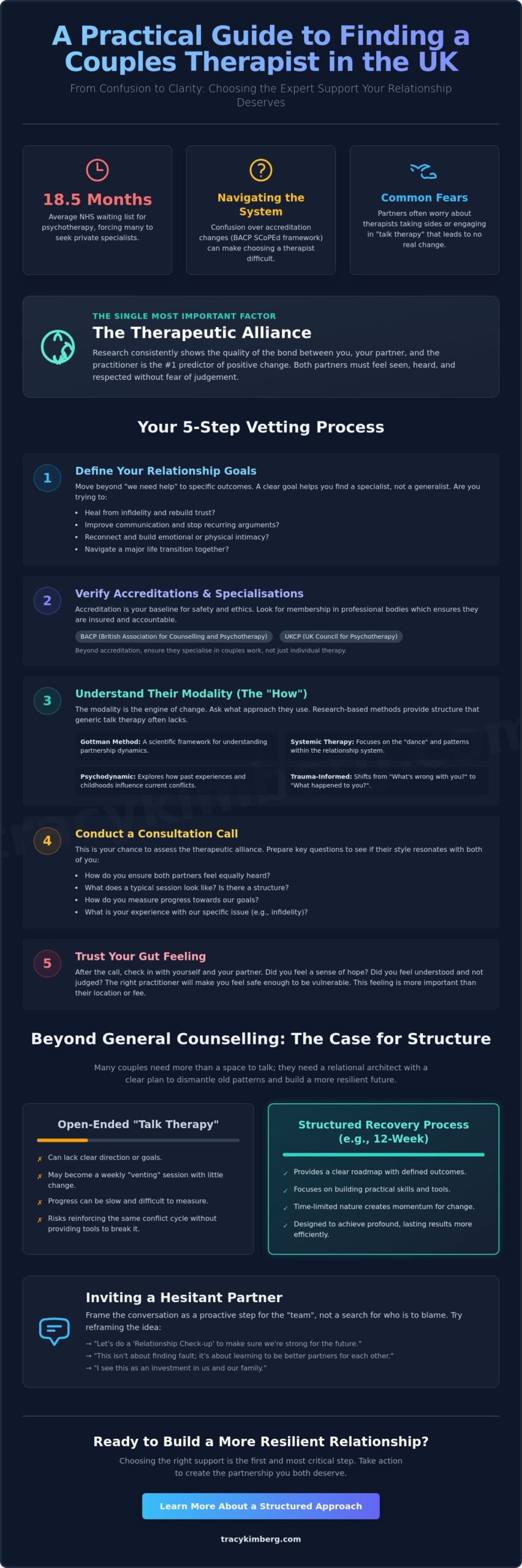
A Practical 5-Step Guide to Vetting Your Potential Therapist
The search for support often feels like a second job, yet it’s perhaps the most vital project you’ll undertake for your future. When you’re learning how to find a couples therapist UK, the goal is to move beyond a simple list of names and toward a professional who resonates with your shared values. This isn’t about finding a referee; it’s about finding a guide who can hold a safe space for both of you whilst challenging the patterns that keep you stuck.
Step 1: Define your primary goal. Before you even open a browser, sit down together. Are you seeking a 12-week relationship recovery process after infidelity, or are you looking for a conscious approach to divorce and separation? Having a clear “why” allows you to filter for specialists rather than generalists.
Step 2: Use specialised directories. General search engines can be overwhelming and often prioritise those with the best marketing rather than the best clinical fit. For a more reliable starting point, consult the UK Council for Psychotherapy (UKCP) therapist register. This ensures your potential therapist has met rigorous standards of training and ethical practice.
Step 3: Review their “About” page. Look for language that speaks to the heart of your experience. Does the therapist use words like “connection,” “intimacy,” or “vulnerability”? Their writing should feel like an invitation into a supportive conversation, not a clinical lecture. If their tone feels too cold or, conversely, too informal, trust that instinct.
Step 4: The 15-minute chemistry call. Most experts offer a brief initial consultation. Use this time to feel the “rhythm” of the conversation. You’re listening for a blend of empathy and authority. You want someone who feels warm but also capable of steering the ship through a storm.
Step 5: Assess the plan. Ask if they offer a structured roadmap or if sessions are purely client-led. Open-ended “chatting” often leads to the “talk therapy” trap where you feel heard but nothing actually changes. A structured approach often yields more profound results in a shorter timeframe.
Questions to Ask During an Initial Consultation
- “What is your specific experience with our primary issue, such as the effects of menopause on intimacy or recovering from a breach of trust?”
- “Do you follow a research-based programme, like the Gottman Method, or is our time together unstructured?”
- “How do you handle moments of high conflict during our sessions to ensure we both feel safe?”
Red Flags to Watch Out For
The most damaging experience in couples work is a therapist who takes sides. If you feel that one of you is being cast as the “villain” or the “problem,” the therapeutic alliance has failed. Watch out for a lack of clear boundaries; a therapist must be able to manage the room effectively. Finally, be wary of generic advice. Your relationship is a unique ecosystem, and the support you receive should reflect that complexity rather than offering “one-size-fits-all” platitudes.
Overcoming the Hesitant Partner Hurdle and Other Obstacles
It’s common for one partner to feel a deep sense of trepidation when the topic of professional support arises. This resistance usually isn’t a lack of love. It’s often a fear of being cast as the “villain” or being told they are “wrong” by an authority figure. When you’re researching how to find a couples therapist UK, you need to find someone who understands this systemic dance. A skilled practitioner doesn’t look for who is at fault; they look at the space between you. They observe the patterns that have taken on a life of their own, trapping both of you in a cycle of reactivity.
Reframing the journey can lower the emotional stakes. Instead of “fixing a broken person,” try viewing the process as a “Relationship Check-up.” We don’t wait for our cars to break down on the motorway before we book an MOT, and our partnerships deserve even more care. Addressing the cost objection is also vital. Whilst private therapy in 2026 typically ranges from £90 to £200 per session, this is a fraction of the emotional and financial cost of a high-conflict divorce. Investing in your connection now is a proactive choice for your family’s long-term stability.
How to Invite Your Partner into the Process
The way you broach the subject matters immensely. Avoid “you” statements that sound like accusations. Instead, use “I” statements that reveal your own vulnerability. You might say, “I feel lonely in our current rhythm, and I want us to find our way back to each other.” Sharing therapist bios or articles like this one can also help. It gives your partner a sense of control and allows them to see the human face behind the clinical title. Suggesting a single “trial session” often feels less daunting than committing to a long-term process. If you’re ready to explore this together, let’s talk about how we can rebuild your connection.
The Online vs. Face-to-Face Debate
The UK therapeutic landscape offers incredible flexibility. For busy professionals in London or those balancing family life in rural areas, online therapy is a game-changer. With platforms typically charging between £40 and £80 per session in 2026, it’s an accessible and highly effective option. However, some couples prefer the physical “holding space” of a centre in Dorchester or London. Being in the same room as your therapist can sometimes help ground the energy of high-conflict sessions. Rest assured that the potency of the work remains high in both formats. The most important factor is the quality of the connection you build with your practitioner, regardless of whether that happens through a screen or on a sofa.
Beyond General Counselling: The Case for a Structured Relationship Recovery Process
Many couples spend months researching how to find a couples therapist UK, yet once they find a name, they often fall into the trap of open-ended “talk therapy.” Whilst having a space to vent is helpful, it rarely addresses the deep-seated systemic patterns that cause emotional drift. This is why I advocate for a 12-Week Relationship Recovery Process. This time-bound, structured approach is a transformational journey designed to move you from crisis to connection. Instead of years of unstructured chatting, we focus on intense, purposeful work that yields measurable results in a fraction of the time.
The goal is to shift from the passivity of “searching” to the proactivity of “acting.” When your partnership is at a crossroads, every week spent in silence or conflict adds to the emotional weight of your shared history. By choosing a structured programme, you aren’t just looking for a listener; you’re hiring a specialist to help you rebuild the very foundation of your life together. This process is potent and not as daunting as you think, especially when guided by someone who understands both the clinical science of attachment and the raw human need for intimacy.
What Makes a Relationship Expert Different?
A relationship expert looks beyond the individual to the “dance” occurring between two people. We use research-based tools from the Gottman Method and the erotic intelligence of Esther Perel to provide a clear roadmap for healing. This approach is “conscious,” meaning we bring awareness to the trauma-informed triggers that dictate your reactions. If you’re currently questioning can your relationship be saved, the answer often lies in whether you’re willing to engage in this deeper, systemic work rather than surface-level fixes.
Starting Your Journey with Tracy Kimberg
Hi, I’m Tracy. I believe that every couple has the capacity for profound growth if they have the right guide. My practice combines clinical expertise with a warm, accessible presence that seeks to demystify the therapeutic process from the very first call. We’ll explore your unique interpersonal dynamics in a non-judgmental space, focusing on “happy” outcomes and long-term emotional health. Don’t let another month of distance pass by. Let’s talk and begin your recovery today; your journey back to each other starts with a single, courageous conversation.
Start Your Journey Toward Lasting Connection
Your relationship is a living ecosystem that requires more than just hope or silence to heal. We’ve explored the necessity of understanding BACP and UKCP accreditations and why a research-based modality is often the engine of real change. Knowing how to find a couples therapist UK is about more than scrolling through endless directories; it’s about identifying an expert who can hold space for your vulnerability whilst providing a clear, actionable roadmap for recovery.
Whether you’re navigating the “roommate phase” or recovering from a profound breach of trust, the right support can transform your dynamic. I provide a specialised 12-Week Relationship Recovery Process that moves beyond traditional talk therapy to create deep, systemic shifts. Within my safe, non-judgemental environments in London and Dorchester, we use the insights of Perel and Gottman to build intimacy and resilience. Potent therapy is a proactive adventure, not a clinical burden.
Start Your Journey to Relationship Recovery with Tracy Kimberg and rediscover the joy of your connection. Your partnership is worth the investment, and your future together starts with a single, courageous step.
Frequently Asked Questions
How much does couples therapy cost in the UK on average?
Private couples therapy in the UK typically costs between £90 and £200 per session as of 2026. In London, standard sessions usually range from £90 to £150, whilst specialist relationship therapy can cost between £120 and £180. Online therapy platforms provide a more accessible option, with prices often falling between £40 and £80 per session, allowing couples to access expert support regardless of their location.
Is couples therapy available on the NHS?
Couples therapy is available on the NHS, but it is often restricted to cases where relationship distress is linked to a diagnosed mental health condition like depression. While 88.7% of referrals accessed NHS Talking Therapies within six weeks as of January 2026, waiting lists for more intensive psychotherapy reached 18.5 months in some regions by late 2024. Many couples choose private support to avoid these delays and access specialised care immediately.
What is the difference between a relationship coach and a counsellor?
A relationship counsellor focuses on exploring the emotional roots and past patterns of your connection, whilst a coach prioritises actionable strategies and future goals. When you are looking into how to find a couples therapist UK, it’s helpful to find a professional who integrates both approaches. This combination allows you to understand the “why” behind your conflicts whilst gaining the practical tools needed to build a more intimate and conscious partnership.
Can I find a couples therapist if my partner refuses to go?
You can certainly begin the therapeutic process alone through individual relationship counselling. This work allows you to explore your own triggers and the role you play in the relational dance. Often, when one partner begins to change their behaviour and communication style, it shifts the entire dynamic of the relationship. This proactive step can also help a hesitant partner feel more comfortable about joining the process later.
How many sessions of couples therapy are usually needed to see a difference?
Most couples begin to notice a shift in their communication and emotional safety within six to eight sessions. However, achieving profound and lasting change usually requires a more structured commitment. A 12-Week Relationship Recovery Process is specifically designed to move you through the layers of conflict and intimacy in a purposeful way. This time-bound approach often yields better results than open-ended talk therapy, which can lack a clear sense of progress.
What should we do if we don’t “click” with our first therapist?
It is perfectly acceptable to seek a different therapist if you don’t feel a strong sense of trust and safety during your initial sessions. The therapeutic alliance is the single most important predictor of a successful outcome. You should both feel equally seen and heard without any sense of judgement. Trust your instincts during the chemistry call and don’t be afraid to keep searching until you find a professional who truly resonates with you both.
Is online couples therapy as effective as meeting in person?
Research indicates that online therapy is just as effective as face-to-face sessions for resolving conflict and increasing relationship satisfaction. For many UK professionals, the flexibility of online sessions reduces the logistical stress of travel and childcare. This format allows for a high level of intimacy and vulnerability, enabling you to work on your connection in the comfort of your own home where your daily interactions actually happen.
How do I know if a therapist is properly accredited in the UK?
You can verify a therapist’s credentials by checking the official registers of the BACP, UKCP, or HCPC. Since February 2026, the BACP has used the SCoPEd framework to categorise members into Registered, Accredited, and Senior Accredited levels. Always ensure your therapist is a member of a recognised professional body. This confirms they have met rigorous training standards and adhere to a strict code of ethics, ensuring you receive safe and professional support.

Article by
Tracy Kimberg
Tracy Kimberg is a Relationship Expert, Couples Therapist and Coach with a dedicated focus on helping couples and individuals rebuild connection, trust and emotional safety in their relationships. Drawing on the research of John and Julie Gottman, the relational insights of Esther Perel, and years of hands-on therapeutic experience, Tracy offers a warm, non-judgemental and deeply compassionate approach to modern relationships. Based in Dorset, Tracy works with couples navigating communication breakdowns, betrayal, intimacy challenges, separation, family dynamics and life transitions. Known for creating a safe and grounded therapeutic space, she combines practical tools with emotional depth to help clients move beyond survival patterns and towards meaningful, lasting change. With a reputation for empathy, professionalism and dedication to her clients’ growth, Tracy is passionate about helping people feel seen, understood and empowered — both within their relationships and within themselves.
Disclaimer
Disclaimer: The information shared in this article is intended for educational and informational purposes only and should not be considered a substitute for professional therapeutic, psychological, medical or legal advice. Every individual and relationship is unique, and the perspectives offered are based on general therapeutic principles, research and professional experience. Reading this article does not establish a therapist-client relationship with Tracy Kimberg. If you are experiencing significant emotional distress, relationship crisis, trauma, or mental health concerns, it is important to seek support from a qualified professional appropriate to your individual circumstances. All content remains the intellectual property of Tracy Kimberg and may not be reproduced or distributed without permission.