

What if the most frustrating moments with your child are actually your greatest opportunities for growth? It is easy to feel defeated when circular arguments become the soundtrack of your home, or when you realise you no longer recognise the person your child is becoming. You might find yourself carrying a heavy weight of guilt after a reactive outburst, wondering where the closeness went. Focus on improving parent-child relationship dynamics often feels like an uphill battle, especially when you are exhausted and overwhelmed by the pressures of modern life.
I understand that you want a sense of calm and mutual respect rather than a constant emotional storm. You deserve to understand the hidden meaning behind your child’s behaviour so you can respond with clarity instead of frustration. In this guide, we will explore how to move from disconnect to deep connection by applying the profound, research-based insights of John Gottman, Esther Perel, and Gabor Maté. We will look at the science of attunement and the vital art of repair; this provides you with the practical tools to rebuild trust and foster a home life rooted in genuine, lasting understanding.
Key Takeaways
- Learn how to create a “secure base” by practising attunement, which allows you to deeply understand your child’s internal world beyond their outward behaviour.
- Identify the “silent distance” caused by digital distractions and discover how your own childhood experiences might be influencing your current parenting triggers.
- Discover why conflict isn’t a sign of failure but a vital opportunity for improving parent-child relationship dynamics through intentional repair and the “good enough” parenting model.
- Master practical techniques like the 10-Minute Rule and learn to recognise subtle “bids for connection” to rebuild intimacy in small, manageable moments.
- Recognise the key signs that suggest it’s time to seek professional support, such as persistent silence or escalating aggression, to move beyond a painful impasse.
Understanding the Secure Base: What a Healthy Parent-Child Relationship Truly Looks Like
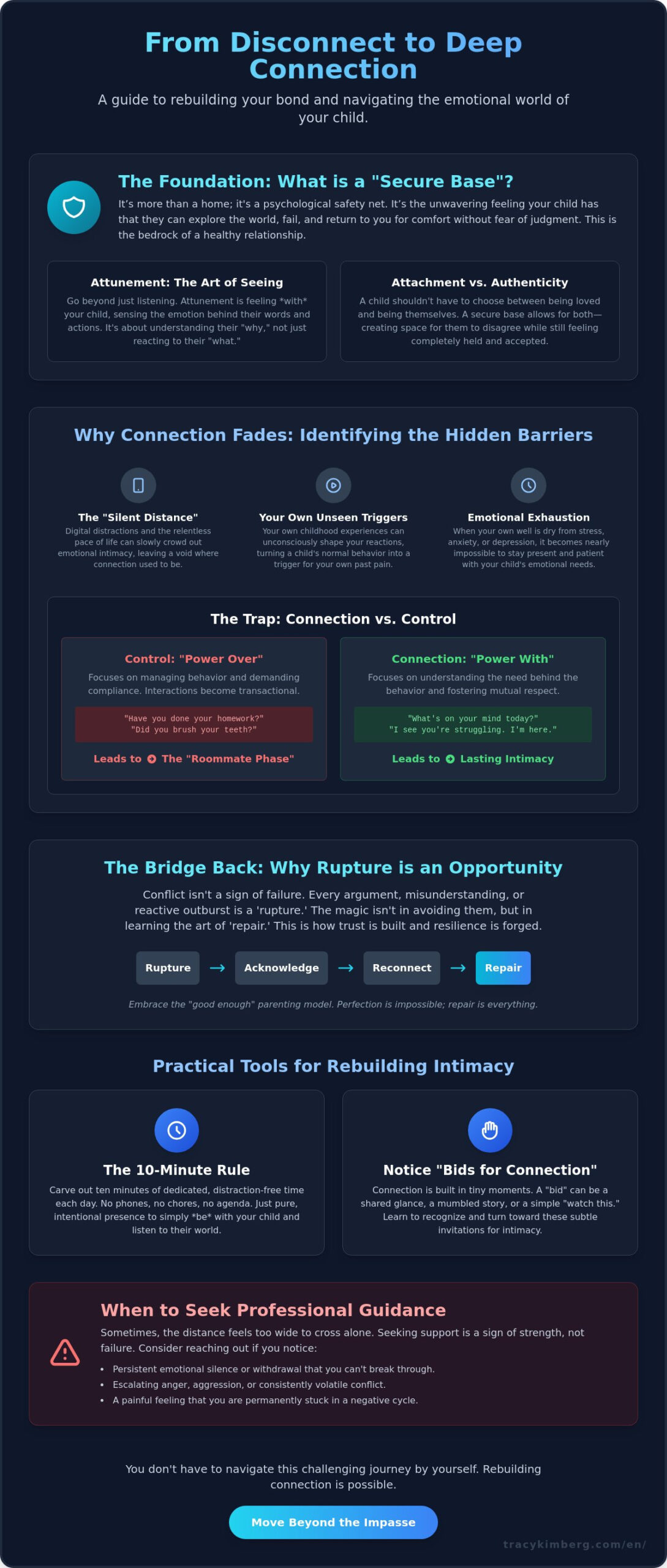
A relationship is not a static list of chores or a collection of hours spent in the same house; it is a living, breathing state of being. At the heart of this connection lies the concept of the “Secure Base.” It functions as a psychological safety net that allows your child to venture into the world with confidence. They don’t just need to know you are there; they need to feel that your presence is a reliable anchor. This sense of security provides the freedom to take risks, experience failure, and return to you for comfort without the fear of judgment or rejection.
True connection requires attunement. This goes far beyond active listening or asking about their day at school. Attunement is the profound ability to be present with your child’s internal world. It means sensing the vibration of their emotions and seeing the “why” behind the “what.” When we focus on improving parent-child relationship health, we move from being mere observers of behaviour to becoming participants in our child’s emotional experience. It is about feeling with them, rather than just reacting to them.
There is often a quiet struggle between attachment and authenticity. Children have a biological imperative to stay connected to their caregivers, but they also have a deep-seated need to be themselves. If a child feels they must hide their true thoughts or feelings to keep your love, authenticity is sacrificed for the sake of the bond. A healthy relationship allows for both closeness and independence. It creates a space where your child can say “no” or express a different opinion whilst still feeling completely held and accepted.
The Difference Between Connection and Control
Many parents unintentionally fall into the trap of “behaviour management,” believing that if they can just control a child’s actions, the relationship will naturally improve. This “power over” approach often has the opposite effect, eroding the emotional bond and creating a “silent distance.” When we look at improving parent-child relationship dynamics, we often discover that the “Roommate Phase” is a sign that the emotional fuel has run low. Your interactions become purely transactional: “Have you done your homework?” or “Did you brush your teeth?” Shifting to “power with” means exploring different parenting styles and choosing one that prioritises the soul of the connection over the compliance of the moment.
The Lifelong Impact of Relational Security
These early bonds are not just about the present; they are the blueprints for every future relationship your child will have. Attachment theory teaches us that the way we are held today dictates how we will hold others in adulthood. Relational security is the emotional foundation that allows a child to return to a safe harbour after facing the world’s challenges. When children learn that their internal world is valid and manageable, they develop the emotional regulation skills essential for long-term mental health. It is a proactive and positive adventure in building a resilient, connected human being.
Why Connection Fades: Identifying the Barriers to Emotional Intimacy
Connection rarely disappears in a single moment of conflict. It is usually a gradual erosion, a “silent distance” that grows whilst we are busy managing the logistics of life. We often mistake this for a natural phase of growing up. However, it is frequently a sign that emotional intimacy has been crowded out by the noise of modern existence. Identifying these internal and external barriers is the first step toward improving parent-child relationship quality.
When you are struggling with your own anxiety or depression, your capacity to stay present with your child’s emotions becomes severely limited. You aren’t just tired; you’re emotionally overextended. This leads to misinterpreting behaviour. You see defiance or “naughtiness” where there is actually an unmet need or a cry for help. Improving parent-child relationship health requires us to pause and look for the distress behind the “disrespect.” When we respond to the behaviour rather than the need, we inadvertently push our children further away.
The ‘Ghost in the Nursery’: How Our Past Shapes Our Present
Unresolved trauma or unmet needs from our own upbringing often “ghost” our parenting. If you weren’t heard as a child, your child’s loud emotions might feel like a personal threat or a failure on your part. This creates a cycle of reactive parenting where you are responding to your past rather than the child in front of you. Breaking these generational patterns is difficult, but it is essential work. Engaging in individual relationship counselling can provide the psychological insight needed to stop these cycles and transform your partnership with your child.
Digital Drifting: The New Barrier to Connection
The “Still Face” experiment famously demonstrated how infants become distressed when a parent’s face becomes blank and unresponsive. In our modern context, the smartphone has become the new “still face.” “Phubbing,” or phone snubbing, sends a subtle but consistent message to a teenager that the digital world is more valuable than their presence. To rebuild trust, we need to create sacred spaces where technology does not interfere with eye contact. It is about prioritising the human over the digital. If you find that the distance has become too great to bridge alone, therapy for teenagers can offer a safe, professional environment to begin the process of reconnecting.
The Power of Repair: Why Rupture is an Opportunity for Growth
Many parents carry the heavy burden of believing that a healthy relationship is one defined by a total absence of conflict. In reality, improving parent-child relationship dynamics isn’t about avoiding the “rupture” but mastering the “repair.” Rupture, those painful moments of shouting, misunderstanding, or cold silence, is an inevitable part of being human. It is the friction that occurs when two distinct people, with their own needs and internal worlds, live in close proximity.
The concept of the “Good Enough Parent” is vital here. You don’t need to be perfectly attuned 100% of the time; in fact, research suggests that being “right” about 30% of the time is often enough, provided the remaining time is spent in the process of coming back together. When you initiate a repair, you are doing something profound for your child’s developing brain. You are teaching them that relationships are resilient and that emotional safety can be restored even after it has been shaken. This builds a sense of internal security that lasts a lifetime.
John Gottman’s research into the “Magic Ratio” applies just as strongly to families as it does to couples. For every one negative interaction or rupture, we need five positive ones to maintain a stable emotional bank account. Improving parent-child relationship health involves being mindful of this balance, ensuring that the warmth and delight we feel for our children isn’t swallowed up by the necessary corrections of daily life.
The 4 Steps to an Effective Relational Repair
A successful repair session isn’t about litigating who was right; it is about restoring the bond. You can follow these four steps to guide the process:
- Step 1: Self-Regulation. You cannot co-regulate a child if your own nervous system is in a state of fight-or-flight. Take a moment to breathe and settle yourself before approaching them.
- Step 2: Acknowledging the Rupture. Name what happened without defensiveness. “I lost my temper earlier, and I spoke to you in a way that wasn’t okay.”
- Step 3: Validating the Child’s Experience. Use “I see you” language to honour their feelings. “It must have felt quite scary when I raised my voice like that.”
- Step 4: Re-establishing Connection. Close the gap with a physical gesture like a hug, a shared laugh, or simply sitting quietly together until the tension melts away.
Overcoming Contempt and Criticism
Gottman’s “Four Horsemen,” particularly criticism and contempt, can easily slip into our parenting when we are exhausted. We might find ourselves attacking the child’s character rather than the behaviour. To counter this, try using a “gentle start-up” when addressing issues like chores or schoolwork. Instead of saying, “You’re so lazy, you never clear your plate,” try, “I feel frustrated when the table isn’t cleared, and I need some help with the dishes.” This shifts the focus from blame to collaboration. An apology to a child is not a sign of weakness but a profound lesson in emotional accountability.
Practical Strategies for Improving Parent-Child Relationship Dynamics
Moving from the theoretical understanding of attunement into the messy reality of daily life requires a shift in how we perceive our interactions. Every day, your child sends out “bids for connection.” These are subtle reach-outs, a sigh, a look, or a shared meme, that invite you into their world. Improving parent-child relationship health often comes down to how frequently we turn toward these bids rather than turning away. It isn’t about grand gestures; it is about the micro-moments of recognition that tell a child they are seen and valued.
One of the most effective tools in your arsenal is the 10-Minute Rule. This involves dedicated, child-led attention where you have no agenda, no questions about homework, and no mobile phone in sight. During this time, you simply follow their lead. This creates a low-pressure environment where connection can flourish naturally. When they do speak, practice active listening. This means moving away from the urge to “fix” their problems and instead “bearing witness” to their emotions. By asking, “I wonder what’s happening for you right now?” instead of “Why did you do that?”, you replace judgement with curiosity, which is the antidote to defensiveness.
Communicating with Teenagers: From Interrogation to Dialogue
For parents of older children, the standard “How was school?” often feels like an interrogation that leads to a dead end. To foster a genuine dialogue, try “side-by-side” communication. Talking whilst driving, walking the dog, or washing the dishes lowers the intensity of eye contact, making it easier for teenagers to share their internal world. If you find yourself in the middle of a conflict, refer to this Help for Anxious Teens checklist for navigating emotional storms with grace. If the distance feels too wide to bridge alone, our therapy for teenagers provides a professional space to rebuild that vital connection.
Fostering Emotional Literacy at Any Age
Gabor Maté and Dan Siegel often speak about the power of “naming it to tame it.” When we help a child label their feelings, we help them regulate their nervous system. Normalising difficult emotions like jealousy, anger, or deep sadness prevents them from becoming “ghosts” that haunt future behaviour. You might consider creating a “Family Emotional Map.” This is a collaborative way to understand each person’s triggers and needs. By making emotions a standard topic of conversation, you ensure that improving parent-child relationship dynamics becomes a proactive and positive adventure for the whole family, rather than a reaction to a crisis. Understanding how to fix communication in a relationship at the family level means recognising that beneath every argument lies a deeper cry for connection and emotional safety.
When to Seek Professional Guidance: Moving Beyond the Impasse
Sometimes, despite our best intentions and the most earnest attempts at repair, we hit a wall. An impasse in improving parent-child relationship dynamics often manifests as persistent silence, escalating aggression, or a total withdrawal that feels impossible to penetrate. These aren’t signs of failure; they are signals that the current relational patterns have become too rigid to shift without external support. Professional guidance acts as a translator, helping each family member articulate the deep-seated emotional needs that often get lost in the heat of conflict. It provides a neutral ground where the “silent distance” can finally be bridged by words.
It is also vital to recognise the systemic nature of the family. Often, the security a child feels is a direct reflection of the stability within the home. Working on the parental relationship creates a powerful “trickle-down” effect. When the primary partnership is anchored in safety and respect, the child’s world becomes inherently more predictable and secure. Improving parent-child relationship health often begins with the adults in the room rediscovering their own capacity for attunement and emotional regulation.
The 12-Week Relationship Recovery Process for Families
A structured approach can be the catalyst for lasting change. Our 12-Week Relationship Recovery Process is designed to move families away from the exhaustion of “crisis management” and toward a state of “proactive connection.” By utilising research-based insights inspired by the Gottman Method, we identify the specific dance of rupture and repair that is unique to your home. This programme provides the necessary scaffolding to dismantle old defences and build a new, more resilient way of being together. It is an investment in the long-term emotional health of every family member.
Individual Support for Teenagers and Parents
There are times when a teenager needs a safe, non-judgemental space that exists entirely outside the family unit. This allows them to process their internal world without the fear of hurting or disappointing their parents. Simultaneously, parental coaching offers you the tools to remain steady whilst your child navigates the turbulent waters of adolescence. It is about providing the emotional scaffolding that supports their growth whilst maintaining your own well-being. This dual approach ensures that both the individual and the relationship are nurtured. If you are ready to transform your family dynamic into one of mutual respect and deep understanding, Book a consultation with Tracy Kimberg today.
Reclaiming Connection: Your Path Toward Relational Harmony
Reclaiming a sense of peace in your home isn’t about achieving a flawless record of parenting. It is about the courage to return to your child after a rupture and the commitment to stay present during their emotional storms. We have explored how the journey of improving parent-child relationship dynamics rests on the art of repair and the profound power of attunement. By moving away from control and toward curiosity, you create a sanctuary where every family member feels truly seen and valued.
As a UK-based expert with global online availability, I offer specialised support for teenagers and adults through a research-led approach grounded in the insights of Gottman and Perel. Whether you are navigating a “silent distance” or facing a total communication impasse, professional guidance provides the scaffolding for lasting change. Take the first step towards a deeper connection: Explore my Relationship Recovery Process. Healing is not just possible; it is a proactive and positive adventure that begins with a single moment of reaching out.
Commonly Asked Questions
How can I improve my relationship with my child when they won’t talk to me?
You can begin by focusing on non-verbal presence and “turning toward” small, non-vocal bids for connection. When a child is silent, they are often protecting themselves from perceived judgement. Instead of pushing for conversation, try being quietly present in the same room whilst they do an activity they enjoy. This low-pressure approach signals that your love is not contingent on their willingness to talk, creating a safe space for them to eventually open up.
Is it too late to fix a strained parent-child relationship with a teenager?
It is never too late to repair a bond with a teenager because the adolescent brain is remarkably plastic and receptive to genuine change. Strained dynamics often stem from a lack of felt safety or a history of unaddressed ruptures. By consistently demonstrating a new pattern of attunement and taking responsibility for your own reactive behaviour, you can rebuild trust. Improving parent-child relationship health is a process of small, repeated repairs rather than a single conversation.
What are the most common signs of a breakdown in parent-child communication?
The most common signs include a shift toward purely transactional communication, a persistent “silent distance,” and high levels of emotional reactivity. You might notice that your interactions are limited to logistics, such as schoolwork or chores, with no space for shared delight or vulnerability. If every attempt at connection ends in a circular argument, it is a sign that the underlying emotional safety has been compromised and requires intentional repair to restore the bond. The same hidden patterns that explain what’s really going on beneath the surface when communication breaks down in relationships apply equally to the parent-child dynamic, where every “pointless” argument often masks a deeper need for emotional safety.
How does my own mental health affect my relationship with my child?
Your mental health directly dictates your capacity for emotional attunement and your ability to remain present during your child’s distress. If you are struggling with anxiety or depression, your nervous system may be in a state of constant high alert, making it difficult to co-regulate your child. Children are highly sensitive to their parents’ internal states. Prioritising your own well-being is not a selfish act; it is the essential foundation for a healthy family dynamic.
What is the ‘Magic Ratio’ and how do I use it with my kids?
The “Magic Ratio” is a research-based concept from John Gottman suggesting that stable relationships require five positive interactions for every one negative interaction. In a family setting, this means consciously looking for opportunities to offer praise, shared laughter, or small gestures of affection. These positive moments act as emotional credit in the bank. When the inevitable conflict or “rupture” occurs, this accumulated warmth provides the resilience needed to navigate the storm without damaging the core connection.
How do I apologise to my child without losing my authority?
Apologising to your child actually strengthens your authority by modelling emotional accountability and building a foundation of mutual respect. True authority is not about being infallible; it is about being a reliable and trustworthy leader. When you admit a mistake, you teach your child that it is safe to be human and that relationships can survive errors. This vulnerability fosters a deeper sense of security, making your guidance more influential because it is rooted in trust.
Can individual therapy for me help my child’s behaviour?
Individual therapy for a parent is often the most effective way of improving parent-child relationship dynamics because it addresses the “ghosts” in your own history. When you process your own triggers and unresolved trauma, you stop projecting those past experiences onto your child’s behaviour. This allows you to respond with clarity and calm rather than reacting from a place of old pain. As you become more regulated, your child’s behaviour often settles in response to your new-found stability.
What should I do if my child and I are constantly ‘triggering’ each other?
When you find yourselves in a cycle of mutual triggering, the first step is to prioritise your own self-regulation before attempting to resolve the conflict. Recognise that these intense reactions are usually “protests of disconnect” rather than personal attacks. By taking a “relational time-out” to settle your own nervous system, you can return to the interaction with curiosity. Ask yourself what old wound is being touched, and focus on de-escalating the emotional intensity before addressing the actual issue.

Article by
Tracy Kimberg
Tracy Kimberg is a Relationship Expert, Couples Therapist and Coach with a dedicated focus on helping couples and individuals rebuild connection, trust and emotional safety in their relationships. Drawing on the research of John and Julie Gottman, the relational insights of Esther Perel, and years of hands-on therapeutic experience, Tracy offers a warm, non-judgemental and deeply compassionate approach to modern relationships.
Based in Dorset, Tracy works with couples navigating communication breakdowns, betrayal, intimacy challenges, separation, family dynamics and life transitions. Known for creating a safe and grounded therapeutic space, she combines practical tools with emotional depth to help clients move beyond survival patterns and towards meaningful, lasting change.
With a reputation for empathy, professionalism and dedication to her clients’ growth, Tracy is passionate about helping people feel seen, understood and empowered — both within their relationships and within themselves.
Disclaimer
Disclaimer:
The information shared in this article is intended for educational and informational purposes only and should not be considered a substitute for professional therapeutic, psychological, medical or legal advice. Every individual and relationship is unique, and the perspectives offered are based on general therapeutic principles, research and professional experience.
Reading this article does not establish a therapist-client relationship with Tracy Kimberg. If you are experiencing significant emotional distress, relationship crisis, trauma, or mental health concerns, it is important to seek support from a qualified professional appropriate to your individual circumstances.
All content remains the intellectual property of Tracy Kimberg and may not be reproduced or distributed without permission.