

What if the quiet comfort you’ve settled into isn’t actually peace, but a slow drift into becoming polite strangers? It’s easy to find yourselves in the “roommate phase,” where your dialogue centres more on the shopping list than your dreams or desires. You might feel a lingering fear that raising these concerns will only spark unnecessary conflict. However, committing to a regular relationship check up is not a diagnostic of failure. Instead, it’s a high-performance ritual designed to protect and fuel lasting desire whilst ensuring you stay truly seen by one another.
We recognise how difficult it is to measure emotional intimacy when you don’t have the right map. This guide provides you with a clear framework for assessment and the tools needed to approach difficult topics with safety and compassion. You’ll learn how to move beyond the boredom of co-existence and find your way back to deep intimacy. We will walk through a structured path that replaces the silence of the roommate phase with the vibrant, soulful connection you both deserve.
Key Takeaways
- Reframe the relationship check up as a proactive adventure in intimacy. This simple shift prevents the “roommate phase” from becoming your permanent reality.
- Explore research-based pillars to accurately measure your emotional closeness and foundational stability.
- Learn how to organise a safe, neutral environment for honest conversations whilst replacing blame with a shared sense of curiosity.
- Discover when a self-guided check-in is sufficient and when your bond requires the structured depth of a 12-Week Relationship Recovery Process.
Why Every Partnership Needs a Regular Relationship Check-Up
Think of your partnership as a living, breathing ecosystem. Most couples wait for a drought before they look for water, but a proactive relationship check up isn’t a sign that things are falling apart. It’s a high-performance ritual for people who deeply value their connection. We often spend more time researching a new car or a holiday than we do auditing the health of our interpersonal relationships. This neglect leads to the “roommate phase,” a state where you’ve mastered the logistics of life but lost the pulse of the person standing next to you.
In this phase, silence isn’t golden; it’s often a mask for growing resentment or a quiet withdrawal. You might find yourselves co-existing in a polite, functional vacuum where the spark of intimacy has been replaced by the hum of the dishwasher. The difference between relationship maintenance and relationship repair is timing. Maintenance happens whilst you still have the energy to grow together. Repair happens when the foundation is already crumbling. Healthy couples choose to check-in regularly because they know it’s much easier to adjust the sails than it is to recover from a shipwreck. By the time most people seek help, they’ve already begun to check-out emotionally.
The Psychology of Relational Drift
Relational drift is a subtle process. It’s the slow accumulation of missed bids for connection and the dulling effect of daily routines. Gabor Maté often speaks about how chronic stress impacts our ability to remain present; when our nervous systems are stuck in survival mode, we lose our capacity for soft, empathetic attunement. We stop seeing our partner as a sanctuary and start seeing them as another task on a never-ending list. This is why “fine” is the most dangerous word in a marriage. “Fine” is a wall that stops curiosity. It signals that you’ve stopped exploring each other and have settled for a superficial peace that lacks true depth.
Moving from Anxiety to Curiosity
The goal is to reframe the relationship check up so it becomes a favourite ritual rather than a chore. When you approach your partnership with the mindset of a Wise Guide, you move away from the anxiety of “what’s wrong” and toward the curiosity of “what’s possible.” This shift allows you to identify growth areas with compassion before they transform into breaking points. It’s an opportunity to organise your shared life around intention rather than accident. By creating a safe space to explore your dynamics, you transform a potentially scary conversation into a powerful adventure of rediscovery, ensuring that your bond remains an active, evolving experience.
The Core Pillars of a Deeply Insightful Relationship Assessment
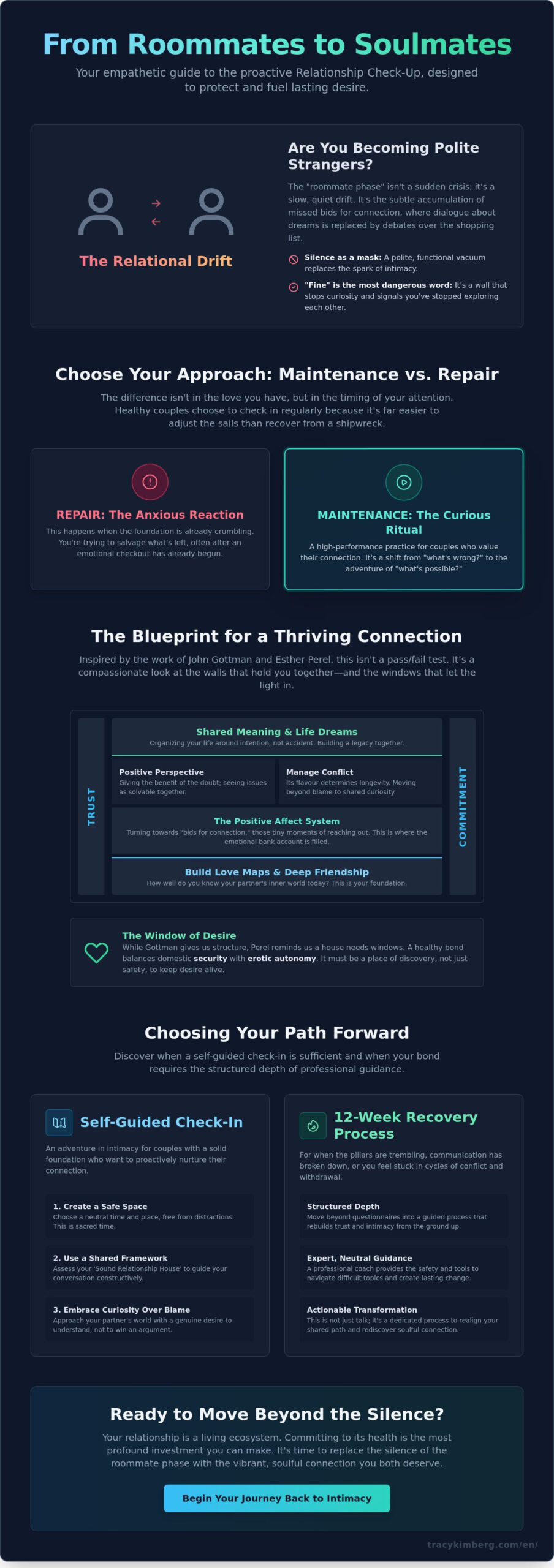
To truly understand the health of your bond, we must look at the structural integrity of what John Gottman calls the “Sound Relationship House.” This isn’t about a pass or fail grade. It’s about looking at the walls that hold you together. A comprehensive relationship check-up assesses whether your foundation is built on a deep, evolving friendship or if you’ve stopped updating the blueprints of each other’s lives. Emotional intelligence is the secret ingredient here; it’s the ability to recognise not just your own needs, but the subtle shifts in your partner’s emotional weather.
Whilst Gottman provides the structure, Esther Perel reminds us that a healthy house also needs windows. We must balance the need for domestic security with the need for erotic autonomy. If a relationship becomes too predictable, desire often fades. A deep assessment explores how you maintain that sense of “me” within the “us,” ensuring that your partnership remains a place of discovery rather than just a place of safety. If you find these pillars are trembling, seeking relationship counselling and coaching for couples can offer the professional support needed to realign your shared path.
Friendship, Intimacy, and Positive Affect
Evaluating your “Love Maps” is the first step. This involves asking how well you actually know your partner’s inner world today. Their dreams, fears, and favourite things change over time. We also look at “bids for connection,” those tiny moments where one partner reaches out for attention or affection. A healthy bond isn’t built on grand gestures but on the frequency and quality of these small interactions, including the non-sexual physical touch that signals safety and warmth. If you aren’t turning toward these bids, the emotional bank account begins to run dry. Understanding how to build emotional intimacy through these everyday moments is what separates couples who thrive from those who merely coexist.
Conflict Management and Shared Meaning
Conflict is inevitable, but its flavour determines your longevity. We analyse whether your arguments are constructive or destructive; do you move toward repair or retreat into silence? Beyond conflict, we explore your shared meaning for the 2026 version of your life. This means identifying shared values and creating “Rituals of Connection.” These are the reliable, intentional ways you turn toward each other, such as a specific morning greeting or a weekly walk, ensuring that your “us” remains a priority amongst the noise of the world.
Comparing Self-Guided Check-Ins with Professional Relationship Coaching
Contrasting the “Sunday Morning Coffee” check-in with a formal clinical assessment is essential for understanding your partnership’s needs. Whilst a casual chat over a latte builds habit and encourages immediate communication, it often lacks the diagnostic precision required for deep-seated issues. A self-guided relationship check up is typically sufficient for couples who feel generally aligned but want to polish their emotional attunement. It’s a beautiful, low-pressure way to stay curious about one another and prevent the slow drift into the roommate phase.
However, there are times when the DIY approach hits a ceiling. If your conversations frequently spiral into circular arguments or if there’s a heavy sense of “walking on eggshells,” these are clear red flags. You might find that despite your best intentions, you keep hitting the same emotional bruises. This is where an objective third party becomes invaluable. A professional can see the systemic patterns that you’re too close to notice, acting as a mirror for your dynamics rather than a judge of your characters.
The DIY Check-In: Pros and Cons
A home-based check-in has distinct advantages:
- Low pressure: It feels like a natural extension of your life together, often conducted in your favourite comfortable space.
- Consistency: It builds a reliable habit of checking in before you feel forced to check out.
- Immediate attunement: You can address minor irritations before they calcify into resentment.
The risks are equally clear. Without a mediator, difficult topics can lead to defensive “stonewalling” or “flooding,” leaving both partners feeling more disconnected than before. It’s best suited for maintenance and minor course corrections amongst couples with high existing trust.
Professional Coaching: The Transformational Edge
Professional guidance offers what many experts call “the third ear.” When you engage in relationship coaching for couples, you aren’t just talking; you’re exploring the unconscious scripts that drive your behaviour. In a clinical setting, a formal relationship check up utilises advanced research-based tools to pinpoint exact areas of disconnect. This is especially crucial for high-stakes healing, such as couples therapy for infidelity. In these moments, you need a guide who understands the neurobiology of trauma and the delicate architecture of trust. This professional support turns a reactive crisis into a proactive adventure in long-term emotional health.
How to Organise and Conduct Your Own Relationship Check-Up
Conducting a relationship check up requires more than just a list of questions. It requires the creation of a sanctuary where emotional safety is the priority. If either partner feels judged or “on trial,” the conversation will inevitably trigger a defensive response, shutting down the very intimacy you’re trying to reach. To begin, choose a neutral, comfortable centre for your discussion. Avoid the bedroom, which should remain a space for rest and erotic connection, and steer clear of the kitchen table if it’s synonymous with household bills and stress. This physical boundary helps signal to your nervous system that it’s safe to be vulnerable.
Establish clear “Rules of Engagement” before you speak. The primary rule is simple: replace blame with curiosity. Instead of asking “Why did you do that?”, try “Help me understand what that was like for you.” Use open-ended questions that invite storytelling rather than one-word answers. To ensure both of you feel truly heard, utilise the “Speaker-Listener” technique. One person speaks whilst the other listens without interrupting, eventually paraphrasing what they heard to ensure accuracy. This process validates your partner’s reality, even if you don’t entirely agree with their perspective. Close the loop by ending with genuine appreciation for the honesty shared and identify one or two actionable next steps.
The 15-Minute Weekly Pulse Check
Consistency is more powerful than intensity. A short, weekly check-in keeps the lines of communication open and prevents small irritations from calcifying into resentment. Start with simple, soft questions: “What went well for us this week?” and “How can I support you more in the coming days?” Acknowledging small wins, like a shared laugh or a helpful gesture, reinforces the “positive affect” in your bond. If you’re looking for more structured ways to engage, you can explore these exercises for couples to reconnect to build your relational skills together.
The Deep Dive: Monthly or Quarterly Reviews
Whilst weekly pulses handle the “now,” a monthly or quarterly relationship check up allows you to evaluate the “Big Three”: Finances, Intimacy, and Parenting or Family life. This is the time to address any “unfinished business” before it transforms into long-term trauma. It’s also the perfect moment to plan your next “Relationship Adventure.” Whether it’s a new hobby or a weekend away, intentional planning keeps the spark alive and ensures you’re moving toward a shared future. If you find these deep dives reveal challenges that feel too heavy to carry alone, reaching out for online therapy can provide the professional guidance needed to navigate these complex emotional landscapes safely.
Beyond the Questionnaire: Moving into 12-Week Relationship Recovery
Sometimes, a relationship check up doesn’t just suggest you need more date nights. It might expose significant cracks in your foundation that have been ignored for years. This realisation can feel overwhelming, but it’s actually the first moment of true honesty you’ve had in a long time. Instead of seeing these “cracks” as a sign of failure, we view them as the places where the light can finally get in. When the DIY approach isn’t enough to bridge the distance, a more structured, clinical intervention is required to move you from the “roommate phase” into a truly conscious partnership.
The goal is never just “staying together” for the sake of it. We want you to thrive. This often requires a dual approach where both partners commit to their own growth. Engaging in individual relationship counselling allows you to unpack your own emotional scripts whilst the couple’s work focuses on the space between you. By working on yourself, you transform the energy you bring to the partnership, making the 12-Week Relationship Recovery Process significantly more effective. This holistic method ensures that the healing is deep and systemic.
The Path to Transformational Healing
Our structured 12-week journey is designed to move you through the stages of de-escalation, restructuring, and consolidation. We use research-based methods to ensure that your progress is measurable and lasting, rather than just a temporary “therapy high.” You’ll move from a state of surviving day-to-day conflict to thriving in a connection built on mutual respect and renewed desire. This isn’t just about fixing what’s broken; it’s about building a new version of your relationship that is more resilient and soulful than the original.
Taking the First Step Today
It’s time to stop kicking the can down the road. The longer you wait to address the elephant in the room, the more resentment calcifies into a permanent wall. There is a profound sense of relief that comes from finally speaking the truth and having a Wise Guide to help you navigate the fallout. You don’t have to figure this out alone. If your relationship check up revealed that you’re ready to move beyond the questionnaire and start the real work of healing, we invite you to book a discovery call. Let’s explore how our 12-Week Relationship Recovery Process can help you reclaim the intimacy you thought was lost.
Reclaiming Your Connection for a Shared Future
The journey back to intimacy isn’t a return to the past, but an evolution into a more conscious future. By committing to a regular relationship check up, you’ve already taken the first step toward dismantling the walls of the roommate phase. You now have the tools to replace silence with curiosity and conflict with connection. Remember that your partnership is a living thing; it requires consistent nourishment and the courage to look beneath the surface of your daily routines.
If your assessment has revealed deeper patterns that feel too complex to navigate alone, there is a clear path forward. With Gottman-trained expertise and a 12-Week Relationship Recovery Process, we provide a safe and non-judgemental online environment to help you rebuild. You don’t have to stay stuck in the quiet drift of co-existence. It’s entirely possible to transform your bond into a sanctuary of mutual respect and vibrant desire. Healing is a proactive adventure, not a clinical necessity.
Book Your Relationship Discovery Call with Tracy Kimberg today to begin your transformation. Your partnership deserves the care and professional insight needed to thrive in 2026 and beyond. We are here to guide you every step of the way.
Frequently Asked Questions
What is a relationship check up, and how often should we do one?
A relationship check up is a proactive review of your partnership’s emotional and structural health, designed to identify growth areas before they become crises. Ideally, you should conduct a brief fifteen-minute “pulse check” once a week to stay attuned to daily needs. For a deeper assessment of your long-term goals and intimacy, a more comprehensive quarterly review is recommended. This consistent rhythm prevents the slow drift into the roommate phase.
Will a relationship check up cause more arguments?
It might surface underlying tensions, but its purpose is to provide a safe, structured environment for resolution rather than ignition. Arguments often happen because feelings are suppressed until they explode; a check-up allows you to address these feelings whilst they are still manageable. By following established rules of engagement, you move away from reactive blame and toward a shared understanding of your dynamic, which actually reduces conflict over time.
What are the signs that we need a professional check-up rather than a DIY one?
You should seek professional guidance if your attempts at conversation consistently lead to “stonewalling” or if you feel you’re “walking on eggshells.” If the same circular arguments repeat without any resolution, it’s a sign that the DIY approach has reached its limit. A professional Wise Guide provides the objective mirror needed to see through the fog of your own emotional triggers and offers a safe container for deeper work.
How do we talk about sex and intimacy during a check-up without feeling awkward?
Start by acknowledging the awkwardness and framing the conversation around desire and connection rather than performance or “to-do” lists. Focus on the emotional quality of your intimacy, asking what makes you feel truly seen and valued by one another. By discussing the “erotic mind” rather than just physical mechanics, you create a space for discovery. This shift in focus often makes the conversation feel more like an adventure and less like a clinical critique.
What should we do if my partner refuses to participate in a check-up?
Focus on your own needs and invite them in with curiosity rather than a demand. You might say, “I’ve been feeling a bit disconnected lately and I’d love to spend some time hearing about your inner world.” If they still refuse, you can engage in individual relationship counselling to explore your own role in the dynamic. Often, when one partner changes their behaviour and responses, the other naturally shifts in response over time.
Can a relationship check up help if we have already experienced infidelity?
Yes, but in cases of betrayal, a professional relationship check up is far more effective than a self-guided one. Infidelity creates a trauma-informed landscape that requires a specialist to navigate safely without causing further harm. A structured assessment helps identify the vulnerabilities that existed before the breach and provides a clear, research-based roadmap for rebuilding trust through a dedicated process like our 12-Week Relationship Recovery Process.
How do we keep the conversation “empathetic” rather than “clinical”?
Use soft, evocative language and focus on “I” statements that describe your internal experience. Instead of listing problems like a technician, share how certain behaviours make you feel in the context of your bond. Empathy grows when you listen with the intent to understand your partner’s reality rather than to build a case for your own. Keep the focus on the “us” you are building together and the possibility of a shared future.
What are the best questions to ask during a relationship check-in?
Focus on questions that invite storytelling, such as “What was a moment this week when you felt really loved by me?” or “Is there a dream you’ve been thinking about lately?” These inquiries go beyond logistics and touch the soulful parts of your partnership. By asking about their inner world, you update your “Love Maps” and ensure that your connection remains an active, evolving experience rather than a static arrangement.

Article by
Tracy Kimberg
Tracy Kimberg is a Relationship Expert, Couples Therapist and Coach with a dedicated focus on helping couples and individuals rebuild connection, trust and emotional safety in their relationships. Drawing on the research of John and Julie Gottman, the relational insights of Esther Perel, and years of hands-on therapeutic experience, Tracy offers a warm, non-judgemental and deeply compassionate approach to modern relationships.
Based in Dorset, Tracy works with couples navigating communication breakdowns, betrayal, intimacy challenges, separation, family dynamics and life transitions. Known for creating a safe and grounded therapeutic space, she combines practical tools with emotional depth to help clients move beyond survival patterns and towards meaningful, lasting change.
With a reputation for empathy, professionalism and dedication to her clients’ growth, Tracy is passionate about helping people feel seen, understood and empowered — both within their relationships and within themselves.
Disclaimer
Disclaimer:
The information shared in this article is intended for educational and informational purposes only and should not be considered a substitute for professional therapeutic, psychological, medical or legal advice. Every individual and relationship is unique, and the perspectives offered are based on general therapeutic principles, research and professional experience.
Reading this article does not establish a therapist-client relationship with Tracy Kimberg. If you are experiencing significant emotional distress, relationship crisis, trauma, or mental health concerns, it is important to seek support from a qualified professional appropriate to your individual circumstances.
All content remains the intellectual property of Tracy Kimberg and may not be reproduced or distributed without permission.