

What if the most heartbreaking conversation you will ever have could actually become the foundation for your children’s long-term emotional resilience? You likely feel a heavy weight of guilt right now, fearing that your words might fracture their world or that you will lose your footing amongst their tears. It’s natural to feel uncertain about how to tell kids about separation when your own heart is still finding its rhythm. You want to protect them, yet you aren’t sure which language is safe to use or how to manage the potential for emotional outbursts.
We believe that whilst the structure of your home is changing, the integrity of your connection doesn’t have to break. This guide provides a psychologically grounded, age-appropriate framework for sharing this news whilst maintaining your children’s sense of security. You will discover a clear plan for the conversation and practical tools to manage the complex emotions that arise for both you and your little ones. We’ll explore how to transition into a healthy co-parenting dynamic that ensures your children feel loved, seen, and profoundly safe as you move forward together.
Key Takeaways
- Master the emotional foundation required to present a united front and protect your children from the weight of your own distress.
- Access a compassionate script for how to tell kids about separation that uses honest, no-fault language to preserve their sense of security.
- Learn to adapt your conversation for different developmental stages, ensuring your message resonates whether your child is a toddler or in primary school.
- Discover how to interpret and hold space for the emotional aftermath, including common reactions like denial, anger, or quiet withdrawal.
- Build a framework for conscious co-parenting that prioritises your children’s well-being and maintains a respectful, positive perspective of the other parent.
Preparing for the Conversation: The Emotional Foundation
You are standing on the precipice of a conversation you never wanted to have. It is heavy, and the urge to rush through it just to find the other side is understandable. However, the success of this moment depends less on your specific words and more on the emotional atmosphere you cultivate beforehand. To understand how to tell kids about separation, you must first stabilise the ground beneath your own feet.
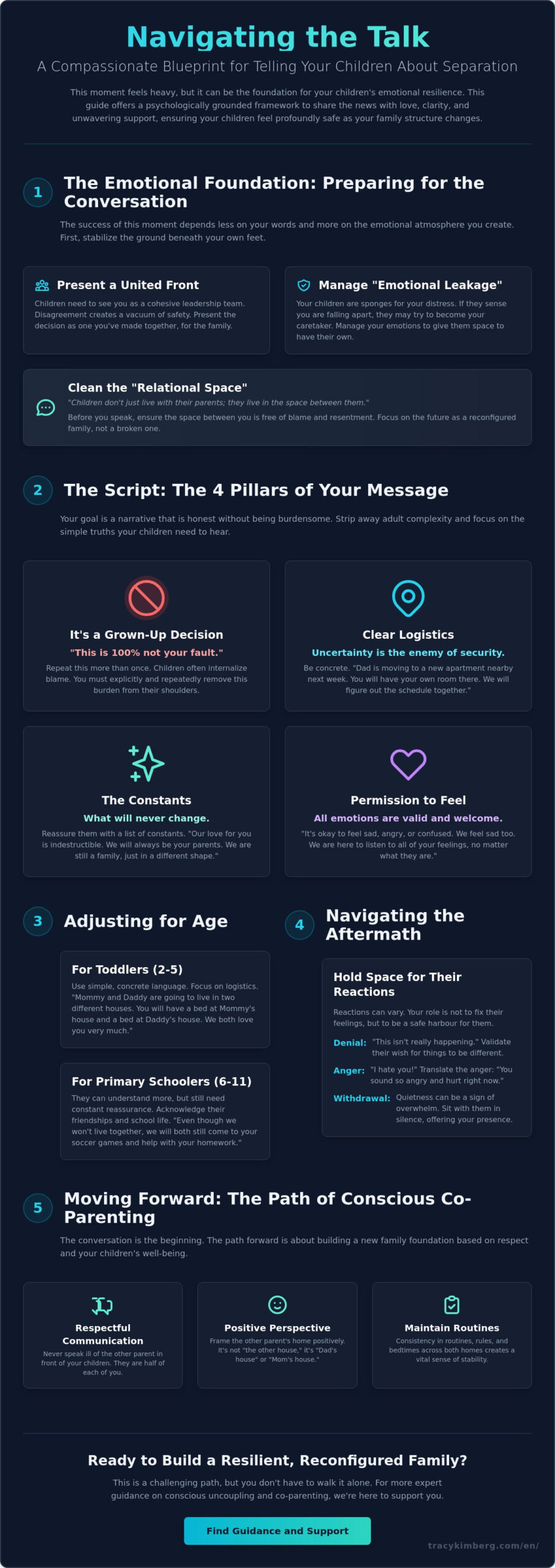
Presenting a united front is paramount. Even if the decision to end the relationship was unilateral, children need to see their parents as a cohesive leadership team. When parents disagree in front of the child about the “why” or the “how”, it creates a vacuum of safety. Your primary task is to manage “emotional leakage”. Children are like sponges for parental distress; if they sense you are falling apart, they may unconsciously step into the role of your caretaker. This role reversal can exacerbate the long-term effects of divorce on children, as they lose their own space to grieve whilst trying to hold you together.
Choosing the right time and place is equally critical. Avoid high-stress days, school nights, or moments immediately before bed. Your children will need time to process, ask questions, and simply sit in your presence. The core message must be unwavering: whilst the living arrangements are changing, the love you have for them is constant and indestructible. This is the emotional anchor that will prevent them from drifting into feelings of abandonment.
The Concept of the “Relational Space”
As Esther Perel often suggests, children don’t just live with their parents; they live in the space between them. If that space is filled with unresolved resentment or unspoken anger, the children breathe it in. Before you speak, you must sanitise this conflict. This does not mean pretending the pain doesn’t exist, but it does mean ensuring that your adult issues do not contaminate the children’s environment. Focus on the future as a reconfigured family unit rather than a broken one. By cleaning the relational space, you allow your children to focus on their own adjustment rather than managing your adult conflict.
Practical Logistics Before You Speak
Preparation requires more than just emotional resolve; it requires a practical plan. Before you gather the family, ensure you have agreed on a basic “why” that removes all blame from the children. This is a grown-up decision, and they must hear that clearly. We recommend following these steps:
- The 48-Hour Rule: Ensure you have at least two days of “low-demand” time following the news. No parties, no exams, and no major transitions.
- The United Script: Agree on the key facts of who is moving and when. Inconsistency breeds fear.
- Professional Support: If the conflict between you is currently too high to co-present a calm front, consult with a professional to mediate the preparation process.
By laying this foundation, you ensure that the news of how to tell kids about separation is delivered from a place of strength and clarity, allowing your children to feel held amongst the coming changes.
The Script: What to Say and How to Say It
Finding the right words for this moment can feel like trying to hold water in your hands; you want to be clear and firm, yet you fear the message will slip through your fingers and cause pain. The key is to strip away the complexity of your adult relationship and focus on the simple, foundational truths your children need to hear. When considering how to tell kids about separation, your goal is to provide a narrative that is honest without being burdensome, and firm without being cold.
Core Elements of the Message
The message must be delivered with a “no-fault” perspective. This isn’t about hiding the truth; it’s about protecting the children from a conflict that isn’t theirs to resolve. You are not just delivering news; you are redefining the family’s structure. Understanding how to tell kids about separation requires a commitment to radical honesty regarding the logistics, paired with radical love regarding the relationship. Your script should include these non-negotiable points:
- The “Grown-Up Decision”: Explicitly state that this is a decision made by the adults and that it is 100% not the children’s fault.
- Immediate Logistics: Clearly explain who is moving, where they will live, and when the change will happen. Uncertainty is the enemy of security.
- The Constants: List the things that will stay the same, such as their school, their favourite toys, their pets, and your shared commitment to their happiness.
Handling “The Why” with Integrity
Handling the “why” is often where parents stumble into the “truth-bombing” trap. Whilst you want to be honest, you must avoid oversharing adult intimacy issues or grievances. Seeking expert advice on talking to children about divorce can help you calibrate your language to their specific developmental age. Instead of focusing on what went wrong, frame the separation as a proactive choice to find a healthier way of being a family.
For children, the conscious separation narrative can be summarised in one simple truth: “Conscious separation means we are choosing to live in two different homes so we can be the best, happiest parents possible for you, whilst our love for you stays exactly the same.”
Finally, remember the power of the pause. After you speak, allow the news to land in silence. Your children may need minutes, or even days, to process what they have heard. Sit with them in that stillness; your presence is more comforting than a thousand extra explanations. If you need support in structuring these delicate conversations, our conscious approached divorce and separation services provide a safe, professional space to plan your path forward with confidence.
Adjusting Your Approach Based on Your Child’s Age
A child’s understanding of the world is not static; it evolves through distinct developmental lenses. When you are planning how to tell kids about separation, you must meet them where they are cognitively and emotionally. A three-year-old processes the news through their physical senses and daily rhythms, whilst a thirteen-year-old views it through the prism of social identity and personal autonomy. Tailoring your delivery ensures the message lands with the necessary clarity rather than causing unnecessary confusion.
The Toddler Perspective: Security in Routine
For children aged two to five, the concept of “separation” is abstract. Their world is defined by who makes their breakfast and who tucks them in at night. Focus on concrete, physical changes. Use simple stories or play to illustrate the transition, perhaps using dolls to show how one parent will live in a new house. Visual aids are incredibly powerful at this stage. A colour-coded calendar can help them visualise when they will be with each parent, providing a sense of predictability in an unpredictable time. Keep a close watch for regressive behaviour, such as bed-wetting or increased clinginess. These aren’t “naughty” actions; they are a toddler’s way of communicating that their internal world feels shaky.
The Primary Years: Fairness and Social Impact
Primary schoolers, aged six to twelve, are deeply invested in the idea of fairness. They may struggle with the “why” and might even feel a sense of social shame amongst their peers. It is vital to address these feelings head-on. Reassure them that their family is simply reconfiguring, not disappearing. This age group needs to know how to support your kids during a divorce by focusing on their social stability. Ensure they know they can still attend their favourite clubs and see their friends, as their external world often feels like their only anchor when their internal world is in flux.
The Teenager Perspective: Respect and Truth
Teenagers require a different level of honesty. They can often sense the tension long before the conversation happens, so “truth-bombing” them with a sudden announcement can feel like a betrayal of their intelligence. Acknowledge their need for autonomy. Give them space to be angry, distant, or even indifferent without taking it personally. The greatest risk here is the “confidant trap”, where a parent begins to lean on the teen for emotional support or uses them as a messenger. This is a heavy burden that can damage their own developing relationships. If you notice your teen struggling to process the shift, encouraging them to engage with therapy for teenagers can provide a vital, neutral space for them to voice complex feelings they might feel “disloyal” sharing with you. Regardless of age, the common thread is a desperate need to know that they remain your priority and that their safety is non-negotiable.
Navigating the Emotional Aftermath and Reactions
The first time you sit down to share this news isn’t the finish line. It’s the opening chapter of a long, unfolding story. When you consider how to tell kids about separation, remember that the initial disclosure is merely the first note in a much longer symphony of adjustment. Your children will process this information in waves, often revisiting the same questions as they attempt to map out their new reality. Your role now shifts from being a messenger to being a “secure base”, a term often used by attachment experts to describe a parent who can remain steady whilst their child’s world feels shaky.
Reactions will vary wildly. Some children may respond with immediate, visceral grief, whilst others might offer a haunting silence or ask if they can go back to their video games. This “business as usual” response is often a psychological defence mechanism; the news is simply too large to digest all at once. Others may manifest their distress through anger, which is frequently a mask for deep-seated fear or a sense of powerlessness. During this time, maintaining familiar routines is essential. Keeping bedtimes, mealtimes, and school runs consistent provides an external sense of order that helps regulate their internal chaos.
Decoding Behaviour as Communication
It’s helpful to view challenging behaviour not as a personal attack, but as a form of communication. When a child “picks a side” or directs intense blame toward one parent, they are often trying to simplify a complex, painful situation into something they can control. Validating their feelings is crucial. You might say, “I can see you are incredibly angry with me right now, and it’s okay to feel that way,” without feeling the need to defend your adult choices. By holding space for their big feelings without becoming defensive, you teach them that their emotions are survivable and that your love is robust enough to handle their pain.
Self-Care for the Parent
You cannot be a calm container for your children’s emotions if your own internal world is overflowing with unprocessed grief. It’s vital to build a support network of friends, family, or professionals who can hold you whilst you hold your children. This is the time to embrace “good enough” parenting; you don’t have to be perfect, you just have to be present. As you navigate this transition, exploring moving on after separation and reclaiming your identity can be a vital part of ensuring you show up as your best self for your children. Seeking individual relationship counselling can provide you with the psychological tools to process your own transition, ensuring you don’t inadvertently lean on your children for emotional support. If you’re feeling overwhelmed by the weight of these conversations, our conscious approached divorce and separation support can help you navigate this transition with clarity and compassion.
Moving Forward: The Path of Conscious Co-parenting
Separation is not a destination; it’s a profound transition into a new way of being a family. Once you have navigated the initial challenge of how to tell kids about separation, the focus shifts to the long-term architecture of your children’s lives. This stage requires you to move from the intimacy of a romantic partnership to the structured, respectful collaboration of business partners in the “firm” of parenting. Whilst the romantic bond has dissolved, the parental bond remains a lifelong commitment that requires a new set of boundaries and communication channels.
Adopting the Gottman approach to this transition involves maintaining a positive perspective of the other parent. This doesn’t mean you must ignore past hurts, but it does mean you consciously choose to highlight the other parent’s strengths in front of your children. When a child hears one parent speak respectfully of the other, their own internal sense of self remains intact. They are, after all, a product of both of you. Establishing clear, neutral communication channels for logistics is essential. By treating co-parenting as a professional, child-centred endeavour, you reduce the risk of emotional “leakage” that can distress your children. If the transition feels particularly fraught, seeking amicable separation guidance can provide a structured path toward this new relational reality.
Creating a New Family Narrative
The goal of conscious separation is to prove that two happy, separate homes are infinitely better for a child’s nervous system than one high-conflict environment. Start by celebrating “new normals” and creating traditions that belong specifically to this reconfigured family unit. Whether it’s a specific Friday night film tradition or a new way of handling birthdays, these rituals provide a sense of continuity. Handling holidays with grace requires advance planning and a commitment to the child’s experience over your own adult preferences. By focusing on the future rather than the breakdown of the past, you help your children write a story of resilience rather than one of loss.
When to Seek Professional Help
Identifying when a child is struggling beyond the normal adjustment period is a key responsibility for co-parents. Look for persistent signs of withdrawal, significant changes in school performance, or prolonged regressive behaviour. Sometimes, the conflict between parents remains too high to navigate alone. In these instances, couples therapy can pivot into effective co-parenting coaching. This isn’t a sign of failure; it’s a proactive strength. It shows your children that you are willing to do the hard work of personal growth to ensure their long-term emotional health and security.
Building Your New Family Foundation
You now have the tools to shift from a place of fear to one of conscious leadership. By stabilising your own emotional foundation and using a clear, no-fault script, you’ve learned how to tell kids about separation in a way that preserves their fundamental sense of safety. Whether you are navigating the concrete needs of a toddler or the complex autonomy of a teenager, your presence remains their most vital anchor as the family reconfigures.
Transitioning into this new chapter doesn’t have to be a solitary struggle. I offer a research-based approach grounded in the insights of experts like Gottman and Perel to help you navigate these intricacies with professional care. Through my specialised 12-Week Relationship Recovery Process, we provide a safe, non-judgemental environment to help your family heal and thrive. Book a Conscious Separation Discovery Call with Tracy to begin this journey today. You are capable of guiding your children through this change with grace; healing is not just possible, it is already beginning.
Frequently Asked Questions
How long should we wait after deciding to separate before telling the kids?
You should wait until you have a firm, concrete plan for living arrangements but before any physical changes begin in the home. Generally, aim for two to three weeks before a parent moves out. This timeframe provides enough space for the initial shock to settle whilst ensuring the transition feels tangible. Telling them too early can create prolonged anxiety; telling them too late can feel like a betrayal of their trust.
Should we tell all the children at the same time if they are different ages?
It is best to tell all your children together initially, regardless of their ages. This prevents siblings from feeling burdened by secrets or excluded from the family narrative. Once the collective conversation is over, you can then spend individual time with each child to address their specific developmental concerns. This dual approach ensures everyone feels included in the family transition whilst receiving the age-appropriate detail they need.
What if my partner and I cannot agree on what to say?
You must delay the conversation until you have reached a consensus if you cannot agree on a narrative. Speaking to your children whilst you are still in active conflict creates a vacuum of safety that they will instinctively try to fill. Consider seeking professional coaching to help you align on a “no-fault” story. It is vital that you present a united front to protect the children’s emotional security.
How much detail should I give about why we are separating?
Focus on the “what” rather than the “why” of your adult grievances when considering how to tell kids about separation. Children need to know how their daily lives will change, not the intricate details of your relationship’s breakdown. Keep the explanation centred on the idea that you have made a grown-up decision to live apart so that everyone can be happier and healthier in the long term.
Is it normal for my child to have no reaction at all when I tell them?
It is completely normal for a child to have no immediate reaction or to simply ask if they can go back to playing. This is often a psychological defence mechanism called “delayed processing,” where the news is simply too large for their nervous system to handle at once. Don’t mistake their silence for indifference; they are simply taking the time they need to feel safe enough to engage.
What should I do if my child asks if we will ever get back together?
You must be honest and gentle whilst avoiding the trap of offering false hope. If the decision is final, it’s kinder to say, “No, we have decided this is the best way forward for our family,” rather than saying “we don’t know.” Providing a clear, firm answer helps the child begin the necessary process of grieving and eventually accepting the new family structure with a sense of reality.
How can I help my child feel safe moving between two homes?
You can help your child feel secure by ensuring both homes have a sense of familiarity and predictable routine. Having duplicate favourite items, such as a specific brand of cereal or a beloved teddy, can bridge the gap between environments. Most importantly, ensuring that your communication with the other parent remains respectful and business-like reduces the relational static that often makes children feel unsafe during transitions between houses.
Can separation actually be better for my children in the long run?
Research into how to tell kids about separation often shows that children thrive more in two peaceful homes than in one high-conflict household. Chronic exposure to parental tension can have a significant impact on a child’s nervous system and future relationship patterns. By choosing a conscious, amicable path, you are modelling healthy boundaries and the possibility of positive transformation even in the midst of difficult life changes.

Article by
Tracy Kimberg
Tracy Kimberg is a Relationship Expert, Couples Therapist and Coach with a dedicated focus on helping couples and individuals rebuild connection, trust and emotional safety in their relationships. Drawing on the research of John and Julie Gottman, the relational insights of Esther Perel, and years of hands-on therapeutic experience, Tracy offers a warm, non-judgemental and deeply compassionate approach to modern relationships.
Based in Dorset, Tracy works with couples navigating communication breakdowns, betrayal, intimacy challenges, separation, family dynamics and life transitions. Known for creating a safe and grounded therapeutic space, she combines practical tools with emotional depth to help clients move beyond survival patterns and towards meaningful, lasting change.
With a reputation for empathy, professionalism and dedication to her clients’ growth, Tracy is passionate about helping people feel seen, understood and empowered — both within their relationships and within themselves.
Disclaimer
Disclaimer:
The information shared in this article is intended for educational and informational purposes only and should not be considered a substitute for professional therapeutic, psychological, medical or legal advice. Every individual and relationship is unique, and the perspectives offered are based on general therapeutic principles, research and professional experience.
Reading this article does not establish a therapist-client relationship with Tracy Kimberg. If you are experiencing significant emotional distress, relationship crisis, trauma, or mental health concerns, it is important to seek support from a qualified professional appropriate to your individual circumstances.
All content remains the intellectual property of Tracy Kimberg and may not be reproduced or distributed without permission.