

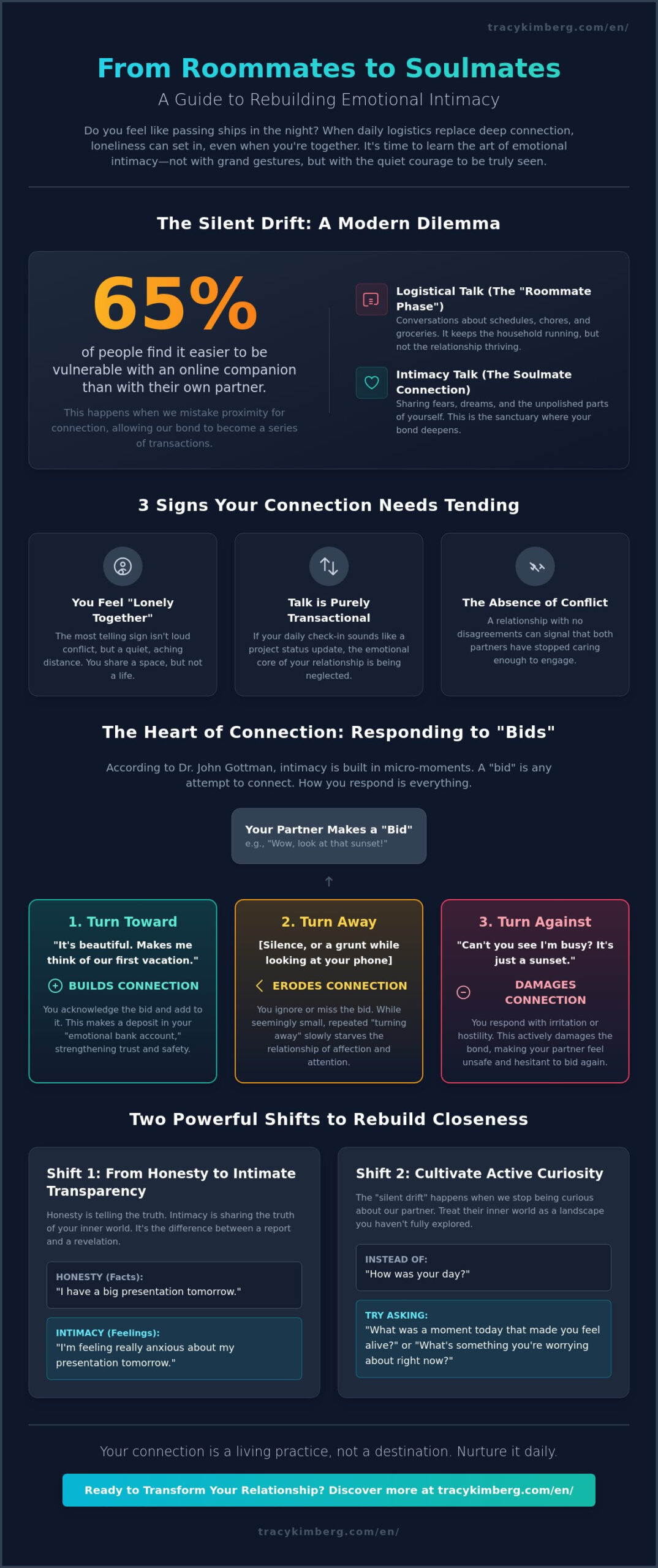
You sit across from each other at dinner, the air filled with the clink of cutlery and talk of school runs or grocery lists, yet you feel like two passing ships in the night. It’s a heavy, quiet ache; that sense of loneliness whilst being in a relationship where conversations have dwindled into a repetitive loop of logistics. Recent data shows that 65% of people now find it easier to open up to an online companion than to their own partner. If you’ve felt this widening gap, learning how to build emotional intimacy is the vital first step toward reclaiming your bond. It isn’t about grand gestures; it’s about the quiet courage to be seen in your most authentic, unpolished state.
We agree that a relationship shouldn’t feel like a series of transactions or a struggle to be understood. In this guide, you’ll discover the psychological foundations and practical rituals needed to dismantle your fear of vulnerability and foster a connection that feels both safe and revitalising. We’ll explore how to move beyond surface-level chatter to create a space where you both feel truly seen, ultimately reducing relationship anxiety and deepening your physical closeness through a more profound emotional bond.
Key Takeaways
- Distinguish between logistical coordination and the deep psychological safety required for true emotional intimacy.
- Master the “Bids for Connection” framework to turn towards your partner’s emotional needs in everyday moments.
- Explore how to build emotional intimacy by overcoming the fear of losing your independence whilst opening your heart.
- Cultivate practical rituals like “Love Maps” to stay updated on your partner’s changing internal world.
- Treat your connection as a living practice that requires regular check-ups to maintain long-term resilience.
Understanding Emotional Intimacy: Beyond the “Roommate Phase”
We often mistake proximity for connection. You can share a mortgage, a bed, and a digital calendar without ever truly touching your partner’s inner world. At its core, emotional intimacy is a shared psychological space where both individuals feel safe enough to be vulnerable. It is the sanctuary you build together. Whilst logistical talk, such as coordinating school runs or grocery lists, keeps the household running, it is intimacy talk that keeps the relationship alive. This involves sharing fears, longings, and the unfiltered parts of your identity that you hide from the rest of the world.
Many couples eventually slide into what therapists call the “Roommate Phase.” This isn’t a sign of a broken relationship; it is a natural plateau where the comfort of routine replaces the spark of discovery. Data from 2025 suggests that 65% of individuals find it easier to open up to an online companion than to their own partner. This “silent drift” happens when we stop being curious about each other. Understanding how to build emotional intimacy requires shifting from a state of co-existence to a state of active, conscious engagement.
There is a profound link between your emotional bond and your physical life that many guides overlook. Emotional closeness is the vital prerequisite for sustainable physical desire. In long-term partnerships, we often find that the “spark” isn’t lost; it is simply buried under layers of emotional detachment. To truly desire someone, you must first feel seen and accepted by them. Without this foundation, physical intimacy can start to feel performative or even hollow.
The Difference Between Honesty and Intimacy
Simply telling the truth is a moral obligation, but intimacy is a choice to be transparent. You can be honest about your schedule without being intimate about your feelings. Building a secure base requires emotional transparency. This means sharing not just what happened during your day, but how those events affected your internal state. Focus on sharing your inner world in manageable portions, using “I” statements to describe your feelings rather than focusing on your partner’s actions.
Signs Your Emotional Intimacy Needs Attention
The most telling sign of a drift isn’t high-conflict shouting; it is often the absence of noise. A total lack of conflict can sometimes signal that both partners have stopped caring enough to engage. If you feel “lonely together” or find that your conversations have become entirely transactional, your bond needs tending. Recognising this quiet distance is the first step in learning how to build emotional intimacy and moving back toward a vibrant, deeply connected partnership. If you suspect something deeper is at play, it may be worth exploring the signs of emotional neglect in marriage to better understand the patterns that may be keeping you apart.
The Psychology of Connection: Bids, Barriers, and Bridges
Connection isn’t a static state you achieve; it’s a rhythmic series of micro-choices made every single day. John Gottman, a pioneer in relationship research, identifies these choices as “Bids for Connection.” A bid is any attempt for attention, affirmation, or affection, ranging from a simple sigh to a direct request for a hug. When your partner makes a bid, you have three options: you can turn toward them with acknowledgement, turn away by ignoring them, or turn against them with hostility. Consistent “turning toward” is the fundamental unit of how to build emotional intimacy, as it signals to your partner that they are valued and heard.
Emotional safety is the essential soil in which these connections grow. Without a sense of safety, vulnerability feels like an invitation to be hurt rather than a bridge to closeness. Many couples struggle because their attachment styles, often formed in childhood, create a mismatch in how they seek safety. Those with an anxious attachment may “pursue” connection with a frantic energy that feels overwhelming, whilst those with an avoidant style may “distance” themselves to maintain a sense of control. Understanding these internal blueprints is a vital part of learning how to build emotional intimacy that lasts.
Mastering the Art of “Turning Toward”
Intimacy is built in the tiny, seemingly mundane moments. If your partner mentions a headline they read or touches your shoulder as they walk past, these are bids for your presence. By responding with interest, you make a deposit into your “emotional bank account.” This reserve of trust becomes your cushion during times of stress. Over time, the cumulative effect of ignoring these small bids is far more damaging to a relationship than a single large argument, as it leads to a slow, painful erosion of trust.
Recognising Your Attachment Patterns
We often carry the ghosts of our past into our current partnerships. If you find yourselves trapped in a “pursuer-distancer” dynamic, where one partner’s request for closeness triggers the other’s need to retreat, you are likely reacting to old attachment wounds. Moving toward a secure bond involves recognising these triggers without judgement. It’s about learning to stay present when you want to run and learning to be patient when you want to chase. If you feel stuck in these repetitive loops, Relationship Counselling and Coaching for Couples can help you navigate the complex terrain of your shared history and build a more resilient future together.
Why We Drift: Overcoming the Barriers to Closeness
Drifting apart isn’t always a result of neglect; sometimes, it is a subconscious strategy for self-preservation. One of the most significant barriers to closeness is the fear of engulfment, the worry that becoming “too close” will lead to a loss of your individual identity. We crave belonging, yet we fear being swallowed by the needs of another. This tension creates a “push-pull” dynamic that makes learning how to build emotional intimacy feel like a risky endeavour. When the fear of losing oneself outweighs the desire for connection, we instinctively create distance.
Modern life adds another layer of complexity through digital distraction. The phenomenon of “phubbing,” or phone snubbing, has become a silent wedge in many partnerships. When you choose your screen over your partner’s gaze, you are essentially turning away from a bid for connection. This creates a cumulative sense of being second best, which eventually leads to the “roommate phase” where you share a space but no longer share a life. In fact, 78% of dating app users experience burnout, and this exhaustion often carries over into established relationships, making the effort of deep conversation feel insurmountable.
For successful singles and couples who find themselves struggling with this modern fatigue, Rachel Mailer Coaching provides the tailored guidance needed to rediscover the path to meaningful connections.
Trust, once broken through infidelity or smaller betrayals, also creates formidable “intimacy blocks.” Without a foundation of safety, the heart remains guarded. This often manifests as “kitchen-sinking,” a destructive habit where every past grievance is thrown into a current argument. Instead of resolving the issue at hand, the conversation becomes a weight too heavy to carry, preventing any new closeness from taking root. Learning how to build emotional intimacy in the wake of such blocks requires a patient, trauma-informed approach to rebuilding safety. For couples who have experienced this kind of deep fracture, a 12 week relationship recovery programme can offer the structured, time-bound container needed to move from the brink of collapse toward renewed connection.
The Vulnerability Hangover
Have you ever shared something deeply personal, only to feel an intense urge to withdraw the next day? This is the “vulnerability hangover.” It is a natural reaction to the exposure that comes with emotional honesty. Feeling “too seen” can trigger a sense of shame or a fear of judgement, causing us to retreat into the safety of surface-level conversation. Normalising this feeling is essential; it is a sign that you are pushing into new, meaningful territory. The key is to acknowledge the discomfort rather than letting it drive you back into isolation.
The Impact of Unresolved Conflict
Conflict itself isn’t the problem; it is the failure to repair that causes damage. When partners engage in “stonewalling,” building a metaphorical fortress around themselves, they effectively shut down all emotional pathways. Repair is the process of acknowledging the hurt and reconnecting. Utilising the Gottman Method therapy UK approach helps couples move away from defensive posturing and toward constructive dialogue. It teaches that the goal isn’t to win the argument, but to understand the vulnerability hidden beneath the anger, allowing the bond to be restored through mutual understanding.
How to Build Emotional Intimacy: Five Practical Rituals
Moving from the “roommate phase” back into a deep, soulful connection isn’t achieved through a single grand gesture. It is won in the small, quiet moments of intentionality. Understanding how to build emotional intimacy requires a shift from “Functional Time,” which is spent managing the household, to “Sacred Time,” which is reserved for the relationship itself. Whilst Functional Time is about efficiency, Sacred Time is about presence. It is a space where you put down your shields and pick up your curiosity, allowing active, non-judgemental listening to become your primary tool for reconnection.
Ritual 1: The Daily Stress-Reducing Conversation
This is a 20-minute, device-free ritual designed to help you decompress together. The rules are strict: no problem-solving and no unsolicited advice. Your only job is to be your partner’s teammate against the outside world. When they vent about a difficult colleague or a stressful commute, respond with empathy rather than solutions. By validating their external stressors, you build internal bonds. This consistent responsiveness acts as a buffer, ensuring that the stresses of life don’t become a wedge between you.
Ritual 2: Meaningful Enquiry and Love Maps
We often assume we know everything about our partner, but people are evolving landscapes. A “Love Map” is the part of your brain where you store the details of your partner’s world. To keep this map updated, you must move beyond “How was your day?” and ask questions that invite depth, such as “What has been weighing on you lately?” or “What are you most looking forward to this month?” Using specific exercises for couples to reconnect can provide a structured way to rediscover each other’s dreams and fears, ensuring you don’t become strangers sharing a kitchen.
Ritual 3: Physical Touch Without Expectation
Intimacy often withers when physical touch becomes synonymous with a request for sex. To lower the pressure and increase safety, practice non-sexual physical affection. The “6-second kiss” is a powerful tool; it is long enough to feel significant and short enough to fit into a busy morning. This simple act resets the nervous system and signals to the brain that you are in a safe, loving environment. Whether it is a long hug or holding hands whilst watching television, these moments of touch act as a bridge to deeper desire. If you find that these rituals feel out of reach, our Relationship Counselling and Coaching for Couples offers a supportive space to practise these skills under expert guidance.
Turning Intimacy into a Sustainable Practice
Intimacy isn’t a destination you reach and then inhabit forever; it’s a muscle that requires regular, deliberate exercise. To keep your connection vibrant, you must move away from the idea that relationships should “just work” without effort. Instead, consider a regular relationship check up as a preventative tool. This proactive approach allows you to identify small drifts before they become deep chasms. When you understand how to build emotional intimacy as a rhythmic practice, you create a foundation that can weather any storm.
Often, the most profound changes in a partnership begin with the individual. Engaging in individual relationship counselling isn’t about fixing yourself in isolation. It’s about exploring your own triggers and attachment wounds so you can show up more fully for your partner. By cultivating your own sense of self, you actually increase the vitality of the relationship. This personal growth ensures you don’t lose your identity whilst opening your heart to another, preventing the stagnant energy that often leads to the roommate phase.
When to Seek Professional Guidance
There are times when the emotional disconnect feels too heavy to lift on your own. If you find yourselves trapped in repetitive cycles of “stonewalling” or if trust has been severely fractured, a neutral third party can provide the clarity you need. Professional support helps identify the “blind spots” in your communication that you simply cannot see from the inside. Our 12 week relationship recovery process offers a structured, research-based framework to help you dismantle your defences and rebuild a secure base together in a safe environment.
Maintaining the Bridge Long-Term
Sustainable closeness requires a conscious effort, particularly during the second half of a long-term partnership. It’s vital to embrace the “ebb and flow” of connection, accepting that intimacy isn’t a constant, high-intensity state. There will be seasons of distance and seasons of profound closeness. The goal isn’t perfection, but the willingness to keep coming back to the table. Healing is entirely possible if both partners are willing to be truly seen, turning the work of connection into a proactive and positive adventure for the long term.
Stepping into a Deeper Connection
Realising that your relationship has entered the “roommate phase” can feel disheartening, but it’s actually an invitation to evolve. You’ve explored how small, daily bids for connection and the courage to remain curious about your partner’s inner world are the real secrets to lasting closeness. By prioritising “sacred time” over mere logistics, you move from simply co-existing to truly being seen. Understanding how to build emotional intimacy isn’t a one-time event; it’s a rhythmic, beautiful practice of returning to one another with open hearts and steady presence.
If you feel the distance has become too wide to bridge alone, you don’t have to navigate this landscape without a map. We provide a safe, non-judgemental environment where you can engage in a 12-Week Structured Relationship Recovery Process. This research-based approach, grounded in the insights of Gottman and Perel, offers a clear path out of the silence and back toward each other. Begin your journey to deeper connection with a free discovery call today. Your relationship is a living thing; with the right care and intention, it can feel vibrant and new again.
Frequently Asked Questions
What is the first step to building emotional intimacy if we have grown apart?
The first step is acknowledging your own contribution to the distance rather than pointing fingers at your partner. It begins with an internal shift from resentment to curiosity. By asking yourself what you’ve been withholding or where you’ve closed off, you open the door for a more honest dialogue. This self-awareness is the bedrock of learning how to build emotional intimacy after a period of drift.
Can emotional intimacy be restored after infidelity?
Restoring closeness after infidelity is entirely possible, provided there is a dedicated commitment to transparency and healing. It involves a painful but necessary process of deconstructing the betrayal and understanding the unmet needs that preceded it. Many couples find that a 12-Week Relationship Recovery Process offers the structured safety needed to navigate this trauma and eventually forge a bond that is more resilient than before.
How do I talk to my partner about our lack of closeness without them getting defensive?
To avoid triggering a defensive response, initiate the conversation using a “softened startup” that focuses on your own feelings of longing. Instead of saying “You never talk to me,” try saying “I’ve been feeling a bit lonely lately and I really miss our deep chats.” By framing the issue as a desire for more of them rather than a critique of their behaviour, you invite cooperation instead of conflict.
Is it possible to have a healthy relationship without deep emotional intimacy?
Whilst some couples maintain stable “parallel lives” based on shared goals and logistics, a lack of deep emotional intimacy often leaves the relationship vulnerable during times of crisis. Without that psychological safety, the partnership may feel more like a business arrangement than a soulful connection. Most people find that true relationship satisfaction requires the depth and resilience that only emotional closeness can provide.
How long does it typically take to rebuild an emotional bond?
There is no universal timeline for rebuilding a bond, as the pace depends on the depth of the initial wound and the consistency of current efforts. Significant shifts often begin to emerge after three to six months of intentional practice. The goal isn’t a quick fix but a steady, progressive evolution where trust is earned through small, repeated actions of reliability and presence.
What are some specific questions to ask my partner to build closeness?
Move beyond surface-level queries by asking questions that explore your partner’s internal world and current emotional state. Try asking “What is a dream you’ve recently put on the shelf?” or “When do you feel most supported by me?” These enquiries invite your partner to share their vulnerabilities and hopes, providing fresh insights into how to build emotional intimacy in your daily life together.
How does emotional intimacy differ from physical intimacy?
Emotional intimacy is the meeting of minds and souls, whilst physical intimacy is the meeting of bodies. Whilst they are distinct, they are deeply symbiotic; emotional safety often acts as the fuel for physical desire. In a healthy partnership, the vulnerability of sharing your inner thoughts creates the trust necessary to fully let go and experience true physical closeness.
Why do men and women often view emotional intimacy differently?
Differences in how genders view intimacy often stem from socialisation rather than biology. Many women are raised to value “face-to-face” intimacy through verbal sharing, whilst many men are socialised to feel close through “side-by-side” activities or shared tasks. Recognising these different “languages” of closeness can help partners appreciate the varied ways they each try to show up and connect within the relationship. If you are concerned that unmet emotional needs have gone unaddressed for some time, learning to identify the signs of emotional neglect in marriage can be a powerful first step toward understanding and healing the distance between you.

Article by
Tracy Kimberg
Tracy Kimberg is a Relationship Expert, Couples Therapist and Coach with a dedicated focus on helping couples and individuals rebuild connection, trust and emotional safety in their relationships. Drawing on the research of John and Julie Gottman, the relational insights of Esther Perel, and years of hands-on therapeutic experience, Tracy offers a warm, non-judgemental and deeply compassionate approach to modern relationships.
Based in Dorset, Tracy works with couples navigating communication breakdowns, betrayal, intimacy challenges, separation, family dynamics and life transitions. Known for creating a safe and grounded therapeutic space, she combines practical tools with emotional depth to help clients move beyond survival patterns and towards meaningful, lasting change.
With a reputation for empathy, professionalism and dedication to her clients’ growth, Tracy is passionate about helping people feel seen, understood and empowered — both within their relationships and within themselves.
Disclaimer
Disclaimer:
The information shared in this article is intended for educational and informational purposes only and should not be considered a substitute for professional therapeutic, psychological, medical or legal advice. Every individual and relationship is unique, and the perspectives offered are based on general therapeutic principles, research and professional experience.
Reading this article does not establish a therapist-client relationship with Tracy Kimberg. If you are experiencing significant emotional distress, relationship crisis, trauma, or mental health concerns, it is important to seek support from a qualified professional appropriate to your individual circumstances.
All content remains the intellectual property of Tracy Kimberg and may not be reproduced or distributed without permission.