

What if the years of resentment and the heavy silence of a sexless marriage aren’t a sign that your partnership is over, but simply proof that your current “dance” has run its course? Many couples find themselves trapped in a cycle of repetitive arguments or the lingering trauma of infidelity, fearing that traditional therapy will take years to yield any real change. You aren’t alone in feeling that your connection is stuck. However, a structured 12 week relationship recovery programme offers a different path, focusing on reorganising the systemic patterns between you rather than just “fixing” a broken partner.
In this article, you’ll discover how a time-bound, evidence-based container can move a relationship from the brink of collapse to a state of renewed emotional intimacy. We’ll provide a clear roadmap to reconnection, offering practical tools to handle conflict without escalation and restore the trust you thought was lost. You’ll see exactly how this three-month journey unfolds, providing a compassionate guide to reclaiming the warmth and physical closeness you both deserve.
Key Takeaways
- Identify the subtle signs of the “Roommate Phase” and learn why a structured intervention is more effective than open-ended talk therapy for couples in high distress.
- Discover how neuroplasticity allows you to rewire reactive communication patterns during a 12 week relationship recovery, utilising a 90-day window to establish lasting emotional habits.
- Understand the three-phase roadmap that guides you from immediate de-escalation to the deep exploration required for a genuine relational rebirth.
- Learn how a blend of systemic therapy and trauma-informed perspectives creates a safe environment for healing, whether you choose online or face-to-face sessions.
Understanding the Need for a 12-Week Relationship Recovery Programme
A 12 week relationship recovery isn’t just about talking through your problems; it’s a deliberate, time-bound intervention designed for couples who feel they’re standing on the edge of a precipice. When high distress becomes the background noise of your life, the traditional model of open-ended counselling can sometimes feel like trying to empty the ocean with a teaspoon. You need a container that is both safe and urgent, providing a non-judgemental space where both partners feel heard without being blamed. This structured timeframe creates a necessary boundary, allowing you to focus on healing without the anxiety of an indefinite process.
Relational drift occurs when we stop being curious about our partner and start operating on autopilot. This drift is often rooted in The Psychology of Adult Attachment, where our early wiring dictates how we respond to perceived abandonment or criticism. Without a structured approach, these deep-seated patterns continue to pull you apart whilst you wait for things to “just get better” on their own. Passive waiting rarely solves systemic issues; it only allows them to calcify.
Signs Your Partnership Requires Urgent Intervention
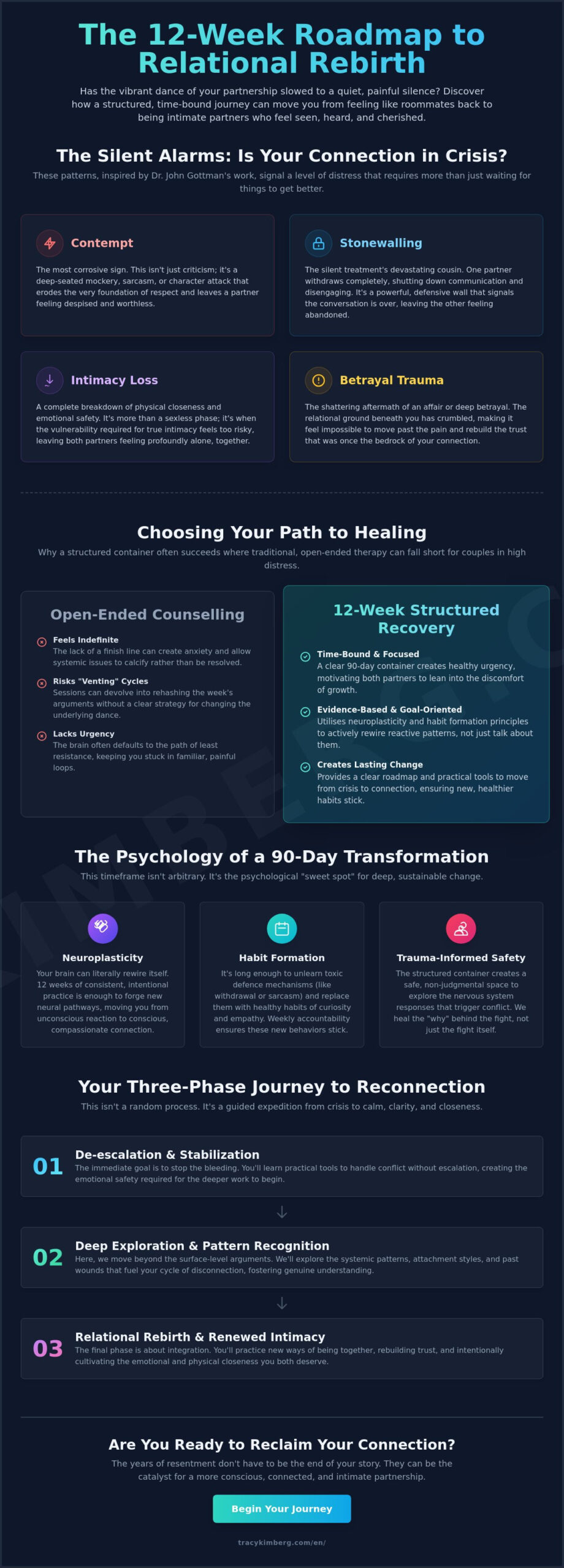
How do you know if your partnership has reached a point of crisis? It’s often found in the presence of what Dr John Gottman calls the “Four Horsemen”. These specific behaviours indicate a level of distress that requires more than just casual conversation:
- Contempt: Mockery or character attacks that erode the foundation of respect.
- Stonewalling: Withdrawing from interaction and shutting down communication entirely.
- Intimacy Loss: A total loss of physical closeness or emotional safety.
- Betrayal Trauma: The aftermath of an affair that feels impossible to move past alone.
The “Roommate Phase” vs. Relational Breakdown
There’s a significant difference between a temporary lull and the systemic emotional disconnect known as the “roommate phase”. In this state, you may still share a home, a mortgage, and a calendar, but your inner worlds no longer touch. It’s a form of “quiet quitting” where both partners are present but emotionally checked out, often staying together only for the children or out of financial fear. Recognising the signs of emotional neglect in marriage can help you understand whether this disconnection runs deeper than a temporary rough patch. To understand where you stand, taking a relationship check up can provide the clarity needed to distinguish between a rough patch and a structural breakdown. A 12 week relationship recovery provides the intensive focus required to reorganise this systemic dance, moving you from being polite strangers back to being intimate partners who feel seen and valued.
The Psychology of Time-Bound Transformation: Why 12 Weeks?
Choosing a three-month window isn’t an arbitrary decision. It’s based on the psychological “sweet spot” for habit formation and neuroplasticity. Whilst traditional, open-ended therapy can sometimes lead to a cycle of weekly “venting” sessions that lack a clear exit strategy, a structured 12 week relationship recovery programme provides the necessary friction to spark genuine change. Without a deadline, the brain often defaults to the path of least resistance, keeping you stuck in the same reactive loops you’ve walked for years. This time-bound approach creates a healthy sense of urgency that encourages both partners to lean into the discomfort of growth.
Gabor Maté often reminds us that our adult reactions are frequently echoes of past trauma. By using a trauma-informed lens within a time-bound container, we can accelerate the healing process. We aren’t just looking at the argument you had last night; we’re looking at the nervous system responses that triggered it. Neuroplasticity tells us that the brain is capable of rewiring these reactive communication patterns, but it requires consistent, intentional practice. The 90-day timeframe acts as a catalyst, forcing a shift from passive observation to active participation in your own relational health.
Habit Formation and Relational Patterns
Twelve weeks provides enough time to identify, challenge, and unlearn toxic defence mechanisms like sarcasm or withdrawal. It’s about moving from a state of constant “fight or flight” into a space of conscious, compassionate action. Weekly accountability ensures that the new behaviours you’re learning actually stick. If you’re curious about how this structured approach might work for your specific situation, exploring professional relationship coaching can offer the clarity you need to begin. This consistency is what transforms a temporary “fix” into a permanent shift in how you relate to one another.
The Gottman Influence: Research-Based Results
The 12-week model draws heavily on the “Sound Relationship House” theory developed by John and Julie Gottman. By using data-driven assessments at the start, we can bypass the months of guesswork that often plague traditional counselling. This approach focuses on “small things often”. Over the course of three months, these small, positive interactions build a new foundation of trust and shared meaning. It’s not about one grand gesture, but about the cumulative effect of ninety days of choosing connection over conflict. This intensive focus allows couples to see measurable progress in their emotional safety and physical intimacy in a fraction of the time they might expect.
Structured Recovery vs. Open-Ended Counselling: Finding Your Path
Traditional therapy often feels like an open-ended conversation, a space to explore the past without a clear destination in sight. Whilst this can be valuable for long-term self-discovery, couples in high distress often find that “just talking” isn’t enough to stop the bleeding. A 12 week relationship recovery programme operates differently. It’s a goal-oriented, intensive container designed to produce specific behavioural shifts. Instead of merely discussing the history of your arguments, you’re given a structured roadmap to change the very way you interact in real-time.
This active approach involves more than just sitting on a sofa once a week. It requires engagement through homework, specific communication exercises, and the development of tangible skills you can use in the heat of a moment. However, it’s essential to recognise that sometimes the “system” of the couple is too fragile to start joint work immediately. In these cases, individual relationship counselling might be a necessary precursor. By working on your own internal landscape and attachment triggers first, you can bring a more regulated and resilient version of yourself to the joint 12-week journey.
When to Choose a Structured Programme
Many couples arrive at my door when they’re facing a “make or break” deadline. Perhaps you’ve set a date to decide on a separation, or you’ve realised that another year of the same patterns will be the end of your partnership. A structured programme is ideal for those who have tried traditional therapy and felt they were merely treading water. The presence of a clear end-date often provides immense relief, especially for partners who might be hesitant about the idea of long-term therapy. It turns the process into a proactive project with a visible finish line and a clear financial and emotional ROI.
The Role of Expert Guidance
In this model, the practitioner acts as what Esther Perel describes as an “active choreographer”. I don’t just sit back and observe; I actively guide the movement between you, interrupting toxic cycles as they happen. This role of strategic direction is not unlike how a film festival strategy consultant might assist a director in navigating the complex narrative of a film’s release. This “Wise Guide” role is crucial for navigating the inevitable mid-point slump, where the initial enthusiasm fades and the real work of rebuilding trust begins. My approach blends the clinical depth of therapy with the forward-moving energy of coaching. This combination ensures that you aren’t just understanding why you’re stuck, but you’re actually learning how to walk out of the woods together. We focus on the “how” just as much as the “why”, providing a compassionate lens through which to view your shared future.
The Three Phases of Relational Rebirth: A Case Study Narrative
To understand the profound shift that occurs during a 12 week relationship recovery, let’s look at Sarah and Mark. After twelve years of marriage, they arrived in my office feeling like polite strangers living under the same roof. Their communication had devolved into a series of logistical hand-offs and silent resentments. They weren’t sure if they still loved each other, or if they were simply staying together out of habit. Their journey illustrates the chronological arc of healing that a structured programme provides, moving from crisis management to a deep, conscious reconnection.
Phase 1: Breaking the Cycle of Contempt
The first month is always about “stopping the bleed”. For Sarah and Mark, this meant identifying the specific triggers that led to their nightly “stonewalling” sessions. We established firm ground rules for safe communication, ensuring that disagreements didn’t escalate into character attacks. By introducing specific exercises for couples to reconnect, they began to experience small wins. These early weeks are less about solving every problem and more about creating enough emotional safety to allow the real work to begin. We focused on de-escalation, helping them recognise the “dance” they were caught in before it spun out of control.
Phase 2: Rediscovering Emotional Intimacy
Once the house was no longer on fire, we moved into the deep exploration phase. This is where we addressed the roots of their disconnect. Sarah and Mark had to learn how to build emotional intimacy from the ground up, moving beyond the logistics of childcare and finances. We utilised Esther Perel’s techniques to reignite a sense of curiosity about one another, treating the partner as a “mysterious other” rather than a known entity. For couples dealing with deeper wounds, this phase often touches upon couples therapy for infidelity themes, even if a physical affair hasn’t occurred. The “emotional affair” with work, hobbies, or children can be just as damaging to the relational bond.
Phase 3: The Conscious Partnership
The final four weeks of the recovery process are dedicated to future-proofing. Sarah and Mark worked on creating a “Relationship Vision” that reflected their shared values and individual needs. We developed a bespoke relational toolkit, a set of skills they could rely on when future conflicts inevitably arise. They moved from a reactive “I” perspective to a resilient “We” mindset, celebrating the fact that they were no longer just surviving, but thriving. This integration ensures that the changes made aren’t just temporary fixes, but permanent shifts in their systemic dance. If you feel your partnership is ready for this level of transformation, you can enquire about our 12-week process to begin your own narrative of rebirth.
Embarking on Your Journey: The Tracy Kimberg Approach to Recovery
My approach to the 12 week relationship recovery process is built on the belief that your partnership is a living, breathing system. It requires more than just a sympathetic ear; it needs a strategy that is as compassionate as it is clinical. By weaving together the research-led foundations of the Gottman method, the evocative relational intelligence of Esther Perel, and the trauma-informed depth of Gabor Maté, I offer a framework that addresses both the immediate fires and the old embers. This isn’t a “cookie-cutter” solution. Instead, it’s a bespoke reorganising of your systemic dance, tailored specifically to the nuances of your shared life.
Whether we meet through online therapy or face-to-face in the UK, my commitment is to provide a safe, contained environment where both of you can feel truly seen. We move beyond the “roommate phase” by looking at the nervous system responses that keep you stuck in reactive loops. Healing is possible, even when it feels entirely out of reach. It’s about moving from a place of survival to a place of thriving connection. This 12 week relationship recovery is designed to be both powerful and manageable, acknowledging your anxiety whilst offering immediate comfort through a structured path forward.
What Makes This Programme Different?
The distinction lies in the unique combination of clinical relationship counselling and transformational coaching. We don’t just explore the “why” behind your emotional wounds; we focus heavily on the “how-to” of daily interaction. This approach is particularly effective for those navigating the complexities of modern British life, where the pressures of work, family, and digital distraction often erode the space for intimacy. You get direct access to a specialist who understands these interpersonal dynamics and provides the tangible tools to navigate them with grace and authority.
Your Next Step Toward Healing
Taking the first step is often the most daunting part of the journey. I invite you to book an initial consultation to explore whether this 12-week journey is the right fit for your partnership. This process requires a shared commitment; both partners must be willing to lean into the work for the duration of the programme. I prefer to frame this engagement as a proactive and positive adventure rather than a clinical necessity. Your relationship can be your greatest source of strength, and I’m here to help you reclaim that power. Let’s work together to turn the page and begin your next chapter of profound emotional intimacy.
Reclaiming Your Connection and Future
Your partnership doesn’t have to remain stuck in the heavy silence of the roommate phase or the exhausting cycle of repetitive arguments. By understanding that relational health is a skill rather than a static state, you can begin to reorganise the systemic dance that has kept you apart. A structured 12 week relationship recovery provides the necessary container to move from de-escalation to a profound emotional rebirth. This journey isn’t about fixing a broken person; it’s about creating a new, resilient “We” through intentional, research-based action.
Drawing on Gottman-trained expertise and a research-based approach inspired by the insights of Esther Perel, I offer a safe, confidential, and transformational environment for your healing. Whether we work together online or face-to-face, the focus remains on providing you with a tangible toolkit for lasting intimacy. You deserve a relationship that serves as your greatest source of strength and joy. If you’re ready to move beyond survival and start thriving together, Book Your Discovery Call to Start Your 12-Week Journey. Healing is a proactive adventure, and it begins with the courageous decision to lean in.
Frequently Asked Questions
How does a 12-week relationship recovery programme differ from regular couples therapy?
A 12 week relationship recovery programme differs from regular therapy by providing a structured, goal-oriented roadmap rather than open-ended talk. Whilst traditional therapy often explores history without a clear finish line, this intensive process focuses on active de-escalation and rewiring your current communication patterns. It’s an active experience involving specific skills and weekly accountability to ensure you don’t just talk about change but actually embody it.
Is 12 weeks really enough time to fix a marriage that has been struggling for years?
Twelve weeks is a psychological “sweet spot” for establishing new relational habits and disrupting long-standing toxic loops. It isn’t about reaching a state of perfection, but about installing a new operating system for your marriage. By focusing on neuroplasticity and consistent practice, couples can achieve more momentum in three months than they often do in years of passive waiting.
What happens if one partner is more committed to the recovery process than the other?
It’s quite common for one partner to lead the way whilst the other feels hesitant or stuck. The structured nature of the programme often helps the more cautious partner feel safe because there’s a clear end-date and a non-judgemental framework. Once the “dance” between you begins to shift, the more hesitant partner typically finds their own motivation to engage as the emotional temperature in the home drops.
Can this 12-week programme help us recover from a recent affair or infidelity?
Yes, this programme is specifically designed to handle high-distress situations, including the aftermath of infidelity. We focus on “stopping the bleed” in the first phase, providing the safety needed to eventually explore the roots of the betrayal. It offers a compassionate path to rebuilding trust through transparency and specific de-escalation tools that traditional, slower-paced therapy might miss.
Do we need to be in the UK to work with Tracy Kimberg on this programme?
You don’t need to be based in the UK to benefit from this specialised guidance. Whilst face-to-face sessions are available for those in the UK, the entire programme is delivered effectively through online therapy. This allows couples from various time zones to access an expert level of care from the comfort and privacy of their own home, ensuring distance is never a barrier to healing.
What kind of exercises or “homework” should we expect during the 12 weeks?
You can expect practical exercises like “Gottman-style” communication scripts, emotional intimacy building, and conflict regulation tools. These aren’t just theoretical tasks; they’re designed to be practiced in your daily life between sessions. This homework ensures that the insights gained during our time together are integrated into your actual lived experience, turning new behaviours into lasting habits.
What is the success rate for couples who complete the full 12-week journey?
Success in this context is defined by a couple’s ability to reorganise their relationship and move out of high distress. Whilst I don’t quote arbitrary percentages, couples who commit to the full 12 week relationship recovery journey typically report a significant shift in their emotional safety and communication clarity. The goal is to provide you with a permanent toolkit that prevents future signs of emotional neglect in marriage from taking hold and fosters long-term intimacy.
Can we do the 12-week relationship recovery programme online?
You can certainly complete the 12-week programme entirely through online therapy. Digital sessions offer the same level of clinical depth and expert choreography as face-to-face work. Many couples find that working from their own environment helps them apply new behaviours directly to the space where their relationship actually lives, making the transition from session to daily life feel more natural.

Article by
Tracy Kimberg
Tracy Kimberg is a Relationship Expert, Couples Therapist and Coach with a dedicated focus on helping couples and individuals rebuild connection, trust and emotional safety in their relationships. Drawing on the research of John and Julie Gottman, the relational insights of Esther Perel, and years of hands-on therapeutic experience, Tracy offers a warm, non-judgemental and deeply compassionate approach to modern relationships.
Based in Dorset, Tracy works with couples navigating communication breakdowns, betrayal, intimacy challenges, separation, family dynamics and life transitions. Known for creating a safe and grounded therapeutic space, she combines practical tools with emotional depth to help clients move beyond survival patterns and towards meaningful, lasting change.
With a reputation for empathy, professionalism and dedication to her clients’ growth, Tracy is passionate about helping people feel seen, understood and empowered — both within their relationships and within themselves.
Disclaimer
Disclaimer:
The information shared in this article is intended for educational and informational purposes only and should not be considered a substitute for professional therapeutic, psychological, medical or legal advice. Every individual and relationship is unique, and the perspectives offered are based on general therapeutic principles, research and professional experience.
Reading this article does not establish a therapist-client relationship with Tracy Kimberg. If you are experiencing significant emotional distress, relationship crisis, trauma, or mental health concerns, it is important to seek support from a qualified professional appropriate to your individual circumstances.
All content remains the intellectual property of Tracy Kimberg and may not be reproduced or distributed without permission.