

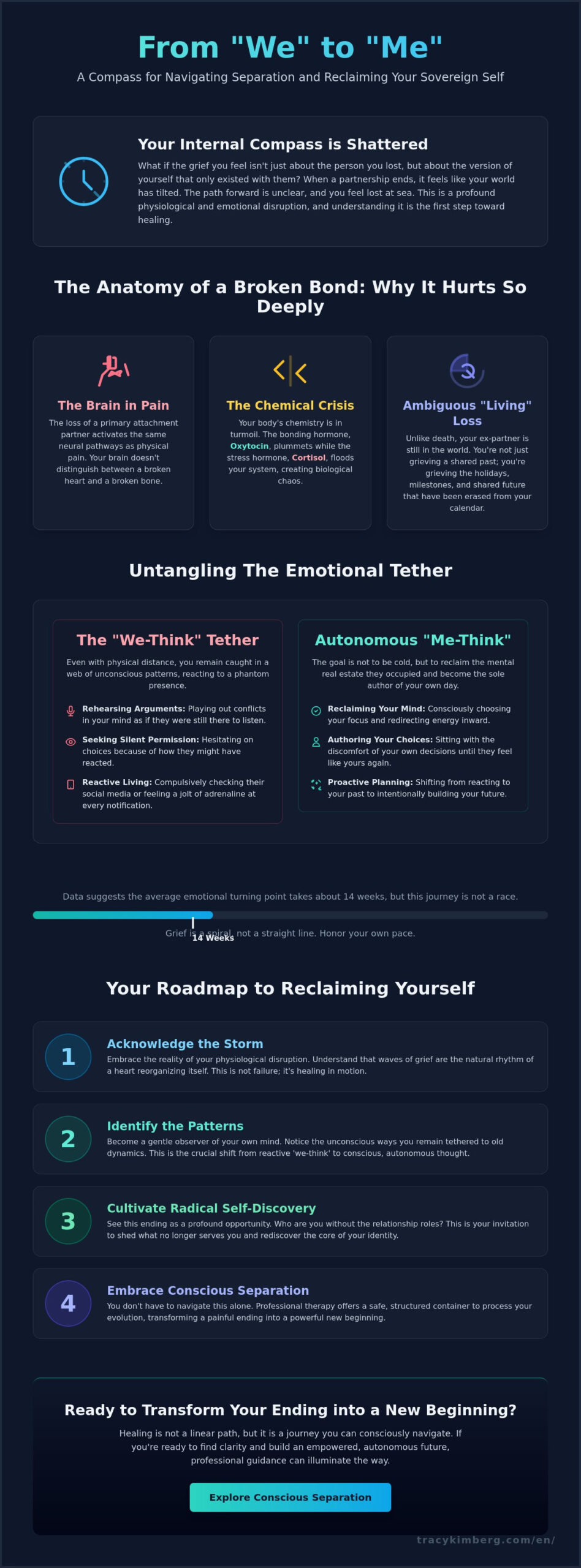
What if the profound grief you feel isn’t just about the person you lost, but about the version of yourself that only existed in their presence? When a long-term partnership ends, it often feels as though your internal compass has been shattered. You might find yourself caught in unpredictable waves of emotion; one moment you’re steady, whilst the next, you’re submerged by a sense of lost purpose amongst the memories of your shared life. Data from 2026 indicates the average emotional turning point now takes about 14 weeks, yet it remains an exhausting cycle that makes the idea of moving on after separation feel like a distant peak to climb.
I understand how difficult it is to disentangle your identity from a shared history. You’ve likely spent years co-authoring a story that has now reached an abrupt conclusion. This guide will help you navigate this complex emotional landscape, offering a way to transition from a shared past to an empowered, autonomous future. We’ll explore practical strategies for setting boundaries with your ex-partner and finding clarity on your new goals. By the end, you’ll have the tools to foster emotional independence and move towards a sense of peaceful closure or constructive co-parenting.
Key Takeaways
- Understand why separation feels like a physiological disruption of your attachment bond and how to steady yourself whilst navigating these waves of change.
- Learn to identify the unconscious patterns that keep you emotionally tethered to conflict, allowing you to move from “we-think” to autonomous decision-making.
- Discover how moving on after separation serves as a unique opportunity for radical self-discovery and the shedding of relationship roles that no longer serve your growth.
- Build a structured recovery roadmap that balances essential practical tasks with the emotional rest required to transition from reactive living to proactive planning.
- Explore the transformative power of a “Conscious Separation” approach, utilising professional therapy as a safe container for your personal evolution.
Understanding the Emotional Landscape of Separation
Separation is rarely just a legal or logistical event; it’s a fundamental tectonic shift in your internal world. When we bond with a partner, we don’t just share a home or a bank account; we weave our nervous systems together. This is why the process of moving on after separation feels less like a simple breakup and more like a profound disruption of a primary attachment bond. You aren’t just losing a person; you’re losing the mirror in which you’ve viewed yourself for years.
This disorientation often leads to what many describe as a “lost at sea” feeling. It’s not just a metaphor. It is a physiological response to the sudden absence of a co-regulatory figure. For years, your partner’s presence helped regulate your heart rate, sleep cycles, and stress responses. When that bond breaks, you experience a form of identity collapse. The “we” has vanished, leaving the “me” feeling fragile and undefined. It’s vital to recognise that the emotional effects of separation aren’t linear. Grief is a spiral, not a straight line. You might feel empowered on Monday and entirely undone by Wednesday. This isn’t a sign of failure; it’s the natural rhythm of a heart trying to reorganise itself.
The Science of the Broken Bond
Your brain doesn’t distinguish between a broken heart and a broken bone. Neuroimaging shows that the loss of a primary attachment activates the same neural pathways as physical pain. During the initial “detox” phase, your body undergoes a chemical crisis. The steady supply of oxytocin, the bonding hormone, suddenly drops, whilst cortisol, the stress hormone, floods your system. This creates a state of biological desynchrony. Your daily rhythms, from when you eat to how you sleep, are suddenly out of sync with your environment, making even small tasks feel monumental.
Why Grief Feels Different After Separation
Mourning a separation is distinct from mourning a death. It’s often called an ambiguous loss because the person is still physically present in the world, yet emotionally and structurally absent from your life. This creates a unique type of “living loss” that can complicate the healing process. Living loss is the mourning of a future that will no longer happen. You aren’t just grieving the past; you’re grieving the holidays, the retirement plans, and the shared milestones that have been erased from your calendar. Moving on after separation requires acknowledging these ghosts of the future just as much as the memories of the past.
Untangling the Emotional Tether from Your Ex-Partner
The true work of moving on after separation often begins when the shouting stops and the physical distance is established. Whilst you may have separate addresses, an invisible architecture of shared habits often remains. This is the psychological tether; a complex web of unconscious patterns that keeps you emotionally bonded to a dynamic that no longer exists. You might find yourself still seeking their silent permission for your life choices or rehearsing arguments in the shower as if they were still there to listen. To truly heal, you must transition from “we-think”—the constant, reflexive consideration of their perspective—to autonomous decision-making. This shift is not about being cold; it is about reclaiming the mental real estate that they have occupied for so long.
Transitioning to autonomy is a muscle you must train. For years, your choices were likely filtered through the lens of another person’s preferences, moods, and reactions. When you move on, that filter remains as a phantom presence. You might hesitate to buy a certain item because they would have disliked it, or feel a strange twinge of guilt for enjoying a hobby they found tedious. Breaking this habit requires you to sit with the discomfort of your own choices until they start to feel like yours again. It is an act of courage to be the sole author of your own day.
Recognising Emotional Enmeshment
Signs of enmeshment are often subtle but deeply draining. You might find yourself compulsively checking their social media “last seen” status or feeling a spike of adrenaline at the sound of a text notification. This is the “walking on eggshells” behaviour continuing even after the relationship has ended. You are still reacting to them rather than acting for yourself. Breaking these tethers requires a conscious effort to look inward and understand the roots of your attachment. Engaging in individual relationship counselling can provide the professional insight needed to deconstruct these cycles and help you stand firmly in your own identity.
Establishing Internal Boundaries
Boundaries are often misunderstood as aggressive walls built to shut others out. In reality, a healthy boundary is a protective circle drawn around your own peace. It is about reclaiming your narrative from your ex-partner’s version of the story. When you stop defending your character against their accusations, you take away their power to define you. Integrating practical coping strategies can help you maintain emotional composure during necessary interactions, such as co-parenting handovers. By focusing on your internal landscape, moving on after separation becomes an act of self-reclamation. If you feel stuck in these old loops, exploring a Conscious Approached Divorce and separation process can help you map out a clearer, more peaceful path forward.
Reclaiming Your Identity: From “We” to “Me”
The end of a partnership often leaves a vacuum where a shared identity once stood. This space, whilst terrifying, is also the fertile ground required for radical self-discovery. As Gabor Maté often suggests, we frequently sacrifice our authenticity for the sake of attachment. In a relationship, you might have unconsciously suppressed your own needs, colours, or voice to maintain the “we”. Reclaiming your identity is not about returning to who you were before the relationship; it’s about discovering who you have become through the experience. Moving on after separation is, in many ways, an invitation to finally meet yourself without the filter of another person’s expectations.
The Mirror of Relationship
Our partnerships often act as mirrors, reflecting our deepest attachment wounds and early childhood patterns. When the mirror breaks, we are forced to look at the fragments. Instead of seeing this as a failure, try using the separation as a diagnostic tool for your own growth. Ask yourself: What roles did I play? Was I the caretaker, the peacekeeper, or the one who stayed small to avoid conflict? By analysing these behaviours, you can identify the patterns that no longer serve your future self. You are not broken; you are becoming.
Building Your New Foundation
As you move forward, your foundation must be built on core values that are uniquely yours. Often, these values are compromised during a long-term partnership to keep the peace or align with a shared vision. Now is the time to identify what truly resonates with your spirit. This clarity is essential for achieving a sense of “conscious closure”, ensuring you don’t carry the heavy baggage of resentment into your next chapter. To help navigate this transition with grace, seeking amicable separation guidance can be a vital step in ensuring your ending is also a healthy beginning. Moving on after separation becomes significantly more manageable when you have a roadmap that honours both your past and your potential.
Practical Steps for Moving On After Separation
Rebuilding your life after a partnership ends can feel like trying to assemble a puzzle whilst the pieces are still changing shape. It is easy to get stuck in a reactive mode, simply responding to the demands of your ex-partner or the logistics of your new living situation. To truly start moving on after separation, you must shift from being a passenger in your own life to being the architect of your new reality. This begins with a recovery roadmap; a living document that balances necessary practical tasks with the deep emotional rest your nervous system craves.
Part of this roadmap involves a social support audit. Not everyone in your current circle will have the capacity to hold space for your growth. Some may inadvertently keep you tethered to the past by rehashing old grievances or offering unsolicited advice. Identify the people who fuel your progress and offer a sense of calm optimism. Similarly, if you are co-parenting, implementing a “business-only” communication style is essential. Research from 2026 indicates that 45% of people now believe a complete digital removal of an ex is necessary for healing. Whilst that may not be possible with children, you can certainly limit your interactions to a structured, low-contact approach to protect your emotional energy.
The SMART Way to Rebuild
Reclaiming your life doesn’t require grand, exhausting leaps. Instead, focus on small, consistent movements that respect your current capacity. Use the SMART framework to ground your progress:
- Specific: Define one small area of life to reclaim this week, such as reorganising a shared cupboard or taking a walk in a new neighbourhood.
- Measurable: Track your emotional wins. This might be a day without a “grief wave” or successfully ignoring a provocative text message.
- Achievable: Set goals that feel manageable. If a whole day feels too long, focus on winning the next hour.
Navigating Family Transitions
When children are involved, their emotional safety must be the primary focus of the transition. They need to feel that whilst the family structure is changing, their world remains secure. This requires clear, compassionate communication strategies for how to tell kids about separation and maintaining that consistency during the months that follow. During handovers, aim for a BIFF approach: keep your behaviour Brief, Informative, Friendly, and Firm. This structure provides the “safe container” children need whilst you navigate your own healing journey. If you find the weight of these practical and emotional changes overwhelming, our 12-Week Relationship Recovery Process offers a structured path toward reclaiming your clarity and peace.
Conscious Separation: Transforming an Ending into a Beginning
Separation is often viewed through the lens of failure, but there is another way to perceive this transition. Tracy Kimberg’s approach to “Conscious Separation” reframes the end of a relationship as a purposeful evolution rather than a simple collapse. By bringing intention to the way you untie your lives, you can transform a painful ending into a resilient beginning. This isn’t about ignoring the hurt; it’s about creating a safe container where that hurt can be processed with dignity and foresight. Moving on after separation becomes a proactive adventure in emotional health when you choose to engage with the process consciously.
The 12-Week Relationship Recovery Process is designed specifically for this purpose. Whilst the name might suggest a couple’s focus, it is a powerful tool for individuals navigating the aftermath of a split. It provides a structured roadmap to help you reclaim your sense of self and build the emotional resilience needed for the road ahead. You aren’t just moving away from a partner; you are moving toward a more authentic version of yourself. This journey is about ensuring that your future connections are built on a foundation of self-awareness rather than the echoes of old wounds.
Why Professional Support Matters
Whilst friends and family offer essential comfort, they often bring their own biases and emotional histories to your situation. A research-based therapist provides a neutral, expert perspective grounded in an understanding of attachment theory and interpersonal dynamics. This professional guidance is crucial for identifying the unconscious patterns we discussed earlier, preventing you from repeating the same behaviours in future relationships. Seeking help isn’t an admission of defeat; it’s a sophisticated commitment to your long-term well-being. Overcoming the stigma of a “failed” relationship allows you to see the experience as a profound teacher amongst the challenges of adult life.
Your Next Chapter Starts Today
The journey from the initial disorientation of a broken bond to the empowerment of a reclaimed identity is rarely easy, but it is deeply rewarding. You have moved through the physiological “detox” of separation, untangled the emotional tethers, and started to remember your favourite colours and values. You are now the sole author of your new life, holding the pen with a steadier hand. The future is not a void to be feared; it’s a space for you to design. If you’re ready to transition from a shared past to an autonomous, empowered future, I invite you to Book a consultation for Conscious Separation Support and take the first step toward your new chapter.
Stepping into Your Future with Clarity
The journey of moving on after separation isn’t about erasing your shared history, but about integrating those experiences into a more resilient version of yourself. Whilst the path may feel uncertain, you’ve explored how to steady your nervous system, untangle complex emotional tethers, and reclaim the “me” from the “we”. These shifts are the foundation of a life built on authenticity rather than old habits. By choosing a conscious approach, you ensure that this transition becomes a powerful catalyst for your personal evolution.
Healing doesn’t have to be a solitary or overwhelming task. As a specialist in Conscious Separation, I provide a safe, non-judgemental space for online therapy, rooted in the research-based insights of experts like Gottman and Perel. Whether you’re navigating the initial waves of grief or seeking a structured recovery process, professional support offers the clarity needed to break repetitive patterns. You deserve to move forward with a sense of purpose and peace. Your next chapter is ready for you to begin, and you have the strength to be its author.
Begin your journey to emotional freedom with Tracy Kimberg.
Frequently Asked Questions
How long does it typically take to move on after a long-term separation?
Research from 2026 suggests the average emotional turning point now occurs at approximately 14 weeks, though the full process of moving on after separation is rarely a linear journey. For many, the initial fog of disorientation begins to lift after three to four months, whilst the deeper work of reclaiming a sense of identity can take a year or more. It’s important to respect your own internal rhythm rather than comparing your progress to an arbitrary calendar.
Is it normal to still feel angry with my ex-partner months later?
Anger is a completely natural and often protective response that can persist long after the physical separation has occurred. This emotion often acts as a guardian for the more vulnerable parts of your heart, shielding you from the raw pain of grief or the injustice of a lost future. Instead of judging the anger, try to see it as a signal that your boundaries or values are still being processed and reorganised.
Can I move on while still living in the same house as my ex?
It is possible to begin the healing process whilst sharing a home, but it requires the implementation of rigorous psychological boundaries. You must create a “business-only” environment where communication is limited to essential logistics, allowing you to find pockets of emotional solitude amongst shared physical spaces. Whilst this arrangement is challenging, focusing on your autonomous future can help you maintain your composure until separate living arrangements are finalised.
How do I handle mutual friends who feel like they have to choose sides?
The best approach is to lead with transparency and avoid triangulating your friends into the conflict of your relationship. Clearly communicate that whilst your partnership has ended, you value their independent friendship and don’t expect them to act as messengers or sounding boards. By refusing to use your social circle as a battleground, you protect the support system you’ll need as you move forward.
What is the best way to deal with the loneliness of being single again?
Dealing with loneliness involves reframing it as solitude; a space for radical self-discovery rather than a void of abandonment. Use this time to rediscover the hobbies, colours, and values that might have been suppressed during your years as a couple. Loneliness is often your system’s way of inviting you to reconnect with yourself, and building a social support audit can help you identify which connections truly fuel your growth.
Should I start dating immediately to help myself move on?
Generally, rushing into dating can bypass the essential grief work required for long-term emotional health. Global trends in 2026 show a “dating recession” where people are 30% less likely to go on dates immediately after a breakup, choosing instead to focus on personal recovery. Taking a period of intentional singleness prevents you from repeating old patterns and ensures you enter your next chapter from a place of wholeness. As you eventually begin to explore new relationships, you may want to check out LoveSkar to help manage personal health disclosures with confidence and without stigma.
How do I stop my ex-partner from controlling my emotional state?
You regain control by shifting your focus from their external actions to your internal reactions. Approximately 45% of people now believe that a complete removal of an ex from their digital life is the only way to heal, as it cuts the constant tether of provocation. By establishing these firm boundaries, you move from being a reactive participant in their drama to an autonomous individual who owns their own peace of mind.
Can therapy help if I am the one who didn’t want the separation?
Therapy is a vital tool for those facing an unwanted ending, as it provides a safe container to process the shock and trauma of rejection. Professional support helps you move from the identity of the person “left behind” to the empowered author of your own resilience. It allows you to explore the intricacies of the partnership with clinical accuracy whilst holding your experience with deep, human compassion.

Article by
Tracy Kimberg
Tracy Kimberg is a Relationship Expert, Couples Therapist and Coach with a dedicated focus on helping couples and individuals rebuild connection, trust and emotional safety in their relationships. Drawing on the research of John and Julie Gottman, the relational insights of Esther Perel, and years of hands-on therapeutic experience, Tracy offers a warm, non-judgemental and deeply compassionate approach to modern relationships.
Based in Dorset, Tracy works with couples navigating communication breakdowns, betrayal, intimacy challenges, separation, family dynamics and life transitions. Known for creating a safe and grounded therapeutic space, she combines practical tools with emotional depth to help clients move beyond survival patterns and towards meaningful, lasting change.
With a reputation for empathy, professionalism and dedication to her clients’ growth, Tracy is passionate about helping people feel seen, understood and empowered — both within their relationships and within themselves.
Disclaimer
Disclaimer:
The information shared in this article is intended for educational and informational purposes only and should not be considered a substitute for professional therapeutic, psychological, medical or legal advice. Every individual and relationship is unique, and the perspectives offered are based on general therapeutic principles, research and professional experience.
Reading this article does not establish a therapist-client relationship with Tracy Kimberg. If you are experiencing significant emotional distress, relationship crisis, trauma, or mental health concerns, it is important to seek support from a qualified professional appropriate to your individual circumstances.
All content remains the intellectual property of Tracy Kimberg and may not be reproduced or distributed without permission.