

What if the constant urge to “fix” your child’s distress is actually the very thing keeping you both stuck? When you see your child struggling socially or falling behind at school, the instinct to intervene is powerful. Yet, for many parents, providing help for anxious teenagers often feels like walking through a minefield whilst every supportive word triggers a fresh explosion. It is exhausting to feel like a failure in your own home, watching the person you love most drift away amongst a fog of worry.
You aren’t alone in this struggle, and your teenager’s behaviour isn’t a puzzle you must solve alone. We’ll move beyond the clinical checklists to discover how a shift in your own presence can foster the long-term emotional health your family deserves. This guide offers a path toward a calmer household and a teenager who feels truly seen. You will learn practical tools to manage daily anxiety spikes and, more importantly, how to build a resilient bond that serves as a lighthouse during their darkest storms. By prioritising the relationship over the result, you can transform your home from a place of conflict into a centre for healing.
Key Takeaways
- Understand that anxiety is a physiological response to modern stressors rather than a broken part of your child’s personality.
- Master the art of co-regulation to settle your teenager’s nervous system through the power of your own calm presence.
- Identify the hidden signs of high-functioning anxiety, from disrupted sleep to physical aches, that often go unnoticed.
- Learn to navigate the “advice trap” by using curious questioning to provide effective help for anxious teenagers without causing further conflict.
- Determine exactly when to seek professional therapy to support your child’s development in a safe, neutral environment.
Understanding the Modern Landscape of Teenage Anxiety
To offer genuine help for anxious teenagers, we have to recognise that their distress is often a functional response to a dysfunctional environment. Anxiety isn’t just a collection of worries or a diagnosis found in a manual. It’s a physiological event; a survival mechanism triggered when a young person’s nervous system perceives a threat it cannot escape. Whilst healthy worry might nudge a student to study for a test, chronic anxiety is a persistent state of alarm that feels inescapable. It often acts as a messenger, signalling a deep-seated relational disconnect or an unmet need for safety and belonging. In the journey of understanding anxiety disorders, we see that for a teenager, the “threat” is often social or emotional rather than physical.
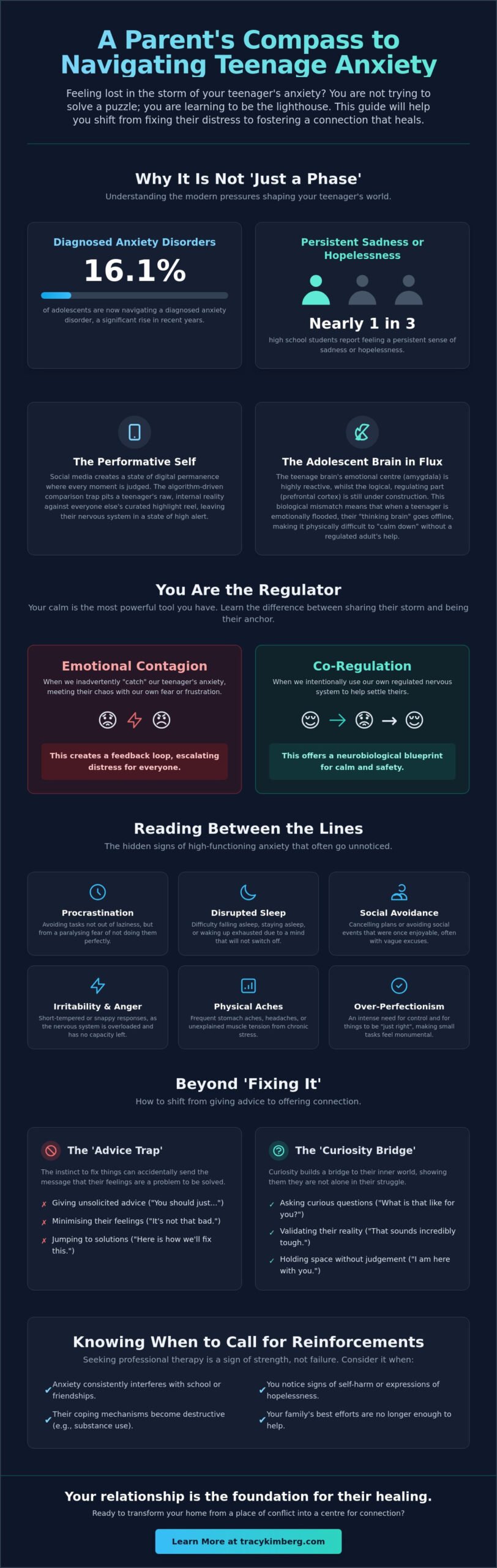
By 2026, the pressures on the adolescent spirit have reached a fever pitch. According to 2023 federal reports, approximately 16.1% of teenagers now struggle with a diagnosed anxiety disorder, and nearly one in three high school students reports feeling persistent sadness or hopelessness. These aren’t just numbers; they represent a generation trying to find its footing on shifting sand. When we look at their lives, we see that the traditional milestones of growing up are now shadowed by a constant, invisible pressure to perform.
The Performative Self: Social Media and Digital Pressure
The boundary between the private self and the public persona has almost vanished. Adolescents today live in a state of digital permanence where every mistake is potentially archived and every moment is “performative”. This constant “online” state prevents them from developing a secure, private sense of self away from the gaze of others. The comparison trap is no longer a choice; it’s an algorithm. Teenagers don’t just compare themselves to their peers; they compare their raw internal reality to everyone else’s curated highlight reel. Digital dysregulation occurs when constant connectivity overrides the brain’s ability to find stillness and safety, leaving the nervous system in a state of perpetual high alert.
Biological Shifts: The Adolescent Brain in Flux
The teenage brain is essentially a high-powered engine with unfinished brakes. There’s a biological mismatch between the sensitive, reactive amygdala and the still-maturing prefrontal cortex responsible for logic and regulation. In 2026, this gap is widened by environmental factors like disrupted sleep patterns and constant blue-light exposure, which throw hormonal balances out of sync. When a teenager is in a state of high emotional arousal, their “thinking brain” effectively goes offline. This is why logic fails in the heat of an anxious moment. They aren’t being difficult; they are physically unable to access the reasoning required to “calm down” without external support from a regulated adult.
The Science of Connection: Why Your Presence Matters
We often treat a teenager’s anxiety as a solo performance, something they must manage in the isolation of their own room or with a specialist. This perspective misses the profound neurobiological reality of our connection. As Gabor Maté often observes, the quality of the attachment relationship is the primary factor in a child’s ability to regulate their emotions. Providing help for anxious teenagers isn’t merely about finding the right coping skill. It’s about the invisible cord that links your nervous system to theirs. When you are present, you aren’t just “watching” them; you are providing the external scaffolding their brain needs to find balance.
The emotional climate of the home often dictates the pace of a child’s healing. If the environment is thick with unspoken tension or parental conflict, a teenager’s nervous system remains on high alert. This is why the health of the parental partnership is so vital. Understanding how to save my relationship or foster harmony between caregivers creates a ripple effect of safety. It allows the home to become a sanctuary rather than another source of stress. When parents prioritise their own emotional health, they offer their children a blueprint for resilience.
Co-Regulation vs. Emotional Contagion
Co-regulation is the intentional use of your calm to meet their chaos. It is a quiet, steady invitation for their nervous system to mirror yours. Conversely, emotional contagion happens when we “catch” their anxiety, reacting with our own frustration or fear. This inadvertently fuels their distress, creating a feedback loop of panic. Before you engage with your child, take a moment to ground yourself. Feel your feet on the floor. Take three slow breaths. If you are already looking into professional help for teen anxiety, remember that your grounded presence remains the most powerful tool in the room. You can explore how Online Therapy can support this transition from your own home.
The Gottman Influence: Emotion Coaching for Teens
John Gottman’s research highlights “Emotion Coaching” as a transformative tool for parents. It involves five essential steps: becoming aware of the emotion, recognising it as an opportunity for intimacy, listening with empathy, labelling the feeling, and eventually problem-solving. When you say, “I can see you feel overwhelmed,” you are helping their brain move from the reactive amygdala to the logical prefrontal cortex. This simple act of naming the emotion reduces its physical intensity. Validation must always precede instruction because a teenager’s brain is physically incapable of processing advice whilst it remains in a state of perceived threat.
Recognising the Subtle Signs of Anxiety in Your Teenager
Anxiety is a master of disguise. Whilst we often look for the visible tremor or the overt panic attack before we offer help for anxious teenagers, the reality is often much quieter and more complex. In my experience, anxiety in adolescence frequently presents as a “high-functioning” state where the child appears to be succeeding whilst drowning internally. We must look past the surface to see the nervous system in distress. It is less about what they are doing and more about the energy behind their actions. Is their diligence born of passion or a desperate need to avoid the perceived catastrophe of a B-grade?
According to research on Mental Health for Adolescents, identifying these early warning signs is crucial for timely intervention. One of the most insidious patterns is the cycle of avoidance. When a teenager feels overwhelmed by a social situation or a school project, retreating provides immediate, intoxicating relief. However, this relief is a trap. Each time they avoid a trigger, the brain receives a signal that the situation was indeed life-threatening, which strengthens the anxiety cycle for the next time. Breaking this requires us to recognise the subtle shifts before they become entrenched habits.
Physical Red Flags and Somatic Complaints
The body often speaks when the mind cannot find the words. Because of the “gut-brain axis,” anxious teenagers frequently experience chronic stomach aches, nausea, or changes in eating behaviour. These aren’t “excuses” to skip school; they are genuine psychosomatic responses to a flooded nervous system. You might also notice a shift in their sleep hygiene. Cortisol, the stress hormone, can cause intense morning fatigue whilst keeping them in a state of “tired but wired” late into the night. If your child is constantly exhausted yet unable to rest, their body is likely stuck in a state of high alert.
Behavioural Shifts: Withdrawal and Perfectionism
We often mistake an anxious teenager for a defiant or lazy one. The “irritability shield” is a common defence mechanism where anger serves as a cover for fear. It feels safer for a teen to be “the angry kid” than “the scared kid.” Similarly, some children retreat into the digital worlds of gaming or spend hours behind closed bedroom doors as a form of safety-seeking. On the opposite end of the spectrum, obsessive perfectionism can be a masked form of distress. These students become “the perfect student” to quiet the internal critic that tells them they are never enough. Recognising these as cries for connection rather than “bad behaviour” is the first step toward true healing.
Practical Strategies to Support Your Teenager Whilst Building Trust
When we see our children in pain, our first instinct is to build a bridge out of solutions. We want to fix the problem, offer the answer, or provide the perspective that will stop the spiralling. But for an adolescent, this “Advice Trap” often feels like a dismissal of their internal reality. It sends a message that their feelings are a problem to be solved rather than an experience to be understood. If you want to provide effective help for anxious teenagers, you must first learn to sit in the discomfort with them. Connection is built in the spaces where we stop talking and start witnessing.
The Power of Validation and Active Listening
Validation isn’t about agreeing that their fear is logical; it’s about acknowledging that the fear is real. Instead of saying “You have nothing to worry about,” try a response that acknowledges the complexity of their world: “It sounds like you’re carrying a heavy weight right now. I can see how much this is costing you.” This shifts the focus from the facts to the relationship. Try using “curious questioning” rather than “interrogative questioning.” Instead of asking “Why are you doing that?”, try “I’m curious about what’s happening for you right now.” Use the “10-minute Rule”: spend ten minutes every day in their presence without an agenda, a phone, or a single question. If they meet your presence with an “I don’t know,” don’t push. Silence is a form of safety. It allows them to exist without the pressure of performance.
Building a Resilient Routine at Home
A chaotic environment creates a chaotic mind. Organising your home to reduce sensory overload can significantly lower baseline anxiety. Think about “digital sunsets”—a collective family commitment to put away screens an hour before bed. This isn’t a punishment; it’s a boundary that protects the nervous system from the performative pressure we discussed earlier. Incorporate movement and nature into your weekly rhythm. These aren’t just “hobbies”; they are biological anxiety-mufflers that help process stored cortisol. Practical help for anxious teenagers is most effective when it is woven into the fabric of daily life.
True healing comes from building competence through “brave behaviour.” This involves small, manageable exposures to things they fear, rather than forced, high-stakes confrontations. We want to help them discover that they can be anxious and capable at the same time. If you feel that your family needs more structured support to navigate these challenges, you can explore Face-to-Face Therapy to begin a collaborative journey toward healing.
When to Seek Professional Therapy for Your Teenager
Knowing when to transition from home-based support to professional intervention is one of the most delicate decisions a parent faces. It is not an admission of failure, but rather an expansion of your child’s support system. We often wait for a crisis before seeking help for anxious teenagers, yet the most effective work happens when we identify the “tipping point” early. This threshold is usually reached when anxiety begins to halt normal development; perhaps they are refusing to attend school, withdrawing from friendships they once loved, or struggling with persistent physical symptoms that have no medical cause. If their world is shrinking to accommodate their fear, it is time to invite a professional into the conversation.
Seeking therapy for teenagers provides them with a neutral, non-judgemental space where they can explore their identity and fears without the pressure of protecting their parents’ feelings. In my practice, I often frame this process as “emotional coaching” or a “mental fitness programme.” By stripping away the clinical stigma, we allow the teenager to view therapy as a proactive adventure in self-discovery. This relational approach acknowledges that the teenager exists within a family system; therefore, healing is often accelerated when we work on the dynamics of connection between parent and child alongside the individual’s distress. To explore specialised skills training for both parents and adolescents, you can visit Balan-sé.
Choosing the Right Therapeutic Approach
There are various ways to approach healing. Cognitive Behavioural Therapy (CBT) is excellent for providing immediate, practical tools to manage panic. However, Relational Therapy goes deeper, focusing on the quality of the teenager’s attachments and how they navigate interpersonal closeness. Many young people today find that Online Therapy is a particularly effective medium. As “digital natives,” the screen provides a familiar layer of comfort that can make the vulnerability of therapy feel less intimidating than a traditional office setting. The therapist acts as a bridge, helping to translate the teenager’s internal world for the parent whilst equipping the teen with the resilience to face the world.
Beyond these methods, some families find that a deeper, Freudian-based exploration of the subconscious can reveal the underlying causes of a teenager’s distress. If you are considering this path, you can explore rates for psychoanalytic analysis sessions with Emerson Teles – Terapia Online, providing a specialised perspective on anxiety and self-esteem.
The Path Forward with Tracy Kimberg
My approach is rooted in the belief that every teenager deserves to feel seen rather than studied. By blending research-based insights with deep empathy, I create a safe, confidential environment where young people can unburden themselves of the “performative” pressures of modern life. We work together to dismantle the perfectionism and fear that keep them stuck, replacing them with a grounded sense of self-worth. If you are ready to move from a state of constant conflict to one of collaborative healing, please Book a consultation to support your teenager’s mental wellbeing today. Your family’s journey toward a calmer, more connected home starts with a single, brave step.
Moving Toward a Future of Connection and Resilience
The journey through teenage anxiety doesn’t have to be a solitary battle against a clinical diagnosis. It’s an invitation to deepen the bond with your child and transform your home into a sanctuary of safety. By shifting from a “fixing” mindset to one of presence and co-regulation, you offer your teenager the emotional scaffolding they need to navigate the digital and social pressures of 2026. Remember that their behaviour is a messenger; when we listen with curiosity rather than judgement, the path to healing reveals itself.
Finding the right help for anxious teenagers involves more than just tools. It requires a relational approach that sees the whole person. Tracy Kimberg offers specialised experience in teenage and relational therapy, utilising a research-based approach inspired by the work of experts like Gottman and Perel. Whether you choose online or face-to-face sessions, you’ll find a safe, non-judgemental environment designed to foster long-term emotional health. You don’t have to navigate this landscape alone. Begin your family’s journey to emotional health with Tracy Kimberg. There is profound hope for a calmer, more connected future for you and your child.
Frequently Asked Questions
How can I tell the difference between normal teenage moodiness and clinical anxiety?
You can distinguish clinical anxiety from moodiness by looking at the duration and impact on your child’s daily functioning. Whilst mood swings are a standard part of adolescent development, clinical anxiety is persistent, often lasting for weeks or months. It prevents them from engaging in activities they once enjoyed or causes significant distress in social and academic settings. If their worry feels inescapable and dictates their choices, it has likely moved beyond typical teenage behaviour.
What should I do if my teenager refuses to go to therapy?
If your teenager resists therapy, avoid turning it into a power struggle and instead reframe the process as “mental fitness” or “performance coaching.” You might suggest a single trial session where they have total control over the conversation and the goals. This reduces the perceived threat and allows them to experience the neutral, supportive space of a professional therapist without feeling coerced or like they are being “fixed.”
Can my own anxiety be making my teenager’s anxiety worse?
Yes, through a process called emotional contagion, your own state of mind can inadvertently influence your child’s nervous system. Teenagers are highly sensitive to the emotional climate of the home; if you are constantly in a state of high alert, their system may mirror yours as a survival response. By staying grounded and regulated yourself, you provide the external scaffolding they need to find their own sense of calm.
How much should I push my anxious teen to face their fears, like going to school?
You should encourage “brave behaviour” through small, manageable exposures rather than forcing a direct confrontation with their biggest fears. Pushing a teenager too hard can lead to a shutdown or increased avoidance. Instead, collaborate on tiny steps that feel slightly uncomfortable but achievable. This builds their competence muscle, proving to their nervous system that they can be anxious and capable at the same time without needing to retreat.
Are there any natural ways to help my teenager manage anxiety at home?
Effective help for anxious teenagers at home often involves environmental shifts like “digital sunsets” and regular movement in nature. Reducing sensory overload by organising a clutter-free environment can lower their baseline stress. Encourage activities that promote rhythmic breathing, such as walking or swimming, which naturally muffle the nervous system’s alarm response. These somatic tools provide a physical release for stored cortisol without the pressure of a formal conversation.
What are the most common triggers for teenage anxiety in 2026?
The most common triggers in 2026 include the performative nature of social media and intense academic pressure. Research shows that 83% of teenagers cite school and the pressure to get good grades as a significant source of stress. Additionally, the lack of digital privacy means mistakes feel permanent and public. This constant state of being “on display” prevents the development of a secure, private self, keeping their nervous system on alert.
Is online therapy as effective as face-to-face sessions for teenagers?
Online therapy is often just as effective as face-to-face sessions, particularly for the digital native generation who feel comfortable communicating via screens. The familiar environment of their own room can lower their initial defences, making them more willing to open up. It removes the logistical stress of travel and the potential stigma of being seen at a clinic, allowing the therapeutic relationship to flourish in a space where they already feel safe.
How do I talk to my teenager about anxiety without making them feel “broken”?
Start by framing anxiety as a protective nervous system response rather than a personal flaw or a broken part of their identity. Use curious questioning like, “I’ve noticed you seem to be carrying a lot lately; what does that feel like for you?” this invites them into a conversation without the weight of a diagnosis. By validating their experience first, you ensure they feel seen and understood rather than analysed or pathologised.

Article by
Tracy Kimberg
Tracy Kimberg is a Relationship Expert, Couples Therapist and Coach with a dedicated focus on helping couples and individuals rebuild connection, trust and emotional safety in their relationships. Drawing on the research of John and Julie Gottman, the relational insights of Esther Perel, and years of hands-on therapeutic experience, Tracy offers a warm, non-judgemental and deeply compassionate approach to modern relationships.
Based in Dorset, Tracy works with couples navigating communication breakdowns, betrayal, intimacy challenges, separation, family dynamics and life transitions. Known for creating a safe and grounded therapeutic space, she combines practical tools with emotional depth to help clients move beyond survival patterns and towards meaningful, lasting change.
With a reputation for empathy, professionalism and dedication to her clients’ growth, Tracy is passionate about helping people feel seen, understood and empowered — both within their relationships and within themselves.
Disclaimer
Disclaimer:
The information shared in this article is intended for educational and informational purposes only and should not be considered a substitute for professional therapeutic, psychological, medical or legal advice. Every individual and relationship is unique, and the perspectives offered are based on general therapeutic principles, research and professional experience.
Reading this article does not establish a therapist-client relationship with Tracy Kimberg. If you are experiencing significant emotional distress, relationship crisis, trauma, or mental health concerns, it is important to seek support from a qualified professional appropriate to your individual circumstances.
All content remains the intellectual property of Tracy Kimberg and may not be reproduced or distributed without permission.