

What if the reason your partner resists therapy isn’t because they don’t care, but because they’re terrified of being told they’ve already failed? It’s incredibly painful to feel lonely whilst sitting right next to the person you love, especially when you’re anxious about the future of your relationship. You might have already researched the gottman method couples therapy uk specialists offer, hoping for a way to bridge the gap without triggering another exhausting argument.
I understand that this conversation feels heavy. You want to offer a hand, not point a finger. In this guide, you’ll discover how to transform a difficult talk into a gentle invitation for healing using research-backed communication strategies. We’ll explore how to reduce tension, prepare a clear plan for your first session, and ultimately help your partner feel safe enough to open up to professional support. Let’s move towards a shared vision of emotional relief together.
Key Takeaways
- Learn how to replace criticism with a ‘softened start-up’ that prioritises connection over conflict.
- Identify the ‘Four Horsemen’ in your communication and understand how they might be fuelling your partner’s hesitation.
- Discover why the gottman method couples therapy uk practitioners offer is uniquely effective for both logical and emotional partners.
- Master a step-by-step approach to inviting your partner into a therapeutic space without making them feel like they’ve failed.
- Address common fears about ‘opening a can of worms’ by framing therapy as a proactive way to organise and heal your bond.
Understanding the Resistance: Why Your Partner Might Hesitate
Resistance isn’t a wall; it’s a signal. When you suggest professional support and your partner pulls away, it’s rarely because they’ve stopped caring about the relationship. More often, it’s a protective reflex against the fear of being judged or blamed. Many people view therapy as the final stop before a divorce, a sort of “emergency exit” that signals the end rather than a new beginning. This “stigma of struggle” can make the mere mention of a therapist feel like an admission of failure.
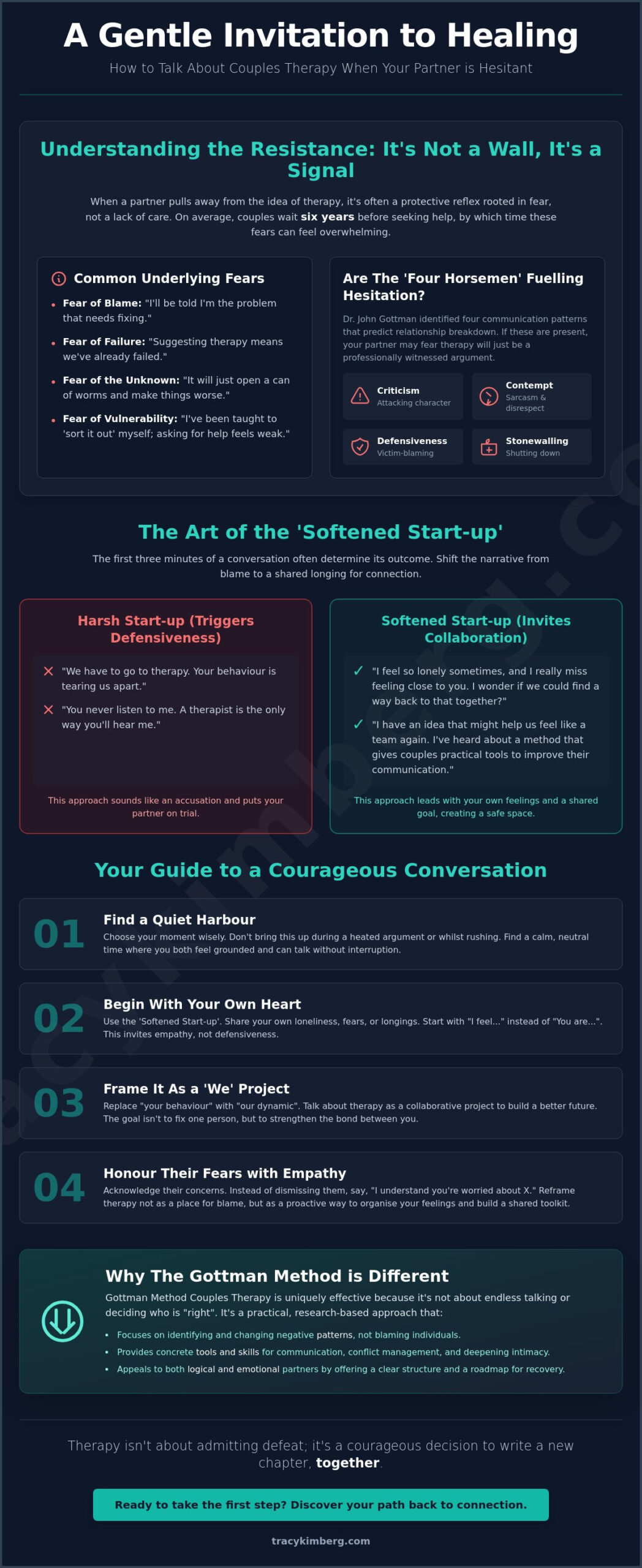
Your partner might also be reacting to the current climate of your communication. If your daily interactions have become strained, they may be viewing the prospect of therapy through the lens of what Dr. John Gottman famously identified as the “Four Horsemen”: criticism, contempt, defensiveness, and stonewalling. If these patterns are present, your partner likely fears that a session of gottman method couples therapy uk based will simply be an hour of being “ganged up on” by you and a professional witness. They worry about being the “problem” that needs fixing, rather than a partner in a shared healing process.
It’s vital to distinguish between a “relational breakdown” and a temporary “rough patch.” Whilst 42% of marriages in the UK end in divorce, research suggests that many couples wait an average of six years before seeking help for their problems. By the time the conversation happens, the anxiety isn’t just about the relationship’s future; it’s about the exhaustion of the present. Recognising that your partner’s hesitation is rooted in vulnerability can help you approach the topic with more empathy and less pressure.
The Psychology of Defensiveness
Defensiveness is often a byproduct of a “harsh start-up.” When a request for therapy begins with a list of grievances, it triggers a fight-or-flight response. Shame plays a massive role here, particularly for men who may have been socialised to see emotional vulnerability as a weakness. They might feel they should be able to “sort it out” themselves, making the invitation to therapy feel like an attack on their competence as a partner.
Common Misconceptions About Couples Counselling
Many couples believe the myth that therapy is only for those “on the brink” of separation. In reality, the most successful outcomes often come from those who treat it as a proactive programme for relationship health. You might hear objections about the cost, but it’s helpful to view this through a long-term lens; it’s an investment in your shared history and your emotional well-being. Modern gottman method couples therapy uk focuses on identifying cycles and patterns rather than deciding who is “right” or “wrong,” which can be a huge relief for a partner who fears being the villain of the story.
The Art of the ‘Softened Start-up’: Changing the Narrative
The way we begin a conversation often dictates its conclusion. In the majority of cases, the first three minutes of a discussion determine how the rest will unfold. Instead of a “harsh start-up” that sounds like a clinical diagnosis of your partner’s flaws, try a “softened start-up.” This isn’t about sugar-coating the truth; it’s about leading with your own longing. Shift the focus from “You need help” to “I miss our connection.” By sharing your own loneliness, you invite them into a space of mutual support rather than placing them on trial.
Think of therapy as a safe harbour, a neutral ground where the waves of daily stress can be managed together. It’s not a courtroom where a judge decides who is at fault. Since research shows couple therapy is effective for reclaiming a sense of shared purpose, framing it as a collaborative project makes it much more appealing. When you look into gottman method couples therapy uk options, you’re looking for a roadmap to get back to the version of “us” that you both loved. Choose your moment wisely. Don’t bring this up during a heated argument or whilst one of you is rushing out of the door. Find a quiet, favourite space where you both feel grounded and unhurried.
Focusing on Shared Dreams and Intimacy
Esther Perel often suggests that couples need to move from the mundane into the erotic and playful. Therapy isn’t just about stopping the fighting; it’s about starting the living. Talk about what you want to move towards. Maybe it’s more laughter, more intimacy, or simply a Sunday morning without tension. Framing the work as a Relationship Recovery Process allows you both to see the potential for a more vibrant, connected life together.
The ‘We’ Language Framework
Language creates our reality. Replacing “your behaviour” with “our dynamic” shares the weight of the struggle and reduces the need for the defensiveness we discussed earlier. The “We” approach is a collaborative venture where the relationship itself is the patient, not the individuals within it. Express your needs through your own experience. “I feel lonely when we don’t talk” is far more disarming than “You never talk to me.” This shift in perspective is a hallmark of the gottman method couples therapy uk practitioners use to build bridges instead of walls.
Addressing Common Objections with Empathy and Evidence
When your partner says, “We can sort this out ourselves,” they often mean they’re afraid of what a third party might uncover. It’s a natural defence. However, the reality of modern partnership is that we aren’t always equipped with the tools to see our own blind spots. Research indicates that 77% of couples find their relationship difficulties improve after counselling. By choosing a structured approach like gottman method couples therapy uk specialists provide, you aren’t just “talking about feelings”; you’re applying a scientifically validated framework to your specific dynamic.
Another common fear is that therapy will “open a can of worms” that can’t be closed. You might worry that bringing up old hurts will only lead to more pain. It’s helpful to reframe this: those “worms” are already there, affecting your intimacy and peace of mind every day. Therapy provides a controlled, safe environment to clean the wound so it can finally heal. If your partner remains hesitant, remember that you can start by seeking the benefits of couples therapy through your own individual sessions. When one person in a system changes their behaviour, the entire system is forced to recalibrate.
When a Partner Thinks Therapy is ‘Too Clinical’
Modern relationship coaching has moved far beyond the stereotypical “blank slate” therapist. It’s now a warm, human-centred experience. For those who prefer a clear roadmap, a 12-week relationship recovery programme offers a sense of progress and an end goal. This structure feels more like a proactive masterclass in connection than a clinical autopsy of your mistakes. It’s about building skills, not just rehashing the past.
The ‘Time and Money’ Barrier
We often hear that therapy is too expensive or time-consuming. Whilst the initial investment is real, it’s vital to weigh it against the emotional and financial cost of a separation. In 2023, the median duration of marriages ending in divorce in England and Wales was 12.7 years. Investing in gottman method couples therapy uk now can prevent a decade of resentment. Online sessions have also made support more accessible for busy UK professionals, allowing you to connect from the comfort of your own home without the stress of a commute. A structured programme is often more efficient than open-ended talk therapy because it focuses on actionable change from day one.
A Step-by-Step Guide to Inviting Your Partner into Therapy
Inviting someone to therapy is an act of love, not an act of war. It’s a gentle request to build a bridge back to one another. Before you initiate the talk, take a moment for self-reflection. Ask yourself if you’re truly ready to hear their perspective, even the parts that might be difficult to digest. Therapy isn’t a place where you’re “right” and they’re “wrong”; it’s a sanctuary for the relationship itself. When you’re ready, follow these steps to move from tension to a shared invitation for healing.
- Step 1: Self-Reflect. Ensure your intention is connection, not correction. Are you prepared to be as vulnerable as you’re asking them to be?
- Step 2: The Invitation. Choose a calm, favourite moment. Avoid times of high stress or the immediate aftermath of a row. Speak from the heart about your own feelings of loneliness.
- Step 3: The Offer. Be specific. Researching gottman method couples therapy uk specialists beforehand shows you’ve put in the work. Suggest a single trial session to lower the pressure.
- Step 4: The Follow-up. Give them space. People often need time to process the vulnerability of the request. Don’t demand an answer immediately; allow a day or two for the idea to settle.
- Step 5: The Commitment. Once they agree, set a shared goal for the first session. This could be as simple as “learning how to talk without arguing.”
Scripts for the Conversation
If you’re struggling to find the words, try this three-sentence approach. “I’ve been feeling quite disconnected lately, and I really miss the closeness we used to have. I’d love for us to try a session of couples therapy because I want to make sure I’m being the best partner I can be for you. Would you be open to just one meeting to see if it helps us communicate better?” If they say “maybe later,” respond with empathy: “I understand it’s a lot to think about, so let’s check back in on Saturday.” Active listening is your most powerful tool here; let them finish their thoughts without interruption.
Setting the Stage for Success
Success starts long before the first session. It begins with identifying if your relationship can be saved through repair and mutual effort. Remove all distractions like phones or the presence of children to ensure you have each other’s full attention. Maintain a calm, reassuring tone throughout the talk. If your partner gets defensive, don’t match their energy. Instead, stay grounded in your desire for closeness. If you’re ready to take that first step, you can book a consultation to explore how a structured approach can help you both find your way back to one another.
Beyond the Conversation: Finding the Right Support in the UK
Once your partner has said “yes,” the next step is choosing the right environment for your healing. The UK therapeutic landscape has shifted significantly in recent years. Whilst 68% of people still value the physical presence of a therapist, the use of online sessions has grown. In 2024, approximately 13% of therapy sessions were conducted online, and 77% of therapists now work both in-person and online. This flexibility allows you to find the best gottman method couples therapy uk offers without being limited by your postcode.
The Gottman Method is uniquely suited for partnerships where one person might be more logical whilst the other is more emotional. It provides a structured, evidence-based roadmap that satisfies the need for clear goals and data. At the same time, it honours the deep, often messy emotional currents that define our closest bonds. When searching for a practitioner, look for someone who doesn’t just listen, but actively guides you through the process of dismantling old walls and building new bridges.
The Wise Guide Approach
In my practice, I blend the research-backed precision of the Gottman Method with the systemic insights of Esther Perel and the trauma-informed perspectives of Gabor Maté. This holistic experience ensures that we aren’t just treating symptoms, but understanding the roots of your connection. Whether you choose Face-to-Face Therapy or the convenience of Online Therapy, the goal remains the same: creating a safe, non-judgemental environment where both partners feel heard. This balanced approach allows for a deep dive into the “why” of your behaviour whilst providing the “how” for your future.
Your Path Forward
Viewing therapy as a proactive adventure rather than a clinical necessity changes everything. It’s a sign of immense relationship strength to say, “We value this enough to make it better.” To prepare for your first session, simply come with an open heart and a willingness to be curious about each other again. You don’t need all the answers; you just need the desire to find them together. I invite you to take the next step by booking a discovery call. It’s a low-pressure way to ease the transition and begin your journey toward a reclaimed, vibrant connection.
Your Journey Toward a Reclaimed Connection
We’ve explored how a softened start-up and a “we” language framework can shift a conversation from conflict to collaboration. By addressing objections with empathy and understanding the psychological roots of resistance, you’ve already taken the first step in protecting your shared history. Choosing the right support, such as the gottman method couples therapy uk specialists provide, ensures your path forward is grounded in research and deep human insight.
As a specialist in the 12-Week Relationship Recovery Process, I offer a safe and non-judgemental space to navigate the complexities of infidelity or emotional disconnect. You don’t have to carry the weight of this transition alone. I invite you to Book a Discovery Call with Tracy Kimberg to discuss your relationship recovery and begin your proactive adventure in healing today. Your desire for a healthier partnership is a testament to the strength of your bond; it’s the first spark of a brighter future together.
Frequently Asked Questions
What if my partner flatly refuses to go to therapy?
Respect their boundary whilst remains clear about your own emotional needs. You cannot force a partner into a therapeutic space, but you can explain how their refusal affects your sense of hope for the future. Sometimes, a partner needs time to process the request without feeling pressured. If they continue to decline, focusing on your own growth can often be the catalyst that eventually encourages them to join you.
Can I start therapy alone if my partner won’t join me?
How do I choose between online and face-to-face therapy in the UK?
Base your decision on your logistical needs and the level of “physical containment” you require. Online therapy is increasingly popular for its accessibility and the comfort of being in your own home, which can reduce the initial anxiety of the first session. Face-to-face sessions offer a dedicated, neutral space away from domestic distractions. Both formats are highly effective for gottman method couples therapy uk specialists to help you rebuild your bond.
How long does couples therapy usually take to show results?
Many couples report feeling a significant shift in their perspective after just three or four sessions. Whilst every partnership is unique, a structured 12-week Relationship Recovery Process is designed to provide a clear roadmap with measurable milestones. The initial phase focuses on de-escalating conflict, whilst the later stages work on deepening intimacy and shared meaning. The goal is to build sustainable skills that last long after the sessions end.
What should we do if we both feel nervous about the first session?
Acknowledge the nervousness as a shared experience that proves you both still value the relationship. It is completely normal to feel vulnerable when preparing to speak about your private world with a professional. Your therapist is trained to manage this tension and will spend the first session building safety and rapport. Think of it as an introductory meeting where the only goal is to see if you feel comfortable and heard.
Is it better to see a Gottman-trained therapist?
Seeing a therapist trained in this specific method provides you with tools grounded in over 40 years of longitudinal research. This approach is world-renowned for its practical focus on managing conflict and strengthening friendship. By working with a specialist in gottman method couples therapy uk, you ensure that your sessions are guided by proven strategies rather than just anecdotal advice. It offers a reliable structure for couples who want clear, actionable results.
How do I bring up therapy without it sounding like an ultimatum?
Focus on your own feelings of longing and your desire for a better connection rather than listing your partner’s faults. An ultimatum feels like a threat, whilst an invitation feels like an opportunity for shared relief. Try saying, “I miss the version of us that laughed together, and I’d love some help to find our way back there.” This frames therapy as a proactive investment in your happiness rather than a punishment for your struggles.
What happens if the therapist ‘takes sides’?
A professional therapist acts as an advocate for the relationship itself, not for one person over the other. Their role is to observe the “dance” between you and identify the patterns that are causing pain. If you ever feel that the balance has shifted unfairly, it is vital to raise this within the session. A skilled therapist will welcome this feedback as it helps to maintain the safe, non-judgemental environment required for true healing.

Article by
Tracy Kimberg
Tracy Kimberg is a Relationship Expert, Couples Therapist and Coach with a dedicated focus on helping couples and individuals rebuild connection, trust and emotional safety in their relationships. Drawing on the research of John and Julie Gottman, the relational insights of Esther Perel, and years of hands-on therapeutic experience, Tracy offers a warm, non-judgemental and deeply compassionate approach to modern relationships.
Based in Dorset, Tracy works with couples navigating communication breakdowns, betrayal, intimacy challenges, separation, family dynamics and life transitions. Known for creating a safe and grounded therapeutic space, she combines practical tools with emotional depth to help clients move beyond survival patterns and towards meaningful, lasting change.
With a reputation for empathy, professionalism and dedication to her clients’ growth, Tracy is passionate about helping people feel seen, understood and empowered — both within their relationships and within themselves.
Disclaimer
Disclaimer:
The information shared in this article is intended for educational and informational purposes only and should not be considered a substitute for professional therapeutic, psychological, medical or legal advice. Every individual and relationship is unique, and the perspectives offered are based on general therapeutic principles, research and professional experience.
Reading this article does not establish a therapist-client relationship with Tracy Kimberg. If you are experiencing significant emotional distress, relationship crisis, trauma, or mental health concerns, it is important to seek support from a qualified professional appropriate to your individual circumstances.
All content remains the intellectual property of Tracy Kimberg and may not be reproduced or distributed without permission.