

What if the most compassionate choice for your future isn’t to endure, but to acknowledge that the story you’ve written together has reached its final chapter? For many, the question of when to leave a marriage uk isn’t triggered by a sudden explosion, but by a quiet, persistent ache of emotional loneliness whilst sitting right next to their partner. You might find yourself caught in a cycle of “is this normal?” or “can we fix this?”, weighed down by the fear of how a split might affect your children. It’s a heavy burden to carry, and it’s natural to feel a sense of paralysis when the line between a temporary rough patch and a systemic failure feels so thin.
We believe that clarity is the first step toward healing, regardless of the eventual outcome. This guide provides the psychological framework you need to distinguish between a marriage that can be revitalised and one that has fundamentally dissolved. By understanding the core markers of relational health, you can move toward a decision with a sense of internal peace. We’ll explore how to navigate this transition with intention, showing you that there is a path to conscious separation that prioritises the well-being of your entire family.
Key Takeaways
- Recognise that the “liminal space” of ambivalence is a necessary stage of discernment rather than a sign of failure.
- Identify specific psychological markers, such as the presence of contempt, to gain clarity on when to leave a marriage uk whilst protecting your own emotional well-being.
- Learn to distinguish between a “roommate phase” that requires effort and a “dead zone” that signals a structural failure of the bond.
- Reframe the decision regarding children by considering the behaviour and conflict patterns they are internalising from your current partnership.
- Discover the difference between a final attempt at relationship recovery and the transition into a conscious separation that preserves individual dignity.
Navigating the Ambivalence: Why Asking “When to Leave a Marriage” is the First Step to Clarity
Asking the question isn’t the end; it’s the beginning of honesty. Many people feel a sense of guilt just for wondering about the mechanics of What is Divorce? and whether it’s their only option. This is the liminal space, a threshold where you aren’t quite ‘in’ but haven’t yet left. It’s an exhausting place to live. Yet, this internal conflict is a vital signal. It tells you that the current state of your union is no longer providing the emotional sustenance you need to thrive. Validation of this uncertainty is the first step toward finding a path that honours both your history and your future happiness.
In my work, I often see couples who have mastered the art of ‘quiet desperation’. This is particularly common when considering when to leave a marriage uk, where cultural norms might suggest we simply ‘carry on’ for the sake of appearances. Whilst legal frameworks often focus on timelines and durations, your internal experience of the bond is what truly matters. Chronic emotional erosion is different from an acute crisis like a single act of infidelity or a period of grief. Erosion is the slow, steady loss of safety, interest, and respect. It’s the water dripping on the stone until the stone is gone. Before you take any legal steps, I encourage you to seek professional discernment to understand if the relationship’s core is truly broken or if you’ve simply lost the tools to repair the connection.
The Weight of the Decision in a UK Context
The British ‘stiff upper lip’ often acts as a double-edged sword. While it provides resilience, it can also trap individuals in a performance of happiness that feels hollow. You might find yourself maintaining a perfect facade amongst friends and family whilst feeling utterly invisible at home. This social pressure makes the decision feel even heavier, as the fear of judgement often outweighs the desire for relief. It’s vital to remember that ‘for better or for worse’ was intended as a promise of partnership, not a mandate to endure emotional neglect or systemic loneliness. For many women, breaking this cycle requires a dedicated space like Female Focused Therapy to explore their needs safely and without judgement.
Emotional vs. Legal Separation
There is a significant difference between the legal end of a marriage and the emotional one. Most couples have emotionally separated years before they ever see a solicitor. You might be living separate lives under one roof, sharing a calendar but not a heart. This state of being physically present but relationally absent carries a massive psychological toll. It creates a ‘dead zone’ where intimacy cannot grow. Understanding this distinction helps you realise that when to leave a marriage uk becomes a question of acknowledging a reality that has likely existed for quite some time, allowing you to move from confusion to a place of informed choice.
The Psychological Markers of a Relationship at its End
Most people look for legal advice first, but the answer to when to leave a marriage uk usually lies within the psychological architecture of the home. Dr John Gottman’s research identifies four toxic patterns that act as predictors of relational failure: criticism, defensiveness, stonewalling, and the most destructive of all, contempt. Whilst occasional bickering is a normal part of the human experience, these patterns become systemic when they replace curiosity with judgement. Understanding the psychological and emotional aspects of divorce involves recognising when these “Four Horsemen” have taken up permanent residence in your daily life. It’s not just about the presence of conflict, but the absence of repair.
Contempt is the “Death Knell” because it’s a position of moral superiority that seeks to diminish the other person. It’s the eye-roll, the sneer, and the biting sarcasm that erases respect. Beyond the noise of conflict, there is often a more chilling sign: emotional deadness. This occurs when you no longer have the energy to even argue. If the fire of anger has turned to the cold ash of apathy, the “Shared Meaning” system that once bound you together has likely dissolved. When your visions for the future no longer align, the structural integrity of the marriage is compromised.
Identifying the Point of No Return
The point of no return is often reached when the “fondness and admiration” system collapses entirely. You no longer remember why you liked each other, and your partner’s presence feels like an intrusion rather than a comfort. The language shifts from a collaborative “we” to an adversarial “me vs you” dynamic. Relational contempt is the psychological equivalent of a broken foundation. Every interaction becomes a negotiation of territory rather than a shared experience of intimacy.
Infidelity and the Capacity for Repair
Infidelity is frequently a catalyst for asking when to leave a marriage uk. Sometimes an affair is a cry for help or a symptom of a systemic issue; other times, it’s the final exit. Trust can be rebuilt, but only if both parties are willing to engage in deep, transparent work. If you’re struggling with the aftermath, couples therapy for infidelity can provide a structured environment to explore whether repair is viable. Signs that the bond is truly over include a refusal to take accountability or a fundamental lack of desire to do the hard work of reconnection. If you feel stuck in this cycle of pain, reaching out for Relationship Counselling and Coaching for Couples can help you navigate these complex emotions with professional support.
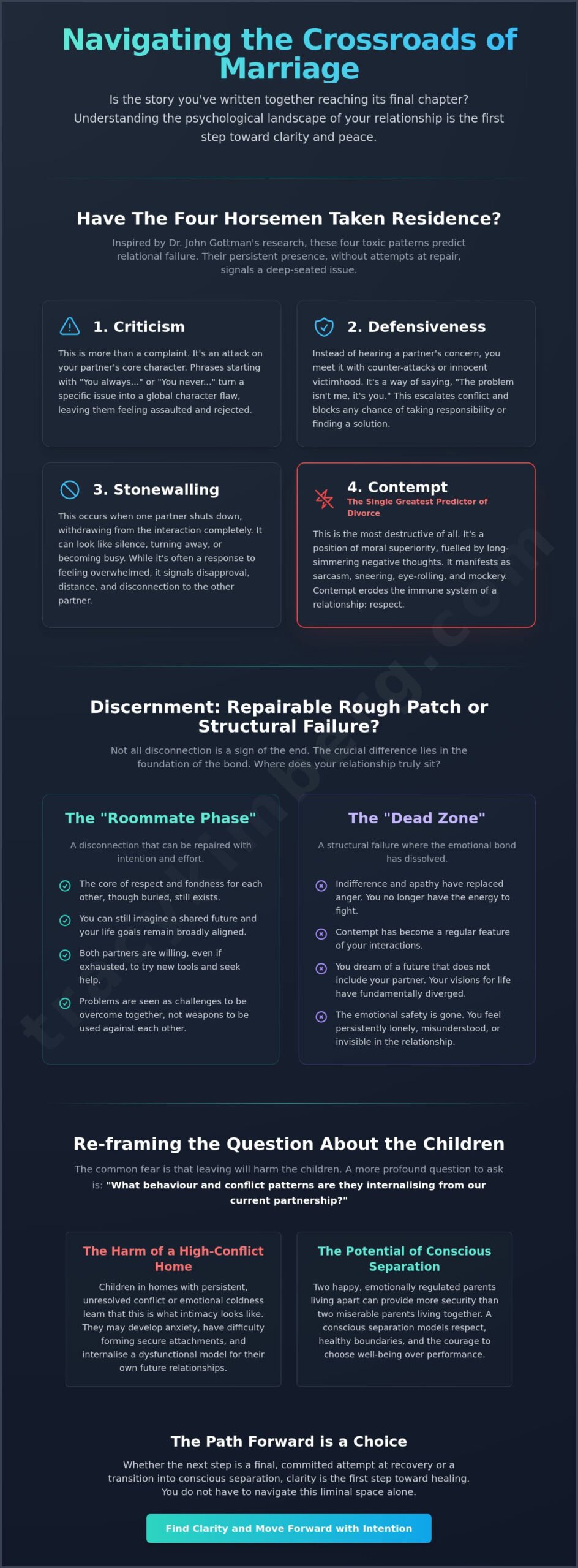
Discernment: Is Your Marriage “Broken but Repairable” or “Structurally Unsound”?
Clarity rarely comes from a single “eureka” moment. It usually emerges through the quiet work of self-reflection. This is where individual relationship counselling becomes invaluable. By finding your own voice amongst the noise of your partner’s expectations and your own fears, you can begin to see the partnership for what it truly is. You start to identify which issues are “deal-breakers” (such as a fundamental misalignment of values or a refusal to address toxic behaviours) and which are simply the “rough edges” of long-term commitment that can be smoothed with effort and time.
The Litmus Test of Shared Effort
A marriage is a bridge that requires two pillars of support. If you are the only one hauling stones while your partner remains passive, the structure will eventually collapse under the weight of your exhaustion. This is often seen in the “One Foot Out” syndrome, where one person remains technically present but is emotionally unavailable for any real healing. To test the capacity for change, look for these markers:
- Does your partner genuinely acknowledge the behaviour that hurts the bond?
- Is there a shared willingness to be vulnerable and “unlearn” old patterns?
- When you look at your favourite memories, are they all from the distant past, or are you still capable of creating new moments of joy?
Physical and Emotional Safety
Whilst we often focus on emotional nuances, there are non-negotiable markers that override all other discernment. If you are experiencing domestic abuse, coercive control, or chronic substance misuse that remains unaddressed, the question of when to leave a marriage uk shifts from a matter of “if” to a matter of “how soon can I be safe”. Safety is the only rule that takes precedence over relational repair. If you are in immediate danger, please reach out to organisations like Refuge (0808 2000 247) or the Men’s Advice Line (0808 8010 327). For those moving toward a legal end, the UK government guidance on separation provides the necessary framework for the practical steps ahead.
Addressing the “Should I Stay for the Children?” Objection
The heaviest burden in the decision of when to leave a marriage uk is almost always the impact on the children. There is a deeply ingrained belief that a “broken home” is the worst possible outcome for a child’s development. However, we must ask ourselves: what is the cost of staying in an emotionally dead or high-conflict environment? Children are not fooled by closed doors or polite silences. They are emotional barometers, absorbing the tension, resentment, and loneliness that permeate a home where the parents are estranged. Staying for the children often means asking them to live in a house without a heartbeat.
Research consistently shows that children fare better in a stable, healthy co-parenting arrangement than they do in a high-conflict marriage. Chronic parental unhappiness creates a baseline of anxiety for a child, affecting their fundamental sense of security. By choosing to stay in a marriage that has reached its natural conclusion, you might inadvertently be teaching your children that love is synonymous with endurance, neglect, or sacrifice. Transitioning toward a conscious separation allows you to preserve the integrity of the family unit, even as the structure of the marriage changes.
The Emotional Environment of the Home
Relational modelling is the subconscious blueprint children develop for their own future partnerships by observing the intimacy, conflict, and boundaries within their parents’ marriage. If they grow up amongst parents who are emotionally distant or perpetually defensive, they may struggle to form healthy attachments later in life. It’s a concept of behavioural inheritance. You are teaching them what to expect from a partner and what to settle for. Providing a peaceful, honest environment in two separate homes is often more beneficial than maintaining a facade of unity in one.
Transitioning to Co-Parenting with Dignity
The goal is to shift your relationship from “spouses” to “business partners in the firm of Our Children”. This requires a high level of emotional maturity and a commitment to keeping adult grievances away from the nursery or the dinner table. Seeking amicable separation guidance is a vital step in this transition. It helps you set the stage for a healthy post-divorce dynamic where the children feel safe and loved by both parents. If you find yourself stuck in a cycle of guilt or fear, I invite you to explore my Conscious Approached Divorce and separation services to help you navigate this transition with clarity and compassion.
Choosing the Path Forward: Recovery or Conscious Separation
Once you’ve navigated the ambivalence and examined the psychological markers of your bond, you reach a fork in the road. Determining when to leave a marriage uk is ultimately about moving from a state of paralysis into a state of intentional action. This doesn’t always mean an immediate trip to a solicitor. For many, the final stage of discernment involves a “last effort” that is designed to provide absolute clarity. Whether you choose to repair the foundation or dismantle the structure entirely, doing so with intention ensures that you move forward without the haunting weight of “what if”.
Radical acceptance is a powerful tool at this stage. It involves seeing the relationship exactly as it is, rather than how you wish it were or how it used to be. If the answer is that the marriage has reached its natural conclusion, the focus shifts to a “Conscious Separation”. This approach prioritises the emotional health of both individuals and any children involved. It’s a way of ending the legal contract without destroying the human connection or the respect you once shared. Unlike the purely legalistic paths often suggested, this is a heart-centred transition that acknowledges the complexity of your shared history.
The 12-Week Relationship Recovery Process
Before making a final decision, many couples find peace of mind through a structured relationship recovery program. This 12-week litmus test isn’t just about “saving” the marriage; it’s about testing its capacity for change. By focusing on communication, intimacy, and breaking old patterns of behaviour, you gain a clear “yes” or “no”. If the bond remains unresponsive despite this intensive effort, you can move toward separation knowing you’ve tried everything. This certainty is essential for your future mental health and long-term healing.
Starting the conversation with your partner requires a delicate balance of empathy and firmness. You might say, “I value our history, but I can no longer live in a partnership that lacks emotional safety.” This clarity prevents the “One Foot Out” syndrome mentioned earlier and allows both parties to begin the grieving process. It’s a proactive choice for your well-being, acknowledging that when to leave a marriage uk is sometimes the most loving thing you can do for yourself and your family.
Embracing the Future with Calm Optimism
Leaving a marriage is undoubtedly a significant life transition, but it’s also an opportunity for profound personal growth. Therapy plays a vital role here, helping you navigate the grief of a lost future whilst rebuilding your sense of self. You aren’t just losing a partner; you’re gaining the possibility of a life that aligns with your values and emotional needs. Whether you’re seeking a discernment session to find your voice or recovery coaching to explore a final effort, I am here to support you. I invite you to connect with me for a conversation about your path forward, ensuring you move toward your next chapter with peace and clarity.
Reclaiming Your Peace and Clarity
The decision of when to leave a marriage uk is never a single event; it’s a series of honest realisations that your emotional well-being and relational health deserve more than just endurance. We’ve explored how to identify the markers of a bond that has reached its natural conclusion and why choosing a path of conscious separation can be a profound act of love for your entire family. Whether you are ready to attempt a final recovery or need to transition with dignity, you don’t have to navigate this complex landscape alone.
I am here to offer the expert guidance you need. As a specialist in the Gottman Method with over 5 years of experience in transformational coaching, I provide a safe, non-judgemental space for you to find your truth. Whether you require support through a structured recovery or a compassionate, conscious separation, we can work together to ensure your future is built on a foundation of health and respect. I invite you to Book a Relational Discernment Session with Tracy Kimberg to gain the clarity and calm optimism required for your next chapter. Healing is possible, and it begins with the courage to listen to your own heart.
Frequently Asked Questions
How do I know if my marriage is over or just in a rough patch?
A rough patch is typically characterised by a mutual desire to find a way back to each other, even amongst the struggle. You know a marriage is likely over when curiosity has been replaced by a permanent lack of interest and a refusal to engage in repair. If the thought of your partner’s presence feels like an intrusion rather than a comfort, you’ve likely moved beyond a temporary dip into a deeper relational failure.
Is it better to stay in a marriage for the sake of the children?
Staying for the children often does more harm than good if the home environment is toxic or emotionally vacant. Children are highly sensitive to parental unhappiness and learn their own relationship patterns by watching yours. Providing a peaceful, stable life in two separate homes is often the most compassionate choice for their long-term emotional health and development, as it stops them from internalising a blueprint of sacrifice and loneliness.
What are the first signs that a marriage is failing in the UK?
Early signs often include a quiet withdrawal from shared vulnerability and the loss of everyday interest in each other’s lives. You might find yourself dreading the journey home or feeling a sense of relief when your partner is away. These subtle shifts in behaviour are often the first indicators of when to leave a marriage uk, suggesting the emotional foundation is eroding long before legal steps are considered.
Can a marriage be saved after contempt has set in?
Saving a marriage after contempt has set in is possible, but it requires a radical shift in how you view each other. Contempt is a position of moral superiority that must be replaced by a culture of appreciation and respect. This work is intensive and often requires professional guidance to unlearn the biting sarcasm and eye-rolling that destroy trust and replace them with genuine empathy and vulnerability.
How long should you try to save a marriage before giving up?
There is no universal expiry date for effort, but a three-month period of focused, research-based recovery usually reveals whether change is possible. If you’ve committed to a structured process and see no improvement in communication or empathy, it provides the clarity needed for when to leave a marriage uk. Peace of mind comes from knowing you’ve truly tested the relationship’s capacity for repair before choosing to walk away.
What is conscious separation and how does it differ from a standard divorce?
Conscious separation is a heart-centred approach that seeks to end the marriage without destroying the individuals involved. Unlike a standard adversarial divorce, it focuses on the psychological and emotional transition of the family. It’s about dismantling the partnership with dignity, ensuring that the legal ending of the marriage is not the ending of the family’s integrity or the respect you share as parents.
Can couples therapy help if only one person wants to stay?
Therapy can be incredibly useful even when one partner is leaning out. This specific type of work focuses on discernment, helping the couple decide whether to commit to a period of recovery or move toward separation. It provides a neutral space to explore the “why” behind the desire to leave, ensuring any final decision is made with clarity and intention rather than through impulse or untreated resentment.
What should I do if I feel lonely whilst still being married?
Feeling lonely whilst in a partnership is often more painful than being alone, as it highlights the lack of connection where it should most exist. This chronic emotional isolation is a signal that your needs for intimacy and being “seen” aren’t being met. It’s vital to address this loneliness directly with your partner or a therapist to see if the bond can be revitalised or if the partnership has reached its natural conclusion.

Article by
Tracy Kimberg
Tracy Kimberg is a Relationship Expert, Couples Therapist and Coach with a dedicated focus on helping couples and individuals rebuild connection, trust and emotional safety in their relationships. Drawing on the research of John and Julie Gottman, the relational insights of Esther Perel, and years of hands-on therapeutic experience, Tracy offers a warm, non-judgemental and deeply compassionate approach to modern relationships. Based in Dorset, Tracy works with couples navigating communication breakdowns, betrayal, intimacy challenges, separation, family dynamics and life transitions. Known for creating a safe and grounded therapeutic space, she combines practical tools with emotional depth to help clients move beyond survival patterns and towards meaningful, lasting change. With a reputation for empathy, professionalism and dedication to her clients’ growth, Tracy is passionate about helping people feel seen, understood and empowered — both within their relationships and within themselves.
Disclaimer
Disclaimer: The information shared in this article is intended for educational and informational purposes only and should not be considered a substitute for professional therapeutic, psychological, medical or legal advice. Every individual and relationship is unique, and the perspectives offered are based on general therapeutic principles, research and professional experience. Reading this article does not establish a therapist-client relationship with Tracy Kimberg. If you are experiencing significant emotional distress, relationship crisis, trauma, or mental health concerns, it is important to seek support from a qualified professional appropriate to your individual circumstances. All content remains the intellectual property of Tracy Kimberg and may not be reproduced or distributed without permission.