

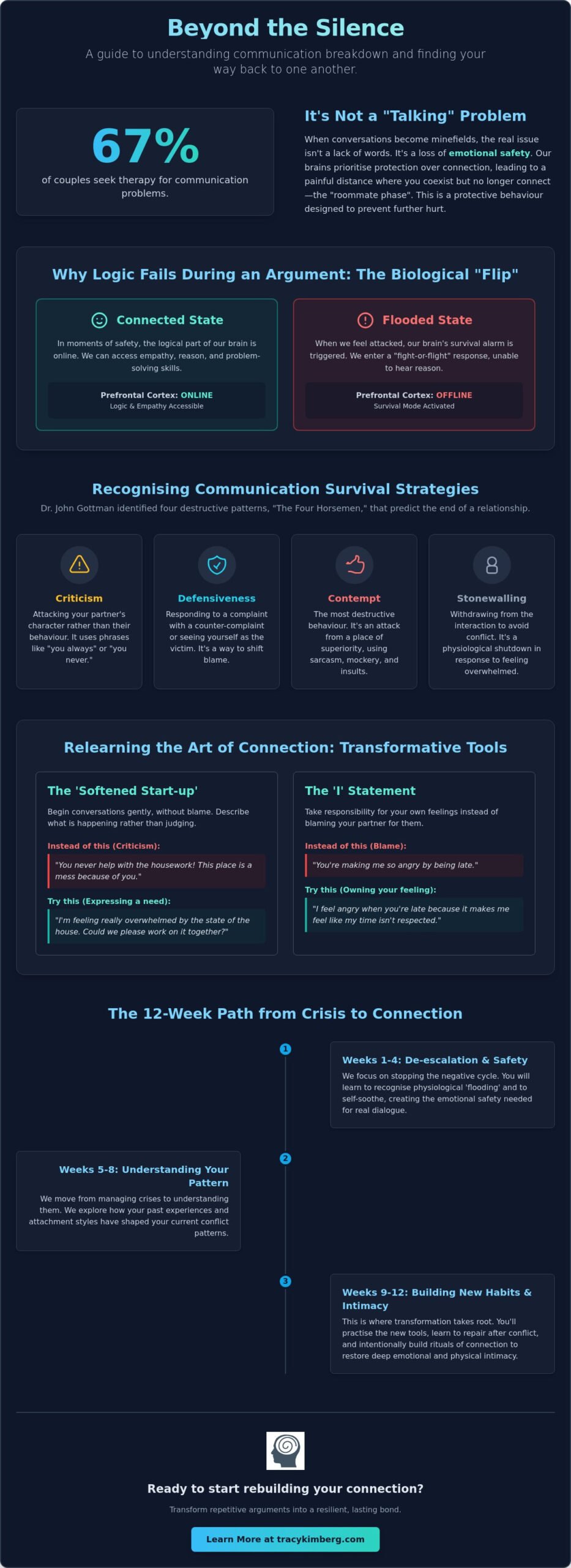
You are sitting in the same room, yet the distance between you feels like a vast, unbridgeable canyon. Another evening has dissolved into that heavy, familiar silence where every word feels like a potential landmine, and you’re left wondering how a simple conversation went so wrong. It’s exhausting to walk on eggshells, fearing that a small request will trigger another row. You aren’t alone; communication breakdown is the primary reason approximately 67% of couples seek couples therapy for communication problems. When you feel unheard or invisible, it’s natural to retreat, but this protective behaviour often only deepens the divide.
This guide explores how professional support can help you dismantle these defensive walls and find your way back to one another. We will examine why these cycles happen and how you can learn to speak your truth without sparking defensiveness. By understanding the underlying emotions behind the silence, you can begin to restore the intimacy you’ve been missing and build a relationship where you both feel truly seen and valued. You will discover how to transform repetitive arguments into a resilient, lasting connection.
Key Takeaways
- Understand why communication breakdown is actually a loss of emotional safety and how to recognise the signs of the “roommate phase” in your partnership.
- Identify the “Four Horsemen” of conflict and discover how these survival behaviours are often learned patterns rather than intentional malice.
- Learn how professional couples therapy for communication problems uses research-based frameworks to transform repetitive rows into meaningful dialogue.
- Master practical tools such as “softened start-ups” and “I” statements to express your deepest needs without triggering your partner’s defensiveness.
- Discover a structured 12-week path that guides you from the exhaustion of crisis management back to a place of genuine emotional intimacy.
Why We Stop Talking: Understanding Communication Problems in Relationships
Most couples arrive at my door believing they have a “talking” problem. They feel that if they could just find the right words, the arguments would stop. However, communication breakdown is rarely about a lack of vocabulary. It is almost always a symptom of a loss of emotional safety. When we no longer feel safe to be vulnerable, our brains prioritise protection over connection. We stop sharing our dreams, our fears, and eventually, our day-to-day thoughts. This retreat often leads to the “roommate phase,” a painful state where you coexist in the same house whilst living entirely separate emotional lives. This phase isn’t just a lull in excitement; it is a sophisticated avoidant behaviour designed to prevent further hurt.
Our current struggles are often echoes of our earliest experiences. Professional couples therapy for communication problems often begins by exploring how your childhood attachment styles dictate your adult arguments. If you grew up in a home where conflict was explosive or, conversely, entirely suppressed, you likely learned specific “survival strategies.” For some, this manifests as the silent treatment. Whilst it feels like a hostile act to the person on the receiving end, for the one staying silent, it is often a desperate attempt to self-soothe and avoid making things worse. It is a protective wall, not just a cold shoulder.
The Anatomy of a Relational Breakdown
In the early days of a relationship, we are fuelled by curiosity. We ask questions because we genuinely want to know the answer. Over time, curiosity is replaced by assumption. We stop asking and start “knowing” what our partner thinks, feels, and intends. This shift is often accelerated by the “noise” of modern life. Stress, children, and financial pressures drown out subtle emotional signals. We become efficient at managing logistics but fail at maintaining intimacy. To understand the deeper mechanics of this shift, it is helpful to look at When Communication Breaks Down in Relationships, which examines what is actually happening beneath the surface of your daily interactions.
The Biological “Flip”: Why Logic Fails During Conflict
Have you ever noticed that during a row, you say things you don’t mean, or your partner seems unable to hear reason? This is a biological reality. When we feel attacked, our amygdala triggers a “flooding” response, sending us into a fight-or-flight state. In this moment, the prefrontal cortex, the part of the brain responsible for logic and empathy, essentially shuts down. You cannot solve a relationship problem whilst your body believes it is fighting for survival. This is a core focus within couples therapy for communication problems, where partners learn to recognise these physiological shifts. The history and evolution of Couples therapy has shown us that teaching couples how to physically soothe themselves and each other is the first step toward meaningful dialogue. Without this biological regulation, even the best communication techniques will fail.
The Science of Connection: How Therapy Reframes Your Dialogue
When you enter a therapeutic space, you aren’t just there to talk. You are there to build a structure. John Gottman describes this as the “Sound Relationship House.” For many couples, the walls of this house have become thin; the foundation of friendship and admiration has eroded under the weight of unresolved conflict. In our work together, we don’t just patch the cracks. We look at the underlying architecture of your connection. We examine how the house was built and where the support beams have weakened over time.
This process involves finding a delicate balance between what Esther Perel describes as the fundamental human need for security and the equally vital desire for adventure and autonomy. Often, communication fails because one partner is fighting for safety whilst the other is fighting for freedom. By utilising couples therapy for communication problems, we create a “third space.” This is a neutral ground where your individual truths can coexist without one cancelling out the other. It allows us to shift the narrative from “You vs Me” to a collaborative “Us vs The Problem.”
Research-Based Approaches to Healing
We rely on proven methods because your relationship is too precious for guesswork. The Gottman research has demonstrated that we can predict relationship success with startling accuracy by observing how partners interact during conflict. A key element we explore is the “bid for connection.” These are the small, everyday moments where you reach out for your partner’s attention. Do you turn toward them, or do you turn away? Systemic therapy allows us to see these moments as part of a larger “dance.” When one person steps, the other reacts. By changing your individual steps, you change the entire rhythm of the partnership.
The Role of the Wise Guide in Your Journey
Navigating complex emotional landscapes alone is difficult. As your therapist, my role is to act as a neutral, empathetic facilitator. I don’t take sides. Instead, I observe the circular arguments that keep you trapped and help you see the exit. Professional intervention provides the brakes when a conversation starts to spiral into a row. In the safe, non-judgemental environment I provide, you can explore the vulnerable feelings that usually stay hidden behind anger or silence. If you feel ready to change the rhythm of your relationship, you might find that exploring face-to-face or online therapy is the first step toward a more resilient bond. This specialised couples therapy for communication problems is designed to move you beyond mere survival into a state of thriving connection.
Identifying Your ‘Communication Survival Strategies’
Conflict often feels like a battle for survival. When we feel threatened, we don’t reach for our best selves; we reach for the weapons we learned to carry long ago. In couples therapy for communication problems, we identify these weapons as the “Four Horsemen”: criticism, contempt, defensiveness, and stonewalling. These are not signs that you are a “bad” partner or that your spouse is heartless. Instead, they are survival behaviours. They are the ways you learned to protect your heart long before you entered this relationship. By naming these patterns, we take away their power to control your narrative.
Many couples find themselves trapped in what we call the “Pursuer-Distancer” dynamic. One partner pursues connection through high-intensity communication, which the other partner perceives as a verbal attack. In response, the second partner distances themselves to find safety, which the first partner perceives as a terrifying abandonment. This cycle is a classic example of how communication problems are often just two people trying to feel safe in different ways. Identifying your “favourite” defensive posture is the first step toward dismantling it. There is no shame in having a go-to strategy; the goal is simply to see it clearly so you can choose a different path together.
When Criticism Becomes Contempt
There is a vital distinction between a complaint and a personal attack. A complaint addresses a specific action, whilst criticism attacks the partner’s character. When criticism evolves into contempt, it becomes truly corrosive. Contempt is fuelled by long-simmering negative thoughts and a sense of superiority. It is the single greatest predictor of relationship failure because it makes the other person feel despised and worthless. Ask yourself: “Am I attacking the problem, or am I attacking my partner’s soul?” Contempt doesn’t just hurt the bond; it actually impacts your physical health, as the stress of being on the receiving end can weaken the immune system.
The Wall of Stonewalling
Stonewalling occurs when one partner withdraws from the interaction, shutting down or simply looking away. To the partner seeking connection, this feels like a cold act of apathy. However, stonewalling is usually a sign of being physiologically overwhelmed. The “silent treatment” often masks a heart rate that has soared into a state of “flooding.” Whilst it triggers intense anxiety in the partner who is being shut out, the stonewaller is often just trying to stop a total internal collapse. In some cases, unpicking these deep-seated habits requires a specialised approach to understand why silence became your safest refuge in the first place.
Transformative Tools: Relearning the Art of Connection
Moving from the theoretical understanding of our survival patterns into the practical realm of change requires a specific set of skills. It isn’t about grand gestures; it’s about the small, deliberate choices we make when the tension rises. In couples therapy for communication problems, we focus on tools that help you drop your shield and invite your partner back in. These methods are designed to rebuild the emotional safety we discussed earlier, allowing you to move from a place of survival to one of genuine intimacy.
Vulnerability is the cornerstone of this transformation. It involves owning your feelings through “I” statements rather than pointing the finger of blame. Instead of saying, “You make me feel invisible,” try, “I feel lonely whilst we sit in silence, and I would love to spend ten minutes talking about our day.” This shift moves the focus from your partner’s perceived failures to your own internal experience. When combined with active listening, where you listen specifically to understand your partner’s perspective rather than building your own legal case for a retort, the entire dynamic begins to soften.
Mastering the Softened Start-up
The first three minutes of a conversation are critical. They almost always determine how the rest of the interaction will go. If you start with a harsh accusation, your partner’s brain will immediately “flip” into a defensive state. A softened start-up allows you to bring up a problem without sparking a row. A helpful template to use is: “I feel [emotion] about [event] and I need [need].” By focusing on your positive need rather than your partner’s negative behaviour, you provide a clear path for them to succeed in supporting you.
The Power of Repair Attempts
Even the most connected couples have rows. The difference lies in how they navigate them. A repair attempt is any statement or action, such as a joke, a gentle touch, or a brief apology, that seeks to de-escalate tension whilst a conflict is happening. However, the attempt itself is only half the story. The reception of that repair is just as vital. When your partner reaches out with an olive branch, choosing to accept it, even if you are still feeling frustrated, is a profound act of relational health. Repair attempts are the emotional glue of a resilient partnership.
Organising your life to include scheduled check-ins can prevent small grievances from festering into major divides. This proactive maintenance ensures that you are both seen and valued on a consistent basis. If you feel ready to move beyond the exhaustion of repetitive arguments and start relearning the art of connection, you can explore my relationship counselling and coaching services to begin your journey toward a more resilient bond. This specialised couples therapy for communication problems provides the structure and support you need to heal the silent divide for good.
Beyond the Argument: The 12-Week Relationship Recovery Process
Healing a relationship isn’t a linear process, but it does require a map. Whilst we have explored the biological triggers and the survival strategies that keep you apart, understanding the “why” is only the beginning of the journey. To truly transform your connection, you need a pathway that moves you beyond the immediate heat of an argument into a sustained state of mutual understanding. My signature 12-week programme is designed to provide this exact structure. It serves as a highly focused form of couples therapy for communication problems, offering a clear beginning, middle, and end to the most volatile phase of your relational recovery.
This process is built on the belief that even the most long-standing communication problems can be unlearned. We often think of our patterns as fixed traits, but they are actually adaptive responses to a perceived lack of safety. By following a research-based, step-by-step approach, we move from the exhaustion of crisis management into the warmth of deep intimacy. You stop simply surviving the week and start building a proactive, positive adventure together. This structured intervention ensures that the progress you make in the therapy room translates into your living room, your kitchen, and your shared future.
Whilst repairing a partnership is a collaborative effort, individual development is equally important; to find support for your personal journey, visit Create a life you love.
In addition to therapeutic support, many find that spiritual reflection provides a meaningful foundation for personal growth. To read more about the spiritual guidance and books offered by Dr. Anthony Martin, you can explore his available resources.
A Structured Roadmap to Recovery
The 12-Week Relationship Recovery process differs significantly from traditional, open-ended talk therapy. Rather than simply “checking in” each week, we follow a specific roadmap that addresses the root causes of your disconnect. The initial phases focus on immediate relief and de-escalating conflict, providing you with the tools to stop the “flooding” before it starts. As we progress, the focus shifts toward long-term relational health, unpicking the childhood attachment styles that influence your adult bonds. This ensures that you aren’t just fixing a single row, but instead, you are fundamentally reorganising how you relate to one another.
Taking the First Step Toward Change
It is entirely normal to feel a sense of anxiety when considering couples therapy for communication problems. Opening up the “silent divide” can feel like a daunting task, especially if you have been walking on eggshells for years. However, choosing to sit across from your partner and look at the wounds you have both carried is perhaps the most profound act of courage and love you can offer. It is a declaration that the relationship is worth the effort of transformation. I invite you to book a discovery call to see if this coaching approach is the right fit for your partnership. Taking this first step is an invitation to move amongst the shadows of past arguments and step into a clearer, more resilient light together.
Finding Your Way Back to Each Other
The journey from emotional silence to a resilient connection begins with the courage to look beneath the surface of your arguments. You now understand that your communication patterns aren’t personal failings, but protective survival strategies learned long ago. By identifying the “Four Horsemen” and mastering tools like softened start-ups, you can begin to dismantle the walls that have kept you apart. This transformation isn’t just a clinical necessity; it’s a proactive adventure toward a deeper, more fulfilling partnership.
My specialised 12-Week Relationship Recovery Process offers a research-based path inspired by the insights of Gottman and Perel. I provide a safe, non-judgemental environment where you can both feel truly seen and valued. Choosing professional couples therapy for communication problems provides the structure you need to move beyond repetitive rows and into a place of genuine understanding. If you’re ready to heal the silent divide and restore your emotional intimacy, I invite you to book your discovery call with Tracy Kimberg today. You don’t have to navigate this landscape alone; a more vibrant, connected future is well within your reach.
Frequently Asked Questions
How do I know if we need couples therapy for communication problems?
You likely need support if your conversations feel like a series of predictable rows or if you’ve retreated into a heavy silence to avoid further conflict. Research suggests that the average couple waits six years after problems begin before seeking help. If you feel misunderstood, lonely, or like you’re walking on eggshells whilst sitting next to your partner, it’s a clear sign that your current survival strategies are no longer working.
Can couples therapy work if only one person wants to go?
Yes, therapy can still be transformative because a relationship is a systemic dance. When one partner changes their behaviour and begins to unpick their own defensive patterns, the other partner must inevitably react differently. Whilst having both partners committed is ideal, individual work often serves as a powerful catalyst for relational change by shifting the energy and the responses within the partnership.
How long does it typically take to see improvement in how we talk?
Many couples experience a sense of relief within the first few sessions as they begin to understand the biological triggers behind their rows. For deep, lasting transformation, a structured approach like the 12-week Relationship Recovery Process is often most effective. This timeframe allows you to move from urgent crisis management to the long-term work of rebuilding emotional safety and genuine intimacy.
What is the difference between relationship coaching and traditional counselling?
Relationship coaching tends to be more proactive and goal-oriented, focusing on providing practical tools and a structured roadmap for the future. Traditional counselling often involves a more open-ended exploration of past wounds and emotional processing. Both are valuable, but coaching is particularly effective for couples who want a clear, time-bound strategy to dismantle repetitive communication blocks and build new habits.
Is online couples therapy as effective as face-to-face sessions?
Research indicates that online therapy is just as effective as face-to-face sessions for improving relationship satisfaction and communication. It offers the added benefit of being in your own comfortable environment, which can sometimes make it easier to discuss vulnerable topics. For many busy couples, the convenience of digital sessions reduces the stress of travel, allowing more focus on the healing process itself.
What should we do if our communication problems have led to infidelity?
Infidelity is a profound trauma that requires a specialised, non-judgemental space to process the underlying causes and the resulting pain. It is often a symptom of a relationship where communication has completely broken down over time. In therapy, we work to understand the disconnect whilst holding space for the betrayal, helping you decide whether the bond can be repaired or if a conscious separation is needed.
Can we fix our relationship if we have already started talking about divorce?
Talking about divorce is frequently a desperate signal that the current way of relating has become unsustainable. It doesn’t necessarily mean the love has vanished; it often means that hope is exhausted. Many couples find that couples therapy for communication problems acts as a vital intervention that provides the tools needed to rebuild the foundation of their partnership even when it feels like the end is near.
How much does couples therapy cost in the UK?
The cost of therapy in the UK varies significantly depending on the therapist’s experience and your specific location. Private sessions typically range from £80 to over £150 per hour in many metropolitan areas. Whilst this represents a financial commitment, it is often helpful to view it as an essential investment in your long-term emotional health and the future stability of your relationship and family.

Article by
Tracy Kimberg
Tracy Kimberg is a Relationship Expert, Couples Therapist and Coach with a dedicated focus on helping couples and individuals rebuild connection, trust and emotional safety in their relationships. Drawing on the research of John and Julie Gottman, the relational insights of Esther Perel, and years of hands-on therapeutic experience, Tracy offers a warm, non-judgemental and deeply compassionate approach to modern relationships.
Based in Dorset, Tracy works with couples navigating communication breakdowns, betrayal, intimacy challenges, separation, family dynamics and life transitions. Known for creating a safe and grounded therapeutic space, she combines practical tools with emotional depth to help clients move beyond survival patterns and towards meaningful, lasting change.
With a reputation for empathy, professionalism and dedication to her clients’ growth, Tracy is passionate about helping people feel seen, understood and empowered — both within their relationships and within themselves.
Disclaimer
Disclaimer:
The information shared in this article is intended for educational and informational purposes only and should not be considered a substitute for professional therapeutic, psychological, medical or legal advice. Every individual and relationship is unique, and the perspectives offered are based on general therapeutic principles, research and professional experience.
Reading this article does not establish a therapist-client relationship with Tracy Kimberg. If you are experiencing significant emotional distress, relationship crisis, trauma, or mental health concerns, it is important to seek support from a qualified professional appropriate to your individual circumstances.
All content remains the intellectual property of Tracy Kimberg and may not be reproduced or distributed without permission.