

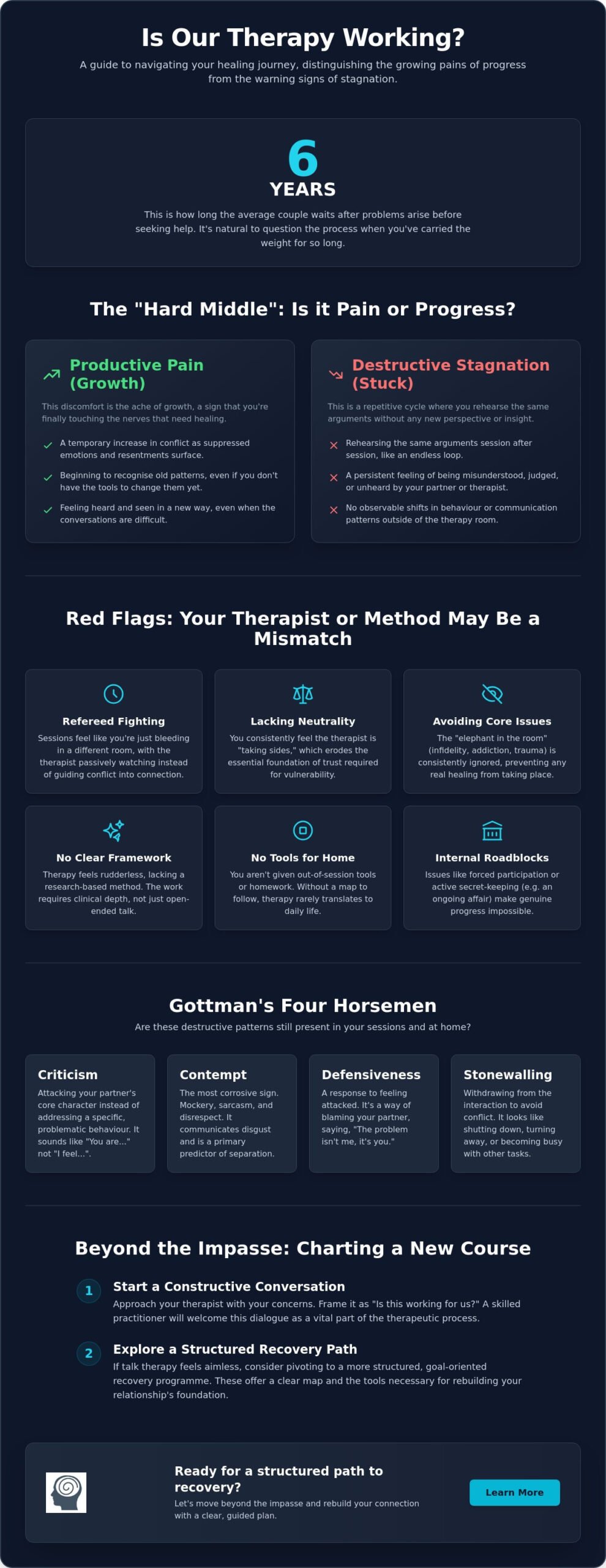
What if the increased tension you feel after a session isn’t a signal to quit, but a sign that you’re finally touching the raw nerves that need healing? It’s deeply exhausting to invest your hope into a process only to worry about the signs couples therapy is not working as conflict seems to escalate. You might feel failed by the very space meant to be your sanctuary, particularly when you consider that the average couple waits six years after problems begin before seeking help. It’s natural to feel a sense of loss when the breakthrough feels out of reach.
We understand that discerning progress from stagnation is difficult whilst you’re in the thick of it. This guide will help you distinguish between the “hard middle” of deep psychological work and genuine red flags that your relationship therapy is failing. You’ll learn to recognise when the therapeutic alliance is misaligned and understand when to persist with your current path or pivot toward a different approach that better honours your relationship’s unique journey.
Key Takeaways
- Distinguish between the temporary discomfort of the “hard middle” and actual stagnation to understand if your current conflict is actually a sign of emotional growth.
- Identify specific signs couples therapy is not working, such as a lack of a research-based methodology or a therapist who fails to maintain professional neutrality.
- Recognise how internal resistances, including “forced participation” or active secret-keeping, can create an insurmountable block to the therapeutic process.
- Utilise clinical indicators like the “Four Horsemen” to objectively assess whether your relationship foundation is being rebuilt or is continuing to crumble.
- Learn how to navigate a constructive “Is this working?” conversation and explore transitioning toward a more structured, goal-oriented recovery programme.
Understanding the Plateau: Is It a Bad Sign or Just the “Hard Middle”?
The first few sessions of Couples therapy often bring a sense of profound relief. You finally have a witness to your struggle and a neutral space to breathe. But after this “honeymoon phase” of therapy, many couples hit what we call the “Hard Middle”. This is the therapeutic plateau, a natural stage where the initial excitement of being heard fades and the gritty, deep work begins. You might find yourself searching for the signs couples therapy is not working because the sessions feel heavier and the progress feels invisible.
This phase is frequently marked by a temporary increase in conflict. As you lower your defences, suppressed emotions and long-held resentments naturally rise to the surface. It’s vital to distinguish between productive pain and destructive stagnation. Productive pain is the ache of growth, like the soreness in your muscles after a long walk. Stagnation, by contrast, is a repetitive cycle where you’re simply rehearsing the same arguments without any new perspective or insight. Therapy isn’t a “fix-it” shop where you drop off a broken dynamic and pick it up repaired; it’s a collaborative evolution. Not every session will end with a breakthrough or a feeling of lightness. Some of the most important hours are spent in the uncomfortable silence of mutual reflection.
The Difference Between Process and Progress
Whilst the process might feel agonisingly slow, progress is usually measured in microscopic behavioural shifts rather than grand gestures. It’s about developing “Relational Intelligence”, which is the capacity to observe your own patterns of behaviour even when you don’t yet have the tools to change them. If you can stop mid-argument and recognise that you’re both playing out an old script, that is a victory. Try to evaluate your growth over a period of three to four months rather than judging the entire process by the mood of a single session.
When “Not Working” Is Actually Growth
Often, what feels like a step backward is actually the removal of a mask. Uncovering deep-seated contempt or the habit of stonewalling is a necessary, albeit painful, part of the healing journey. You cannot mend a relationship foundation until you’ve cleared away the debris of years of miscommunication. Temporary discomfort is the necessary price of admission for long-term relational health. To better understand these underlying currents, you might explore how to fix communication in a relationship by looking at what’s happening beneath the surface. Sometimes, the signs couples therapy is not working are actually just the growing pains of a relationship finally starting to breathe.
Red Flags: Signs Your Therapist or Method is the Wrong Fit
Sometimes the issue isn’t the relationship’s capacity to change, but the vehicle carrying you there. If you’re consistently questioning the signs couples therapy is not working, it’s vital to look at the practitioner. A therapist should be a wise guide, not just a passive listener. If your sessions feel like “refereed fighting” where you simply repeat the week’s arguments whilst the therapist watches, you aren’t building skills; you’re just bleeding in a different room. You need a space where the heat of conflict is transformed into the light of understanding.
A major red flag is the avoidance of “the elephant in the room”. Whether it’s active infidelity, hidden addictions, or deep-seated trauma, a therapist must have the courage to address these directly. Without a clear, research-based framework like the Gottman Method or Systemic Therapy, the work can feel rudderless. It lacks the clinical depth required for genuine transformation. If the therapist lacks neutrality amongst the couple or feels like they’re “taking sides”, the necessary foundation of trust will quickly erode.
The Importance of a Structured Approach
Talk therapy can be beautiful, but it often lacks the rigour needed for complex relationship repair. Contrast open-ended talk therapy with a more structured 12 week relationship recovery programme. In these settings, the “patient” is the relationship itself, not just two individuals venting frustrations. Without out-of-session tools or specific homework, therapy rarely sticks. You need a map, not just a mirror. The centre of the work must always be the health of the partnership.
Feeling Unheard or Judged
A therapist must maintain a “Safe Environment” whilst still being brave enough to challenge destructive behaviours. If you feel the therapist’s own biases are leaking into your sessions, the alliance is fundamentally broken. You should feel challenged, yes, but never judged. If you feel unheard, it’s worth bringing this up directly before deciding to quit. A professional will welcome the feedback as a clinical data point. If the response feels defensive, it might be time to consider specialised relationship counselling that better aligns with your needs.
The Mirror Effect: When Internal Resistance Halts Progress
Sometimes the most frustrating signs couples therapy is not working have nothing to do with the therapist’s skill or the methodology being used. Instead, the impasse exists within the internal landscape of the partners themselves. Therapy is, at its heart, a mirror. If one or both partners are unwilling to look at their own reflection, the process becomes a performative exercise rather than a transformative one. We often see the “Forced Partner” dynamic, where one person attends sessions solely to appease their spouse or to delay an inevitable breakup. In these cases, the body is in the room, but the heart is barricaded.
Secret-keeping acts as a total block to progress. Whether it’s an active affair or a hidden addiction, therapy cannot heal what is not revealed. There is also the complex role of “Secondary Gain”, where a partner might subconsciously benefit from the relationship staying broken. Perhaps being the “victim” provides a sense of moral superiority, or remaining in conflict avoids the terrifying vulnerability of true intimacy. Without addressing these hidden agendas, the work remains on the surface, unable to take root in the soil of the relationship.
Trauma and the Nervous System in the Room
Drawing on Gabor Maté’s perspective, we must recognise that for many, relational vulnerability feels life-threatening rather than life-giving. When a partner has unaddressed individual trauma, the intimacy of a therapy session can trigger “physiological flooding”. This is a state where the nervous system is so overwhelmed that the prefrontal cortex, the part of the brain responsible for logic and communication, shuts down. You might see a partner who is “checked out” or in a state of chronic “freeze”. In these moments, individual relationship counselling is often the necessary precursor to joint work, allowing each person to regulate their own system before attempting to co-regulate with another.
The “One Foot Out” Syndrome
It’s a painful reality that some individuals have already “consciously uncoupled” in their minds whilst still sitting on the therapy couch. This “One Foot Out” syndrome is different from the healthy ambivalence many feel during the hard middle of healing. It’s a state of being “done” whilst going through the motions. Identifying these signs couples therapy is not working requires radical transparency. Honesty, even if it leads to a difficult ending, is the only way to make the therapeutic space productive and respectful for everyone involved.
Decoding the Stagnation: Scientific and Relational Indicators
How do we measure the intangible shifts of the heart? Whilst emotions feel fluid, clinical research provides us with concrete metrics to assess the health of a partnership. If the “Four Horsemen” (Criticism, Contempt, Defensiveness, and Stonewalling) are still galloping through your sessions after months of work, these are clear signs couples therapy is not working in its current form. These behaviours aren’t just “bad habits”; they’re corrosive elements that eat away at the “Sound Relationship House” you’re trying to rebuild. When the foundation continues to crumble despite professional intervention, we have to ask if the structure itself is still viable.
A particularly telling indicator is the absence of “Repair Attempts”. In healthy dynamics, one partner will eventually offer a metaphorical olive branch, such as a joke, a touch, or an apology, to de-escalate tension. If these attempts have ceased, or if they’re consistently met with a cold shoulder, the emotional connection is severely depleted. We also look for “Gridlocked Conflicts”, those perpetual issues that feel like walking into a brick wall. If therapy isn’t helping you move from gridlock to dialogue, the relationship may be stuck in a cycle of repetitive wounding rather than healing.
Productive Conflict vs. Destructive Stagnation
It’s helpful to distinguish between sessions that challenge you and those that simply drain you. Use the table below to evaluate your recent experiences:
| Insight-Led Sessions (Progress) | Wounding-Led Sessions (Stagnation) |
|---|---|
| Discovery of “why” we react | Re-litigation of “what” was said |
| Softened start-ups to difficult topics | Escalating attacks and blame |
| Shared vulnerability and “we” language | Increased defensiveness and “you” language |
Measuring relational repair outside the room is equally vital. For those navigating the aftermath of a breach, couples therapy for infidelity requires a unique set of metrics, focusing heavily on transparency and the slow restoration of safety. If the betrayed partner cannot move past the trauma or the unfaithful partner cannot maintain consistent honesty, the stagnation is a signal that needs your attention.
The Role of Hope as a Clinical Metric
We often discuss “Negative Sentiment Override”, a state where a partner can no longer see any positive behaviour as genuine. If your spouse brings you tea and you think, “What do they want from me?”, the filter of the relationship has become toxic. Hope isn’t just a feeling; it’s a clinical requirement for change. When hope is entirely absent, it may be time to transition toward a conscious decision to repair or let go. If you feel stuck in this cycle, reaching out for expert relationship coaching can provide the clarity you need to stop the cycle of stagnation.
Beyond the Impasse: Pivoting to a Structured Recovery Path
Recognising the signs couples therapy is not working isn’t an admission of failure; it’s a moment of radical clarity. When you reach this impasse, the most constructive step is to have an honest “Is this working?” conversation with both your partner and your therapist. A skilled practitioner won’t be offended. They’ll use your feedback as clinical data to adjust the treatment plan. If the current approach feels like you’re simply treading water, it’s time to stop the drift and choose a new direction. Sometimes, a simple change in format, such as moving from online sessions to face-to-face therapy, or increasing the frequency of meetings, can break the deadlock and provide the container your relationship needs to feel safe again.
Often, the stagnation occurs because the therapy lacks a clear destination. General talk therapy can sometimes devolve into a weekly venting session without measurable growth. Transitioning to a time-bound, goal-oriented programme allows you to move from passive observation to active transformation. It shifts the focus from “what happened this week” to “how are we building our future”. This pivot requires you to be brave enough to admit that the current path has reached its end, whilst remaining optimistic that a different route might lead you home.
The Case for a 12-Week Intensive
Open-ended therapy can feel aimless when you’re in the midst of a crisis. This is why many couples find profound relief in a 12-Week Relationship Recovery Process. Rather than wandering through emotional landscapes, a structured path focuses on specific relational pillars each week, from rebuilding trust to mastering the art of the repair attempt. You need a Wise Guide who combines clinical skill with a transformational approach, providing you with a map and the tools to navigate it. This structure creates a sense of momentum, helping you move past the “hard middle” and into a space of genuine reconnection.
When the Goal Changes: Conscious Divorce
It’s vital to recognise that the “success” of therapy isn’t always defined by staying together. Sometimes, the most healthy, professional outcome is the realisation that the partnership has completed its journey. Therapy can help you navigate a “Conscious Approach to Divorce”, allowing you to separate with dignity, respect, and emotional health. By ending a relationship consciously, you do a profound favour for your future selves and, crucially, for any children involved. It transforms a potential battle into a process of mutual growth. If you feel stuck and aren’t sure which way to turn, let’s explore a different path together through a specialised recovery process designed to bring you the clarity you deserve.
Choosing Clarity and Growth Over Stagnation
If you’re ready to move beyond the impasse, I’m here to help. My work is inspired by the Gottman Method and utilises a 12-Week Relationship Recovery Process designed to provide the structure that general talk therapy often lacks. As a specialist in infidelity and relational breakdown, I help couples rebuild on a foundation of transparency and emotional safety. You don’t have to stay stuck in a cycle that no longer serves your partnership.
Book a Discovery Call with Tracy Kimberg to find a path that works for you. Let’s discover how a specialised approach can turn your struggle into a proactive adventure in healing. Your relationship deserves a guide who understands both the science of connection and the heart’s complexity.
Frequently Asked Questions
How many sessions should it take to see if couples therapy is working?
You should generally allow 8 to 12 sessions to gauge the effectiveness of the process. The first few hours are typically spent on assessment and history-taking, whilst the subsequent sessions involve the deeper, more challenging work. If you haven’t noticed even small behavioural shifts or a change in how you perceive your partner by the twelfth session, it may be a signal to discuss a change in methodology with your practitioner.
Is it normal for things to get worse after starting marriage counselling?
It is entirely normal, and often necessary, for conflict to increase temporarily. As you begin to lower your defences and address long-held resentments, the “hard middle” of therapy can feel quite turbulent. This isn’t a sign of failure; it’s a sign that the masks are coming off. Once these raw emotions are in the room, you can finally begin the genuine work of repair and reconnection.
Can therapy work if only one person is trying?
Whilst individual work can transform how you show up in a partnership, couples therapy requires two active participants to be truly successful. If one person has already “consciously uncoupled” in their mind, it becomes one of the primary signs couples therapy is not working. For the relationship house to be rebuilt, both partners must be willing to pick up the tools and engage with the blueprint of change.
What should I do if I don’t like our couples therapist but my partner does?
You must bring this concern into the therapeutic space immediately. For therapy to be effective, the alliance between the therapist and both partners must feel balanced and neutral. If you feel judged, unheard, or that the therapist is taking sides, the foundation of trust is compromised. A professional will welcome this feedback and work to adjust the dynamic so that you both feel equally supported.
How do I tell our therapist that I don’t think this is working?
Speak your truth directly during your next session. You might say, “I feel we are treading water and I’m not seeing the progress I hoped for.” A wise guide will treat this as valuable clinical data rather than a personal slight. This transparency often breaks the deadlock and helps you identify the signs couples therapy is not working, allowing you to pivot toward a more structured recovery path.
What happens if we finish therapy and the problems come back?
Relapsing into old patterns often means the new behaviours haven’t yet become “muscle memory.” It’s common for couples to need occasional “booster” sessions to reinforce the pillars of their relationship. If the issues return with their original intensity, it may indicate that the initial work didn’t go deep enough into the underlying trauma or that the structured tools weren’t fully integrated into your daily lives.
Can a therapist tell us if we should get a divorce?
A therapist will not make the decision for you, but they will help you reach your own conclusion. Their role is to hold up a mirror to your dynamic and help you identify if you are in a state of productive growth or destructive stagnation. Whether you choose to stay together or move toward a conscious separation, the goal is to ensure the decision is made with clarity and emotional health.
Is it ever too late to start couples therapy?
It is rarely too late if both partners have a genuine desire for a different outcome. Even if the goal has shifted from saving the marriage to ending it with dignity, therapy provides a vital container for that transition. Whilst waiting the average six years after problems begin makes the work more complex, the capacity for human connection and healing remains powerful as long as there is a willingness to engage.

Article by
Tracy Kimberg
Tracy Kimberg is a Relationship Expert, Couples Therapist and Coach with a dedicated focus on helping couples and individuals rebuild connection, trust and emotional safety in their relationships. Drawing on the research of John and Julie Gottman, the relational insights of Esther Perel, and years of hands-on therapeutic experience, Tracy offers a warm, non-judgemental and deeply compassionate approach to modern relationships.
Based in Dorset, Tracy works with couples navigating communication breakdowns, betrayal, intimacy challenges, separation, family dynamics and life transitions. Known for creating a safe and grounded therapeutic space, she combines practical tools with emotional depth to help clients move beyond survival patterns and towards meaningful, lasting change.
With a reputation for empathy, professionalism and dedication to her clients’ growth, Tracy is passionate about helping people feel seen, understood and empowered — both within their relationships and within themselves.
Disclaimer
Disclaimer:
The information shared in this article is intended for educational and informational purposes only and should not be considered a substitute for professional therapeutic, psychological, medical or legal advice. Every individual and relationship is unique, and the perspectives offered are based on general therapeutic principles, research and professional experience.
Reading this article does not establish a therapist-client relationship with Tracy Kimberg. If you are experiencing significant emotional distress, relationship crisis, trauma, or mental health concerns, it is important to seek support from a qualified professional appropriate to your individual circumstances.
All content remains the intellectual property of Tracy Kimberg and may not be reproduced or distributed without permission.