

What if the most profound shift in your partnership doesn’t actually require your partner to be in the room? It’s incredibly isolating to feel like you’re the only one trying to save a sinking ship, especially when you’re stuck in a cycle of repetitive arguments or exhausted by a partner who is resistant to therapy. You might feel that if they won’t join you on the couch, your progress is permanently stalled. It’s a common belief that it takes two to tango, but in the world of systemic therapy, we know that when one person changes their steps, the entire dance must change. This is the transformative potential of relationship counselling for one person.
You deserve to feel heard and supported, even if you’re currently navigating this path alone. I promise that by focusing on your own internal landscape and communication patterns, you can gain the clarity you need to decide whether to stay or leave whilst reducing the personal anxiety that keeps you awake at night. In this article, we’ll explore how individual relational work empowers you to reclaim your agency. We’ll look at how your own growth can act as a catalyst for a shift in your partner’s behaviour and provide you with the practical tools to foster a more conscious, connected life.
Article Summary
- Understand why the “client” in these sessions is actually your relationship, allowing you to address partnership dynamics even when your partner is absent.
- Discover how relationship counselling for one person uses systems theory to show that changing your behaviour naturally forces a shift in the entire couple dynamic.
- Learn to distinguish between traditional individual therapy and relational work, ensuring your sessions focus on the “we” through the lens of the “I”.
- Identify your personal attachment history and communication triggers to gain clarity on your relationship’s future and reduce emotional distress.
- Explore how a research-based, empathetic approach can help you reclaim your agency and foster a more conscious connection with your partner.
What is Relationship Counselling for One Person?
It’s a common misconception that therapy for a partnership requires two chairs to be occupied. Relationship counselling for one person is a specialised therapeutic approach where the focus isn’t solely on your individual psyche, but on the invisible thread that connects you to your partner. Whilst traditional individual therapy often centres on personal self-actualisation or managing specific symptoms like anxiety, this work treats the relationship itself as the primary client. Even if your partner is absent, their presence is felt in every session through the patterns, echoes, and dynamics we explore together.
It takes immense courage to step into this space alone. You might be feeling the weight of a connection that feels frayed, yet you’re currently the only one ready to pick up the needle and thread. The goal here isn’t to “fix” your partner by proxy or to vent about their flaws in a vacuum. Instead, we work on gaining deep clarity, breaking toxic cycles of reactivity, and fostering a high level of relational intelligence. We’re looking for the “how” of your interactions, not just the “why” of your history. By changing your internal response to the external relationship, you disrupt the status quo and create space for something new to emerge.
The “Hopeful Spouse” Perspective
I often hear clients ask, “Why should I be the one doing all the heavy lifting?” It’s a valid question born from genuine exhaustion. However, being the first mover isn’t a sign of weakness or a surrender to being the “problem” person. It’s an act of profound leadership. By entering relationship counselling for one person, you’re creating a safe sanctuary to voice fears you might be too terrified to share at home. You’re giving yourself permission to stop waiting for permission. This space allows you to process the isolation of a resistant partner without the immediate pressure of their reaction, providing the breathing room necessary for real change to take root.
Relational Intelligence: Beyond Self-Help
This work moves beyond simple self-help by focusing on what Esther Perel describes as the “shadow” in relationships; those parts of ourselves we disown that play out in our most intimate connections. We look at circular causality. This means moving away from the linear blame of “What is wrong with them?” and towards a more systemic understanding of “What is happening between us?” When you begin to see how your own defensive reactions trigger their withdrawal, or how your silence fuels their pursuit, you regain your power. You stop being a passenger in your own relationship and start becoming an architect of its future.
The Science of the Solo Shift: How One Person Changes the System
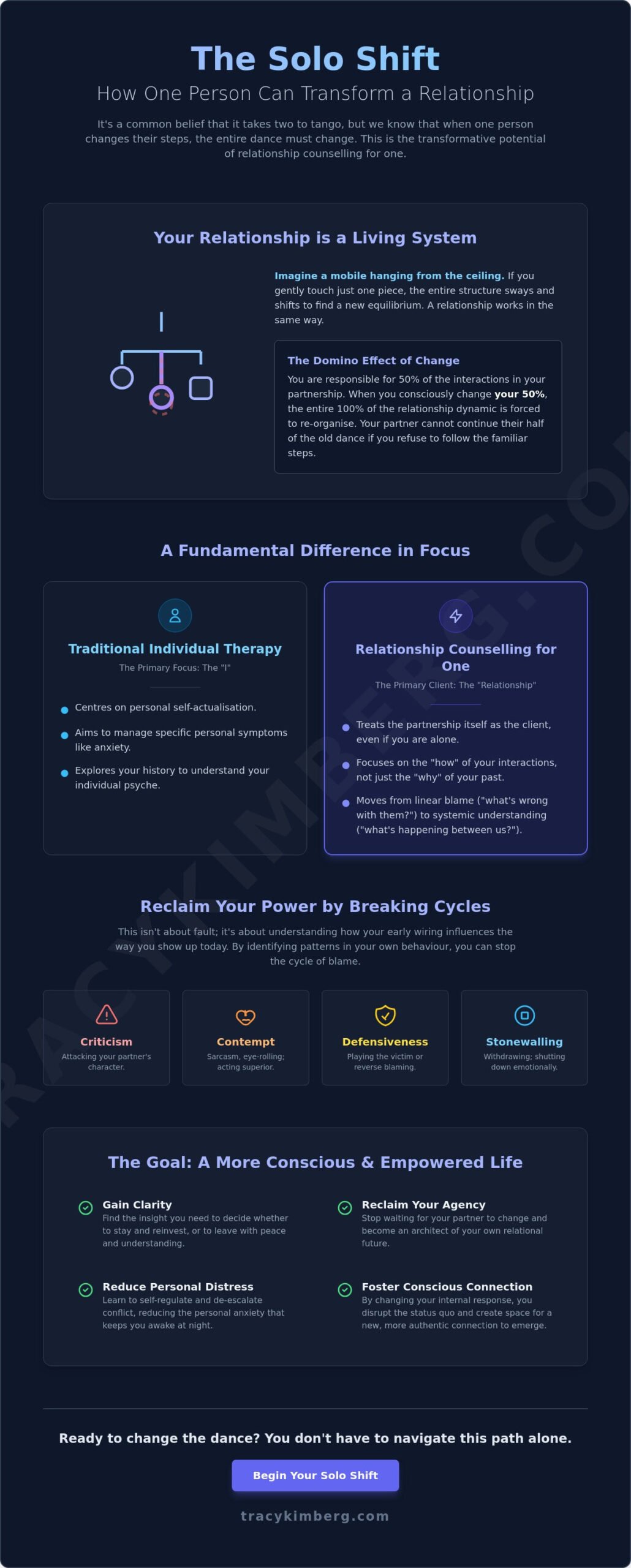
Imagine a decorative mobile hanging from a ceiling. If you reach out and tug on just one small piece, the entire structure begins to sway and rotate. Every other piece must shift its position to find a new equilibrium. This is the core of Systems Theory. A relationship is not just two people; it’s a living system where every action is a reaction, and every silence is a message. When you engage in relationship counselling for one person, you’re essentially becoming that one piece of the mobile that chooses to move differently.
The power of this approach lies in the “Domino Effect.” You are responsible for 50% of the interactions in your partnership. When you change your 50%, the remaining 100% of the relationship is forced to re-organise. Your partner cannot continue their half of the old dance if you refuse to follow the steps. By identifying John Gottman’s “Four Horsemen”, criticism, contempt, defensiveness, and stonewalling, within your own behaviour, you stop the cycle of blame. You begin to see, through the lens of Gabor Maté, how your childhood attachment styles colour your current reactions. This isn’t about being at fault; it’s about understanding how your early wiring influences the way you show up today.
Breaking the Cycle of Reactivity
Most arguments are a series of rapid-fire reflexes. By learning to pause, you employ self-regulation that can de-escalate even the most heated moments. In the classic “Pursuer-Distancer” dynamic, the more one person chases for connection, the more the other retreats. When the pursuer stops chasing and begins to focus on their own emotional grounding, the distancer often feels the space to move back toward the centre. Relational mindfulness is the ability to observe the dance whilst you are dancing it.
The Internal Family Systems (IFS) Lens
We all contain different “parts.” Perhaps a “Protector” part of you lashes out to prevent you from feeling hurt, or a “Critic” part tries to control the environment to feel safe. In therapy, we identify these parts and the wounded child they are trying to shield. When you operate from a “Self-led” place, you naturally invite your partner to lower their defences. If you’re ready to explore these dynamics, Online Therapy provides a flexible way to begin this individual work from the comfort of your own home. This trauma-informed perspective ensures we aren’t just treating symptoms, but healing the roots of your relational pain.
Individual Therapy vs Relationship Counselling for One: Understanding the Difference
It is easy to assume that any therapy session where you sit alone with a practitioner is “individual therapy.” However, the distinction lies in the focus of the work. Traditional individual therapy is often a quest for self-actualisation, focusing on your personal history, your specific symptoms, and your own healing. Whilst this is deeply valuable, it can sometimes create an echo chamber where your partner’s perspective is lost. In relationship counselling for one person, the lens is wider. We aren’t just looking at you; we are looking at the “we” through the lens of the “I”.
There is a hidden danger in regular therapy that many don’t talk about: the “venting” trap. If you spend forty-five minutes each week detailing your partner’s failings to a therapist who only seeks to validate your feelings, you may leave the room feeling righteous but more alienated from your partner than ever. A relational expert works differently. They keep your partner’s “voice” present in the room, even in their absence. They might ask, “If your partner were sitting here, how would they describe this moment?” This prevents the session from becoming a place of blame and instead turns it into a laboratory for relational growth.
When to Choose Individual Relationship Counselling
This path is often the most effective choice when you find yourself at a crossroads. You might choose this if:
- Your partner refuses to attend, but you aren’t ready to give up on the connection.
- You want to explore your own patterns and triggers before committing to relationship coaching for couples.
- You are considering a conscious approach to divorce and separation and need a neutral, expert space to process your next steps.
The Role of the Therapist as a Wise Guide
A relational therapist acts as a Wise Guide who holds the “relational space” even amongst the most intense conflict. It’s a delicate balance. You should feel deeply supported, yet you must also be prepared to be challenged. True growth happens when you realise that your own defensive behaviours, whilst born from a need for safety, might be the very thing blocking the intimacy you crave. Understanding how individual relationship counselling transforms the partnership allows you to move from a place of helplessness to one of active, conscious change.
Navigating the Process: What to Expect in Solo Relationship Work
Entering relationship counselling for one person is a structured, intentional process that feels less like a lecture and more like a collaborative cartography of the heart. It begins with an initial assessment where we map the history of your partnership alongside your personal attachment history. We look for the echoes of the past that might be distorting your present. By pinpointing the exact moments where communication breaks down, we move away from vague feelings of being “stuck” and toward a surgical understanding of your relational triggers.
Once the landscape is clear, we move into active skill building. This phase integrates the core tools of the 12-week relationship recovery process. You’ll learn to master the art of “I” statements, which allow you to express deep needs without triggering your partner’s defensiveness. We also focus on active listening, the ability to hear the vulnerability beneath your partner’s anger. Crucially, we work on clarifying boundaries. This involves the vital work of differentiation; learning where you end and your partner begins, so you can remain grounded even whilst they are in distress.
From Conflict to Connection (or Conscious Closure)
There is a common fear that seeking help alone is merely a precursor to a breakup. In reality, this work opens the door to three potential outcomes: a renewed reconnection, a state of healthy maintenance, or the path of conscious uncoupling. If trust has been severely compromised, this solo work acts as a vital foundation for future couples therapy for infidelity by ensuring you are emotionally prepared to do the work of rebuilding. The goal is not always “saving” the relationship, but reaching a state of “relational integrity” where your choices align with your deepest values.
Practical Exercises for the Solo Client
We don’t just discuss the dance; we practice the steps in a safe, contained environment. I often utilise the “Empty Chair” technique, which allows you to rehearse difficult conversations and process your reactions before you bring them into the heat of your home life. Journaling prompts for relational self-discovery help you track your progress and identify recurring patterns in your behaviour. By developing a “Relational Recovery” mindset, you learn to value steady, incremental progress over the exhausting pursuit of perfection. If you’re ready to transform how you show up in your partnership, I invite you to explore my Relationship Counselling and Coaching for Couples to see how we can begin this journey together.
Taking the First Step: How Tracy Kimberg Supports Your Solo Relational Growth
Choosing to embark on relationship counselling for one person is a profound act of self-care that ripples outward into your partnership. My approach is deeply rooted in the research-based methods of John Gottman and the systemic insights of Esther Perel. It is a blend of clinical expertise and warm, accessible guidance designed to demystify the complexities of human connection. Whether you choose the flexibility of Online Therapy or the intimate setting of Face-to-Face Therapy, the focus remains on providing you with a manageable path toward healing. We don’t just look at the weight of the problems; we look at the possibility of a different, more vibrant future.
The 12-Week Relationship Recovery Process is often seen as a journey for two, but it is equally powerful when adapted for the individual. We focus on the same core pillars of communication, trust, and emotional safety, but we do so through the lens of your own experience and agency. This structured rhythm allows us to move from the initial shock of a breakdown into a collaborative solution that honours your emotional well-being. I invite you to book a discovery call where we can discuss your specific situation and see if this path feels right for you.
A Safe Space for Your Story
I provide a non-judgemental, professional environment where your narrative is the priority. My extensive background in treating anxiety and depression provides a sturdy foundation for this relational work. Often, the distress within a partnership is inextricably linked to our individual mental health. By addressing both, we ensure that your growth is holistic and sustainable. As your Wise Guide, I am here to ensure you don’t have to navigate this breakdown alone. I am here to offer clarity whilst you find your footing again.
Your Next Steps to Healing
Prioritising your own emotional health isn’t selfish; it’s essential. Interestingly, when one partner begins this work, the shift in the dynamic often piques the curiosity of the other. It isn’t uncommon for a resistant partner to eventually join the process once they see the positive, calm changes in you. Regardless of their involvement, your progress is your own. Investing in relationship counselling for one person is the first step toward a more conscious and peaceful life. If you are ready to reclaim your agency and start the healing process, please Book your initial consultation with Tracy Kimberg today.
Reclaiming Your Relational Power
You don’t have to wait for your partner’s permission to begin the process of healing. As we’ve explored, your relationship is a living system; when you choose to move differently, the entire dance is forced to change. By stepping away from the cycle of blame and embracing your own relational intelligence, you regain the agency that often feels lost in the heat of conflict. Relationship counselling for one person isn’t a consolation prize; it’s a proactive choice to prioritise your emotional health and the future of your partnership.
My safe, non-judgemental UK-based practice provides a sanctuary where you can process your story with a Wise Guide. Utilising research-based methods inspired by the work of Gottman and Perel, I offer a specialised 12-Week Relationship Recovery Process that can be adapted specifically for your solo journey. You deserve a space where you feel heard, challenged, and supported as you navigate these complex emotional landscapes. Whether you are seeking a path back to intimacy or the strength to move forward with integrity, you don’t have to do it alone.
Begin your journey toward relational clarity with Tracy Kimberg and discover the transformative power of working on yourself.
Frequently Asked Questions
Can relationship counselling really work if only one person attends?
Yes, it can be highly effective because every relationship operates as a system where each person’s behaviour influences the other. When you change your reactions and patterns, the entire dynamic is forced to shift in response to maintain a new balance. By focusing on your 50% of the interaction, you disrupt repetitive cycles, which often acts as a powerful catalyst for broader change within the partnership.
How is individual relationship counselling different from regular therapy?
While traditional therapy often focuses on personal symptoms like anxiety or depression, relationship counselling for one person treats the relationship as the primary client. We explore the “we” through your eyes, examining how your attachment styles and communication triggers impact the bond. It is less about solo self-actualisation and more about building the relational intelligence needed to navigate your partnership with greater clarity and purpose.
What if my partner is angry that I am seeing a relationship counsellor alone?
It is natural for a partner to feel defensive or threatened when they aren’t part of the therapeutic conversation. I encourage you to frame your sessions as a personal commitment to your own emotional health and a desire to show up more effectively in the relationship. Often, once a partner observes you becoming less reactive and more grounded, their initial anger softens into curiosity about the positive changes they see.
How many sessions will I need before I see a change in my relationship?
Every partnership is unique, but many clients report a shift in their own internal perspective and reactivity within four to six sessions. While systemic change takes time, the moment you begin to apply new self-regulation techniques, the atmosphere at home often begins to feel different. My 12-Week Relationship Recovery Process provides a structured timeline for those seeking deeper, sustainable transformation through consistent effort.
Can this type of therapy help me decide whether to leave my partner?
Absolutely. One of the primary goals of solo relational work is to achieve “relational integrity,” which involves making choices that align with your deepest values rather than your immediate fears. Therapy provides a neutral, expert space to untangle your feelings from the noise of daily conflict. This clarity allows you to decide whether to stay and repair the bond or move toward a conscious separation with a sense of peace.
Is relationship counselling for one person suitable after infidelity?
Yes, it is often a vital first step after trust has been compromised. Whether you are the partner who was betrayed or the one who stepped outside the relationship, you require a safe sanctuary to process the trauma and understand the underlying dynamics. Individual work helps you stabilise your emotional responses and determine if you have the capacity to begin the long, complex process of rebuilding trust together.
Do you offer online sessions for relationship counselling in the UK?
Yes, I provide Online Therapy sessions for individuals across the UK who prefer the privacy and convenience of their own environment. These digital sessions are just as effective as face-to-face work, allowing us to maintain a steady, supportive rhythm regardless of your location. It is a flexible way to prioritise your relational health whilst managing the demands of a busy life.
What happens if my partner decides they want to join the sessions later?
It is quite common for a previously resistant partner to express interest once they see the progress you are making alone. In these instances, we can discuss the best way to transition into joint work or how they might begin their own individual journey first. My priority is always the health of the relationship, and I will guide you on the most ethical and effective way to integrate them into the process.
Article by
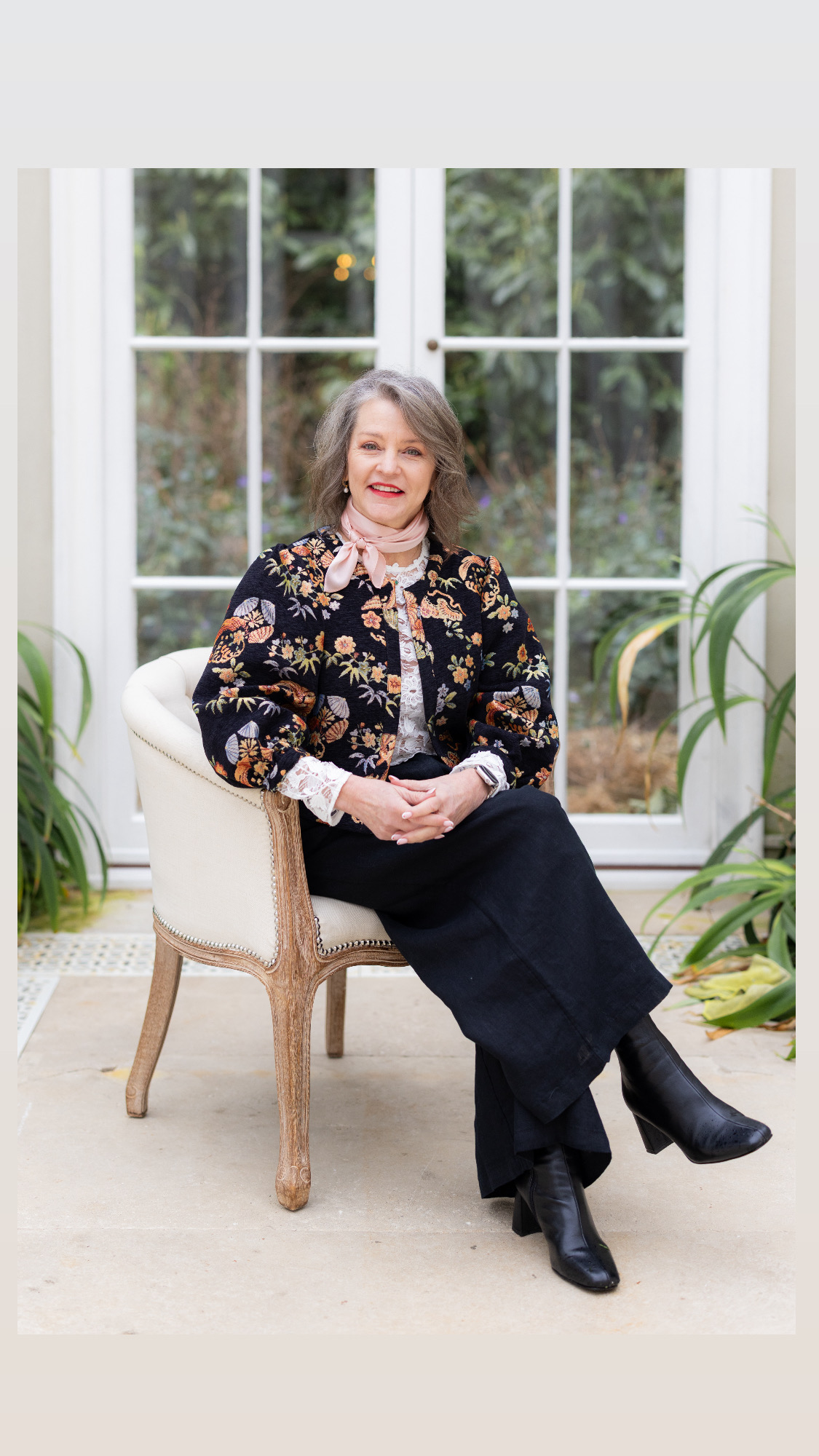
Tracy Kimberg
Tracy Kimberg is a Relationship Expert, Couples Therapist and Coach with a dedicated focus on helping couples and individuals rebuild connection, trust and emotional safety in their relationships. Drawing on the research of John and Julie Gottman, the relational insights of Esther Perel, and years of hands-on therapeutic experience, Tracy offers a warm, non-judgemental and deeply compassionate approach to modern relationships.Based in Dorset, Tracy works with couples navigating communication breakdowns, betrayal, intimacy challenges, separation, family dynamics and life transitions. Known for creating a safe and grounded therapeutic space, she combines practical tools with emotional depth to help clients move beyond survival patterns and towards meaningful, lasting change.With a reputation for empathy, professionalism and dedication to her clients’ growth, Tracy is passionate about helping people feel seen, understood and empowered — both within their relationships and within themselves.
Disclaimer
Disclaimer:The information shared in this article is intended for educational and informational purposes only and should not be considered a substitute for professional therapeutic, psychological, medical or legal advice. Every individual and relationship is unique, and the perspectives offered are based on general therapeutic principles, research and professional experience.Reading this article does not establish a therapist-client relationship with Tracy Kimberg. If you are experiencing significant emotional distress, relationship crisis, trauma, or mental health concerns, it is important to seek support from a qualified professional appropriate to your individual circumstances.All content remains the intellectual property of Tracy Kimberg and may not be reproduced or distributed without permission.