

Imagine it is Thursday evening, three days after your last appointment. A simple comment about the kitchen dishes spirals into a familiar, jagged argument, and suddenly that breakthrough you felt on Monday feels like a distant memory. Knowing exactly what to do between therapy sessions is often where the real healing takes root. It is natural to feel a bit “dropped” or unsupported when you leave the safety of the consulting room, especially when old behaviours resurface the moment you step through your front door.
We understand that the “therapy hangover” is a heavy weight to carry and that the six days between appointments can feel like a long time to hold onto new realisations. You can bridge this gap by turning therapeutic insights into lasting relational habits that live and breathe in your home. This article provides practical tools to help you de-escalate conflict, track your emotional progress, and feel empowered rather than dependent on your weekly hour. We will explore how to cultivate a resilient connection that thrives even when the therapist isn’t in the room.
Key Takeaways
- View the six days between appointments as a vital laboratory where you can actively test and organise new emotional insights in real-time.
- Learn exactly what to do between therapy sessions by implementing micro-connections that take less than five minutes but significantly strengthen your relational bond.
- Navigate the “therapy hangover” with the 24-hour rule, allowing intense emotions to settle before you attempt to debate or process them further with your partner.
- Master the art of the “softened start-up” to prevent home conflicts from escalating, ensuring you maintain a safe and respectful environment whilst working through challenges.
- Discover how a structured 12-week relationship recovery process can bridge the gap between sessions, providing the essential scaffolding needed for lasting change.
The “Connective Tissue”: Why the Time Between Sessions Matters
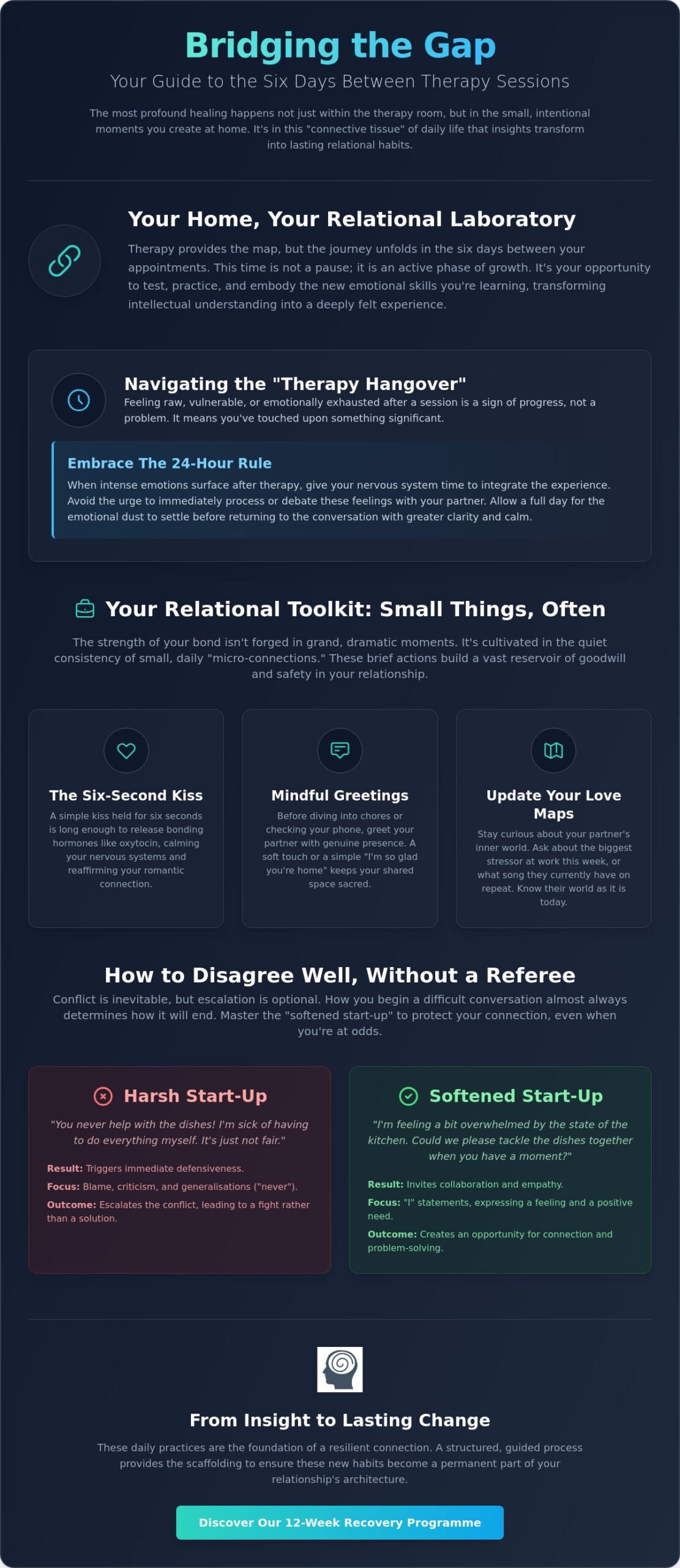
Therapy provides the map, but the journey happens in the “connective tissue” of the six days between sessions. Whilst the consulting room is a sanctuary for dissecting patterns, your home is the laboratory where those insights are tested in real-time. Many couples find themselves wondering what to do between therapy sessions to prevent their hard-won progress from evaporating. The shift begins when you stop waiting for the next session and start living the current work. This “in-between” time is where the intellectual understanding you gained on the sofa transforms into a visceral, felt experience in your daily life.
It is common to feel a “therapy hangover” after a deep session. You might feel emotionally drained, unusually vulnerable, or even a bit raw. This is not a sign that something is wrong; rather, it is evidence of the deep work you are doing. When we touch on old wounds or confront difficult truths, the nervous system needs time to settle. Clinical research suggests that the ability to practice skills taught in therapy during these windows is what separates temporary relief from permanent change.
Understanding the Integration Phase
Your brain requires specific windows of time to organise and integrate new emotional data. After a session, your mind continues to work in the background, much like a computer installing an update. You may find that “dormant insights” suddenly surface whilst you are doing the washing up or driving to work. These “aha” moments are precious. Instead of rushing to fix everything at once, try to observe your behaviour without judgement. Note when you feel the urge to retreat into old patterns and simply acknowledge it. This mindful awareness is the first step toward breaking the cycle.
The Relational Space Between Partners
Experts like Harville Hendrix and Esther Perel often speak about the “Space Between.” This is the invisible field that exists between two people in a partnership. When you are in therapy, the therapist helps you clear the “pollution” from this space. However, once you leave the office, it is your responsibility to protect it from old, reactive habits. Deciding what to do between therapy sessions involves making small, conscious choices to keep that space clean. Learning how to fix communication in a relationship is not a one-time event; it requires daily practice. It is about the small choices you make on a Tuesday afternoon when you are both tired and stressed. By treating this time as an active phase of growth, you ensure that your relationship continues to evolve long after the hour is up.
A Relational Toolkit: Practical Exercises for Couples
The “Small Things Often” Approach
Building a secure bond doesn’t require hours of deep processing every night. Instead, it’s about the “bids” you make for each other throughout the day. A bid is any attempt from one partner to another for attention, affirmation, or affection. When your partner sighs or points out a beautiful sunset, they’re inviting you into their world. Turning towards these bids, rather than ignoring them, builds your “Emotional Bank Account” for when times get tough.
To keep your bond vibrant, try these micro-connections:
- The six-second kiss: A kiss that lasts six seconds is long enough to feel romantic and signal physiological safety to the nervous system.
- Mindful greetings: Offer a genuine “I’m glad you’re home” or a soft touch before checking your phone or starting chores.
- Updating Love Maps: Stay curious about your partner’s internal world. Ask about their current favourite song or the biggest stressor they’re facing at work this week.
The Weekly Relationship Check-In
For many, the most transformative tool is a structured “State of the Union” meeting. This 20-minute weekly ritual provides a safe container to discuss the relationship without it spilling into a daily argument. It allows you to organise your thoughts and ensures that both partners feel heard and valued. The format is simple: start with five appreciations, identify what went well during the week, and end with the question, “What can I do to make you feel loved this week?”
The golden rule here is a strict “no criticism” policy. This is about connection, not litigation. By keeping this space positive and supportive, you protect the “Space Between” from the pollution of old, reactive habits. If you find the resentment is too high to manage this alone, seeking relationship coaching for couples can provide the professional scaffolding needed to make these check-ins productive rather than painful.
Individual Reflection: Processing the “Therapy Hangover”
Whilst therapy is a shared journey, the individual work you do in the quiet moments often determines the pace of your progress. Deciding what to do between therapy sessions frequently involves managing the “therapy hangover”, which is that sense of emotional exhaustion or raw vulnerability that follows a deep breakthrough. It’s a period where your psychological skin feels thin and your usual defences are down. This isn’t a sign of regression; it is the necessary softening that precedes genuine change.
One of the most effective strategies for this period is the 24-hour rule. If a session was particularly intense, agree with your partner to wait a full day before debating or dissecting the details. This isn’t about avoiding the topic. Instead, it’s about giving your nervous system time to return to a state of calm. When you are in a state of high physiological arousal, your ability to process information is compromised. By waiting, you ensure that your subsequent conversations come from a place of reflection rather than reactivity. Sometimes, individual relationship counselling can be a vital supplement to your joint work, providing a private space to explore your personal history without the immediate pressure of your partner’s presence.
Deepening Self-Awareness
Gabor Maté often reminds us that the body never lies. Pay close attention to your physical sensations during the week. Does your throat tighten when you want to speak? Does your stomach knot when you hear the front door? These are vital data points. When the “shadow” of a past argument looms, practice mindful breathing to stay anchored in the present. Identifying these triggers allows you to bring concrete observations to your next session, making the work more precise and effective.
The Art of Relational Journaling
Move beyond “what happened” journaling, which often turns into a list of grievances that keeps you stuck in an emotional loop. Instead, focus on growth-oriented journaling. Use prompts like: “I felt disconnected when…” or “One thing I appreciated about my partner today was…”. This shifts your focus from the partner’s faults to your own internal experience. Note any recurring thoughts or dreams too; they are often the subconscious trying to organise the relational shifts occurring in your waking life.
Navigating Conflict Without the “Ref”
Conflict is a natural, even necessary, part of any deep connection. In the therapy room, you have a “referee” to keep the conversation safe, but the true test of your progress happens at the kitchen table or in the car. Learning what to do between therapy sessions when tensions rise is about building a shared set of “Fair Fight” rules. This involves moving away from the desire to “win” and towards a desire to understand your partner’s perspective. It requires you to organise your internal reactions so that a simple disagreement doesn’t spiral into a relational crisis.
It helps to distinguish between solvable problems and perpetual ones. Research from the Gottman Institute suggests that 69% of relationship conflicts are perpetual, rooted in fundamental differences in personality or lifestyle. You don’t “solve” these issues; you learn to dialogue about them with curiosity instead of contempt. To prevent escalation, focus on the “softened start-up.” Most arguments are decided in the first three minutes. Instead of accusing your partner, focus on your own experience. Say, “I feel overwhelmed by the house chores, and I need some help,” rather than attacking their behaviour with, “You never help me.”
The Time-Out Protocol
When your heart rate exceeds 100 beats per minute, you are likely “flooded.” In this state, your brain’s creative problem-solving centre shuts down, and you enter fight-or-flight mode. It’s impossible to have a productive conversation when you’re physiologically overwhelmed. Agree on a signal, a specific word or gesture, that means “I am too flooded to continue.” Once called, take a mandatory 20-minute break. This isn’t a time to ruminate on your partner’s faults. Instead, focus on self-soothing activities like deep breathing or a short walk to let your nervous system reset before you try again.
Repair Attempts in the Moment
A repair attempt is any statement or action that prevents negativity from escalating. It could be a bit of shared humour, a gentle touch on the arm, or the powerful phrase: “I hear you, and I want to understand.” These small bridges are essential for maintaining safety whilst you navigate difficult territory. For couples managing high-volatility triggers, such as those in couples therapy for infidelity, these repairs are the lifeblood of rebuilding trust. If you’re struggling to find your way back to each other during the week, a guided approach to Relationship Counselling and Coaching for Couples can help you refine these essential conflict skills.
Transforming Insight into a 12-Week Recovery
Many couples find that the initial momentum of therapy begins to stall when they return to the pressures of work, parenting, and daily routine. This is why having a clear plan for what to do between therapy sessions is so vital. Instead of simply reacting to the latest argument, you can move into a more intentional phase of growth. The 12-week relationship recovery process is designed to eliminate the “dead time” that often occurs between weekly appointments. It provides a continuous stream of support, ensuring that the work you do on the sofa translates into meaningful changes in your living room. This shift from crisis management to intentional building is where the most profound healing occurs.
When you have a structured process, you aren’t just waiting for your next appointment to “fix” things. You are actively participating in a proactive adventure. This approach acknowledges that whilst insights are born in the session, they must be raised and nurtured in the home. By providing the necessary scaffolding, a structured programme helps you hold onto your progress even when life feels chaotic. It turns the “connective tissue” of your week into a period of active, supported evolution.
The Power of a Structured Framework
Drifting is the enemy of progress in any therapeutic journey. When therapy lacks a clear trajectory, it’s easy to feel like you’re just treading water, waiting for the next hour to feel heard. A structured framework provides the accountability that many couples lack when they are left to their own devices. By following a path with clear milestones, both partners stay engaged and focused on the same relational goals. This programme incorporates masterclasses and research-based tools that allow you to deepen your understanding of your own psychological patterns at your own pace. It ensures that the six days between sessions are filled with purpose rather than silence or regression.
Taking the Next Step
Healing is a daily practice, not a final destination. It requires a conscious choice to invest in your partnership beyond the single hour you spend with a professional. If you feel that your relationship is ready for more than just a weekly check-in, the 12-week process offers a way to accelerate your connection. We invite you to view your recovery as a shared project, a commitment to building something resilient and beautiful. To see if this structured approach is the right fit for your dynamic, you can book a discovery call to discuss your specific needs. Remember, the goal of what to do between therapy sessions is to eventually feel empowered enough that the tools you’ve learned become a natural part of how you love one another every day.
Embracing the Journey of Everyday Healing
Therapy provides the essential framework, but your relationship is truly built in the quiet, unscripted spaces of your daily life. We’ve explored how the “connective tissue” of your week is where intellectual insights transform into lived habits. By mastering micro-connections and respecting the 24-hour rule after intense emotional work, you protect the sacred space between you and your partner. Knowing what to do between therapy sessions is the vital difference between seeking a temporary fix and cultivating a lifetime of resilient growth.
Our signature 12-Week Relationship Recovery Process offers a research-based approach, drawing on the proven wisdom of Gottman and Perel to provide the scaffolding you need at home. We provide a safe, non-judgemental environment where transformation becomes a manageable, positive adventure rather than a clinical necessity. You don’t have to navigate these complex emotional landscapes without a guide. This is your invitation to move beyond crisis management and into a phase of intentional, lasting connection.
Book your 12-Week Relationship Recovery Discovery Call today to begin this new chapter. Healing is a daily practice, and we are here to support you in making every moment count.
Frequently Asked Questions
Is it normal to feel worse after a therapy session?
It is completely normal to feel emotionally drained or even more distressed immediately following a session. This occurs because you are bypassing your usual defences to confront deep-seated wounds and patterns. Think of it as the soreness after a physical workout; it indicates that you have reached muscles that were previously dormant. Give yourself permission to rest and settle before trying to analyse the experience further.
What should I do if my partner and I have a huge fight between sessions?
Prioritise safety and de-escalation by using the Time-Out protocol to stop the conflict before it spirals. Your primary goal is to halt the physiological flooding rather than “winning” the argument in the moment. Once you are both calm, try to note what specifically triggered the explosion. This provides concrete, valuable material for you to process together during your next appointment.
Can I contact my therapist between scheduled appointments?
Most therapists have specific boundaries regarding out-of-session contact, so it is best to check your initial agreement. Generally, contact is reserved for administrative issues unless you are in a crisis. Many people wonder what to do between therapy sessions when they have a sudden realisation. Instead of emailing, try recording these thoughts in a dedicated journal to bring to your next hour.
How much “homework” is typical in relationship coaching?
Expect to spend about 15 to 30 minutes a day on small, intentional practices rather than traditional academic tasks. Relationship coaching is about integrating new behaviours, such as a weekly State of the Union meeting or daily micro-connections. The volume of work is designed to be manageable whilst providing enough “connective tissue” to keep your growth steady and consistent throughout the week.
Should I tell my partner everything I write in my therapy journal?
No, your journal is a private space for your own internal processing and unedited reflections. You are not obligated to share these thoughts unless you feel it would genuinely benefit the relationship. Whilst transparency is vital in a partnership, maintaining a private internal world is a sign of a healthy individual identity. Use your discretion to share only what feels helpful and constructive.
What if I forget what we talked about in the last session?
It is helpful to take five minutes immediately after a session to jot down three key takeaways whilst they are fresh. Forgetting details is a natural response to the high emotional load of deep therapeutic work. Making a brief voice note or writing bullet points helps your brain organise the information. You can review these notes when deciding what to do between therapy sessions to maintain your momentum.
How do I manage the anxiety of waiting for my next session?
Focus on “living the work” in the present moment rather than obsessing over the next scheduled hour. Anxiety often stems from a feeling of being unsupported, so lean into practical tools like mindful breathing or Updating Love Maps. Remind yourself that the healing is happening in your daily interactions at home. This shift in focus helps you feel empowered rather than dependent on the weekly appointment.
Is it okay to see an individual therapist whilst in couples coaching?
Yes, individual therapy can be an excellent complement to your joint work and often accelerates progress. It allows you to explore personal triggers and history in a private setting without the immediate pressure of your partner’s presence. Just ensure that both practitioners are aware of the other’s involvement. This holistic approach ensures that your personal growth and relational recovery move forward in harmony.

Article by
Tracy Kimberg
Tracy Kimberg is a Relationship Expert, Couples Therapist and Coach with a dedicated focus on helping couples and individuals rebuild connection, trust and emotional safety in their relationships. Drawing on the research of John and Julie Gottman, the relational insights of Esther Perel, and years of hands-on therapeutic experience, Tracy offers a warm, non-judgemental and deeply compassionate approach to modern relationships.Based in Dorset, Tracy works with couples navigating communication breakdowns, betrayal, intimacy challenges, separation, family dynamics and life transitions. Known for creating a safe and grounded therapeutic space, she combines practical tools with emotional depth to help clients move beyond survival patterns and towards meaningful, lasting change.With a reputation for empathy, professionalism and dedication to her clients’ growth, Tracy is passionate about helping people feel seen, understood and empowered — both within their relationships and within themselves.
Disclaimer
Disclaimer:The information shared in this article is intended for educational and informational purposes only and should not be considered a substitute for professional therapeutic, psychological, medical or legal advice. Every individual and relationship is unique, and the perspectives offered are based on general therapeutic principles, research and professional experience.Reading this article does not establish a therapist-client relationship with Tracy Kimberg. If you are experiencing significant emotional distress, relationship crisis, trauma, or mental health concerns, it is important to seek support from a qualified professional appropriate to your individual circumstances.All content remains the intellectual property of Tracy Kimberg and may not be reproduced or distributed without permission.