

What if the most important secret in your therapy session isn’t what you say, but who the therapist is actually protecting? When you step into the room, the “client” isn’t just you or your partner; it’s the relationship itself. It’s entirely natural to feel a flutter of anxiety about opening up your private world. You might fear being judged for past behaviours or worry that your partner is holding something back. Understanding the nuances of confidentiality in couples counselling is the vital first step toward transforming that trepidation into a sense of profound safety.
We recognise that trust isn’t just a feeling; it’s a structure built on clear boundaries and ethical integrity. This guide will demystify how the therapeutic “container” works and explain why transparency is the heartbeat of genuine healing. You’ll gain clarity on your legal rights and clinical best practices, providing the emotional security you need to begin a 12-week recovery process. Discover how professional privacy doesn’t just hide secrets; it creates the sanctuary where your relationship can finally breathe, recover, and grow again.
Key Takeaways
- Understand why the relationship itself is considered the “client” in therapy, shifting the focus from individual secrets to the health of your partnership.
- Learn how a “no secrets” policy ensures transparency and prevents the therapist from being caught in the middle of conflicting loyalties.
- Discover why maintaining professional confidentiality in couples counselling is designed to create a safe sanctuary rather than a wall for hiding information.
- Gain clarity on the specific UK legal and ethical frameworks that protect your privacy whilst ensuring the safety of everyone involved.
- Explore how a structured 12-week Relationship Recovery Process provides the emotional security needed to move from disconnect to deep, honest connection.
Defining the ‘Client’: How Confidentiality Works in Couples Counselling
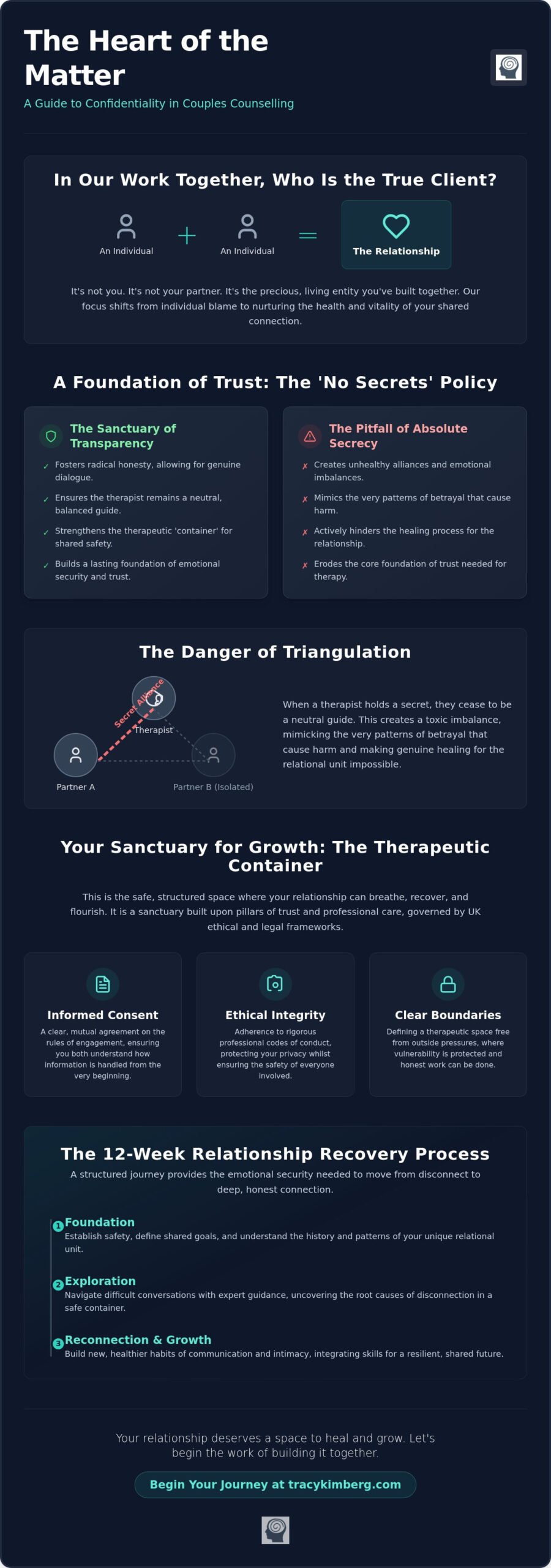
Many couples arrive at their first session expecting the same experience they would have in individual therapy. They imagine a private space where their personal feelings are the sole priority. However, Couples Therapy functions quite differently. In this space, the “client” isn’t you, and it isn’t your partner. Instead, the client is the relationship itself. This radical shift in perspective is fundamental to how we manage confidentiality in couples counselling, as it moves the focus from individual secrets to the health of the shared bond.
When we treat the relationship as the primary focus, we create what clinicians call a “therapeutic container.” This container acts as a neutral ground where the history, patterns, and potential of your partnership are held with equal care. It isn’t about who’s right or who’s wrong; it’s about what serves the vitality of the connection. By focusing on this collective entity, the therapist avoids the trap of taking sides or becoming an ally to one person over the other. This ensures that the work remains balanced and that both partners feel equally seen and heard.
The Relational Unit represents the unique entity formed by two people, encompassing their shared history, emotional bonds, and systemic interactions as a single focus of clinical care.
The Relationship as the Primary Focus
In the room, your individual needs are certainly valued, but they are understood within the context of the partnership’s long-term health. This approach is essential for preventing “triangulation,” a situation where a therapist might inadvertently join one partner against the other. If a therapist holds a secret for one person, the container of trust begins to crack. True healing requires the therapist to remain a custodian of the bond, ensuring that neither individual feels isolated whilst working through complex dynamics.
Informed Consent: Your Agreement of Trust
Trust begins long before the deep emotional work starts. When you embark on a programme like the 12-Week Relationship Recovery Process, you’ll begin with an initial consultation. This is where we lay out the “rules of engagement” clearly. You aren’t just signing a standard form; you’re entering into a profound agreement of trust. This informed consent process ensures you both understand how information is handled and where the boundaries lie. It protects your individual dignity whilst creating a secure foundation for your shared future, allowing you to be both vulnerable and safe in the knowledge that the process is designed for your mutual growth.
The ‘No Secrets’ Policy: Balancing Individual Privacy with Transparency
Imagine a scenario where one partner shares a significant revelation with the therapist during a private moment, expecting it to be kept hidden. Whilst this might feel like a relief for the individual, it creates a profound ethical dilemma for the practitioner. In many therapeutic models, including those inspired by the research of John Gottman, we operate under a “No Secrets” policy. This means that information shared individually that is relevant to the health of the partnership will eventually need to be brought into the shared space. This isn’t about a lack of privacy; it’s about ensuring the therapist remains a custodian of the relationship’s integrity.
Adopting this approach fosters an environment of radical honesty. It removes the burden of “holding” secrets, which often act as toxins within a connection. When we navigate confidentiality in couples counselling this way, we ensure that the therapy room remains a sanctuary of truth rather than a place where old patterns of avoidance are reinforced. This transparency acts as the foundation for genuine emotional security.
The Dangers of Triangulation
Secrets are more than just hidden facts; they are energetic barriers that create an unhealthy alliance between one partner and the therapist. This is known as triangulation. When a therapist is forced to keep a secret for one half of the couple, they are no longer a neutral guide. Instead, they become a co-conspirator. This dynamic mimics the very patterns of betrayal and emotional disconnect that often lead couples to seek help. The psychological weight a therapist carries when holding a secret can hinder the clinical process, making it nearly impossible to facilitate true healing for the relational unit.
Individual Sessions within Couples Work
You might wonder why we ever meet individually if secrets aren’t permitted. During a 12-Week Relationship Recovery Process, brief one-on-one sessions can be incredibly valuable. These are not silos for hiding information. Instead, they are safe spaces to process your personal triggers, explore individual attachment styles, or work through trauma that might be impacting the relationship.
The specific rules for these moments are clear: the information shared is used to prepare you for a deeper, more honest conversation with your partner. We work together to find the courage and the right language to bring your private thoughts into the “therapeutic container.” This ensures that individual sessions serve the ultimate goal of strengthening the bond rather than creating further distance.
Why Absolute Secrecy Can Hinder the Healing Process
Absolute secrecy is often mistaken for a protective shield, yet in the context of a partnership, it can become the very thing that erodes intimacy. In my work, I often draw on the insights of Esther Perel, who masterfully distinguishes between the “private self” and the “secret self.” We all need a private garden, a place for our internal musings and individual identity that belongs only to us. However, the secret self is built on the intentional exclusion of our partner from a reality that directly affects them. When we discuss confidentiality in couples counselling, we aren’t looking to dismantle your privacy, but rather to ensure that secrecy doesn’t become a barrier to the connection you’re trying to save.
When information is withheld, it creates a profound emotional disconnect. You might feel a sense of relief in the short term by staying silent, but that silence eventually becomes a wall. Transparency is the only true antidote to this distance. By bringing hidden truths into the light within a structured 12-week recovery process, we can begin to rebuild a foundation that is actually solid, rather than one built on the shaky ground of what remains unsaid.
Privacy vs Secrecy: A Critical Distinction
Understanding the difference between these two concepts is vital for your progress. Privacy is about autonomy; it’s the right to your own internal world, your separate friendships, and your personal thoughts. It’s healthy and necessary for a balanced relationship. Secrecy, conversely, involves the active withholding of information that impacts your partner’s reality or their ability to make informed choices about the relationship. Healthy boundaries allow for individual autonomy whilst ensuring that shared truths are never sacrificed. Navigating confidentiality in couples counselling requires us to respect your privacy whilst challenging the secrets that keep you apart.
Rebuilding Trust through Disclosure
Coming clean in a safe, moderated environment is infinitely more effective than continuing to hide the truth. In the therapy room, my role is to act as a “softener” for difficult revelations. I help you frame your truths in a way that they can be heard and processed, rather than simply causing more pain. This is particularly crucial in sensitive cases, such as couples therapy for infidelity, where the path to healing is paved with honest, guided disclosure. When we move from a place of hiding to a place of being seen, the relationship finally has the oxygen it needs to heal.
The Legal and Ethical Boundaries of Your Privacy in the UK
Whilst the emotional side of therapy is about vulnerability and connection, the structural side is built on a robust legal and ethical framework. In the UK, professional bodies like the British Association for Counselling and Psychotherapy (BACP) and the UK Council for Psychotherapy (UKCP) provide the guidelines that ensure your safety. These frameworks aren’t just administrative hurdles; they are the architecture of trust. They define the parameters of confidentiality in couples counselling, ensuring that what you share remains within the “therapeutic container” unless specific, rare legal requirements dictate otherwise.
It’s also vital to distinguish between confidentiality and legal privilege. In a clinical setting, confidentiality is an ethical and contractual promise to protect your privacy. Legal privilege, however, is a narrower concept often reserved for communications between a client and their solicitor. Whilst your therapist will always fight to protect your privacy, there are moments where the law may require the disclosure of records, such as through a court order. Understanding these boundaries allows you to engage with the process fully, knowing exactly where the lines are drawn.
When Confidentiality Must Be Broken
There are specific, narrow circumstances where a therapist has a legal and ethical duty to step outside the circle of privacy. These primary exceptions involve safeguarding against serious harm. If there is a disclosure regarding child protection, acts of terrorism, money laundering, or an immediate risk of serious harm to yourself or another person, the therapist is required to take action. These limitations aren’t designed to be punitive; they exist to keep you, your family, and the wider community safe. These breaks in confidentiality are exceptionally rare and, in almost all cases, the therapist will discuss the necessity of this step with you before taking any action.
Therapy Records and Data Protection
Under UK law and GDPR, your session notes and personal data are treated with the highest level of security. You have the right to know how your information is stored and who can access it. Typically, session notes are brief and focus on the relational themes rather than a verbatim transcript of every word spoken. If a couple chooses to pursue a conscious separation, the question of record access can become complex. Generally, because the “client” is the couple, both individuals must consent before joint records are released to a third party. You always maintain the right to request access to your own therapeutic data, ensuring you remain in control of your personal history.
If you have concerns about how your privacy is managed, the best time to address them is now. You can book a consultation to discuss your specific needs and ensure you feel completely secure before we begin our work together.
Creating a Sanctuary: My Approach to Confidentiality and Trust
I believe that the true power of therapy lies in the creation of a sanctuary. This isn’t merely a quiet room; it’s a psychological space where the “unspoken” can finally find a voice. My approach to confidentiality in couples counselling is rooted in the idea that privacy isn’t a wall to keep people out, but a garden fence that protects the growth happening within. When you feel certain that your vulnerabilities are held with professional integrity, you gain the courage to explore the deeper, often uncomfortable truths that have been stowed away for years.
For individuals exploring their identity within the context of their partnership, organisations such as the Gender Identity Center offer specialised resources that support this journey toward self-discovery and relational honesty.
The 12-Week Relationship Recovery Framework
Within my 12-Week Relationship Recovery Process, we use a structured approach to manage information and emotions. This framework ensures that both partners feel heard and that neither feels sidelined by the process. By utilising research-based methods, such as the Gottman Method, I provide a clear roadmap for your journey. We focus on building the “Sound Relationship House,” where trust and commitment are the two primary pillars. This structured path allows us to navigate sensitive topics whilst maintaining the highest ethical standards, ensuring that every disclosure serves the goal of strengthening your shared future.
Your Next Steps Toward Healing
Beginning this work is a significant decision. It’s essential that you feel a genuine “click” with your therapist before diving into the complexities of your partnership. Trust isn’t just about the rules on a page; it’s about the human connection you feel when you speak with someone who truly understands the weight of your experience. I invite you to start with an initial consultation where we can discuss your specific privacy concerns and explore how this process can work for you. This is your opportunity to see if my approach feels like the right fit for your unique relationship dynamics.
Book a discovery call to see how we can transform your relationship dynamics.
Embracing a Future of Radical Honesty and Connection
Choosing to open up your relationship to a professional is an act of profound courage. We’ve explored how the relationship itself becomes the primary focus, ensuring that confidentiality in couples counselling serves as a bridge to intimacy rather than a wall for hiding. By distinguishing healthy privacy from corrosive secrecy, you can begin to dismantle the emotional disconnect that has kept you apart for too long.
As a BACP Registered Professional and a specialist in the 12-Week Relationship Recovery Process, I utilise research-based methods inspired by the work of John Gottman and Esther Perel to ensure your safety and progress. You don’t have to navigate these complex emotional landscapes alone. This is your invitation to move beyond the weight of the past and step into a proactive adventure of healing.
Begin your journey to a more transparent, connected relationship today. Your partnership deserves the chance to breathe, recover, and flourish in a space built on absolute trust.
Frequently Asked Questions
Is what I say in couples therapy completely confidential from my partner?
In most relational therapy models, what you share is not kept secret from your partner if it affects the health of the relationship. We treat the partnership as the primary client, which means the therapist acts as a custodian of shared truth. If you reveal something privately that impacts your partner’s reality, I’ll work with you to bring that information into the joint session. This ensures the therapeutic container remains transparent and safe for both of you.
Can my therapist be subpoenaed to testify in our divorce proceedings?
Yes, a therapist can technically be subpoenaed, but it’s quite rare in the UK. Most practitioners will vigorously defend your privacy to maintain the integrity of the therapeutic space. Since January 2026, new rules have further restricted how counselling notes can be accessed by authorities in certain contexts. We aim to keep the focus on healing rather than providing evidence for legal disputes, ensuring your records remain a tool for growth rather than litigation.
What happens if I tell my therapist about an affair during an individual session?
If you disclose an ongoing affair, we cannot continue effective work whilst that secret remains hidden. Under a “no secrets” policy, I won’t lie to your partner or hold that burden for you. Instead, we’ll use individual time to explore why the affair happened and prepare a safe way for you to share this truth. The goal is to move from a secret self to a private self that allows for genuine, honest healing.
How do UK therapists handle confidentiality differently from those in the US?
UK therapists operate under the BACP or UKCP ethical frameworks, which prioritise the therapeutic relationship as an ethical core. Unlike the US, our protocols are heavily influenced by the UK’s specific safeguarding laws and GDPR. For instance, we have unique legal obligations to report disclosures related to terrorism or money laundering. These rules ensure that your privacy is balanced with a robust commitment to public and individual safety within the British legal system.
Will our therapy sessions be recorded or kept on a permanent record?
Sessions are rarely recorded and only ever with your joint, written consent for specific clinical purposes. We do, however, maintain brief session notes as part of our professional duty. These records are stored securely according to GDPR and focus on the overarching themes of confidentiality in couples counselling. They aren’t a verbatim transcript but a professional summary of the relational dynamics and progress we have explored together in our work.
Can my partner access my individual therapy notes if we are in couples counselling?
Generally, your partner cannot access notes from your individual sessions without your explicit permission. However, because the relationship is the client, many practitioners keep joint records for the work done together. In the event of a formal records request, UK law typically requires consent from both parties before joint files are released. We maintain these clear boundaries to ensure that whilst we work toward transparency, your individual dignity and data rights remain protected.
What should I do if I don’t feel safe being honest in front of my partner?
If you feel unsafe, it’s vital to communicate this to your therapist privately as soon as possible. Physical or emotional safety is our absolute priority. In cases where there is a risk of harm, the standard “no secrets” policy is secondary to our safeguarding obligations. We can pivot the work to focus on individual safety or discuss whether couples work is appropriate at this time, ensuring you have the support needed to stay secure.
Is online couples counselling as confidential and secure as face-to-face therapy?
Online therapy is remarkably secure when conducted through encrypted, professional platforms designed for clinical use. I utilise technology that meets high data protection standards to ensure our digital conversations remain private. To maintain confidentiality in couples counselling whilst meeting remotely, you simply need to ensure you’re in a space where you won’t be interrupted. This creates a virtual sanctuary that is every bit as confidential as a traditional face-to-face consulting room.

Article by
Tracy Kimberg
Tracy Kimberg is a Relationship Expert, Couples Therapist and Coach with a dedicated focus on helping couples and individuals rebuild connection, trust and emotional safety in their relationships. Drawing on the research of John and Julie Gottman, the relational insights of Esther Perel, and years of hands-on therapeutic experience, Tracy offers a warm, non-judgemental and deeply compassionate approach to modern relationships.
Based in Dorset, Tracy works with couples navigating communication breakdowns, betrayal, intimacy challenges, separation, family dynamics and life transitions. Known for creating a safe and grounded therapeutic space, she combines practical tools with emotional depth to help clients move beyond survival patterns and towards meaningful, lasting change.
With a reputation for empathy, professionalism and dedication to her clients’ growth, Tracy is passionate about helping people feel seen, understood and empowered — both within their relationships and within themselves.
Disclaimer
Disclaimer:
The information shared in this article is intended for educational and informational purposes only and should not be considered a substitute for professional therapeutic, psychological, medical or legal advice. Every individual and relationship is unique, and the perspectives offered are based on general therapeutic principles, research and professional experience.
Reading this article does not establish a therapist-client relationship with Tracy Kimberg. If you are experiencing significant emotional distress, relationship crisis, trauma, or mental health concerns, it is important to seek support from a qualified professional appropriate to your individual circumstances.
All content remains the intellectual property of Tracy Kimberg and may not be reproduced or distributed without permission.