

What if the true measure of your healing isn’t the total absence of conflict, but the grace and speed with which you navigate it? Many couples arrive for their first session feeling stuck in a cycle of re-hashing the same tired arguments, wondering if they’re simply spending time and money to stay in the same place. It’s completely understandable to feel a sense of trepidation when you don’t know what “healthy” is actually supposed to look like. Understanding how to measure progress in relationship counselling is often the first step towards reclaiming a sense of agency and hope in your partnership.
I want to reassure you that growth is rarely a straight line, but there are clear, reliable markers that signal you’re moving towards a deeper connection. You deserve to feel that your investment in your relationship is yielding more than just temporary silence. In this article, you’ll discover the psychological markers and practical shifts that signal true healing and growth in your partnership. We will explore how to track your emotional safety, the speed of your repair after a disagreement, and the specific ways you can witness your own evolution as a couple.
Key Takeaways
- Learn why a temporary increase in visible conflict can actually be a sign of breakthrough and deeper honesty rather than a step backwards.
- Discover how to measure progress in relationship counselling by tracking the speed of your repair and the depth of your emotional safety.
- Recognise the subtle shifts in your daily life, such as moving from logistical “kitchen table” talk to sharing vulnerable feelings and playfulness.
- Understand how tools like the Relationship Check-Up can help you quantify improvements in your positive sentiment towards your partner.
- Explore how a structured 12-week relationship recovery process provides clear milestones to help you navigate the complex stages of healing.
Redefining Success: Why ‘Not Fighting’ Isn’t the Goal of Counselling
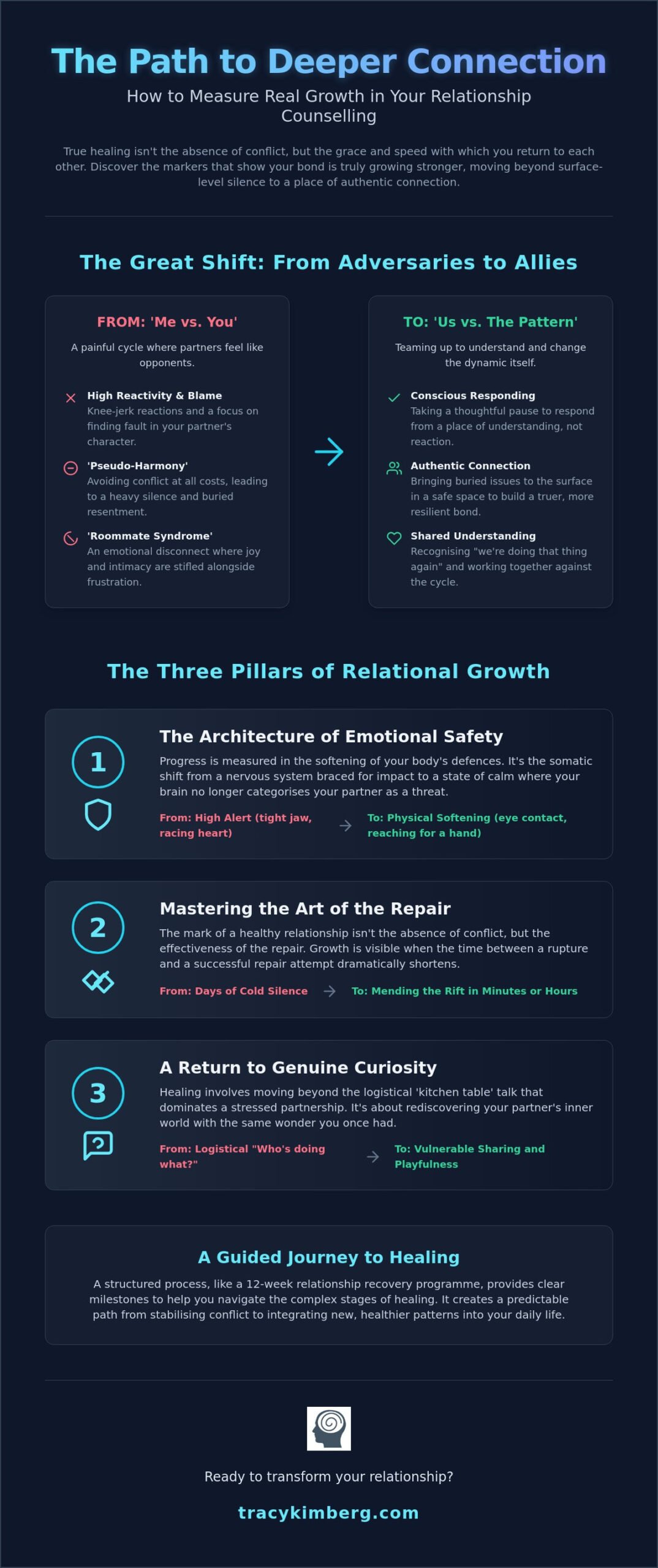
Many couples enter my office with the hope that, by the end of our time together, they will have stopped arguing entirely. It’s a natural desire born from exhaustion. However, if you are looking for how to measure progress in relationship counselling, you must look deeper than the surface level of silence. Silence isn’t always golden; sometimes, it’s leaden, weighted with the things we’ve stopped saying to one another. In the context of Couples therapy, we define success as the transition from high reactivity to conscious responding. It’s the difference between a knee-jerk explosion and a thoughtful pause.
We often use foundational metrics like ‘The Sound Relationship House’ to help you visualise these shifts. This model reminds us that a sturdy partnership is built on friendship, positive perspective, and the ability to manage conflict rather than eliminate it. Paradoxically, you might find that arguments increase in the early stages of our work together. This isn’t a sign of failure. Instead, it’s often a breakthrough in honesty where issues that were previously buried are finally being given the air they need to be processed. We want to move you away from ‘pseudo-harmony’, where you avoid conflict at all costs, and towards an authentic connection built on the messy, beautiful reality of vulnerability.
The Illusion of the Conflict-Free Relationship
When we suppress our anger or frustration to keep the peace, we often inadvertently create ‘roommate syndrome’. You might stop fighting, but you also stop feeling. This emotional disconnect happens because you can’t selectively numb emotions; when you push down the ‘hard’ feelings, you also stifle the joy and intimacy. Counselling brings these ‘underground’ issues to the surface so they can be processed in a safe, structured environment. Progress is the ability to navigate stormy waters together rather than avoiding the sea.
Shifting from ‘Me vs You’ to ‘Us vs The Pattern’
Most relationship arguments are circular. They follow a predictable script where one person pursues and the other withdraws, or both parties escalate until someone shuts down. Real growth happens when you stop blaming your partner’s character and start observing the dynamic itself. You begin to see the ‘pattern’ as the enemy, not the person sitting across from you. This shift allows you to team up against the cycle. This is a natural link to understanding when communication breaks down and what is truly happening beneath the surface of your interactions. When you can say, “We’re doing that thing again,” you’ve already won half the battle.
Psychological Markers: The Three Pillars of Relational Growth
When considering how to measure progress in relationship counselling, we must look past individual symptom reduction. While feeling less anxious as an individual is wonderful, relational health is found in the space between you. It is about the quality of your connection and the resilience of your bond. Research suggests that effective when both partners are invested, therapy provides a laboratory for these shifts to occur. We look for three specific pillars: emotional safety, the speed of your repair, and a return to genuine curiosity about your partner’s inner world.
The Architecture of Emotional Safety
Drawing on Gabor Maté’s trauma-informed perspective, we must ask: how safe does your nervous system feel in the presence of your partner? In the beginning, many couples exist in a state of high alert. Their bodies are braced for impact. You might notice your heart rate spikes or your jaw tightens the moment a difficult topic arises. Progress is visible when this defensive armour begins to drop. You might find yourself making more consistent eye contact or reaching for a hand during a tense moment. This somatic shift, a physical softening, indicates that your brain is no longer categorising your partner as a threat. When you can share a shameful or vulnerable thought without fearing immediate retaliation, you have reached a significant milestone in your healing journey.
Mastering the Art of the Repair Attempt
John Gottman’s extensive research highlights that the difference between “masters” and “disasters” of relationship isn’t the absence of conflict. It’s the presence of repair. We track how long the stony silence lasts now compared to when you started. Does a disagreement derail your entire weekend, or can you find your way back to each other within an hour? A successful repair attempt is any statement or action, silly or serious, that prevents negativity from escalating out of control. It might be a self-deprecating joke, an apology, or a simple “I hear you.” Recognising these bids for connection, which were previously ignored or rejected, is a profound indicator of growth. If you are currently navigating a significant rupture, our Relationship Counselling and Coaching for Couples can provide the structured support needed to rebuild this vital skill.
Finally, we look for the return of curiosity. When we are hurt, we become certain. We assume we know exactly why our partner said that hurtful thing. Progress means moving from “I know why you did that” to “Can you help me understand why you feel that way?” This shift from judgement to inquiry is the hallmark of a maturing partnership. It shows that you are once again prioritising the relationship over being right.
Subtle Shifts: Identifying Progress in Your Daily Life
Progress in relationship counselling often reveals itself in the quiet, mundane moments between sessions. While the big breakthroughs in my office are vital, the true pulse of your partnership is found in your ‘kitchen table’ conversations. It is easy to get caught up in the heavy lifting of therapy, but when you are looking for how to measure progress in relationship counselling, you should start by noticing the air between you at home. Is it thick with tension, or has a sense of ease begun to return? One of the most beautiful signs of healing is the return of playfulness. When you can share a private joke or find humour amidst a stressful week, it suggests your bond is becoming flexible enough to hold both the weight of your challenges and the lightness of your connection.
We also look for a measurable decrease in what John Gottman calls ‘The Four Horsemen’: Criticism, Contempt, Defensiveness, and Stonewalling. These behaviours are the primary predictors of relationship rupture. Progress isn’t just about what you do; it’s about what you’ve stopped doing. You might find that you no longer feel the urge to roll your eyes when your partner speaks, or perhaps you’ve noticed that you’re staying in the room during a disagreement rather than shutting down. This individual evolution is crucial. As Esther Perel suggests, ‘erotic intelligence’ requires a level of differentiation—the ability to be a ‘me’ within the ‘we’. When you focus on your own emotional regulation, you provide the partnership with a more stable foundation.
From Logistics to Intimacy
Many couples I work with have fallen into the trap of ‘admin talk’. Their conversations are entirely consumed by the logistics of life: school runs, mortgage payments, and grocery lists. A clear marker of growth is when you move past these logistics and back into ‘soul talk’. You start sharing your dreams, your fears, and your internal experiences again. This shift often requires a commitment to unstructured time, where you aren’t ‘doing’ anything other than being present with one another. If you find that working on your own triggers helps you show up more fully for these moments, you might find our guide on Individual Relationship Counselling particularly helpful for understanding how self-work fuels relational intimacy.
The Softened Start-Up
How you bring up a grievance is 90% predictive of how that conversation will end. In the early stages of distress, start-ups are often ‘harsh’, beginning with ‘You always’ or ‘You never’. Progress is visible when you adopt a ‘softened start-up’. This involves taking responsibility for your feelings and expressing a positive need. You move from ‘You’re so lazy’ to ‘I feel overwhelmed with the housework, and I’d really appreciate some help with the kitchen tonight.’ Gentleness is perhaps the most underrated metric in relationship recovery. It signals that you have moved from a posture of attack to one of collaboration.
Measuring the Intangible: Tools and Frameworks for Couples
While the heart doesn’t have a dashboard or a speedometer, we can still track the velocity of your healing. If you’re wondering how to measure progress in relationship counselling, you must look at the internal narrative you hold about your partner. In the early days of distress, that narrative is often tinted with suspicion and hurt. As you grow, that lens begins to clear. We use specific frameworks to help you quantify these shifts, moving from vague feelings to concrete observations about your bond.
One of the most effective ways to monitor your journey is through a ‘Weekly State of the Union’ meeting. This isn’t a board meeting; it’s a dedicated space to check in on the relationship’s temperature. It allows you to address small frictions before they become massive ruptures. Combined with journaling, these tools act as a mirror. When you look back at your ‘entry state’ notes from three months ago and compare them to your current ‘growth state’, the evolution is often startling. You’ll see that the things that once triggered a weekend-long silence now only cause a momentary ripple.
The Power of Positive Sentiment Override
There is a specific tipping point in relationship recovery called ‘Positive Sentiment Override’ (PSO). This is when your ’emotional bank account’ becomes solvent again. In a state of distress, we often operate from negative sentiment override, where even a neutral comment is perceived as an attack. Progress is visible when you start giving your partner the benefit of the doubt. You begin to see a forgotten chore as an accident or a sign of a busy day rather than a character flaw or a lack of love.
Research from the Gottman Institute suggests that stable, happy relationships maintain a 5:1 ratio of positive to negative interactions. During conflict, this ratio helps keep the connection buoyant. As you move through your sessions, you’ll notice this ratio naturally shifting. You aren’t just fighting less; you’re appreciating more. If you’re ready to start building that emotional surplus, you can book a session for Relationship Counselling and Coaching to begin your own 12-week journey.
Self-Assessment Questions for the End of the Month
At the end of each month, I encourage couples to sit with these three questions. They serve as a compass for your progress:
- Do I feel more ‘seen’ and understood by my partner than I did 30 days ago? This measures the depth of your emotional intimacy and the success of your bids for connection.
- Am I less afraid of our next argument? This indicates an increase in your collective ‘repair’ skills and a decrease in the fear of escalation.
- Would I choose this person again today, knowing what we’ve worked through? This touches on the core of your commitment and the vitality of the bond you’re rebuilding.
When you can answer these with a sense of calm optimism, you’ll know that the work you’re doing is taking root. You’re moving amongst the complexities of love with a new set of maps.
The 12-Week Journey: How Structured Counselling Accelerates Progress
When you are in the thick of a relational crisis, time feels distorted. A single argument can feel like an eternity, and a week of peace can feel like a fragile fluke. This is why a time-limited, structured approach is so powerful. It provides the milestones you need to understand how to measure progress in relationship counselling without getting lost in the day-to-day emotional weather. Professional guidance acts as an external anchor, helping you see the broader arc of your growth when you are too close to the situation to notice the subtle shifts. You move from the exhausting work of crisis management into a phase of conscious growth.
Milestones in the 12-Week Relationship Recovery Process
The 12-Week Relationship Recovery Process is designed to guide you through the complex emotional landscape of healing. The journey typically follows a three-stage arc that mirrors the natural rhythm of relational repair. We begin with de-escalation in weeks one to four, focusing on “stopping the bleed” and identifying the reactive cycles that keep you stuck. During weeks five to eight, we move into reconnection, where we explore deeper vulnerabilities and re-establish the emotional bonds that have been stretched thin. Finally, in weeks nine to twelve, we focus on consolidation, ensuring your new behaviours are sturdy enough to withstand the pressures of daily life.
It is vital to remember that “relapse” into old behaviours is a normal part of the learning curve. It isn’t a sign of failure; it’s an opportunity to practice your new repair skills in real-time. You can explore how this transformational journey looks in practice by reading our 12-Week Relationship Recovery Case Study. This structured path is particularly effective for healing after major ruptures, amongst which infidelity is one of the most challenging, as it respects the specific stages of trauma and rebuilding.
When to Transition from Weekly Sessions
One of the clearest signs of progress is when you start to “internalise” the therapeutic process. You might find yourselves in the middle of a familiar disagreement and suddenly hear a prompt or a question from our sessions. You stop, breathe, and choose a different response. This ability to self-correct is the ultimate goal. You move from “needing” therapy to survive the week to “valuing” the space as a proactive way to maintain your relational health. It’s a shift from emergency surgery to long-term vitality.
If you’re ready to move beyond the weight of your problems and towards a partnership of calm optimism, I invite you to book a discovery call to begin your own 12-week journey. This is the start of a proactive and positive adventure in emotional well-being, where we work together to build a relationship that feels both powerful and manageable.
Embracing Your Journey of Relational Growth
Real transformation isn’t found in a perfectly quiet home; it’s found in the courage to speak your truth and the skill to find your way back to one another after a storm. By shifting your focus from the absence of conflict to the depth of your emotional safety and the speed of your repair, you’re building a bond that can truly last. Learning how to measure progress in relationship counselling through these psychological markers and subtle daily shifts provides the clarity needed to trust the therapeutic process.
As a specialist in the Gottman Method and Perel-inspired systemic therapy, I provide a safe, non-judgemental environment where you can explore the intricacies of your partnership. Whether you’re navigating a major rupture or simply feel the distance growing, my signature 12-Week Relationship Recovery Process offers a clear, structured path toward transformational change. You don’t have to navigate this complex emotional landscape alone. I invite you to Book a Discovery Call with Tracy Kimberg to start your Relationship Recovery. Healing is possible, and your relationship can become a proactive and positive adventure once again.
Frequently Asked Questions
How long does it usually take to see progress in relationship counselling?
Most couples begin to notice a tangible shift in their dynamic within 8 to 12 sessions. This timeframe allows for the initial de-escalation of conflict and the consistent practice of new communication tools. Whilst every partnership is unique, research suggests that roughly 70% to 75% of couples experience meaningful improvement when they commit to a regular process. Early progress often looks like a reduction in the intensity of arguments rather than their total disappearance.
What if my partner thinks we are making progress but I don’t feel it yet?
It’s very common for partners to perceive growth at different speeds. One person may value the reduction in shouting, whilst the other still feels the weight of emotional distance or a lack of intimacy. This discrepancy is often a vital topic for a session, as it highlights the need to align on your definitions of safety and connection. Progress is happening when you can discuss these differing perspectives without it devolving into a new conflict.
Is it normal to feel like things are getting worse after the first few sessions?
Feeling a temporary increase in tension is a normal part of the therapeutic journey. Counselling acts as a catalyst, bringing previously avoided or “underground” issues to the surface for healthy processing. This newfound honesty can feel disruptive and raw initially. However, this is often a sign that you are moving past “pseudo-harmony” and towards a more authentic connection. It’s the necessary un-packing of old wounds before you can begin to re-organise your relationship.
How can we track our progress at home between our counselling sessions?
You can track your growth by observing the “speed of repair” after a disagreement. Note how long it takes to move from a rupture back to a state of connection compared to previous months. Another practical method is holding a weekly check-in to acknowledge what went well and address small frictions before they escalate. Consistent self-monitoring helps you understand how to measure progress in relationship counselling in the context of your own daily lives.
What are the signs that relationship counselling is NOT working for us?
Counselling may not be effective if one partner is consistently disengaged or if there is persistent contempt that neither person is willing to address. If you find that sessions are merely used as a platform for blaming rather than self-reflection, it’s a sign the process has stalled. Additionally, progress is impossible if there is ongoing physical or emotional abuse that prevents the establishment of basic psychological safety. In such cases, different specialist interventions may be required.
Can we still make progress if we are only doing online therapy instead of face-to-face?
Online therapy is just as effective as face-to-face sessions for building relational health. The core components of healing, such as developing empathy and improving communication, translate perfectly to a digital environment. Many couples find that the comfort of their own home actually makes it easier to be vulnerable and honest. As long as you have a private, quiet space and a stable connection, the medium doesn’t hinder the depth of the transformational work you can achieve.
What should we do if we hit a ‘plateau’ in our relationship growth?
Hitting a plateau is a natural part of any long-term growth process. When this happens, it’s often an invitation to look at deeper, perhaps more systemic or trauma-informed issues that are still lingering beneath the surface. You might need to pivot from learning communication skills to exploring individual triggers or family-of-origin patterns. Discussing the plateau openly with your therapist can help re-energise your sessions and clarify your next set of relational goals.
How do we measure progress specifically after an affair or infidelity?
Progress after infidelity is measured by a gradual increase in transparency and the consistent, patient answering of difficult questions. You’ll know healing is occurring when the betrayed partner’s intrusive thoughts decrease and the unfaithful partner demonstrates sustained empathy for the pain caused. A clear marker is the transition from “detective work” to “relationship building.” This journey requires a structured approach to ensure that the timeline of truth is fully processed before true reconnection begins.

Article by
Tracy Kimberg
Tracy Kimberg is a Relationship Expert, Couples Therapist and Coach with a dedicated focus on helping couples and individuals rebuild connection, trust and emotional safety in their relationships. Drawing on the research of John and Julie Gottman, the relational insights of Esther Perel, and years of hands-on therapeutic experience, Tracy offers a warm, non-judgemental and deeply compassionate approach to modern relationships.
Based in Dorset, Tracy works with couples navigating communication breakdowns, betrayal, intimacy challenges, separation, family dynamics and life transitions. Known for creating a safe and grounded therapeutic space, she combines practical tools with emotional depth to help clients move beyond survival patterns and towards meaningful, lasting change.
With a reputation for empathy, professionalism and dedication to her clients’ growth, Tracy is passionate about helping people feel seen, understood and empowered — both within their relationships and within themselves.
Disclaimer
Disclaimer:
The information shared in this article is intended for educational and informational purposes only and should not be considered a substitute for professional therapeutic, psychological, medical or legal advice. Every individual and relationship is unique, and the perspectives offered are based on general therapeutic principles, research and professional experience.
Reading this article does not establish a therapist-client relationship with Tracy Kimberg. If you are experiencing significant emotional distress, relationship crisis, trauma, or mental health concerns, it is important to seek support from a qualified professional appropriate to your individual circumstances.
All content remains the intellectual property of Tracy Kimberg and may not be reproduced or distributed without permission.