

What if the most profound moments of your relationship don’t happen on a therapist’s couch, but in the quiet, unscripted space of a Tuesday morning? Transitioning into life after successful couples therapy often brings a complex mix of relief and a subtle, nagging fear. While research shows that roughly 70% to 75% of couples find significant improvement through this process, it’s common to recognise a certain anxiety about whether these new patterns will hold when the “safe space” of the session is gone. You have spent months deconstructing old hurts; now, you are ready to ensure those changes are permanent.
I understand that hesitation; it’s a sign that you deeply value the progress you have made together. In this guide, you will discover how to transition from a guided process to a self-sustaining, thriving partnership by building a resilient “new normal.” We shall explore practical ways to internalise your repair system, deepen your intimacy, and handle new conflicts with the quiet confidence of a couple who truly knows their own strength. It’s time to turn those hard-won insights into the very foundation of your shared future.
Key Takeaways
- Learn how to transition from needing a mediator to becoming your own “internalised therapist” by developing a self-led system for emotional repair.
- Discover how to sustain your progress during life after successful couples therapy by monitoring your “Relational Pulse” and utilising the Sound Relationship House blueprint.
- Identify the subtle warning signs of “relational drift” and understand why a single difficult evening is a manageable slip rather than a total relapse.
- Master practical rituals for connection, including the weekly State of the Union meeting and micro-behaviours that consistently fund your emotional bank account.
- Explore how a focused 12-week relationship recovery process can rewire your neural pathways, moving your partnership from simple conflict resolution to legacy building.
What Does Life After Successful Couples Therapy Actually Look Like?
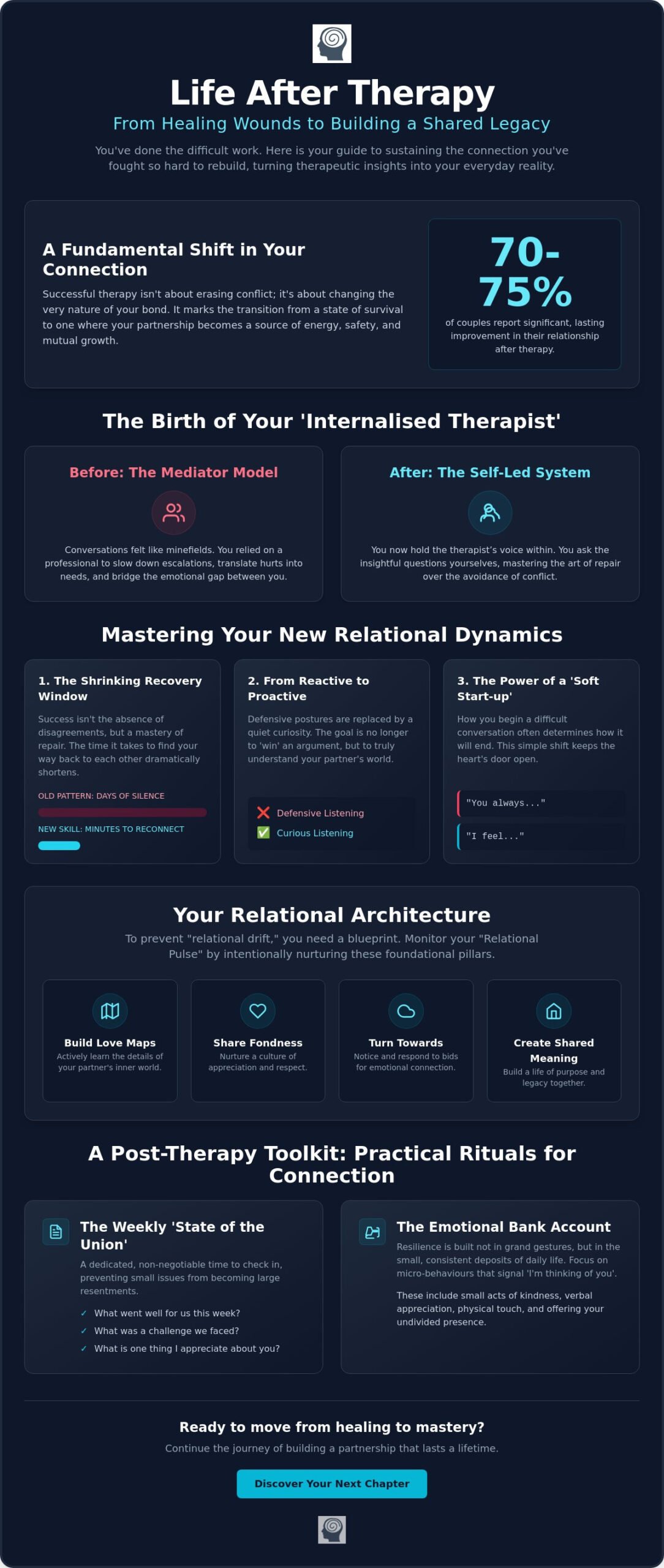
Success in the wake of Couples therapy isn’t simply the absence of noise. It’s a fundamental shift in the frequency of your connection. Many couples begin their journey in “survival mode,” where every conversation feels like a minefield and silence is a fragile truce. However, life after successful couples therapy feels remarkably different. It’s the transition from surviving to thriving, where the relationship becomes a source of energy rather than a drain on your emotional resources.
One of the most significant shifts is the birth of your “internalised therapist.” During your sessions, you likely relied on a professional to bridge the gap, to slow down the escalations, and to translate your hurts into needs. Now, you have integrated that voice. You’ve learned to ask the questions a therapist would ask: “What am I feeling right now?” or “What did I just miss in what you said?” You no longer need a mediator because you’ve learned the rules of engagement yourselves.
It’s a common misconception that a “fixed” relationship is one without friction. The truth is quite the opposite. Conflict is a natural byproduct of two distinct humans sharing a life. The real marker of success is that your “recovery time” has shrunk. Instead of a disagreement resulting in three days of icy silence, you can now find your way back to each other in twenty minutes. Post-therapy success is the mastery of repair over the avoidance of conflict.
The Shift from Reactive to Proactive Communication
In the past, you might have listened only to find a flaw in your partner’s argument. This defensive stance is exhausting. Now, that defensiveness has been replaced by a quiet curiosity. You’re no longer looking for a “win”; you’re looking for understanding. For many in Britain, the traditional “stiff upper lip” has often served as a barrier to true intimacy, masking needs under a veneer of stoicism. Successful therapy replaces this with emotional transparency. You’ve learned the power of a “soft start-up.” By addressing a concern with “I feel” rather than “You always,” you keep the heart’s door open even during difficult chats.
Redefining the “New Normal” for Your Partnership
Your “new normal” is built on a culture of mutual appreciation rather than a ledger of grievances. You’ve moved past the fear of the “roommate phase.” Whilst many couples panic when the initial fire settles into a steady hum, you now see this phase as a stable ground for individual growth. You can be “you” whilst being “us.” This integration of personal evolution into the collective union ensures that the relationship stays dynamic. For those who wish to bring this regenerative mindset into their professional leadership, you can visit Jannine Barron to learn about sustainable business strategy. Life after successful couples therapy isn’t a destination. It’s an active, evolving adventure you’re navigating together with a shared map and a renewed sense of purpose.
The Relational Architecture: Building a Resilient Future
A common fear amongst partners is the “relapse.” You might ask yourself: “Will we just slide back into old habits when life gets stressful?” It is a valid concern. When work deadlines loom or family pressures mount, our nervous systems naturally default to the oldest, most familiar pathways. However, life after successful couples therapy isn’t about achieving a state of permanent perfection where you never stumble. Instead, it is about having a robust structural blueprint to return to whenever you feel the foundation begin to shake.
The Gottman “Sound Relationship House” serves as this permanent blueprint. It moves beyond mere communication tips, offering a tiered system that includes building love maps, sharing fondness, and creating shared meaning. By monitoring your “Relational Pulse” through weekly check-ins, you catch the subtle “drifts” before they become deep divides. In our age of digital distraction, this requires a commitment to conscious presence. If you are physically in the same room but emotionally tethered to your smartphones, the architecture of your bond inevitably weakens. True resilience is built in the small, intentional moments of turning toward each other rather than away.
Mastering the Art of the Repair Attempt
If there is one skill that predicts long-term stability, it is the ability to repair. A repair attempt is any statement or action, silly or serious, that prevents negativity from escalating out of control. Every couple develops their own unique repair language. It might be a specific look, a self-deprecating joke, or a gentle touch on the arm whilst in the heat of a disagreement. Research suggests that the success of these attempts depends less on how eloquent the apology is and more on how much “credit” you have in your emotional bank account. When you master the art of the repair, conflict ceases to be a threat and instead becomes an opportunity for deeper understanding.
Nurturing Erotic and Emotional Intelligence
Drawing on the insights of Esther Perel, we must recognise that intimacy requires a delicate balance between security and mystery. Whilst the domestic side of a relationship thrives on caretaking and predictability, desire often requires a sense of “otherness” and autonomy. If you become too much like caregivers for one another, the erotic spark can dim. This is why individual relationship counselling is such a powerful tool for the collective union. By working on your own emotional health, you bring a more vibrant, differentiated self back to the partnership. Sustaining your progress is a proactive adventure, and you can always connect with a professional guide to ensure your relational architecture remains strong for years to come.
Navigating the “Maintenance Phase”: Preventing Relapse
Entering the maintenance phase of your relationship is a significant milestone. It marks the moment you step out of the intensive care of the therapy room and into the daily rhythm of your shared life. However, it’s vital to recognise that life after successful couples therapy isn’t a plateau where effort ceases; it is a practice. Just as a garden requires regular weeding to prevent the wildflowers from being overtaken, your relationship needs consistent attention to stop old, reflexive behaviours from taking root once more.
Spotting the “drift” is the first step in preventing a full return to old patterns. Drift often starts subtly: a missed weekly check-in, a sarcastic comment that goes unaddressed, or a slow withdrawal into separate digital worlds during the evening. It’s important to distinguish between a “slip” and a “relapse.” A slip is a momentary loss of footing, perhaps a heated argument where you forgot your tools, whilst a relapse is a sustained return to the old lifestyle of disconnection. Don’t let one bad night undo months of hard work. The ultimate goal of therapy is to make the couple the experts on their own unique dynamic, capable of navigating life’s complexities without a permanent outside mediator.
Identifying Your Relational Triggers
To maintain your progress, you must become students of each other’s nervous systems. Drawing from the trauma-informed perspective of Gabor Maté, we understand that many of our “triggers” are actually echoes of past wounds being poked in the present. When your partner reacts with seemingly disproportionate intensity, they may be “activated” rather than simply angry. Their brain has perceived a threat to their safety or belonging. By creating a “Safe Harbour” protocol, you agree on a specific set of actions to take when one of you is activated, such as a timed break or a grounding touch, ensuring that high-stress periods don’t lead to a total breakdown in communication.
The Role of Accountability Without Blame
Maintaining a healthy “emotional temperature” is a shared responsibility. It requires the courage to raise concerns without triggering the “Four Horsemen” of criticism, contempt, defensiveness, and stonewalling. This is where the power of the “I” statement becomes your greatest ally. Instead of saying, “You are ignoring me,” try, “I’m feeling a bit lonely and would love some focused time together.” This approach invites your partner into a collaborative solution rather than forcing them into a defensive spiral. Accountability in this phase isn’t about pointing fingers; it’s about being brave enough to say, “We’re drifting, and I want to find our way back.” When maintenance is viewed as a proactive adventure in intimacy, it ceases to feel like a chore and becomes the very heartbeat of a thriving partnership.
A Post-Therapy Toolkit: Practical Rituals for Connection
Whilst understanding the theory of a healthy bond is essential, it is the daily, lived experience that cements your progress. Maintaining the momentum of life after successful couples therapy requires more than just good intentions; it requires a practical toolkit that you can reach for even when the week feels heavy. These rituals act as the scaffolding for your relationship, ensuring that your connection remains a priority amongst the noise of work, family, and domestic responsibilities. By turning these practices into habits, you move from a state of conscious effort to a natural, self-sustaining flow of intimacy.
One of the most effective ways to honour your progress is to pay attention to the transitions of your day. The rituals of departure and return, how you say goodbye in the morning and how you greet each other in the evening, set the emotional tone for your entire union. A simple, focused greeting can be the difference between feeling like two ships passing in the night and feeling truly seen. To keep your growth dynamic, consider incorporating specific exercises for couples to reconnect into your monthly routine, allowing you to explore new layers of your partnership in a structured, safe way.
The Weekly Relationship Check-In
The “State of the Union” meeting is a cornerstone of relational mastery. This is a dedicated hour, perhaps on a Sunday evening, where you step out of the “roommate” roles and into your roles as partners. The structure is simple but profound. You begin with appreciation, sharing at least five things you’ve admired about each other that week. Next, you discuss what is working well, followed by a gentle space for what needs repair. Finally, you end by planning something fun. It is vital to keep the “business” of the house, such as bills or school schedules, separate from this meeting. This is a time for the heart of the home, not the logistics of it.
Micro-Moments of Intimacy
Small gestures often carry the most weight in building your emotional bank account. John Gottman’s “6-Second Kiss” is a perfect example; it’s a kiss long enough to feel a shift in your nervous system and create a moment of genuine connection. You might also consider an “Appreciation Journal,” where you each write one thing you valued about the other daily. These micro-moments don’t require hours of time. Even active listening exercises that take less than five minutes can de-escalate tension. Physical touch, whether a hand on a shoulder or a long hug, serves as a powerful non-verbal repair tool that reminds you both of your shared warmth. If you find yourself needing more tailored support to establish these habits, you can book a session for relationship coaching to refine your post-therapy toolkit.
From Healing to Mastery: The 12-Week Relationship Recovery Legacy
The true measure of a flourishing partnership is found in its legacy. Whilst the initial stages of therapy often focus on dousing the flames of active conflict, the final transition involves moving from simple resolution to relational expansion. This is where the work becomes truly transformative. By engaging in a structured 12-week relationship recovery process, you have done more than just solve problems; you have begun to rewire the neural pathways of your connection. You are no longer two individuals reacting to each other’s wounds. You are a unified team capable of facing any external challenge with a shared sense of purpose.
Mastery in life after successful couples therapy means that the “we” of the relationship is stronger than the “me” of the ego. You have moved beyond the 50/50 split of effort into a more generous “80/80” model, where both partners aim to contribute a surplus of kindness and support. This abundance creates a buffer against the inevitable stresses of life. To keep this momentum, many couples find value in occasional “tune-up” sessions or masterclasses. These aren’t signs of failure, but rather a commitment to continuous improvement, much like an athlete refines their technique even at the peak of their career.
Integrating Your New Skills into Long-Term Growth
The beauty of your progress is that it rarely stays confined to your partnership. There is a profound ripple effect on your wider family and your parenting style. Children who witness their parents model healthy repair and emotional transparency learn to navigate their own lives with greater resilience. For those who have walked the difficult path of couples therapy for infidelity, this stage represents the solidifying of a new, more honest trust that can actually be deeper than what existed before. Even if your journey leads to a conscious separation, the skills you have gained ensure that the transition is handled with dignity and mutual respect, preserving the emotional health of everyone involved.
Your Relational Adventure Continues
Nurturing Your Relational Legacy
The journey you’ve undertaken is a testament to your shared commitment and courage. As you embrace life after successful couples therapy, remember that the tools you’ve gathered are now your own. You’ve moved from the intensity of crisis management to the steady, fulfilling rhythm of a resilient partnership. By honouring your weekly rituals and maintaining a curious, trauma-informed perspective on each other’s needs, you ensure that your bond remains vibrant and adaptive to whatever challenges life brings.
Sustaining this mastery is a proactive adventure. I provide a safe and non-judgemental environment to help you refine these skills through a research-based approach inspired by the work of Gottman and Perel. Whether you’ve completed my signature 12-Week Relationship Recovery Process or simply wish to safeguard your progress, a little maintenance goes a long way. You don’t have to wait for a crisis to seek support; staying connected is a lifelong practice.
Book a ‘Relational Tune-Up’ session with Tracy Kimberg today to keep your connection thriving. You’ve built a beautiful foundation together; now, it’s time to enjoy the home you’ve created.
Frequently Asked Questions
How do we know if we are ready to stop couples therapy?
You are ready when you have successfully moved from a state of crisis to a state of self-led repair. This transition usually happens when you notice that your “recovery time” after a disagreement has significantly shortened and you no longer look to the therapist to bridge your communication gaps. It’s about feeling confident in your own shared language and your ability to turn toward each other during stress.
What should we do if we have a massive argument right after finishing therapy?
Don’t panic; a single argument is a “slip” and not a “relapse” into old toxic patterns. Use it as a real-world laboratory to practice the repair attempts you’ve learned. The goal of life after successful couples therapy isn’t to never fight, but to ensure that when you do, you have the tools to find your way back to each other without outside help.
Is it normal to feel anxious about ending our sessions?
It’s entirely normal to feel a sense of “separation anxiety” when leaving the therapeutic space. For many, the therapy room has become the only place where they feel truly heard or safe. Recognise that this fear is actually a sign of how much you value your progress. You aren’t losing the safety; you are simply moving it from the clinic into your own home.
How often should we do a ‘relationship check-up’ at home?
I recommend a weekly “State of the Union” meeting to keep your connection vibrant. This doesn’t need to be a heavy, hour-long session. Even twenty minutes of focused, distraction-free conversation about what’s working and what needs a little more attention can prevent the “relational drift” that often leads to future conflict. Consistency is far more important than intensity.
Can we come back for ‘tune-up’ sessions if we feel ourselves slipping?
Yes, returning for occasional tune-ups is a sign of relational maturity rather than failure. Many couples find that a session every six months or during major life transitions, like a career change or a new baby, helps them stay aligned. It’s a proactive way to honour your bond and ensure that your new, healthy habits remain your default response to stress.
What is the most common reason couples ‘relapse’ after successful therapy?
The primary reason for a relapse is the slow erosion of rituals of connection. When life gets busy, couples often stop prioritising the small gestures, like the “6-second kiss” or daily appreciations. When the emotional bank account runs dry, you lose the buffer that prevents minor irritations from escalating. Maintenance should be viewed as a proactive adventure, not a chore to be avoided.
How do we maintain the ‘erotic’ spark whilst focusing on emotional stability?
Intimacy thrives on the balance between belonging and autonomy. Whilst emotional stability provides the safety needed for deep connection, desire often requires a sense of mystery and “otherness.” Don’t let your roles as co-parents or domestic partners swallow your individual identities. Maintaining your own interests and passions makes you more attractive to your partner and keeps the erotic spark alive over time.
What if only one partner wants to keep doing the ‘maintenance’ work?
Lead by example rather than by instruction. When you consistently show up with curiosity and vulnerability, it often invites your partner to do the same. Focus on how the maintenance work benefits you personally and the relationship as a whole. If resistance persists, it may be helpful to have a gentle conversation about what “maintenance” looks like for them, as they may have a different repair language.

Article by
Tracy Kimberg
Tracy Kimberg is a Relationship Expert, Couples Therapist and Coach with a dedicated focus on helping couples and individuals rebuild connection, trust and emotional safety in their relationships. Drawing on the research of John and Julie Gottman, the relational insights of Esther Perel, and years of hands-on therapeutic experience, Tracy offers a warm, non-judgemental and deeply compassionate approach to modern relationships.Based in Dorset, Tracy works with couples navigating communication breakdowns, betrayal, intimacy challenges, separation, family dynamics and life transitions. Known for creating a safe and grounded therapeutic space, she combines practical tools with emotional depth to help clients move beyond survival patterns and towards meaningful, lasting change.With a reputation for empathy, professionalism and dedication to her clients’ growth, Tracy is passionate about helping people feel seen, understood and empowered — both within their relationships and within themselves.
Disclaimer
Disclaimer:The information shared in this article is intended for educational and informational purposes only and should not be considered a substitute for professional therapeutic, psychological, medical or legal advice. Every individual and relationship is unique, and the perspectives offered are based on general therapeutic principles, research and professional experience.Reading this article does not establish a therapist-client relationship with Tracy Kimberg. If you are experiencing significant emotional distress, relationship crisis, trauma, or mental health concerns, it is important to seek support from a qualified professional appropriate to your individual circumstances.All content remains the intellectual property of Tracy Kimberg and may not be reproduced or distributed without permission.