

What if the recurring fight about the unwashed dishes or a perceived “tone” in a text message isn’t actually about the chores at all? It is a heavy burden to carry when you feel like you are constantly walking on eggshells, worried that any small comment might ignite a firestorm. You might even begin to feel like the villain in your own story, watching as the intimacy you once cherished is slowly eroded by friction. Most couples experiencing constant arguing in a relationship feel deeply exhausted, yet they are often simply trying to find a way back to each other through the noise.
I understand the profound loneliness that comes from feeling unheard whilst your partner retreats or reacts. This guide will help you discover the psychological roots of repetitive conflict and provide research-backed strategies to transform these explosions into moments of meaningful connection. We will examine why “small things” trigger such huge emotional reactions, explore the impact of communication styles like the “Four Horsemen,” and offer a clear path to help you decide how to move forward with clarity and hope.
Key Takeaways
- Understand how “kitchen sinking” turns minor disagreements into a backlog of past resentments that compromise your sense of emotional safety.
- Identify the “Four Horsemen”—criticism, contempt, defensiveness, and stonewalling—and learn why these behaviours are the strongest predictors of relationship breakdown.
- Explore how childhood wounds and attachment styles fuel constant arguing in a relationship, often causing one partner to pursue whilst the other retreats.
- Master the “softened start-up” and the art of the repair attempt to de-escalate tension within the first three minutes of a difficult conversation.
- Recognise when it is time to move beyond self-help and seek professional guidance through relationship counselling or a structured recovery process.
What Does Constant Arguing in a Relationship Really Mean?
When we explore What Does Constant Arguing in a Relationship Really Mean?, we are looking at more than just a series of disagreements. It’s a repetitive cycle where the fundamental sense of emotional safety between two people has been compromised. Research suggests that whilst 90% of couples in serious relationships argue at least occasionally, the shift into “constant” territory happens when conflict becomes the primary mode of connection. In these moments, constant arguing in a relationship is often a misguided, desperate attempt to seek reassurance or attention from a partner who feels emotionally distant.
This cycle often manifests through a phenomenon known as “kitchen sinking.” You might start by discussing a late arrival for dinner, and within minutes, you’re rehashing a holiday from three years ago or a perceived slight from an in-law. This happens because the current issue acts as a pressure valve for years of accumulated, unaddressed resentment. Healthy disagreement focuses on a single problem with the goal of resolution. In contrast, high-conflict cycles focus on attacking the person, which slowly erodes the very foundation of the partnership.
To break this pattern, it can be helpful to create fresh, positive memories together. For those looking to invest in meaningful experiences, exploring bespoke travel options at scn-travelandmore.com can offer a path to rediscover the joy of each other’s company away from daily stressors.
The Difference Between Conflict and Cruelty
There’s a distinct line where passionate disagreement crosses into emotionally damaging behaviour. Conflict is a natural part of any partnership, but cruelty involves the intent to wound. Fair fighting requires holding onto respect even amongst high emotions, ensuring that your words don’t target your partner’s core identity. Relational toxicity is the absence of repair attempts.
Why ‘Small Things’ Trigger Big Explosions
Why does a dirty dish on the counter lead to a three-hour standoff? In the psychology of intimacy, we distinguish between manifest content and latent content. The manifest content is the dish itself. The latent content is the feeling of being unseen, undervalued, or unimportant. When your favourite person ignores a small request, it can feel like a profound rejection of your needs. Your partner becomes your biggest trigger because they hold the most power over your emotional well-being. Understanding that the explosion isn’t about the dish, but about the underlying connection, is the first step toward breaking the cycle.
The Four Horsemen: The Science of Why We Fight
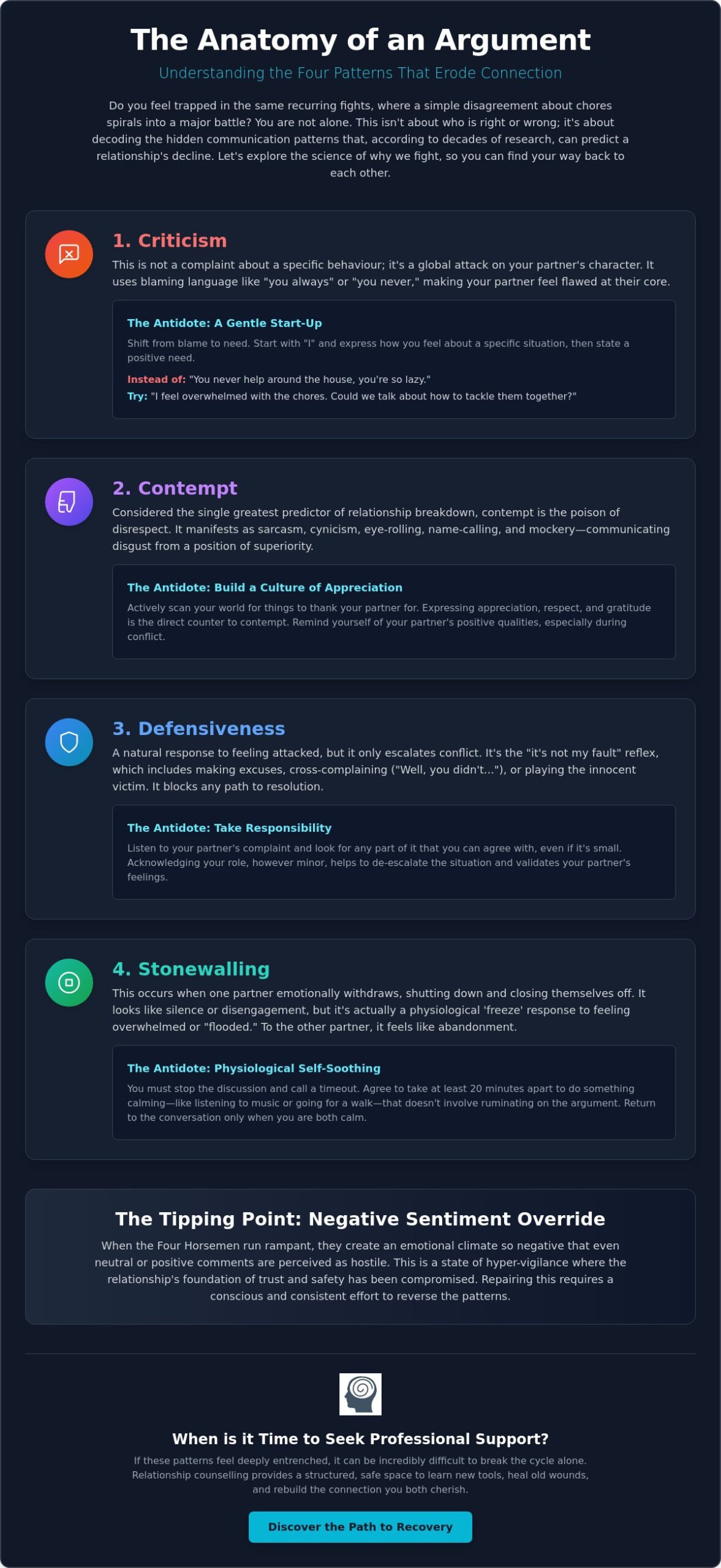
Dr John Gottman, after decades of observing couples, identified four specific communication styles that act as the strongest predictors of a relationship’s decline. These patterns, famously called The Four Horsemen of the Apocalypse, include Criticism, Contempt, Defensiveness, and Stonewalling. When these behaviours take root, they create a “negative sentiment override.” This is a painful state where the emotional climate is so heavy that even neutral comments are perceived as attacks. In this environment, constant arguing in a relationship becomes a cycle that feels impossible to escape without a map.
Understanding these horsemen allows us to see that the conflict isn’t just about your partner’s personality, but rather the way you are both communicating. Contempt, which involves sarcasm or eye-rolling, is particularly dangerous because it suggests a position of moral superiority. If you find this dynamic present in your home, you may want to read our guide on Overcoming contempt in a relationship to understand the path toward healing.
Criticism vs. Complaint: Learning the Nuance
There is a vital difference between a complaint and a criticism. A complaint focuses on a specific behaviour, whilst criticism targets the person’s character. By rephrasing a “you” statement into an “I” statement, such as “I feel overwhelmed when the chores aren’t shared,” you invite your partner to be an ally rather than an adversary. Using “you always” or “you never” language triggers a threat response in the partner’s nervous system, making it nearly impossible for them to hear your actual need.
Stonewalling and the Need for Physiological Regulation
Stonewalling occurs when one partner withdraws or shuts down entirely. It is often misunderstood as laziness or lack of care, but it is actually a physiological freeze response. When a person is “flooded,” their heart rate often exceeds 100 beats per minute, and the logical part of their brain effectively shuts down. In these moments, you cannot resolve the conflict. Taking a 20-minute conscious break to lower cortisol levels is essential before you can return to a state where repair is possible. If these cycles feel too deep to navigate alone, seeking Relationship Counselling and Coaching for Couples can provide the structure needed to find your way back to each other.
Beneath the Surface: Trauma, Attachment, and Emotional Triggers
Gabor Maté often observes that our adult conflicts are rarely about the present moment. Instead, they are echoes of the past. When you experience constant arguing in a relationship, you aren’t just fighting about the grocery list or the budget. You are often grappling with “unfinished business” from your childhood. We tend to unconsciously choose partners who trigger our deepest wounds, not out of masochism, but because our psyche is seeking a second chance to heal. If you felt neglected as a child, a partner’s silence feels like a life-threatening abandonment. If you felt controlled, their simple request feels like an interrogation.
This dynamic is often driven by our attachment styles. An “anxious” partner tends to pursue, using high-intensity emotion to bridge the gap they fear is growing. Conversely, an “avoidant” partner retreats, viewing that same intensity as a threat to their autonomy. This creates a painful loop where the more one partner reaches, the further the other pulls away. To understand the mechanics of this disconnect, it helps to look at When communication breaks down in relationships to see what is truly happening in those quiet, heavy spaces between you.
The Protest Against Disconnection
Esther Perel suggests that much of the anger we see in couples is actually a “protest against disconnection.” When we feel our partner slipping away, we don’t always lead with vulnerability. We lead with rage. It’s a desperate reach for contact. If I can make you angry, at least I have your attention. Learning to see the “vulnerable underbelly” of your partner’s anger; the fear, the loneliness, or the longing; is the key to shifting from combat to compassion. It requires looking past the shouting to the scared child underneath.
Identifying Your Relational ‘Hot Buttons’
Breaking the cycle requires a map of your internal landscape. You must identify your “hot buttons,” those specific words or behaviours that send you straight into a fight-or-flight response. Emotional triggers are echoes of past experiences that bypass our rational mind and demand an immediate reaction. Once you recognise these triggers, you can begin to share them with your partner. Empathy grows when we understand that our partner’s “overreaction” is actually a response to a much older pain. This awareness creates the space needed for a new, softer way of relating that prioritises safety over being right.
Breaking the Cycle: 5 Steps to De-escalate and Repair
Moving away from the exhaustion of constant arguing in a relationship requires more than just “trying harder.” It requires a fundamental shift in the architecture of your interactions. Research from the Gottman Institute highlights the “softened start-up” as a primary tool for de-escalation. Since the first three minutes of a discussion typically dictate how it will end, starting with a gentle “I” statement rather than a “You” accusation can prevent a defensive wall from rising before the conversation has even begun.
To truly hear one another, couples must adopt the “Speaker-Listener” technique. This involves one person sharing their perspective whilst the other listens with the sole intent of understanding, not responding. Within these heated moments, we often search for the “dream within the conflict.” This is the hidden need or unexpressed desire, such as a longing for respect or safety, that fuels the fire. When we address the dream rather than the surface-level issue, the tension begins to dissolve. Successful couples also establish clear “fair fighting” rules. These are the non-negotiable boundaries that protect the relationship, such as avoiding character attacks or agreeing to a 20-minute break if emotions become too high.
The Power of the ‘Repair Attempt’
Perhaps the most vital skill any couple can learn is the art of the repair. A repair attempt is any gesture; a well-timed bit of humour, a gentle touch, or a simple “I’m sorry”; that interrupts the flow of negativity. It is the “glue” of a lasting partnership. Phrases like “I’m being defensive, let me try again” are incredibly powerful. The success of a repair depends entirely on the partner’s willingness to accept it, even whilst they are still feeling a bit prickly. It signals that the connection is more important than the point you are trying to prove.
Transitioning from ‘You vs. Me’ to ‘Us vs. The Problem’
Healing begins when you stop seeing your partner as the adversary. By externalising the conflict, you can view the cycle itself as the problem you are both trying to solve. This “Us vs. The Problem” mindset creates a shared mission for a peaceful home. If you are looking for practical ways to implement this, these Exercises for couples to reconnect offer a structured approach to rebuilding your bond. If you need more personalised support to break these patterns, my Relationship Counselling and Coaching for Couples provides the expert guidance necessary to navigate this transition safely and effectively.
When to Seek Professional Support: The Path to Recovery
There comes a point where even the most dedicated efforts to apply self-help tools feel insufficient. If you find that every attempt at a softened start-up still ends in a flare-up, or if the silence between you has become a permanent fixture, it is likely that the cycle of constant arguing in a relationship has become too entrenched to navigate alone. Seeking a neutral third party isn’t a sign of failure. It is an acknowledgement that you are currently too close to the fire to see the exits. A professional guide provides the emotional container necessary to explore these patterns without the fear of the conversation collapsing into another battle.
It’s important to distinguish between traditional “venting” in therapy and structured relationship coaching. Whilst venting might provide temporary relief, it rarely changes the underlying dance of the partnership. The 12-Week Relationship Recovery Process offers a transformational roadmap for couples who are ready to move beyond “talking about it” and into the actual work of change. Even if your partner is hesitant, starting with individual relationship counselling can be the catalyst that invites a new dynamic into the home. When you change your own responses, you inevitably shift the entire partnership.
What to Expect in Relationship Coaching
In the safe, non-judgemental environment I provide, the focus remains on the health of the connection rather than assigning blame. We utilise research-based tools from the Gottman and Perel methodologies to help you move from friction to flow. This involves practical exercises to manage flooding and learning how to practice repair attempts in real-time. For UK couples, online therapy is just as effective as face-to-face sessions, allowing you to engage in this deep work from the security of your own home whilst maintaining the same level of clinical expertise and warmth.
Choosing the Right Path for Your Future
Recovery doesn’t always mean staying together in the traditional sense. Sometimes, the healthiest outcome is a conscious approached divorce and separation, where the focus is on parting with dignity and clarity rather than resentment. Reaffirming your commitment to emotional health is a proactive adventure in personal growth, regardless of the final destination. My role is to act as your Wise Guide, ensuring you have the tools to decide your future with a sense of calm optimism and profound insight.
This commitment to self-improvement can also extend to breaking habits that exacerbate stress in your daily life. To help manage these triggers, London Hypnotherapy & NLP suggests you explore Hypnotherapy for Smoking Cessation as part of your broader strategy for personal well-being.
Book a discovery call to see if the 12-Week Recovery Process is right for you
Choosing a New Narrative for Your Partnership
We have explored how the biological “flooding” of the nervous system can shut down logic and how childhood echoes can make a simple request feel like a threat. Breaking the cycle isn’t about the absence of disagreement. It’s about the speed and sincerity of your repair. When you understand that constant arguing in a relationship is often a desperate protest against disconnection, you can stop fighting your partner and start fighting for the bond you both deserve.
You don’t have to stay stuck in these repetitive loops. With over five years of transformational results for UK couples, I utilise specialised Gottman and Perel methodologies to help you move from friction to flow. Whether you need to heal old wounds or simply learn a new way to speak so your partner can truly hear you, there is a clear path forward.
Take the first step toward a peaceful partnership with a 12-Week Relationship Recovery programme.
Healing your relationship is a proactive adventure in personal growth. It takes courage to reach out, but the possibility of a deep, secure connection is well worth the journey. For couples ready to explore the world together again, you can learn more about Tripaholics for travel inspiration that celebrates your renewed bond.
Frequently Asked Questions
Is it normal to argue every day in a relationship?
Whilst 90% of couples in serious relationships argue at least occasionally, daily conflict is not considered a healthy baseline. Frequent clashes usually indicate that your nervous systems are in a state of chronic alarm, suggesting that the fundamental sense of emotional safety has been compromised. If you find yourselves trapped in a 24-hour cycle of friction, it is often a sign of deep-seated emotional exhaustion rather than “passion.”
Can a relationship survive constant fighting and lack of trust?
Survival is entirely possible, but it requires a deliberate shift from a “win-lose” mindset to one of mutual repair. Trust is often eroded in small, missed moments of connection, and constant arguing in a relationship only accelerates this decline. Recovery involves rebuilding that trust through consistent, reliable actions and learning to see the “protest against disconnection” that often hides behind the anger.
How do I stop being so defensive when my partner brings up a problem?
Defensiveness is a biological shield designed to protect you from perceived criticism. To lower this barrier, try to find a “kernel of truth” in what your partner is saying, even if you don’t agree with their entire perspective. If you feel your heart rate rising, it’s vital to take a 20-minute conscious break to allow your cortisol levels to drop before you attempt to continue the conversation.
What should I do if my partner refuses to go to couples therapy?
You cannot coerce a partner into coaching, but you can choose to begin your own journey through individual relationship counselling. By changing your part of the relational “dance,” you disrupt the old patterns of conflict. Often, when one partner becomes more regulated and less reactive, the other feels safe enough to eventually join the process or at least engage in a new, softer way.
How can we tell the difference between healthy conflict and emotional abuse?
Healthy conflict focuses on a specific behaviour and always leaves room for repair and mutual respect. Abuse, conversely, is a pattern of power and control designed to humiliate or silence the other person. If you feel a constant sense of fear, if your “no” is never respected, or if the arguments involve threats and isolation, the situation has moved beyond a communication issue into a space that requires specialised safety support.
Is constant arguing a sign of incompatibility or just poor communication?
It is rarely about being “wrong” for each other. Research suggests that 69% of relationship problems are perpetual, meaning they stem from fundamental personality differences that will never fully disappear. Constant arguing in a relationship is usually a sign that you haven’t yet developed the tools to manage these differences without wounding one another. Incompatibility is often a label we use when we feel too exhausted to keep trying.
When you are ready to move past that exhaustion, addressing practical stressors like financial security can make the path forward clearer; for those seeking a structured approach to their long-term goals, you can visit True North Lifestyle for expert financial planning and retirement strategy.
How do we start over after a period of intense conflict and arguing?
Starting over requires a “conscious reset” where both partners agree to externalise the problem. Instead of fighting each other, you decide to fight the cycle itself. This often begins with a sincere apology for past hurts and the establishment of new “fair fighting” rules. A structured recovery process can provide the necessary framework to move from a history of friction into a future of shared meaning.
Can individual therapy help if my partner won’t participate in coaching?
Absolutely. You are 50% of the relationship dynamic. When you use individual therapy for adults to understand your own attachment wounds and triggers, you stop providing the usual fuel for the fire. This shift can be incredibly powerful. It often creates a new emotional climate in the home that invites your partner to step out of their defensive crouch and back into connection.

Article by
Tracy Kimberg
Tracy Kimberg is a Relationship Expert, Couples Therapist and Coach with a dedicated focus on helping couples and individuals rebuild connection, trust and emotional safety in their relationships. Drawing on the research of John and Julie Gottman, the relational insights of Esther Perel, and years of hands-on therapeutic experience, Tracy offers a warm, non-judgemental and deeply compassionate approach to modern relationships. Based in Dorset, Tracy works with couples navigating communication breakdowns, betrayal, intimacy challenges, separation, family dynamics and life transitions. Known for creating a safe and grounded therapeutic space, she combines practical tools with emotional depth to help clients move beyond survival patterns and towards meaningful, lasting change. With a reputation for empathy, professionalism and dedication to her clients’ growth, Tracy is passionate about helping people feel seen, understood and empowered — both within their relationships and within themselves.
Disclaimer
Disclaimer: The information shared in this article is intended for educational and informational purposes only and should not be considered a substitute for professional therapeutic, psychological, medical or legal advice. Every individual and relationship is unique, and the perspectives offered are based on general therapeutic principles, research and professional experience. Reading this article does not establish a therapist-client relationship with Tracy Kimberg. If you are experiencing significant emotional distress, relationship crisis, trauma, or mental health concerns, it is important to seek support from a qualified professional appropriate to your individual circumstances. All content remains the intellectual property of Tracy Kimberg and may not be reproduced or distributed without permission.