

Imagine standing in your kitchen, heart hammering, as you rehearse a simple sentence for the fifth time just to avoid a sudden outburst. It is a quiet, heavy kind of loneliness when your home feels more like a minefield than a sanctuary. You are likely wondering how to stop walking on eggshells around my partner because the chronic anxiety and loss of your own identity have become too much to bear. Research suggests that nearly 48 per cent of people experience psychological aggression in their lifetime, so please know you aren’t alone in this exhausting struggle.
I understand the weight of this emotional exhaustion and the deep desire to finally be seen and heard. This guide will show you how to dissolve that climate of fear and transition from constant hyper-vigilance to a secure, authentic connection. We will explore the patterns that keep you feeling small and the practical steps needed to reclaim your safety, your voice, and your sense of self. It is time to move toward a relationship where you can breathe easily and speak your truth without the constant fear of an explosion.
Key Takeaways
- Understand the “silent contract” of hyper-vigilance and why you have been trading your authentic self for a fragile sense of peace.
- Discover practical strategies on how to stop walking on eggshells around my partner by learning to regulate your nervous system before attempting difficult conversations.
- Identify the hidden costs of emotional flattening and begin the essential work of reclaiming your self-esteem and your voice.
- Shift the focus from individual blame to healing the relational dynamic through the principles of conscious partnership and mutual accountability.
- Learn how a structured 12-Week Relationship Recovery Process can provide the clear, manageable roadmap needed to move from fear to a secure connection.
The Silent Contract: What It Really Means to Walk on Eggshells
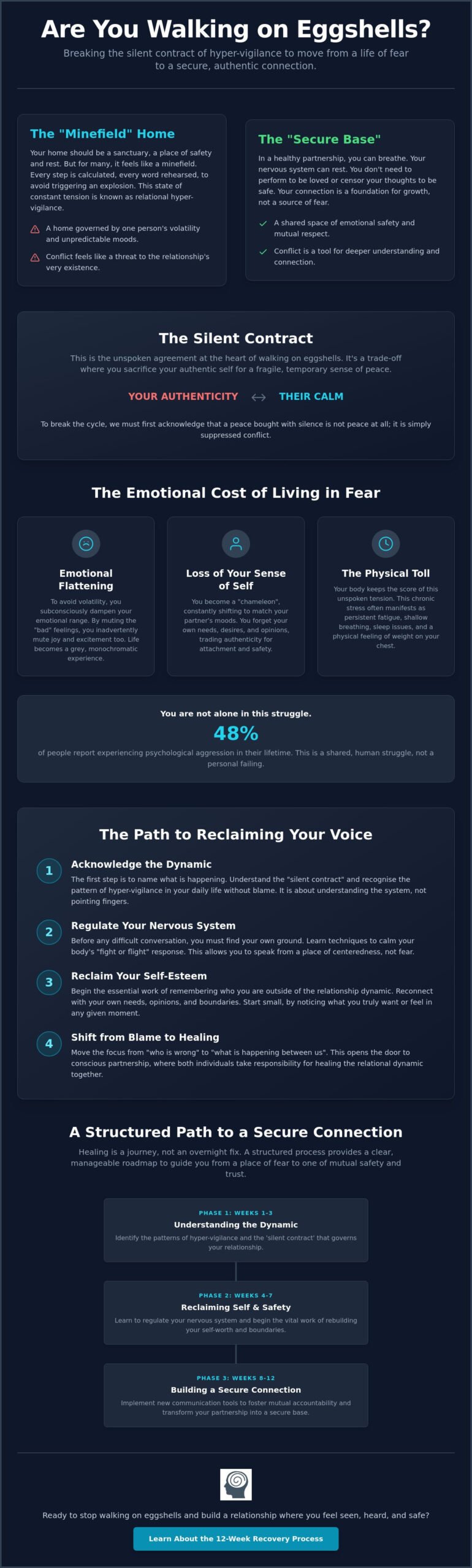
Walking on eggshells is often described as a feeling of being on edge, but psychologically, it is a state of chronic relational hyper-vigilance. It is the exhausting process of constantly monitoring your surroundings to predict and prevent a partner’s negative reaction. This dynamic often sits under the umbrella of psychological abuse, where the atmosphere of the home is dictated by one person’s volatility. When you are searching for how to stop walking on eggshells around my partner, you are essentially looking for a way to break a “Silent Contract”. This is an unspoken agreement where you trade your authenticity and truth for a fragile, temporary sense of peace. You stop being yourself to keep them calm.
In this environment, the triggers are often subtle. It isn’t always a shout. It might be a specific tone of voice, a tightening of the jaw, or “the heavy silence” that fills a room like a physical weight. Contrast this with a “Secure Base” relationship. In a healthy partnership, conflict isn’t a threat to the relationship’s existence; it is a tool for growth and deeper understanding. When safety is present, you don’t need to perform to be loved.
The Anatomy of Relational Hyper-vigilance
Your nervous system is designed to protect you. When you live in fear of an explosion, your body stays in a constant state of “fight or flight”, even during the quiet moments. You might notice “scanning behaviour”, where you instinctively check your partner’s facial expressions the moment they walk through the door. You are looking for signs of weather changes in their mood. Hyper-vigilance is a survival mechanism that has outlived its usefulness in a partnership.
Why We Choose Silence Over Truth
We often choose silence because the alternative feels catastrophic. The fear of an emotional explosion or, perhaps more painfully, the fear of abandonment keeps us small. Many of us carry childhood patterns that make us susceptible to this dynamic; perhaps you learned early on that your safety depended on managing an adult’s emotions. Whilst silence feels like a safe harbour in the short term, it inevitably erodes the foundation of the relationship. To truly learn how to stop walking on eggshells around my partner, we must first acknowledge that a peace bought with silence is not peace at all; it is simply suppressed conflict.
The Emotional Cost of Living in a State of Fear
Living in a state of constant vigilance is more than just exhausting; it is soul-eroding. When you spend every waking hour wondering how to stop walking on eggshells around my partner, you are essentially living in a high-stress environment that your body was never meant to sustain long-term. Emotional and psychological abuse often leaves no visible bruises, but the internal damage to your self-esteem is profound. You begin to censor your thoughts before they even reach your lips, eventually forgetting what your own unvarnished opinion even sounds like.
This constant self-editing leads to what we call “Emotional Flattening”. To survive the volatility, you subconsciously dampen your emotional responses. You become so focused on avoiding the next explosion that you lose the ability to feel genuine joy or excitement. If you turn down the volume on the “bad” feelings to stay safe, you inadvertently mute the “good” ones too. Life becomes a grey, monochromatic experience where the primary goal is simply to get through the day without an incident. Your body keeps the score of this unspoken tension, manifesting as persistent fatigue, shallow breathing, and significant sleep issues. You might feel a physical weight in your chest, the literal burden of a thousand unspoken words.
Losing Your Sense of Self
You eventually become a “chameleon”, shifting your colours and personality to match your partner’s fluctuating moods. Relationship expert Gabor Maté often speaks about the tragic trade-off between authenticity and attachment. As humans, we need attachment to survive; if that attachment is threatened by a partner’s volatile reactions, we sacrifice our authenticity to keep the peace. You forget your own needs, desires, and boundaries because maintaining the connection, however fragile, feels like a survival necessity. This is why many individuals find that online therapy, or specialised support from a Sober Coach, offers a safe, private space to begin finding their voice again.
The Breakdown of Genuine Intimacy
True intimacy requires vulnerability, but vulnerability is impossible when you are afraid of being misunderstood or attacked. “Fake peace” is the ultimate enemy of real connection. Whilst the house might be quiet, resentment is building amongst the eggshells, creating an invisible wall between you. You cannot be truly close to someone you are constantly scanning for threats. When you understand when communication breaks down in relationships, you see that the silence isn’t a sign of harmony; it is a sign of a profound disconnect. Real intimacy cannot breathe in a room where one person is always holding their breath.
Reclaiming Your Voice: How to Stop Walking on Eggshells
Breaking free from the cycle of hyper-vigilance requires a shift from reaction to intention. The first step in learning how to stop walking on eggshells around my partner is to recognise the pattern without the heavy weight of self-blame. You didn’t create this dynamic alone, but you do have the power to change your participation in it. Understanding the mechanics of Eggshell Relationships allows you to see that your caution is a learned response to a perceived threat, not a character flaw. It is a survival strategy that, whilst once necessary, now prevents the very intimacy you crave.
Before you even attempt a conversation, you must regulate your own nervous system. If you approach a partner whilst your body is screaming “danger”, your tone and body language will reflect that, often triggering the very explosion you fear. Take a moment to breathe. Ground yourself. Find a sense of internal safety before you try to build it externally. Once you are calm, identify your “Non-Negotiables”. These are the fundamental standards of respect and safety that you require to stay in the relationship. Recognising these helps you move from a place of fear to a place of self-advocacy.
Identifying Your Personal Boundaries
Boundaries are often misunderstood as cold ultimatums or threats. In reality, they are property lines for your soul, defining where you end and your partner begins. When you communicate a boundary, you aren’t trying to control your partner’s behaviour; you are simply stating what you require to remain present and engaged. For example, you might say, “I value our relationship too much to argue like this; I’m going to take a walk and we can talk when we are both calmer.” A healthy boundary is an invitation to a better relationship, not a wall.
The Power of the Softened Start-up
John Gottman’s research famously suggests that the first three minutes of a conversation determine its eventual outcome with staggering accuracy. Instead of leading with a criticism that puts your partner on the defensive, use a “softened start-up”. Focus on “I” statements that describe your internal experience rather than their external failings. Say, “I feel lonely when we don’t spend time together,” rather than, “You always ignore me.” Timing is equally vital. Choose a neutral moment when you are both fed, rested, and calm. This proactive approach is a cornerstone of how to stop walking on eggshells around my partner, as it replaces the “Silent Contract” with clear, compassionate communication. If the dynamic feels too entrenched to shift alone, seeking professional guidance can provide the structured support needed to facilitate this transition safely.
Building a Secure Base: From Eggshells to Emotional Safety
Once you have begun to reclaim your voice, the focus naturally shifts from individual survival to collective healing. True progress in how to stop walking on eggshells around my partner happens when we stop trying to “fix” the other person and start healing the relationship dynamic itself. This is the move toward a “Conscious Partnership”, where both parties take radical accountability for the energy they bring into the room. It requires a shift from seeing your partner as the problem to seeing the “cycle” as the enemy. You are no longer fighting each other; you are fighting the patterns that keep you both disconnected.
Central to this transformation is the concept of Emotional Responsiveness, often summarised by the acronym A.R.E. developed in Emotionally Focused Therapy. It asks three vital questions:
- Accessibility: Can I reach you?
- Responsiveness: Will you respond to me emotionally when I show you my vulnerability?
- Engagement: Do I know you will value me and stay close through the difficult moments?
When these questions are answered with a “yes”, the need for hyper-vigilance dissolves. Esther Perel often speaks about “Relational Intelligence”, which is the ability to navigate the delicate balance between our need for security and our need for autonomy. In an eggshell relationship, this balance is skewed by power imbalances and fear. By fostering a culture of curiosity rather than criticism, you begin to dismantle those imbalances and build a foundation of mutual respect.
Fostering Mutual Accountability
To move forward, couples must step away from the “Victim-Villain” narrative. It is easy to cast one person as the aggressor and the other as the martyr, but this binary prevents real growth. Both partners must learn to recognise their role in the eggshell cycle: one may trigger with volatility, whilst the other may trigger with withdrawal or passive-aggression. Understanding your own triggers and responses is vital for long-term health. For many, individual relationship counselling provides the necessary mirror to see these patterns clearly, allowing you to transform your partnership by first transforming yourself.
The Journey Toward Relational Safety
A “Safe Space” in a modern partnership isn’t a place where conflict never happens; it is a place where conflict is safe to navigate. Research-based approaches from John Gottman and Esther Perel highlight that the strongest couples aren’t those who don’t fight, but those who know how to repair. Repair is the act of coming back together after a rupture, acknowledging the hurt, and taking responsibility without defensiveness. When you prioritise repair over being “right”, the eggshells begin to disappear. If you are ready to move from fear to a secure, authentic connection, our relationship counselling and coaching for couples offers the professional guidance needed to build that lasting safety.
Transforming Your Partnership: The 12-Week Relationship Recovery Process
When you are drowning in the daily stress of the “Silent Contract”, the biggest obstacle to learning how to stop walking on eggshells around my partner is often simply not knowing where to begin. The sheer weight of the emotional disconnect can feel paralysing. This is why I have developed the 12-Week Relationship Recovery Process. It is a structured, evidence-based path designed to move couples from a state of chronic hyper-vigilance to one of relaxed, authentic connection. By providing a clear roadmap, we reduce the ambient anxiety that comes with trying to “fix” a relationship without a plan. We focus directly on the root causes of relational breakdown, addressing the anxiety and the silence that have kept you apart.
Healing doesn’t happen in a vacuum, and it doesn’t happen overnight. Whether you prefer the convenience of online therapy or the grounded presence of face-to-face therapy, the process remains deeply person-centred and empathetic. We create a space where both partners can feel safe enough to lower their guards. In this environment, the “eggshells” begin to crunch under the weight of new, healthier behaviours. You are not just learning to talk; you are learning to be together in a way that honours both your attachment needs and your individual authenticity.
Why a Structured Programme Works
There is a profound psychological benefit to having a roadmap. When you know what the next step is, your nervous system can begin to settle. The 12-week duration is intentional; it provides enough time for deep-seated, often trauma-informed patterns to be recognised, unlearned, and replaced with more resilient ways of relating. You can see the tangible results of this journey in our 12-Week Relationship Recovery Case Study, which illustrates how even the most entrenched dynamics can shift with the right guidance. It takes time to rewire how we respond to our partner’s triggers, but with a consistent structure, that change becomes manageable rather than overwhelming.
Taking the First Step Toward Freedom
Reclaiming your safety begins with the decision to step into a non-judgemental environment where your experience is validated. If you are wondering how to approach your partner about this, try using the softened start-ups we discussed earlier. Focus on your desire for closeness rather than their failings. You might say, “I miss the ease we used to have, and I’d like us to try a programme that helps us get back to that.” View this not as a clinical necessity, but as a proactive and positive adventure in your emotional health. It is an investment in a future where you don’t have to rehearse your words or hide your heart. You deserve a relationship that feels like a sanctuary, and the first step is simply deciding that the eggshells no longer have a place in your home.
Stepping into a Future of Relational Freedom
Reclaiming your voice is not just about changing how you speak; it is about changing how you exist within your most intimate relationship. You have explored the heavy cost of the “Silent Contract” and learned that true safety comes from mutual accountability rather than constant self-censorship. By understanding how to stop walking on eggshells around my partner, you have already taken the first, most difficult step toward a life of authenticity and joy. The journey from hyper-vigilance to a secure base is possible when you choose to prioritise connection over the fragile peace of silence.
Healing is a collaborative process that requires both insight and action. My specialised support for relational breakdown and emotional disconnect is grounded in a research-based approach inspired by the pioneering work of Gottman and Perel. Whether you choose online therapy or face-to-face sessions, we will work together to replace fear with a secure, responsive base. Begin your journey to a secure partnership with the 12-Week Relationship Recovery Process. It is time to stop surviving your relationship and start thriving within it. You deserve to feel seen, heard, and deeply safe in your own home; let’s embark on this proactive adventure together.
Frequently Asked Questions
Is walking on eggshells a form of emotional abuse?
Yes, walking on eggshells is a primary symptom of emotional abuse. It indicates a relational environment where one person’s volatility or unpredictable reactions dictate the behaviour of the other. This state of chronic hyper-vigilance is psychologically damaging because it requires you to sacrifice your own needs and authenticity to manage your partner’s moods.
Can a relationship survive if one person is always walking on eggshells?
A relationship cannot thrive whilst this dynamic exists; it will eventually erode into a state of profound loneliness and resentment. Whilst a couple may stay together, the lack of genuine safety means that true intimacy is impossible. For a partnership to be healthy, both individuals must feel safe enough to be their authentic selves without fear of retaliation or emotional explosions.
How do I tell my partner I feel like I am walking on eggshells?
The best approach is to use a softened start-up that focuses on your internal feelings rather than their perceived failings. You might say, “I’ve noticed I’ve been feeling quite anxious and hesitant to share my thoughts lately because I’m worried about our connection.” This invites your partner into a conversation about your experience rather than putting them on the immediate defensive.
What if my partner refuses to acknowledge their volatility?
If a partner refuses to acknowledge the issue, the focus must shift to your own boundaries and personal safety. You cannot change another person’s behaviour, but you can change how you participate in the cycle. In these cases, seeking individual support is vital to help you gain clarity on your non-negotiables and decide what is best for your long-term emotional health.
How long does it take to stop the eggshell dynamic in a relationship?
Meaningful change typically begins to take root within three to four months of consistent, intentional effort. Learning how to stop walking on eggshells around my partner involves unlearning deeply ingrained survival mechanisms and replacing them with new communication habits. A structured programme provides the necessary time for these new, healthier patterns to become your new relational baseline.
Can individual therapy help if my partner won’t attend couples coaching?
Individual therapy is incredibly effective for reclaiming your identity and building the resilience needed to set firm boundaries. When you change your part in a relational system, the system itself must shift in response. It provides a safe space to process your own trauma and helps you find your voice again, regardless of whether your partner chooses to join the process.
What are the signs that it is time to leave rather than repair?
It may be time to leave if there is physical violence, a total lack of accountability from your partner, or if your mental health is severely declining. If you have clearly communicated your needs and the response is consistently gaslighting or increased aggression, the environment may be too toxic for repair. Your safety and self-worth must always be the priority.
How does the 12-Week Relationship Recovery Process specifically address this issue?
The 12-Week Relationship Recovery Process provides a clear, guided roadmap to dismantle the climate of fear and replace it with emotional responsiveness. It focuses on regulating the nervous system and teaching couples how to stop walking on eggshells around my partner through research-based tools. This structured path reduces the overwhelm of “where to start” and builds a foundation of lasting relational safety.

Article by
Tracy Kimberg
Tracy Kimberg is a Relationship Expert, Couples Therapist and Coach with a dedicated focus on helping couples and individuals rebuild connection, trust and emotional safety in their relationships. Drawing on the research of John and Julie Gottman, the relational insights of Esther Perel, and years of hands-on therapeutic experience, Tracy offers a warm, non-judgemental and deeply compassionate approach to modern relationships. Based in Dorset, Tracy works with couples navigating communication breakdowns, betrayal, intimacy challenges, separation, family dynamics and life transitions. Known for creating a safe and grounded therapeutic space, she combines practical tools with emotional depth to help clients move beyond survival patterns and towards meaningful, lasting change. With a reputation for empathy, professionalism and dedication to her clients’ growth, Tracy is passionate about helping people feel seen, understood and empowered — both within their relationships and within themselves.
Disclaimer
Disclaimer: The information shared in this article is intended for educational and informational purposes only and should not be considered a substitute for professional therapeutic, psychological, medical or legal advice. Every individual and relationship is unique, and the perspectives offered are based on general therapeutic principles, research and professional experience. Reading this article does not establish a therapist-client relationship with Tracy Kimberg. If you are experiencing significant emotional distress, relationship crisis, trauma, or mental health concerns, it is important to seek support from a qualified professional appropriate to your individual circumstances. All content remains the intellectual property of Tracy Kimberg and may not be reproduced or distributed without permission.