

You are sitting on the sofa, mere inches apart, yet the distance between you feels like a vast, unbridgeable canyon. You try to share a simple observation about the household or your feelings, but before you can finish, the atmosphere shifts. The air thickens with tension as the walls go up. It is exhausting to feel as though my partner is always defensive and angry, especially when your only intention was to reach out for a bit of understanding. This constant state of walking on eggshells doesn’t just drain your energy; it erodes the very foundation of your intimacy, leaving you feeling profoundly lonely whilst sitting right next to the person you love.
It is natural to feel terrified that this cycle of reactive behaviour means your relationship is beyond repair. You are not alone in this struggle; communication problems are the most frequently cited reason for divorce, yet even entrenched patterns can be shifted. This article will help you discover why your partner retreats into this protective armour and provide the psychological tools to transform conflict into a deeper emotional connection. We will examine the biological roots of these outbursts and preview the practical steps required to foster the genuine emotional safety your partnership deserves.
Key Takeaways
- Reframe defensiveness as a misplaced survival mechanism or “armour” designed to protect a vulnerable heart, rather than an intentional act of aggression.
- Understand how childhood attachment wounds and deep-seated shame can cause a partner to perceive simple feedback as a devastating verdict on their character.
- Learn to navigate the “attack-defend” cycle by identifying the specific moments when my partner is always defensive and angry, allowing you to respond with empathy rather than reactivity.
- Master the art of the “productive timeout” by recognising the signs of physiological flooding before a disagreement spirals into a destructive emotional storm.
- Discover when a pattern has become too entrenched for self-help and how a structured, research-based recovery process can provide the map back to genuine intimacy.
Why Your Partner is Always Defensive and Angry: Understanding the Armour
When you feel that my partner is always defensive and angry, it is easy to view their behaviour as a series of calculated strikes against you. However, in the therapy room, we often see this not as a sign of malice, but as a rigid form of self-protection. Defensiveness is the nervous system’s attempt to ward off perceived criticism or rejection. It is the psychological equivalent of a turtle retreating into its shell; the shell is hard and impenetrable, but it only exists because the creature inside feels incredibly soft and exposed.
Anger and defensiveness are rarely the primary feelings at play. Instead, they act as “secondary emotions,” serving as a smoke screen for underlying vulnerabilities like shame, inadequacy, or the fear of being unlovable. When your partner lashes out or shuts down, they are often attempting to regain a sense of control whilst feeling emotionally threatened. This leads to that agonising “walking on eggshells” sensation. This feeling is not just a personal frustration; it is a clinical symptom of a relational breakdown where emotional safety has evaporated.
The Anatomy of a Defensive Response
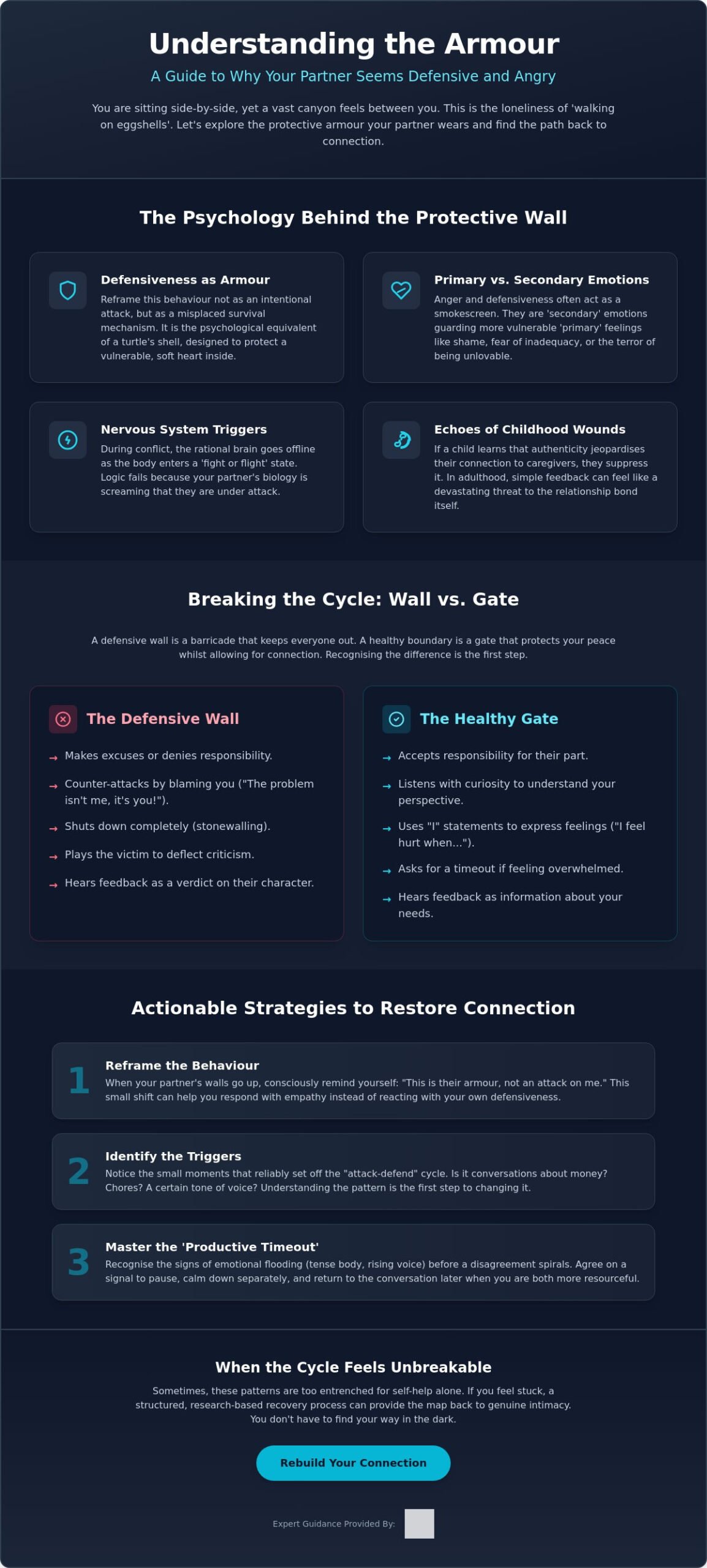
Recognising a defensive episode often starts with the body. You might notice your partner’s shoulders tensing, their voice rising in pitch, or perhaps a sudden, heavy silence known as stonewalling. During these moments, the rational part of the brain effectively goes offline as the nervous system enters a “fight or flight” state. This is why logic so often fails in the heat of the moment. You cannot reason with a person whose biology is screaming that they are under attack. Defensive communication triggers a cycle where both parties stop listening and start preparing their next counter-move. It is vital to distinguish this from healthy boundaries. A boundary is a gate that protects your peace whilst allowing for connection; a defensive wall is a barricade that keeps everyone out, including the person they love most.
When Communication Breaks Down Beneath the Surface
If you find yourself constantly thinking, “my partner is always defensive and angry“, you are likely stuck in what we call repetitive loops. These are those “favourite” arguments that seem to trigger over the smallest things, like the laundry or a missed phone call. In reality, what is being argued about is rarely the real issue. Beneath the surface, there are layers of unmet needs and historical wounds that haven’t been addressed. To understand this better, it helps to explore When Communication Breaks Down in Relationships, as these patterns are often echoes of deeper fears. When we stop fighting about the dishes and start talking about the fear of being overlooked, the armour can finally begin to thin.
The Psychology of Defensiveness: From Childhood Wounds to Nervous System Triggers
Gabor Maté often highlights the fundamental tension between our need for attachment and our need for authenticity. As children, if we sense that being our true selves might jeopardise our connection to our caregivers, we suppress our authenticity to stay safe. In adult relationships, this old survival strategy resurfaces with a vengeance. When you feel that my partner is always defensive and angry, you are often witnessing a person who perceives any feedback as a threat to the bond itself. Their “angry” response is a frantic attempt to protect a self they were once told was not good enough.
Shame plays a central role in this dynamic. For a partner with high shame sensitivity, a simple request for help is not heard as a logistical need. It is processed as a crushing verdict on their character. They don’t hear “could you help with the bins”; they hear “you are failing as a spouse.” This internal collapse triggers an immediate reflex to deflect and blame. According to research on The Four Horsemen: Defensiveness, this counter-attack is a way of saying, “The problem isn’t me, it’s you,” which effectively halts any chance of resolution.
The physical reality of this is what Dr John Gottman calls “Flooding.” When a conflict begins, your partner’s heart rate may quickly exceed 100 beats per minute, flooding the body with adrenaline and cortisol. At this threshold, the rational brain effectively shuts down, and the primitive brain takes over. If your partner has a history of relational trauma, such as past infidelity or emotional neglect, their nervous system is often set to a state of permanent hyper-vigilance. They are scanning for signs of rejection even when your intentions are pure. For those seeking to address these biological triggers, neurofeedback training with Neurobics can help individuals regulate their brain activity for improved emotional stability.
Trauma-Informed Perspectives on Anger
It is helpful to view “angry” behaviour as a frightened inner child in disguise. When your partner explodes or retreats, they are often reacting to a ghost from their past rather than your present words. Emotional neglect in childhood can create an adult who is hyper-aware of any sign of being dismissed or ignored. Realising that their reaction is usually about their own history helps you hold space for them without taking the blow personally.
The ‘Attack-Defend’ Dance
This dynamic often manifests as a pursuer-distancer dance. One partner pushes for connection whilst the other retreats behind a wall of defensiveness to feel safe. Even the most carefully worded “I” statements can feel like an attack to someone whose shame is already at capacity. If you recognise these patterns in your own home, professional relationship coaching can help you decode the language of the nervous system. We choose partners who challenge our specific emotional wounds. The exhaustion of thinking my partner is always defensive and angry begins to lift when we see the dance for what it is: a cry for safety and a longing to be seen.
Breaking the Cycle: Healthy vs. Defensive Communication
When we move from the biological “why” to the practical “how,” we begin to see that communication is a skill, not just a reflex. In a defensive cycle, responses usually fall into two categories: counter-attacking or playing the victim. Neither leads to connection. A healthy response, by contrast, involves taking responsibility for even a tiny fraction of the problem. As research from The Gottman Institute on defensiveness shows, the moment we stop defending our position and start listening to our partner’s experience, the walls begin to crumble. It’s a heavy burden to carry when you feel that my partner is always defensive and angry, but shifting your own response is often the first step in changing the entire dance.
Esther Perel often speaks about the delicate balance between our need for security and our need for autonomy. For many, defensiveness is a misguided attempt to reclaim that autonomy; it is a way of saying “you don’t control me” when they feel emotionally crowded. However, the paradox is that by “winning” an argument through superior logic or louder shouting, you actually lose the relationship. Total victory leaves your partner defeated, and you cannot have a thriving intimacy with a defeated person. This is where repair attempts become vital. These are small, often subtle gestures, like a silly face, a gentle touch, or a self-deprecating comment, that signal a desire to de-escalate. Couples who master these gestures can navigate even the most heated moments without causing lasting damage.
Shifting from Blame to Vulnerability
The most profound shift occurs when we learn to express a desire rather than a complaint. When you say, “You’re never here,” your partner’s nervous system hears an attack, and the armour goes up. If you instead say, “I feel lonely and I miss your company,” you are inviting them in. This transition requires significant self-awareness. Sometimes, the pattern is so deep that Individual Relationship Counselling is the best way to uncover the personal triggers that keep you stuck in these loops. Working on your own reactivity can transform the entire partnership.
The Role of Emotional Safety
You cannot logic someone out of a defensive state. If your partner is flooded, your brilliant arguments will only feel like more stones being thrown at their wall. Instead, focus on a “softened start-up.” This means raising an issue gently, without blame, and focusing on your own feelings. It’s about being consciously present amongst the chaos of conflict, holding the space for both of you to feel safe enough to be vulnerable. When you feel that my partner is always defensive and angry, the goal isn’t to change them, but to change the climate of the conversation so they no longer feel the need to fight for survival.
Actionable Strategies to Calm the Storm and Restore Connection
Moving from understanding the “why” to implementing the “how” is where the healing truly begins. When you are in the thick of a conflict, feeling as though my partner is always defensive and angry, you need a practical map to navigate the emotional minefield. It isn’t about winning the point; it’s about preserving the connection. By following these structured steps, you can begin to dismantle the armour and create a space where vulnerability can safely emerge.
- Recognise the ‘Flooding’: Learn to spot the physiological “point of no return.” If you notice dilated pupils, shallow breathing, or a rapid pulse, the rational brain has left the building.
- Implement a ‘Productive Timeout’: This is not an escape or a punishment. It is a 20-minute regulation period where both partners agree to step away to calm their nervous systems before returning to the conversation.
- The ‘Speaker-Listener’ Technique: Practice repeating back exactly what your partner said before you respond. Validation doesn’t mean you agree; it means you understand their reality.
- Take Responsibility for 2%: Even if you feel 98% right, find the 2% of the conflict that you own. Admitting your part in the dance instantly lowers your partner’s need to defend.
- Re-engage with Affection: Once the storm has passed, use a gentle touch or a sincere word of appreciation to signal that the relationship is safe again.
How to Talk to a Defensive Partner Without Triggering Them
The “sandwich” method is a powerful tool for delivering feedback without raising the walls. Start with a genuine appreciation, follow with your specific request, and end with a reassurance of your love. Timing is equally critical. You should never bring up deep relational issues whilst either of you is tired, hungry, or rushing out the door. Your body language speaks louder than your words. Keep your eye level equal, your arms uncrossed, and remember that a gentle hand on a shoulder can often do more than a thousand perfectly crafted sentences. If you find these patterns are too deep to shift alone, relationship counselling and coaching can provide the professional guidance needed to break the cycle.
Self-Regulation for the ‘Pursuer’
When the Cycle Feels Unbreakable: Rebuilding with Professional Support
Sometimes, the grooves of the “Attack-Defend” cycle are worn so deep that even the most sincere efforts to change feel like shouting into a storm. If you have applied the tools of softened start-ups and productive timeouts but still feel that my partner is always defensive and angry, it is not a sign of failure. Instead, it is an indication that the roots of the conflict are structural and require a different kind of intervention. Inviting a “Wise Guide” into your relationship provides a container of safety that is often impossible to create alone. A professional facilitator ensures that difficult conversations stay on track, preventing the nervous system from spiralling into that familiar state of fight or flight.
If you find yourself at a crossroads, wondering Can Your Relationship Be Saved?, know that the path back to intimacy often requires a map you haven’t yet seen. Research-based approaches, such as the 12-Week Relationship Recovery Process, offer a structured alternative to generic talk therapy. Rather than simply rehashing the week’s arguments, this process focuses on dismantling the defensive armour and rebuilding the foundation of trust from the ground up.
The 12-Week Relationship Recovery Journey
The transition from crisis management to deep connection is rarely a straight line. The 12-Week Relationship Recovery Process is designed to provide the predictable structure that a defensive partner needs to feel safe enough to open up. By moving through specific phases of regulation and discovery, couples can address the underlying trauma whilst learning new ways to relate. You can see the tangible results of this approach by reviewing our 12-Week Relationship Recovery Case Study, which illustrates how even the most entrenched patterns can be transformed through dedicated, guided work.
Choosing the Right Support for Your Future
It is helpful to understand the difference between coaching and counselling when choosing your path. Whilst counselling often explores the historical “why” of your behaviour, relationship coaching focuses on the “how” of your future, providing actionable strategies to change your daily interactions. For high-conflict couples, a “favourite” choice is often a practitioner trained in both Gottman and Perel methods. These experts understand that when my partner is always defensive and angry, the solution lies in balancing the need for individual autonomy with the need for relational security. Healing is entirely possible when both partners commit to the process; the armour can be laid down, and the heart can finally be heard.
Stepping Beyond the Armour into a Shared Future
Moving from a state of constant conflict to one of genuine connection requires more than just willpower; it requires a new way of seeing. You now understand that defensiveness is often a survival mechanism rooted in old wounds, and that breaking the cycle starts with creating emotional safety. By recognising physiological flooding and choosing vulnerability over blame, you begin to dismantle the walls that have kept you apart. Living in a home where my partner is always defensive and angry is a heavy burden, but it is not a life sentence for your relationship.
If the patterns feel too deep to navigate alone, you can reach out for expert guidance. As a specialist in the Gottman Method and Esther Perel’s systemic approach, I provide safe, non-judgemental online and face-to-face sessions designed to facilitate healing. You don’t have to stay stuck in the “Attack-Defend” dance forever. Book a Discovery Call with Tracy Kimberg to start your 12-Week Relationship Recovery journey today. This proven, transformational programme is built specifically for high-conflict couples ready to find their way back to one another. Your relationship can be a place of rest rather than a battlefield, and that journey starts with a single, courageous step.
Frequently Asked Questions
Is it normal for my partner to get defensive when I tell them how I feel?
Yes, defensiveness is a common, albeit destructive, response to perceived emotional threat. When you share deep feelings, your partner may hear it as a critique of their character rather than an invitation to connect. This reflex is often a survival mechanism from childhood, where being “wrong” felt unsafe. Whilst common, it indicates a lack of emotional safety that needs addressing to prevent long-term resentment.
Can a relationship survive if one partner is always angry and defensive?
Yes, relationships can survive and even thrive after these patterns are addressed, provided both partners are willing to look beneath the surface. When you feel that my partner is always defensive and angry, it signifies a system in distress rather than a lack of love. Success depends on moving from a “me versus you” mindset to a collaborative approach where you both work against the cycle itself.
Why does my partner turn everything back on me during an argument?
This behaviour, often called “cross-complaining,” is a psychological manoeuvre designed to shift the focus away from their own perceived failures. By highlighting your flaws, they temporarily escape the crushing weight of shame or inadequacy. This counter-attacking is a sign that they feel too vulnerable to sit with your feedback. It creates a frustrating loop where neither person feels heard or validated in the moment.
How do I stop being defensive when my partner criticises me?
You can stop your own defensive reflex by pausing to find even a small part of their complaint that you can agree with. This doesn’t mean accepting a total character assassination; it means acknowledging your role in the specific situation. Practice deep breathing to stay in your body when you feel the urge to lash out. Taking responsibility for your part instantly lowers the emotional temperature for you both.
What is the difference between defensiveness and stonewalling?
Defensiveness involves actively protecting oneself through excuses or blaming, whereas stonewalling is the act of shutting down and disengaging entirely. Think of defensiveness as a shield and stonewalling as a wall. Both are reactions to physiological flooding. Whilst defensiveness tries to win the fight, stonewalling tries to end the interaction by becoming a “stone wall” that no information or emotion can penetrate.
How can I tell if my partner’s anger is ‘abusive’ or just ‘defensive’?
The key difference lies in the intent and the impact on your sense of safety and autonomy. Defensive anger is typically a reactive attempt to protect the self, whilst abusive anger is a proactive tool used to exert power and control. If you feel afraid to express yourself, or if their outbursts are followed by isolation or threats, it may cross the line into abuse and requires professional intervention.
Does ‘I’ statement communication actually work for defensive people?
They work, but only if they are genuine expressions of vulnerability rather than “you” statements in disguise. Saying “I feel lonely” is far more likely to elicit empathy than “I feel like you are always ignoring me.” For a partner who is hyper-vigilant, even a slight edge of blame can trigger the armour. When done correctly, they provide the safety your partner needs to stop fighting.
What should I do if my partner refuses to go to couples therapy?
If your partner isn’t ready for joint sessions, starting your own therapeutic journey can still shift the relationship dynamic. When one person changes their steps in the “dance,” the other person is forced to move differently too. Focusing on your own regulation and communication can often lower the threat level enough that your partner eventually feels safe enough to join the process and work toward a collaborative solution.

Article by
Tracy Kimberg
Tracy Kimberg is a Relationship Expert, Couples Therapist and Coach with a dedicated focus on helping couples and individuals rebuild connection, trust and emotional safety in their relationships. Drawing on the research of John and Julie Gottman, the relational insights of Esther Perel, and years of hands-on therapeutic experience, Tracy offers a warm, non-judgemental and deeply compassionate approach to modern relationships.
Based in Dorset, Tracy works with couples navigating communication breakdowns, betrayal, intimacy challenges, separation, family dynamics and life transitions. Known for creating a safe and grounded therapeutic space, she combines practical tools with emotional depth to help clients move beyond survival patterns and towards meaningful, lasting change.
With a reputation for empathy, professionalism and dedication to her clients’ growth, Tracy is passionate about helping people feel seen, understood and empowered — both within their relationships and within themselves.
Disclaimer
Disclaimer:
The information shared in this article is intended for educational and informational purposes only and should not be considered a substitute for professional therapeutic, psychological, medical or legal advice. Every individual and relationship is unique, and the perspectives offered are based on general therapeutic principles, research and professional experience.
Reading this article does not establish a therapist-client relationship with Tracy Kimberg. If you are experiencing significant emotional distress, relationship crisis, trauma, or mental health concerns, it is important to seek support from a qualified professional appropriate to your individual circumstances.
All content remains the intellectual property of Tracy Kimberg and may not be reproduced or distributed without permission.