

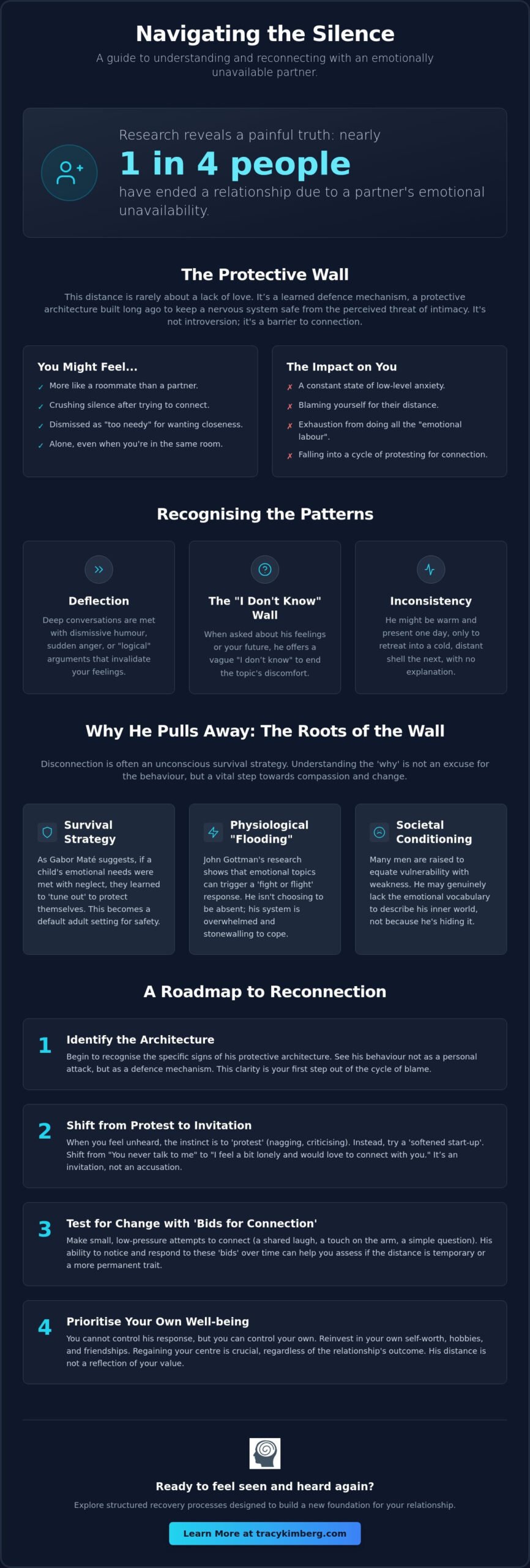
In 2026, research found that nearly one in four people ended a relationship due to emotional unavailability, yet this distance is rarely about a lack of affection. It is often a learned defence mechanism, a protective architecture built to keep a nervous system safe from the perceived danger of intimacy. If you are struggling with how to deal with an emotionally unavailable husband, you likely know the pain of being told you are “too needy” simply for wanting to be known. You might feel more like a roommate than a partner, living in the crushing silence that follows every attempt at a deeper conversation.
We understand how isolating this feels, and we want you to know that you aren’t alone in this experience. This guide will help you navigate the loneliness of an emotional disconnect by offering research-based strategies to invite your partner back into a space of vulnerability. You will learn to identify whether this distance is a temporary phase or a permanent trait, whilst discovering how to regain your own sense of self-worth regardless of his response. We will explore the protest-withdrawal cycle and provide a roadmap to help you feel seen and heard once again.
Key Takeaways
- Identify the specific signs of emotional unavailability to understand the protective architecture behind your husband’s behaviour.
- Explore how attachment theory and early-life stress create defensive barriers that hinder intimacy in adult partnerships.
- Learn how to use the “Bid for Connection” test to determine if the current distance is a temporary phase or a deeper characterological trait.
- Discover how to deal with an emotionally unavailable husband by shifting from protest to invitation using a “softened start-up” technique.
- Understand why structured recovery processes are often more effective than traditional talk therapy for reconnecting with an avoidant partner.
What Does Emotional Unavailability Look Like in a Marriage?
In our work with couples, we often hear about a specific kind of ache. It’s the sensation of being “lonely in a crowd,” or more accurately, lonely in your own living room. You are physically present with your partner, yet you feel worlds apart. This isn’t just about a husband who prefers a quiet evening or someone who is currently stressed by work. True emotional unavailability is a persistent difficulty in expressing or receiving emotional intimacy. It is a wall that remains standing even when the external storms have passed.
When you are trying to figure out how to deal with an emotionally unavailable husband, it helps to recognise that this is often a form of Emotional Detachment. This isn’t a personality trait like introversion; it’s a relational barrier. An introvert might need solitude to recharge, but they can still share their heart with you. An emotionally unavailable partner, however, avoids the very vulnerability that intimacy requires. This leaves you carrying the heavy weight of “emotional labour,” the exhausting task of trying to bridge the gap alone. It’s draining to be the only one checking the pulse of the relationship.
The Red Flags of Emotional Disconnect
Identifying the patterns is the first step toward clarity. You might notice your husband uses specific tactics to keep you at arm’s length. These aren’t necessarily malicious, but they are effective at stopping connection:
- Deflection: Deep conversations are often met with humour that feels dismissive, sudden anger, or “logical” arguments that shut down your feelings.
- The “I Don’t Know” Wall: When you ask about his feelings or your future together, he offers a vague “I don’t know” to end the discomfort of the topic.
- Inconsistency: He might be warm and present on Monday, but by Tuesday, he has retreated into a cold, distant shell without explanation.
The Impact on Your Mental Well-being
Living with this chronic disconnect can lead to what we call relational trauma. It creates a constant state of low-level anxiety. You might start internalising his distance, believing that if you were just “better,” “prettier,” or “less needy,” he would finally open up. This is a painful trap. When you feel unheard, you may begin “protesting” for connection. This often looks like nagging, picking fights, or withdrawing yourself in an attempt to make him notice your absence. Understanding how to deal with an emotionally unavailable husband starts with recognising these cycles and realising his distance is not a reflection of your worth.
If you find that this relational strain is taking a toll on your well-being, you can read more about Women’s Mental Health Specialist and their integrative approach to medication therapy and coaching for women.
Why He Pulls Away: The Roots of Emotional Unavailability
Understanding the “why” behind the wall is essential. When you are learning how to deal with an emotionally unavailable husband, it’s easy to assume the distance is a deliberate choice. However, relationship experts like Gabor Maté suggest that disconnection is often a survival strategy. It’s a coping mechanism developed during early-life stress. If a child’s emotional needs were met with neglect or overwhelm, they learned to “tune out” to protect their nervous system. This habit doesn’t simply vanish in adulthood. Instead, it becomes a default setting for safety.
John Gottman’s research highlights a similar physiological reality called “stonewalling.” When a conversation becomes emotionally charged, an avoidant partner often experiences flooding. Their heart rate spikes, and their brain enters a “fight or flight” mode. They don’t shut down to be cruel; they shut down because their system is overwhelmed. The presence of emotional distance in a relationship is frequently a sign of a husband who lacks the tools to regulate these intense internal states. He is not choosing to be absent; he is biologically unable to remain present.
Societal conditioning also plays a significant role. Many men are raised in cultures that equate vulnerability with weakness. They are taught to prioritise logic over feeling, which leaves them without the necessary vocabulary to describe their inner lives. When you ask him what he’s feeling, he isn’t necessarily hiding the answer. He truly might not have the words to find it. This lack of emotional literacy creates a barrier that can feel impossible to climb without professional guidance.
Avoidant Attachment and the Fear of Vulnerability
For someone with an avoidant attachment style, intimacy can feel like a threat to their autonomy. They perceive closeness as a loss of self or a form of entrapment. This creates the “pursuit-withdrawal” trap. The more you reach out for connection, the more he feels crowded and retreats. It’s a painful cycle that keeps you both stuck. Recognising that his silence is a nervous system shutdown rather than a lack of love is a vital shift in perspective. If you feel trapped in this cycle, exploring Relationship Counselling and Coaching can provide a neutral space to bridge this gap.
The Shadow of Past Trauma
Relational wounds from the past often manifest as “emotional armour.” This isn’t just about childhood; it could be the result of a previous partner who was volatile or dismissive. These experiences reinforce the compulsion to stay safe by staying distant. Beneath the refusal to engage, there is often a deep-seated shame. He may feel he is “failing” at being a husband, and withdrawing is his only way to avoid the pain of that perceived failure. Understanding how to deal with an emotionally unavailable husband requires looking past the silence to the fear that fuels it.
Assessing the Marriage: Can This Dynamic Change?
Once you understand the roots of the silence, the next question is inevitably: can this change? When considering how to deal with an emotionally unavailable husband, it is vital to distinguish between situational and characterological distance. Situational unavailability is often tied to external factors, such as a period of intense grief, a career crisis, or even the exhaustion of early parenthood. These are seasons. Characterological unavailability, however, is a more fixed pattern of being. It is the difference between a husband who is currently “lost” and one who has built his entire identity around being “unfindable.”
A powerful way to assess the potential for change is John Gottman’s “Bid for Connection” test. In every relationship, we make small, daily attempts at intimacy. This might be a touch on the shoulder, a shared joke, or a simple request for attention. Does he turn toward you, even in a small way? Or does he consistently turn away or ignore the bid entirely? If there is still a sense of “The We-ness,” a feeling that you are both on the same team despite the quiet, there is a foundation to build upon. However, if the silence is accompanied by the “Four Horsemen”—criticism, contempt, defensiveness, and stonewalling—the dynamic may be reaching a critical point of erosion.
Signs of Hope and Willingness
Hope often lies in the gap between “I can’t” and “I won’t.” A husband who says, “I know I’m distant and I don’t know how to change it,” is offering a small window of vulnerability. He is acknowledging the reality of the gap. These small moments are the seeds of reconnection. Understanding When Communication Breaks Down can help you see what is really happening beneath the surface during these fragile exchanges. If he is willing to admit the struggle, the door to healing remains open.
When the Distance Becomes Toxic
There is a threshold where emotional unavailability shifts from a defence mechanism into something more damaging. If your attempts to discuss the distance are met with gaslighting—being told you are “crazy” or “imagining things”—the neglect has become toxic. In these instances, unavailability is used as a tool for control or manipulation rather than a shield for a fragile ego. Recognising this boundary is essential for your own mental health. There comes a point where “trying harder” is no longer an act of love, but an act of self-destruction that sacrifices your own sense of reality.
How to Deal with an Emotionally Unavailable Husband: Actionable Steps
When you are trapped in the pursuit-withdrawal cycle, your natural instinct is often to “protest” for the connection you lack. This might look like criticism, nagging, or escalating anger. However, for a husband whose nervous system is already primed for defence, this protest feels like an attack. To learn how to deal with an emotionally unavailable husband, you must shift from protest to invitation. An invitation is a low-pressure request that focuses on your own needs rather than his perceived failings. It opens a door without demanding he walk through it immediately.
A key tool in this process is the “softened start-up.” Most marital arguments are decided in the first three minutes. If you begin with an accusation, he will likely shut down. Instead, try starting with “I feel” followed by a specific situation. For example, “I felt a bit disconnected during dinner, and I’d really value just fifteen minutes of quiet time together.” This approach avoids triggering his shame. Another effective strategy is the “side-by-side” approach. Avoidant partners often find face-to-face “talks” feel like interrogations. Try connecting whilst walking the dog, driving, or cooking. Removing the intense eye contact can lower his physiological arousal, making vulnerability feel safer.
Changing the Communication Dance
We often forget that we are half of the relationship’s “dance.” If you change your steps, he must eventually change his to keep up. This involves masterfully managing your own self-regulation. When he withdraws, your anxiety might spike, causing you to chase him. If you can remain calm and grounded whilst he is distant, you remove the “threat” he is running from. If you notice he is becoming “flooded”—indicated by a blank stare or rising tension—call a productive time-out. Agree to revisit the topic in twenty minutes when your nervous systems have settled. This creates an “Emotional Safety Zone” where vulnerability is eventually rewarded rather than punished.
Reclaiming Your Own Emotional Life
One of the most powerful things you can do is “detach with love.” This doesn’t mean giving up; it means finding joy and purpose outside of his immediate emotional response. When you build a robust support network of friends and hobbies, he is no longer your only source of emotional nourishment. This reduces the pressure on him and restores your own sense of self-worth. If you find yourself struggling to break these patterns alone, Individual Relationship Counselling can be a transformative way to work on your own growth whilst your partnership evolves. If you are ready to move from a place of loneliness to active healing, consider starting our 12-Week Relationship Recovery Process to begin your journey together.
Beyond the Silence: Professional Paths to Reconnection
Traditional talk therapy can sometimes feel like a courtroom to an avoidant partner. If the process feels like a weekly session of highlighting his failures, he will likely shut down even further. This is why many couples find that a structured, goal-oriented approach is far more effective when figuring out how to deal with an emotionally unavailable husband. By moving away from circular complaining and toward active restructuring, we create a roadmap that feels manageable rather than overwhelming for a fragile nervous system.
Sometimes, the path forward involves a conscious approach to transformation, and other times, it may lead to a Conscious Approached Divorce and separation. The ultimate goal is clarity. Whether the partnership stays together or chooses a different path, the professional process ensures that decisions are made with awareness rather than through the fog of resentment. Our 12-Week Relationship Recovery Process is designed to act as a safe container for this work, providing the expert guidance needed to navigate complex emotional landscapes whilst ensuring both partners feel supported.
The 12-Week Relationship Recovery Process
This programme is a structured journey that bridges the gap between disconnect and deep intimacy. We apply research-based methods from experts like Gottman and Perel to address the specific blocks in your marriage. It isn’t about “fixing” one person; it’s about healing the space between you. You can see the real-world impact of this work in our 12-Week Relationship Recovery Case Study, which illustrates how even the most distant partnerships can find their way back to vulnerability through guided, intentional steps.
Taking the First Step Together (or Alone)
Inviting an avoidant husband into coaching requires a gentle hand. Frame it as a proactive adventure for the relationship’s health rather than a punishment for his behaviour. A low-pressure “Relationship Check-up” can serve as an excellent starting point, allowing both of you to assess the dynamic without the immediate weight of a “fix-it” mission. This allows him to engage without feeling like he is the problem that needs solving.
If he isn’t ready to join you yet, remember that you can begin this work through individual Therapy for Adults. When one person changes their steps, the entire dance is eventually forced to evolve. You deserve a relationship where you are truly seen, heard, and valued amongst the noise of daily life. Healing is a possible and powerful outcome, and you don’t have to navigate this silence alone. We are here to guide you toward a more connected future.
Choosing Connection Over Silence
The journey from emotional distance to deep intimacy requires both patience and a significant shift in perspective. We have explored how understanding your husband’s protective architecture and mastering the softened start-up can begin to dissolve the walls between you. Learning how to deal with an emotionally unavailable husband is ultimately about creating a safe environment where vulnerability is no longer perceived as a threat. It’s about moving from a place of lonely protest to one of gentle invitation.
As a specialist in Gottman and Perel methodologies, I provide a safe, non-judgemental environment for transformational healing. My structured programmes are specifically designed to address deep relational breakdowns, moving you away from the roommate dynamic and back toward a true partnership. You deserve a marriage where your emotional needs are met with warmth, curiosity, and presence. You don’t have to navigate this crushing silence on your own.
Ready to break the cycle of silence? Explore the 12-Week Relationship Recovery Process and take the first step toward a proactive and positive adventure in your relationship. Reconnection is possible, and healing is well within your reach.
Frequently Asked Questions
Can an emotionally unavailable husband ever truly change his behaviour?
Yes, change is entirely possible when a husband acknowledges the distance and commits to a structured recovery process. It requires a shift from viewing vulnerability as a threat to seeing it as a bridge to safety. Whilst the defensive architecture of an avoidant partner is deeply ingrained, research-based strategies can help him rewire his nervous system to tolerate and eventually welcome intimacy.
How do I know if he is emotionally unavailable or just depressed?
Depression typically involves a noticeable shift in baseline mood, including lethargy, sleep disturbances, and a loss of interest in previously enjoyed activities. Emotional unavailability is usually a persistent, long-standing pattern of relating to others. Whilst depression is a clinical mental health condition, unavailability is often a defensive coping mechanism developed to manage the perceived “danger” of emotional closeness.
Is it possible to be happy in a marriage with an emotionally distant partner?
Sustaining long-term happiness is incredibly challenging if your fundamental need for emotional reciprocity is consistently ignored. You can certainly find individual fulfilment by “detaching with love” and focusing on your own growth. However, a marriage without a shared emotional life often results in a profound sense of isolation that most people find difficult to tolerate over many years.
Why does he get angry when I try to talk about our relationship?
Anger is frequently a secondary emotion used to shield a husband from the primary pain of shame or inadequacy. When you attempt to discuss the relationship, his system may interpret the conversation as a critique of his performance. This triggers a “fight” response designed to shut down the topic and protect him from the discomfort of feeling like he is failing you.
Should I stop trying to connect with him to see if he chases me?
Withdrawing as a tactic rarely works with an avoidant partner because he may simply feel relieved that the pressure for connection has vanished. A more effective approach for how to deal with an emotionally unavailable husband is to remain grounded in your own life whilst offering low-pressure invitations. This demonstrates that connection is a safe, positive choice rather than an exhausting demand.
What is the difference between emotional unavailability and narcissism?
Emotional unavailability is generally a fear-based defence mechanism rooted in past relational wounds or attachment styles. Narcissism, however, involves a pervasive lack of empathy and a constant need for external validation or admiration. An unavailable husband often feels “too much” and shuts down to cope, whereas a narcissist may struggle to truly value your internal world at all.
How can I tell the kids about why Dad is so quiet or distant?
Provide a neutral, age-appropriate explanation that focuses on his current capacity rather than blaming his personality. You might explain that “Dad is someone who processes his feelings internally and needs more quiet time than others.” The most important thing is to reassure your children that his distance is not a reflection of their worth or his love for them.
How long should I wait for him to open up before considering separation?
The timeline for waiting often depends on his willingness to acknowledge the disconnect and engage with professional support. If he consistently denies the problem or refuses to participate in a structured recovery process, your own mental health must become the priority. There is a point where “trying harder” becomes self-destructive if the desire for change remains entirely one-sided.

Article by
Tracy Kimberg
Tracy Kimberg is a Relationship Expert, Couples Therapist and Coach with a dedicated focus on helping couples and individuals rebuild connection, trust and emotional safety in their relationships. Drawing on the research of John and Julie Gottman, the relational insights of Esther Perel, and years of hands-on therapeutic experience, Tracy offers a warm, non-judgemental and deeply compassionate approach to modern relationships.
Based in Dorset, Tracy works with couples navigating communication breakdowns, betrayal, intimacy challenges, separation, family dynamics and life transitions. Known for creating a safe and grounded therapeutic space, she combines practical tools with emotional depth to help clients move beyond survival patterns and towards meaningful, lasting change.
With a reputation for empathy, professionalism and dedication to her clients’ growth, Tracy is passionate about helping people feel seen, understood and empowered — both within their relationships and within themselves.
Disclaimer
Disclaimer:
The information shared in this article is intended for educational and informational purposes only and should not be considered a substitute for professional therapeutic, psychological, medical or legal advice. Every individual and relationship is unique, and the perspectives offered are based on general therapeutic principles, research and professional experience.
Reading this article does not establish a therapist-client relationship with Tracy Kimberg. If you are experiencing significant emotional distress, relationship crisis, trauma, or mental health concerns, it is important to seek support from a qualified professional appropriate to your individual circumstances.
All content remains the intellectual property of Tracy Kimberg and may not be reproduced or distributed without permission.