

What if the heavy silence in your home isn’t a sign that your love has vanished, but a signal that your relationship has entered a protective state of hibernation? You aren’t alone in this experience; research indicates that approximately 30% of married couples report experiencing an emotional disconnect at some point. If your internal monologue is dominated by the thought, “I’m feeling disconnected from my wife,” you are likely navigating a space where physical proximity only highlights the lack of intimacy. It’s a painful, quiet loneliness that can make you feel like a ghost in your own home, fearing you’ve reached a point of no return.
It’s exhausting to maintain a functional partnership that lacks the warmth of a true, soulful bond. You deserve to understand the “why” behind the silence whilst seeking a way to feel seen and valued by your partner again. This guide will help you discover the psychological roots of emotional distance and provide research-based strategies to transform your marriage back into a deeply connected union. We will explore the intricacies of interpersonal dynamics and offer a clear, low-pressure roadmap for reconnection that honours your shared history and your future together.
Key Takeaways
- Reframe the “Roommate Phase” not as a final ending, but as a protective hibernation that requires intentional movement and psychological insight to overcome.
- Learn why feeling disconnected from my wife is often a biological response to modern stress and how to identify the “Slow Drift” before it becomes permanent.
- Discover why a total lack of arguments can be more concerning than active conflict and how to revitalise the emotional pulse of your partnership.
- Master research-based techniques, such as recognising subtle bids for connection, to bridge the gap between functional logistics and true intimacy.
- Explore how a structured relationship recovery process or professional coaching can provide the neutral expertise needed to navigate your way back to each other.
The Quiet Distance: Understanding Why You Are Feeling Disconnected from Your Wife
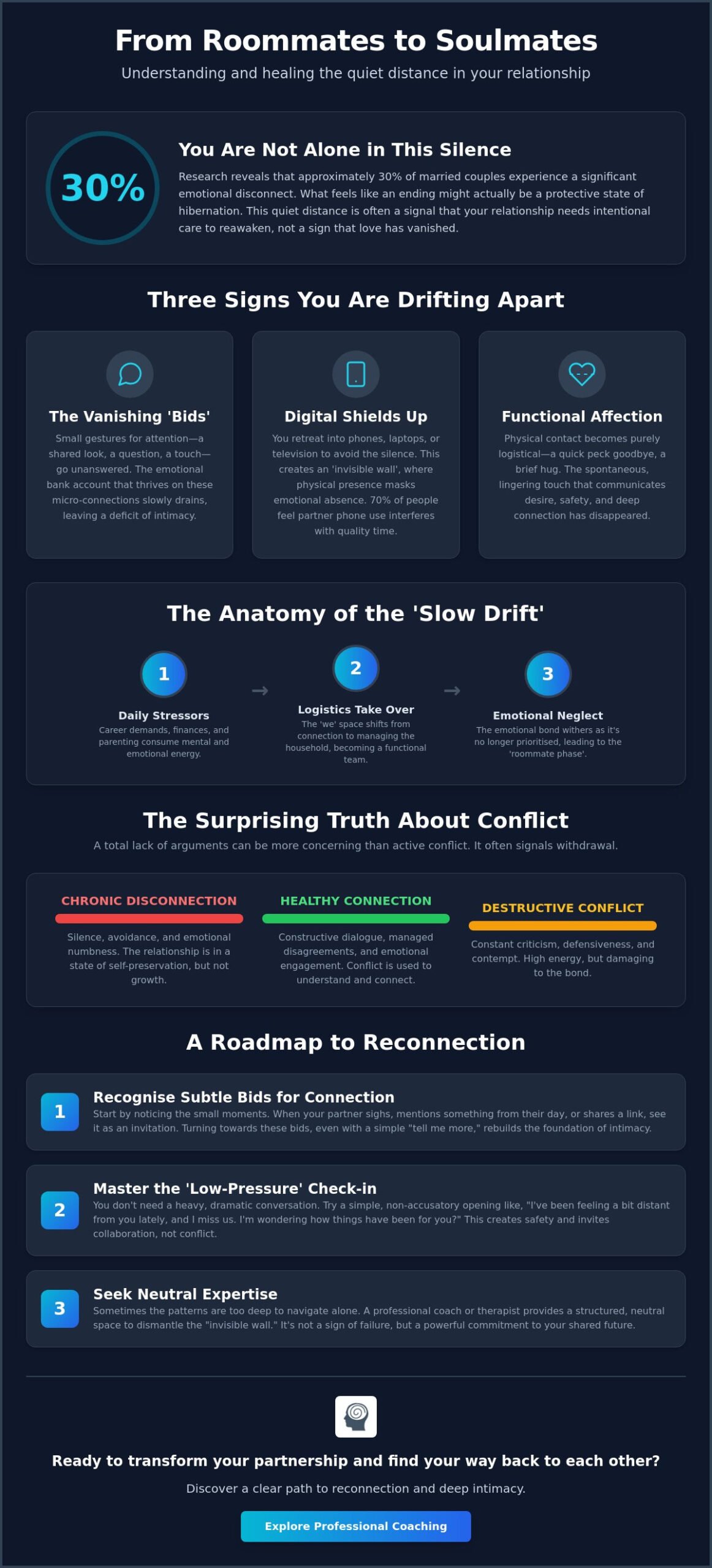
The “Roommate Phase” is a term often used to describe a marriage that has shifted from a vibrant, shared experience into a series of logistical negotiations. You become a highly efficient team, managing the mortgage, the school runs, and the social calendar, yet the spark of genuine emotional intimacy has flickered out. This functional partnership keeps the household running, but it leaves the emotional centre of the home feeling hollow. It’s a state where you are sharing a bed whilst feeling miles apart.
There is a vital distinction between a temporary “rough patch” and chronic emotional withdrawal. A rough patch is typically reactive; it’s a response to a specific stressor like a new job or a family illness. Chronic withdrawal, however, is a slow cooling of the relational atmosphere. When you find yourself feeling disconnected from my wife over a period of months or years, it often stems from an unexamined “relational contract”. These are the unspoken expectations and rules you both brought into the marriage. When these expectations go unmet, they transform into quiet resentment, creating a barrier that feels impossible to scale.
Feeling alone whilst in the presence of your partner is often more painful than actual solitude. In physical isolation, the absence of connection is expected. In a marriage, the presence of your wife acts as a constant reminder of what is missing. It’s a form of sensory deprivation that can make you feel like a ghost in your own living room, invisible to the person who once saw you most clearly.
Signs You Are Drifting Apart
- The loss of “bids for connection”: In healthy relationships, partners make small gestures for attention, a look, a touch, or a shared comment. When these go unnoticed or ignored, the “emotional bank account” begins to drain.
- Digital shields: You might find yourselves retreating into your phones or the television as soon as the children are in bed. Research suggests that 70% of individuals report that their partner’s phone usage interferes with their quality time together.
- Functional affection: Physical contact becomes limited to a quick peck on the cheek or a brief hug when leaving the house. The spontaneous, lingering touch that signals desire and safety has vanished.
The Emotional Impact of Disconnection
Chronic disconnection isn’t just a social problem; it’s a biological crisis. Attachment theory suggests that our nervous systems are wired to seek safety in our primary bond. When that bond feels threatened by distance, the brain triggers a survival response. This often creates the “Invisible Wall” phenomenon. You may desperately want to reach out, but the fear of rejection or further conflict makes you feel paralysed.
For many men, this disconnection triggers a deep sense of inadequacy. If you feel you are failing at the relationship, the natural instinct is often to withdraw even further to protect yourself from the pain of that failure. This creates a self-fulfilling prophecy where your silence is interpreted as apathy, whilst in reality, it is a form of emotional self-preservation. Understanding this “why” is the first step toward dismantling the wall and finding your way back to one another.
The Anatomy of the Drift: Why Emotional Intimacy Fades
Disconnection is rarely a sudden event. It’s a gradual erosion. Daily stressors like the mortgage, career demands, and the relentless pace of modern life begin to consume the “we” space. You might find yourself feeling disconnected from my wife because the logistics of life have simply taken over. This “Slow Drift” happens when the focus shifts from the relationship to the requirements of survival, leaving the emotional bond to wither from neglect.
Esther Perel highlights the profound paradox of intimacy: we crave the security of a partner who knows us, yet we need mystery to fuel desire. When life becomes too certain and predictable, the spark often fades. Gabor Maté adds another layer of insight, suggesting that our ability to stay present is often hampered by past traumas. If your wife seems distant, she may be unconsciously protecting herself from emotional pain rooted in her own history. There are many complex reasons for emotional distance, including the pursuer-distancer dynamic where one partner’s attempt to reach out feels like pressure to the other, causing them to retreat further.
The Functional Partnership Trap
Many couples fall into the trap of becoming “Co-CEOs” of their household. You manage the children and the bills with clinical efficiency, but you’ve stopped being partners in the romantic sense. This prioritising of domestic stability often comes at the expense of interpersonal closeness. When you are in “Parenting-Only” mode, the couple identity is sacrificed for the sake of the family unit, leaving both of you feeling starved of genuine affection and recognition.
Unresolved Conflict and the “Stone Wall”
Sweeping disagreements under the rug creates a mountain of resentment that eventually blocks your view of each other. The psychological cost of avoiding difficult conversations is a steady loss of trust and a rise in defensive behaviours. Over time, this leads to the “Stone Wall” effect. Stonewalling is a protective mechanism used to manage emotional overwhelm rather than an intentional act of malice. It is a biological signal that the relational environment has become too taxing for the nervous system to handle.
Understanding these underlying patterns is a powerful first step toward healing. If you’re ready to move beyond the drift and rediscover your connection, a 12-week relationship recovery process can help you rebuild the bridge between you and your partner.
Moving Beyond the Roommate Phase: Conflict vs. Disconnection
Many couples take pride in the fact that they never fight. They view the absence of raised voices as a hallmark of a stable, successful marriage. However, within the therapeutic space, we often find that a lack of conflict is a more dangerous sign than active disagreement. When you are feeling disconnected from my wife, a quiet house can be a symptom of a “Flatline” relationship. This occurs when the passion for even arguing has disappeared, replaced by a weary, heavy indifference. Conflict, whilst uncomfortable, is often a “bid for change”. It signals that both partners still have enough emotional investment to want things to be different.
The question of whether can your relationship be saved often depends less on the absence of problems and more on your mutual willingness to engage with them. If you have stopped fighting because you have stopped caring, the path back to connection requires a conscious effort to break the stillness. It involves moving from a state of passive coexistence into one of active, albeit sometimes messy, engagement.
The Silence of Resentment
“Polite distance” is a common mask for deep-seated hurts and unmet needs. You might find yourselves speaking in neutral, safe tones about the weather or the children whilst avoiding the emotional elephant in the room. This avoidance often leads to the “Kitchen Sinking” effect. Because issues aren’t addressed as they arise, a single minor disagreement about the grocery list can suddenly spiral into a list of every grievance from the last five years. To move forward, you must learn to distinguish between destructive criticism, which attacks your partner’s character, and productive conflict, which addresses specific behaviours and seeks a collaborative solution.
Breaking the Cycle of Withdrawal
Reconnecting requires you to identify the specific “trigger-response” loop that defines your interactions. Perhaps your wife’s silence triggers your own withdrawal, which in turn makes her feel more isolated and less likely to speak. Breaking this cycle often starts with a “softened start-up”. This is a technique where you initiate a conversation without blame or accusation, focusing instead on your own feelings and needs.
Remember that when communication breaks down, the primary goal isn’t to solve a list of problems immediately. It is to break the silence. The first step is to simply acknowledge the distance you feel. This small act of vulnerability creates the safety needed for both of you to step out of your defensive shells and begin the work of rebuilding your shared world.
Practical Steps to Rebuild the Bridge Between You
If you have spent months feeling disconnected from my wife, the prospect of rebuilding may feel like a mountain too steep to climb. However, connection is rarely restored through one grand, sweeping gesture. Instead, it is rebuilt through a series of small, intentional “turnings”. John Gottman’s research emphasises the power of “bids for connection”. These are the tiny requests for attention, such as a shared glance or a comment about a book, that we often miss when we are distracted. Recognising these moments and choosing to turn towards your wife, rather than away, is the foundational work of repair.
One of the most effective tools for dismantling the “invisible wall” is the 20-Minute Stress-Reducing Conversation. The goal here is simple: share your day’s frustrations whilst the other person listens without offering any solutions. For many men, the instinct is to “fix” the problem, but this often inadvertently shuts down the emotional flow. By simply providing a sanctuary for your partner’s feelings, you signal that you are on the same team against the outside world. This practice, combined with “Rituals of Connection”—like a shared morning coffee or a specific way of saying goodbye—creates a predictable rhythm of safety in the marriage.
Small Gestures with Big Impact
Physical touch is a powerful language that can bypass the analytical brain and speak directly to the nervous system. The “6-Second Kiss” is a simple yet profound ritual; it is long enough to trigger the release of oxytocin and signal to your body that you are safe with your partner. Beyond touch, move from generic politeness to specific gratitude. Rather than a simple “thanks”, try saying, “I really appreciated how you handled that difficult situation today.” This shows you are actively observing her world, not just existing alongside it. Active listening involves hearing the subtext of her words, noticing the emotion behind the logistics, and validating that experience without judgement.
If you are looking for more tailored advice on physical intimacy and building your confidence, you can learn more about Digital Course and Coaching Fees to explore how these programmes can support your relationship goals.
Regaining Autonomy and Desire
Paradoxically, rebuilding intimacy often requires a degree of distance. Esther Perel speaks of “The Space Between”, noting that desire requires a certain amount of mystery and autonomy. When you lose yourself entirely in the household roles, you cease to be the vibrant individual your wife first fell in love with. Re-engaging with your own passions and friendships isn’t an act of withdrawal; it’s an act of replenishment.
When you focus on your own emotional health, you change the relational energy you bring into your home. It is often the case that individual growth transforms your partnership by making you more present and less reactive. If you’re ready to take a proactive step toward healing, Relationship Counselling and Coaching for Couples can provide the expert guidance needed to navigate this transition and find your way back to a deeply connected union.
How Professional Coaching Can Transform Your Partnership
Sometimes, despite your best efforts to “turn towards” or implement new rituals, the weight of the past feels too heavy to lift alone. If you’ve been feeling disconnected from my wife for a significant period, you might find that your attempts at repair inadvertently trigger old wounds or lead back to the same tired arguments. This is where the neutral, expert perspective of a professional becomes invaluable. Unlike traditional therapy, which can sometimes feel like an endless exploration of historical pain, relationship coaching is fundamentally goal-oriented. It focuses on the “how” of moving forward, providing a structured environment where both partners can feel safe enough to lower their guards and speak their truth.
When evaluating the different approaches to rebuilding your bond, you can explore Professional Consulting and Program Enrollment Fees options to see how a professional framework can be tailored to your specific circumstances and emotional needs.
A structured approach is essential because it reduces the overwhelming sense that you have to fix every aspect of your marriage at once. By breaking the recovery down into manageable phases, you can focus on one layer of the relationship at a time. The 12-Week Relationship Recovery process serves as a roadmap for sustainable change, moving you from a state of mere survival back into a thriving, shared life.
The 12-Week Recovery Framework
The journey back to connection is organised into three distinct stages to ensure lasting healing. First, we focus on stabilising the crisis. This involves stopping the “bleed” of daily disconnection and establishing a baseline of emotional safety. Once the immediate tension has eased, we move into a deep dive. Here, we examine the systemic patterns and “shadows”, the unspoken fears and past influences that have driven the drift between you. Finally, we work together to build a new Relational Contract. This isn’t about returning to how things were before; it’s about creating a more resilient, honest, and intimate partnership for the future.
Why a “Compassionate Expert” Matters
In the heat of disconnection, it’s easy for every conversation to feel like a battleground where one person must win and the other must lose. A Compassionate Expert acts as a neutral “centre”, ensuring that both voices are heard and validated without judgement. By utilising research-based methods from leaders like Gottman and Perel, we move beyond generic advice into specific, proven strategies for relational health.
Taking the first step to book a session isn’t an admission of defeat. It’s a profound act of hope. It signals that your marriage is worth the investment and that you believe in the possibility of a future where you’re no longer feeling disconnected from my wife, but deeply, truly seen by her once again. This is the beginning of a proactive adventure back to the heart of your partnership.
Choosing a Future of Connection
Rebuilding a marriage isn’t about grand gestures; it’s about the small, daily choices to turn towards each other. You have learned that the “Roommate Phase” is often a protective hibernation rather than a final ending, and that even conflict can be a vital bid for change. By moving beyond the functional logistics of your household and understanding the psychological roots of your drift, you can begin to restore the mystery and desire that once defined your union.
If you’re tired of feeling disconnected from my wife and want a clear, research-based roadmap for healing, you don’t have to navigate this landscape alone. We provide a safe, non-judgemental environment where both partners are supported through every stage of the repair process. Begin your journey back to each other with the 12-Week Relationship Recovery Process. This structured transformational programme utilises the proven methods of Gottman and Perel to help you stop the emotional drift and build a resilient new relational contract. Your partnership has a remarkable capacity for healing, and the adventure of rediscovering one another starts with this single, hopeful step.
Frequently Asked Questions
Is it normal to feel disconnected from my wife after having children?
It is entirely normal to experience this shift, as the demands of childcare often consume the emotional energy previously reserved for the partnership. When you are both in survival mode, the “we” space is frequently sacrificed for the “parent” space. Recognising this as a common life transition rather than a personal failure can help you move toward a solution without the heavy weight of guilt or blame.
How long does it take to reconnect after years of emotional distance?
Rebuilding a bond after years of distance typically requires a sustained period of intentionality, often showing significant progress within three to six months. Whilst there is no set timeline, using a structured framework helps to organise the recovery. This allows you to move from stabilising immediate tensions to deep-diving into long-standing patterns, ensuring that the new connection you build is grounded in a more resilient relational contract.
Can a marriage survive if only one person wants to work on the connection?
Whilst a thriving partnership eventually requires two engaged people, a marriage can certainly begin to heal through the efforts of one partner. By changing your own behaviour and responses, you disrupt the existing “trigger-response” loop. This shift in relational energy often creates the safety and curiosity necessary for your wife to begin re-engaging, effectively leading the system toward a more positive, connected state of being.
What is the first thing I should say to my wife if I feel we are drifting?
The most effective opening is a “softened start-up” that focuses on your internal experience rather than her perceived shortcomings. You might say, “I’ve noticed I’m feeling disconnected from my wife lately, and I really miss our closeness.” By phrasing it as your own observation and a desire for intimacy, you avoid triggering her defensive response, making it much easier for her to hear your heart and respond with her own.
How do I know if the disconnection is a sign we should separate?
Disconnection is a sign that the current way of relating is no longer working, but it doesn’t automatically necessitate a permanent separation. It is often a call for a fundamental shift in your relational contract. If both partners still have a “bid for change” and are willing to engage in professional support, the distance can often be bridged. Separation is usually considered when there is a chronic refusal to try or a lack of emotional safety.
Does feeling disconnected always mean there is someone else involved?
Feeling a lack of closeness does not necessarily imply infidelity; it’s far more commonly a result of the “Slow Drift” caused by modern stressors. Daily life, career pressures, and financial worries can easily erode intimacy if they aren’t balanced with intentional connection. Most couples who seek help for distance find that the root causes are internal to the relationship dynamics rather than the presence of a third party.
Can “conscious separation” actually help us reconnect in the long run?
Conscious separation can be a powerful tool for reconnection if it’s used to gain clarity and individual emotional health. By intentionally creating space, you allow the “pursuer-distancer” dynamic to reset. This breathing room can provide the perspective needed for both partners to realise the value of the bond, often leading to a more deliberate and mature decision to work on the relationship through a conscious approach to divorce or separation.
What is the “roommate phase” and is it permanent?
The “roommate phase” is a functional state where you manage life’s logistics with efficiency but without romantic or emotional depth. It is not a permanent destination unless it’s left unaddressed. By introducing rituals of connection and prioritising shared meaning beyond the household chores, you can move back into a vibrant partnership. It’s simply a signal that your relationship needs a more intentional focus on intimacy and play.

Article by
Tracy Kimberg
Tracy Kimberg is a Relationship Expert, Couples Therapist and Coach with a dedicated focus on helping couples and individuals rebuild connection, trust and emotional safety in their relationships. Drawing on the research of John and Julie Gottman, the relational insights of Esther Perel, and years of hands-on therapeutic experience, Tracy offers a warm, non-judgemental and deeply compassionate approach to modern relationships.Based in Dorset, Tracy works with couples navigating communication breakdowns, betrayal, intimacy challenges, separation, family dynamics and life transitions. Known for creating a safe and grounded therapeutic space, she combines practical tools with emotional depth to help clients move beyond survival patterns and towards meaningful, lasting change.With a reputation for empathy, professionalism and dedication to her clients’ growth, Tracy is passionate about helping people feel seen, understood and empowered — both within their relationships and within themselves.
Disclaimer
Disclaimer:The information shared in this article is intended for educational and informational purposes only and should not be considered a substitute for professional therapeutic, psychological, medical or legal advice. Every individual and relationship is unique, and the perspectives offered are based on general therapeutic principles, research and professional experience.Reading this article does not establish a therapist-client relationship with Tracy Kimberg. If you are experiencing significant emotional distress, relationship crisis, trauma, or mental health concerns, it is important to seek support from a qualified professional appropriate to your individual circumstances.All content remains the intellectual property of Tracy Kimberg and may not be reproduced or distributed without permission.