

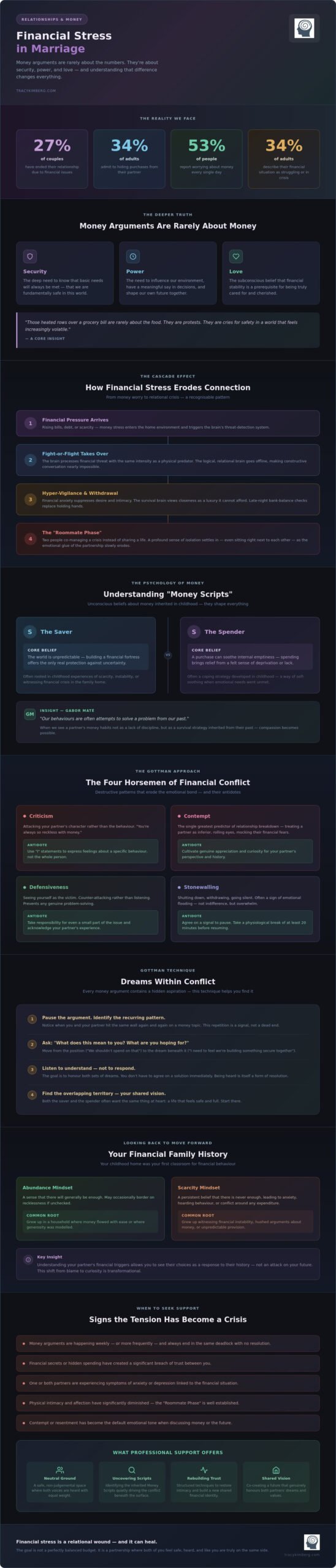
Did you know that 27% of couples have seen their relationship end due to financial issues, whilst 34% of adults admit to hiding purchases from their partner? It’s a staggering reality that highlights how deeply our bank balances are entwined with our hearts. You’ve likely felt that familiar tightening in your chest when a simple chat about the weekly shop spirals into a row about security, leaving you wondering how to handle financial stress in a marriage without losing your connection. It’s exhausting to feel judged for your spending or to carry the heavy weight of anxiety about what the future holds.
We’re here to help you move past the cycle of blame and transform that lingering tension into a new kind of emotional intimacy. By exploring research-based psychological strategies and empathetic communication, we’ll preview how to understand your partner’s unique financial behaviour and start acting like a unified team once more. You’ll discover how to look beneath the surface of the numbers to find a shared path toward lasting security and resilience. You don’t have to navigate these complexities alone; healing and partnership are well within your reach.
Key Takeaways
- Understand that money arguments are rarely about the figures; they are often a clash of inherited ‘Money Scripts’ and subconscious needs for security.
- Learn how to handle financial stress in a marriage by identifying the ‘Four Horsemen’ of conflict, such as criticism and contempt, that erode your emotional bond.
- Discover the ‘Dreams within Conflict’ technique to uncover the deep-seated life aspirations hidden beneath your recurring rows over spending.
- Recognise when financial tension has reached a relational emergency and how structured support can stabilise your partnership and restore intimacy.
Understanding the Weight of Financial Stress on a Partnership
Financial stress isn’t just a line item on a spreadsheet; it’s a systemic tremor that vibrates through the very nervous system of your marriage. When we talk about money, we aren’t just discussing figures. We are talking about our deepest needs for:
- Security: The feeling that our basic needs will always be met and we are safe.
- Power: The ability to influence our environment and have a say in our future.
- Love: The subconscious belief that financial stability is a prerequisite for being cared for.
In 2026, as 53% of people report worrying about money every single day, the cost of living has become more than an economic statistic. It’s a form of collective trauma that settles into our homes, with 34% of adults now describing their situation as struggling or in crisis. If you are wondering how to handle financial stress in a marriage, you must first realise that those heated rows over a grocery bill are rarely about the food. They are protests. They are cries for safety in a world that feels increasingly volatile.
The Invisible Third Party: How Debt Enters the Bedroom
When debt or scarcity enters the home, it often follows you right into the bedroom. Financial anxiety acts as a powerful inhibitor of desire. Your survival brain, occupied with the primal task of ensuring there’s enough to cover the mortgage or the rising utility bills, views intimacy as a luxury it cannot afford. This physiological state of hyper-vigilance often leads to the ‘Roommate Phase.’ You become two people co-managing a crisis rather than two lovers sharing a life. You might find yourselves checking bank balances late at night instead of holding hands, a shift that slowly erodes the emotional glue of your partnership. Over time, this focus on survival can lead to a profound sense of isolation, even whilst you are sitting right next to each other on the sofa.
Why Money Arguments Feel So Dangerous
There’s a reason your heart races and your palms sweat during budget talks. Your brain processes financial threat with the same intensity as a physical predator, triggering a full fight-or-flight response. This makes constructive conversation nearly impossible because the logical part of your brain has essentially gone offline. Understanding The Psychology of Money helps us see that these conflicts often fall into what experts call ‘perpetual gridlock.’ These aren’t just solvable problems like choosing a holiday destination; they are clashes of fundamental values and childhood blueprints. Learning how to handle financial stress in a marriage requires us to move beyond the numbers and look at the emotional pulse of the relationship. Financial stress is a relational hurdle that tests the foundation of trust.
The Psychology of Money: Why We Argue About More Than Just Pounds
Most traditional advice suggests that the secret to a happy marriage lies in a shared spreadsheet. However, if numbers were the only issue, we could all simply download an app and find peace. The reality is that our bank statements are often just mirrors of our internal worlds. We all carry what psychologists call ‘Money Scripts’, which are unconscious, deeply held beliefs about currency that we inherited in childhood. These scripts dictate our financial attachment style, influencing whether we see a surplus as a reason to celebrate or a reason to wait for the next disaster.
Gabor Maté reminds us that our behaviours are often attempts to solve a problem from our past. When one partner is a ‘Spender’ and the other a ‘Saver’, we aren’t seeing a lack of discipline. We are seeing two different survival strategies. The saver might be trying to build a fortress against a world they perceive as unpredictable, whilst the spender might be using a purchase to soothe a sense of internal emptiness or deprivation. Recognising this is the first step in learning how to handle financial stress in a marriage with compassion rather than contempt.
Uncovering Your Financial Family History
To move forward, you must look back. Your childhood home was your first classroom for financial behaviour. Did your parents use money as a reward, or was it a source of constant, whispered tension? By discussing these relational blueprints, you can identify if you are operating from a scarcity mindset, where there is never enough, or an abundance mindset that might occasionally border on recklessness. Understanding your partner’s financial triggers allows you to see their choices as a response to their history, not an attack on your future. If these patterns feel too deeply ingrained to shift alone, relationship coaching for couples can provide the safe space needed to deconstruct these old narratives.
The Emotional Language of Currency
Money is rarely just about the pounds and pence. It is a symbolic language representing autonomy, care, or even control. When we see ‘financial infidelity’, like hiding a shopping bag or a credit card statement, it is often a silent cry for freedom or a way to avoid the pain of being controlled. Instead of asking ‘What did you buy?’, try asking ‘What does this purchase represent for you?’. This simple shift moves the conversation from a courtroom interrogation to an act of curiosity. It allows you to address the underlying emotional need rather than just the transaction, which is essential for anyone seeking how to handle financial stress in a marriage over the long term.
Breaking the Cycle of Blame and Resentment
It’s incredibly easy to look across the breakfast table and think, “If they just stopped spending, we’d be fine.” This mindset, whilst understandable, is often the first step into a destructive cycle of blame. When we frame our partner as the problem, we inadvertently invite what John Gottman calls the ‘Four Horsemen’ into our financial discussions. In the context of money, Criticism and Contempt are particularly damaging. Criticism attacks the person’s character, whilst Contempt suggests you are somehow ‘better’ or more disciplined than your spouse. If you are trying to figure out how to handle financial stress in a marriage, you must first recognise that these behaviours are the true enemies of your progress.
To move forward, we have to change the way we initiate these difficult conversations. Using a ‘softened start-up’ is a powerful tool. Instead of leading with a complaint or a character attack, lead with your own feelings of vulnerability. Saying “I’m feeling a bit overwhelmed by our credit card balance” is far more effective than “You’ve spent too much again.” This approach invites your partner to be a protector rather than a defender. It prevents the fight-or-flight response we discussed earlier and keeps the logical part of the brain engaged for problem-solving.
From Adversaries to Allies: Re-framing the Problem
Transformation begins when you place the financial challenge outside the marriage. Instead of seeing your partner as the adversary, see the debt or the rising costs as a common foe you are both facing. This shift requires the consistent use of “We” language. It isn’t “your spending” or “my savings account”; it’s “our financial health.” Learning how to fix communication in a relationship means understanding that every conversation about money is an opportunity to reinforce your status as a team. When you stop fighting each other, you finally have the energy to fight the actual problem.
Managing Financial Infidelity and Rebuilding Trust
Modern financial infidelity often looks like hidden ‘buy now, pay later’ accounts or secret credit cards. With 28% of married people admitting to hiding significant purchases or debt from their spouse, this is a relational injury that requires careful repair. Rebuilding trust isn’t about one partner becoming a ‘police officer’ who audits every receipt. That only breeds more resentment. Instead, it involves creating a culture of radical transparency where secrets are no longer necessary for survival. Utilising a couples therapy for infidelity framework can help you navigate the betrayal of hidden debt and find a way back to honesty. This is a crucial step in learning how to handle financial stress in a marriage when the foundation of trust has been shaken.
The Gottman Approach: Turning Financial Conflict into Connection
John Gottman’s research reveals a profound truth: 69% of relationship conflicts are perpetual. They don’t go away because they are rooted in our fundamental personalities and values. Money is the ultimate perpetual issue. If you are struggling with how to handle financial stress in a marriage, the goal isn’t necessarily to eliminate the disagreement. Instead, it’s to move from gridlock to dialogue. This happens through the ‘Dreams within Conflict’ intervention, where we stop looking at the price tag and start looking at the aspiration behind the expense.
When you argue about a savings account or a renovation, you’re often protecting a deep-seated life dream. One partner might value the dream of travel and expansion, whilst the other cherishes the dream of a secure, debt-free home. Neither is wrong. By uncovering these dreams, you transform a transactional row into an intimate exchange. You start to see your partner’s ‘stubbornness’ as a commitment to a value they hold dear. If you find yourselves stuck in the same circular arguments, relationship counselling and coaching for couples can help you decode these hidden messages.
Conducting a Successful ‘Money Date’
To implement this, you need to step away from the kitchen table. Choose a neutral location, perhaps a quiet café or a park, where you won’t be interrupted by domestic chores or children. This isn’t a time to look at spreadsheets. Instead, follow these steps:
- Step 1: Set the scene. Agree that no decisions will be made during this talk. This lowers the stakes and reduces anxiety.
- Step 2: Share the dream. Each partner takes twenty minutes to explain what a specific financial goal means to them. What does it represent? What is the history of this dream?
- Step 3: Find the flexible area. Identify your ‘non-negotiables’, which is the core of the dream, and your ‘flexible areas’, which are the methods of achieving it. This is where you find the compromise for 2026.
The 6-Step Process for Financial Gridlock
Moving from gridlock requires ‘Accepting Influence.’ This doesn’t mean giving in; it means being willing to be moved by your partner’s perspective. You must honour their values whilst maintaining your own. The process involves listening without judgement, validating the underlying dream, and searching for a common ground that respects both identities. Compromise is not about losing, but about expanding the ‘us’ to include the hopes of both individuals. This shift is the cornerstone of how to handle financial stress in a marriage whilst deepening your bond.
Investing in Your Emotional Wealth: How Professional Support Helps
The 12-week relationship recovery process is designed specifically to stabilise the bond when it feels most fragile. Unlike a transactional meeting about interest rates or mortgage terms, this process allows you to deconstruct the ‘survival brain’ responses that keep you locked in conflict. It’s about moving from a state of hyper-vigilance to one of shared resilience. When you address the emotional root of your tension, the financial branches often become much easier to manage as a team. This structured approach helps you see that your partner is your greatest asset, not your biggest liability.
Individual vs. Couples Support
Sometimes, the path to a healthier partnership starts with a solo journey. Individual relationship counselling allows you to unpack your own ‘money scripts’ and financial anxiety without the immediate pressure of a partner’s reaction. It provides a neutral, safe space to voice ‘taboo’ topics, such as the shame of hidden debt or the fear of being financially controlled. Professional coaching offers a structured programme that moves you beyond a simple venting session. It gives you the psychological tools to return to your marriage with a clearer heart and a steadier hand, ready to engage in the ‘Money Dates’ we explored earlier.
Your Path Forward: Taking the First Step
Whether your journey leads to a renewed, intimate partnership or a conscious approach to separation, the goal is always clarity and peace. My practice provides a non-judgemental environment where your long-term emotional health is the priority. Financial stress doesn’t have to be the end of your story; it can be the catalyst that finally forces you to build a deeper, more honest intimacy. You’ve carried this burden alone for long enough. Book a discovery call to start your relationship recovery journey today and discover how to handle financial stress in a marriage with grace, strength, and a renewed sense of hope.
Building a Shared Future Beyond the Numbers
You’ve discovered that money is rarely just about currency; it’s a profound language of security, autonomy, and love. By uncovering the ‘Money Scripts’ of your childhood and embracing the ‘Dreams within Conflict’ approach, you’ve already begun the journey toward a more compassionate partnership. Learning how to handle financial stress in a marriage requires moving beyond the spreadsheets to address the emotional pulse of your bond.
If you’re ready to stop the cycle of blame and start building a resilient future, I invite you to Begin your 12-Week Relationship Recovery Process with Tracy Kimberg. My safe, non-judgemental UK-based practice utilises the research-based strategies of experts like Gottman and Perel to help you reclaim your connection. As a specialist in transformational relationship programmes, I’m here to guide you through this emotional landscape. You don’t have to carry the weight of financial anxiety alone. Healing is possible, and your relationship is worth the investment.
Frequently Asked Questions
Is it normal to argue about money every single week?
Whilst it is very common, frequent rows suggest that the underlying emotional needs for safety or autonomy aren’t being met. If you’re stuck in a weekly cycle, it often indicates that you’re arguing about the transaction rather than the deeper dream or fear behind the spending. Chronic conflict is a signal that your relationship’s nervous system is stuck in a state of hyper-vigilance and requires a new approach to communication.
How do I talk to my husband about debt without him getting defensive?
Start with a softened start-up by focusing on your own feelings rather than his actions. Instead of saying “You’ve hidden this debt,” try “I’m feeling anxious about our future security and I’d like us to look at our balances together.” This invites him to be a partner in the solution rather than a defendant in a trial. It shifts the dynamic from an interrogation to a collaborative mission.
What is financial infidelity and does it require therapy?
Financial infidelity involves hiding accounts, debt, or significant purchases from your partner. Since research shows that 40% of people would end a relationship over financial dishonesty, it’s a serious breach of trust. Therapy is often essential to uncover why the secrecy felt necessary and to rebuild a foundation of radical transparency. It helps you move past the shame and into a space of honest reconnection.
Can a marriage survive if one person is a spender and the other is a saver?
Yes, these opposite styles can actually balance a relationship if viewed as different survival strategies rather than character flaws. The key is to accept influence from each other. A saver provides vital security, whilst a spender often advocates for quality of life and joy. The goal is to integrate both values into a shared financial vision that respects both partners’ psychological needs.
How do we handle financial stress if one of us has lost their job?
Job loss is a systemic shock that requires immediate emotional re-alignment. Understanding how to handle financial stress in a marriage during a crisis involves separating a person’s self-worth from their income. Focus on “We” language to ensure the unemployed partner doesn’t feel devalued or shamed. Prioritise emotional connection and reassurance over material status whilst you navigate the transition as a unified team.
Should we have joint or separate bank accounts to reduce stress?
Data suggests that married couples with joint accounts report the highest satisfaction, at approximately 94%. However, the best structure is the one that fosters the most transparency for you. Some couples find a “yours, mine, and ours” approach reduces friction. This allows for individual autonomy over small purchases whilst maintaining a solid, shared commitment to your primary household goals and future security.
How can we protect our children from sensing our financial tension?
Children are highly tuned into the emotional climate of the home, even if you don’t discuss specific figures in front of them. To protect them, focus on regulating your own nervous systems so that money talks don’t spiral into shouting matches. Reassure them that the adults are working together as a team. This teaches them that financial challenges are manageable problems rather than frightening relational threats.
What if my partner refuses to talk about our finances at all?
Refusal to talk is often a stonewalling response triggered by deep-seated shame or a fear of being controlled. Instead of pushing harder for a budget meeting, try addressing the emotional barrier first. Ask your partner what makes talking about money feel unsafe for them. If the impasse continues, professional coaching can provide the neutral ground needed to break the silence and start a healthy dialogue.

Article by
Tracy Kimberg
Tracy Kimberg is a Relationship Expert, Couples Therapist and Coach with a dedicated focus on helping couples and individuals rebuild connection, trust and emotional safety in their relationships. Drawing on the research of John and Julie Gottman, the relational insights of Esther Perel, and years of hands-on therapeutic experience, Tracy offers a warm, non-judgemental and deeply compassionate approach to modern relationships.
Based in Dorset, Tracy works with couples navigating communication breakdowns, betrayal, intimacy challenges, separation, family dynamics and life transitions. Known for creating a safe and grounded therapeutic space, she combines practical tools with emotional depth to help clients move beyond survival patterns and towards meaningful, lasting change.
With a reputation for empathy, professionalism and dedication to her clients’ growth, Tracy is passionate about helping people feel seen, understood and empowered — both within their relationships and within themselves.
Disclaimer
Disclaimer:
The information shared in this article is intended for educational and informational purposes only and should not be considered a substitute for professional therapeutic, psychological, medical or legal advice. Every individual and relationship is unique, and the perspectives offered are based on general therapeutic principles, research and professional experience.
Reading this article does not establish a therapist-client relationship with Tracy Kimberg. If you are experiencing significant emotional distress, relationship crisis, trauma, or mental health concerns, it is important to seek support from a qualified professional appropriate to your individual circumstances.
All content remains the intellectual property of Tracy Kimberg and may not be reproduced or distributed without permission.