

You’re standing in the kitchen at 3:00 am, rocking a crying infant whilst your partner sleeps, and instead of feeling love, you feel a sharp, cold flash of resentment. It’s the silent tally of who changed the last nappy or who got more rest that defines your days now. If you feel more like a logistics manager than a romantic partner, you aren’t alone. Experiencing relationship problems after having a baby is a common, though often hushed, reality for the majority of new parents. It’s exhausting to realise that the person who used to be your sanctuary now feels like a co-worker you can’t quite get along with.
This shift doesn’t mean your love has vanished; it means your relationship is undergoing a profound psychological transformation. We’ll explore research-based strategies to help you move from being mere roommates back to being lovers. We will look at how to reduce conflict over household chores and rediscover the physical desire that sleep deprivation has dampened. You’ll learn how to stop the explosive arguments and start feeling seen and appreciated again, transforming your partnership into a supportive team that thrives amidst the beautiful chaos of parenthood.
Key Takeaways
- Recognise that the “identity earthquake” of early parenthood is a natural developmental shift, not a sign that your bond is broken.
- Learn how to manage the mental load and resolve relationship problems after having a baby by prioritising emotional attunement over logistical perfection.
- Identify the subtle signs of the “roommate phase” and discover how to transition from co-parenting tasks back to romantic intimacy.
- Implement small but powerful rituals, such as the six-second kiss, to regulate your nervous system and rebuild physical closeness.
- Understand why seeking professional guidance is a proactive investment in your family’s long-term emotional health and stability.
Why Relationship Problems After Having a Baby are a Natural Transition
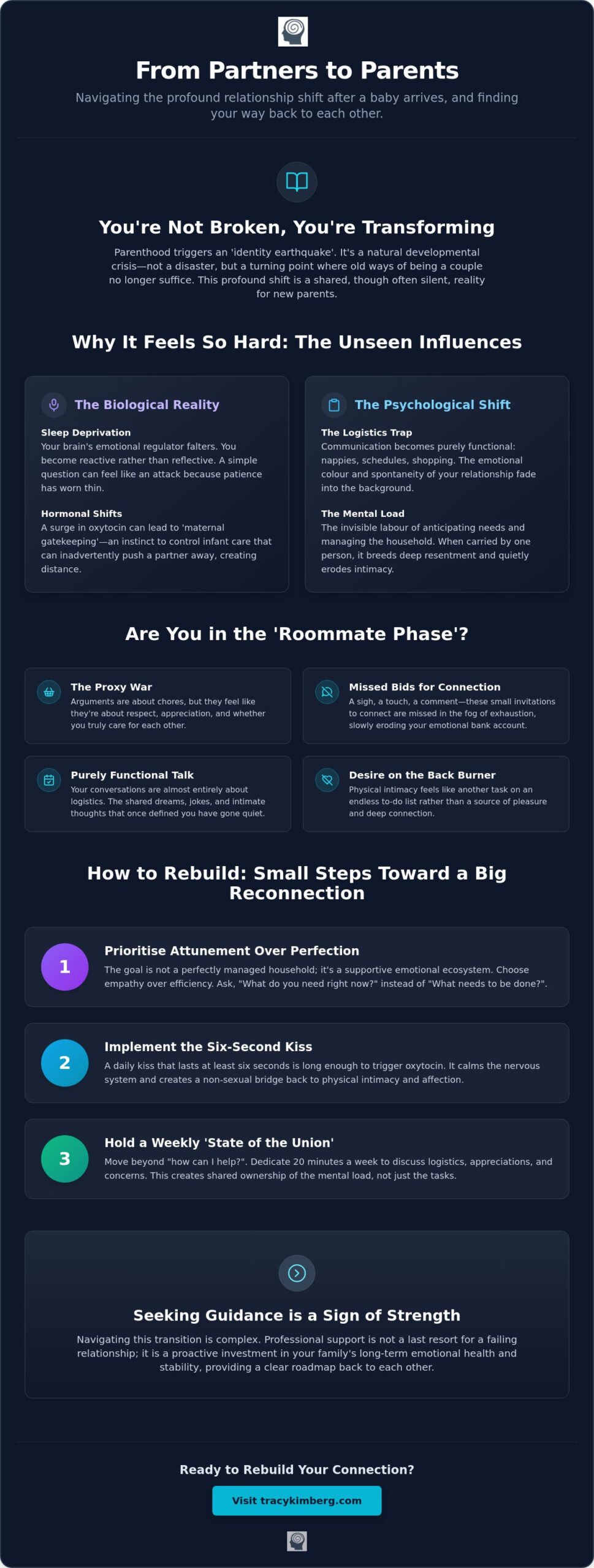
Parenthood is often marketed as a period of soft lighting and quiet bliss, yet for most couples, it feels more like a developmental crisis. In psychological terms, a crisis isn’t necessarily a disaster; it’s a turning point where your old ways of functioning no longer work. When you’re navigating relationship problems after having a baby, you’re essentially living through an identity earthquake. The person you were before, the one who had hobbies, a predictable career path, and a spontaneous romantic life, has been replaced by a version of yourself entirely centred on the survival of a tiny human. This shift happens to both partners simultaneously, often leaving you feeling like two strangers trying to build a new house whilst a storm rages around you.
The shock to the system is profound, even for couples who felt rock-solid before the birth. Much of this friction is rooted in the physical reality of sleep deprivation. When you aren’t sleeping, your prefrontal cortex, the part of the brain responsible for emotional regulation and impulse control, begins to falter. You become reactive rather than reflective. A simple question about what’s for dinner can feel like a personal attack because your brain no longer has the cognitive resources to filter stress or practice patience. You aren’t failing at your relationship; you’re operating in survival mode.
The Biological Reality of Post-Baby Friction
Biology plays a significant role in how you interact during these early months. The surge of oxytocin in a birthing parent can sometimes lead to “maternal gatekeeping,” an instinctive need to control every aspect of the infant’s care. This can inadvertently push the other partner away, intensifying a “pursuer-distancer” dynamic where one person feels overwhelmed by responsibility whilst the other feels rejected and retreats into work or silence. These shifts often correlate with changes to intimacy and sexual connection, as the body and mind prioritise safety and nurturing over desire. Relational strain is a biological byproduct of the survival phase.
From Lovers to Logisticians: The Great Role Shift
As the weeks turn into months, many couples find their communication has become purely functional. You stop talking about your dreams or your day and start talking almost exclusively about nappies, sleep schedules, and grocery lists. This “logistics trap” strips the relationship of its emotional colour. Spontaneity disappears because every outing requires the planning of a small military operation. In this environment, “who does what” becomes a heavy proxy for “do you care about me?”. When your partner forgets to put the laundry in the dryer, it doesn’t just feel like a forgotten chore; it feels like a profound lack of respect for your exhaustion and your contribution to the family.
The Psychology of the Logistics Trap: Beyond Chores and Resentment
Parenthood often transforms a partnership into a small, frantic corporation. You’re no longer exploring each other’s inner worlds; you’re managing inventory, logistics, and supply chains. This shift is a primary driver of relationship problems after having a baby. It’s rarely just about the laundry. It’s about the “Mental Load”—the invisible, cognitive labour of anticipating needs and making decisions. When one partner carries this alone, it breeds a specific, toxic resentment. They feel like the “manager,” whilst the other is merely “helping out,” creating a hierarchy that kills intimacy.
This exhaustion leads to missed “Bids for Connection.” John Gottman describes these as small attempts to get attention, affirmation, or affection. A sigh, a touch, or a comment about a news story are all invitations to engage. In the fog of new parenthood, these bids are often ignored or met with irritation. Over time, failing to turn towards these bids erodes the emotional bank account. Extensive research on relationship decline after a baby suggests that this loss of connection isn’t sudden; it’s a slow leak caused by the weight of domesticity and the silence that follows.
The Mental Load and Relational Equity
True equity isn’t about a 50/50 split of tasks. It’s about shared responsibility. When a partner asks “how can I help?”, they inadvertently place the burden of management back on the other person. To fix this, try a weekly “State of the Union” meeting to discuss the schedule and emotional needs without blame. Understanding when communication breaks down is essential here, as these arguments are often about feeling invisible rather than the chores themselves. If you’re struggling to bridge this gap, relationship coaching can help you rebuild that shared foundation.
Esther Perel and the Conflict of Security vs Desire
Esther Perel reminds us that the qualities that make a “good parent”—reliability, predictability, and stability—are often the very things that dampen erotic desire. Parenting requires a deep, merging closeness, but desire requires a degree of distance and mystery. You must fight to maintain an individual identity that exists outside of being “Mum” or “Dad.” Navigating relationship problems after having a baby requires acknowledging that desire needs space to breathe, whilst parenting thrives on closeness.
This tension often manifests as “Parental Rage.” This isn’t just “being tired.” It’s a physiological scream for support and a desperate need to be seen as a person, not just a function. Recognising this rage as a symptom of a systemic issue within the couple, rather than a personal failing, is the first step toward healing. When you stop seeing each other as obstacles to your rest and start seeing each other as partners in your exhaustion, the dynamic begins to shift.
Identifying the Roommate Phase: Arguments vs Emotional Disconnect
Many couples worry when they start bickering more frequently, but in the world of relationship therapy, loud conflict is often a sign of life. It shows that both partners are still invested enough to protest. The real danger zone, often called the “Roommate Phase,” is characterised by a heavy, hollow silence. This is where apathy replaces anger. You stop fighting because you’ve stopped expecting anything different. When you’re navigating relationship problems after having a baby, this shift toward emotional neutrality can be the first step toward what psychologists call “Emotional Divorce,” where you continue to share a mortgage and a nursery but no longer share an inner life.
Conflict avoidance is frequently more damaging than a heated argument. Whilst shouting is exhausting, silence is isolating. When you stop raising issues to “keep the peace,” you aren’t actually resolving anything; you’re just storing resentment in a basement that will eventually flood. This transition from a romantic partnership to a functional co-parenting arrangement happens slowly, often masked by the sheer exhaustion of caring for an infant. You become “parallel parents,” two people moving in the same direction but never actually touching.
The Four Horsemen in the Nursery
John Gottman’s “Four Horsemen”—Criticism, Contempt, Defensiveness, and Stonewalling—often gallop into the home during the first year of parenthood. Sleep deprivation acts as a catalyst, turning a simple complaint into a character assassination. Instead of saying, “I’m overwhelmed by the mess,” criticism sounds like, “You’re so lazy, you never help.” Contempt is even more corrosive; it’s the eye-roll when your partner struggles with a nappy change or the sarcastic comment about their parenting style. If you recognise these patterns, it’s vital to ask, Can Your Relationship Be Saved?, as these behaviours are the primary predictors of long-term relational breakdown.
The Silence of the Roommate Phase
The Roommate Phase is defined by a loss of “we-ness.” You might be excellent at “tag-teaming” the baby’s schedule, but you’ve stopped being curious about each other. You know the baby’s favourite puree, but you’ve forgotten your partner’s current fears or triumphs. This emotional disconnect is often mistaken for temporary exhaustion, but whilst tiredness passes with a nap, disconnect requires a conscious effort to re-engage. Relationship problems after having a baby often stem from this loss of the “couple bubble,” where the infant becomes the only bridge between two increasingly distant islands. Reclaiming that connection starts with acknowledging that being “just roommates” isn’t a permanent sentence, but a signal that your relationship needs a different kind of nourishment.
Practical Strategies to Rebuild Your Connection and Emotional Intimacy
Fixing relationship problems after having a baby requires more than just vague intentions to “talk more.” When you’re running on four hours of broken sleep, conversation feels like a mountain you don’t have the strength to climb. You need concrete, research-based tools that work with your exhaustion, not against it. Reclaiming your bond is about small, intentional shifts in your daily rhythm that signal safety and value to your partner’s nervous system.
- The 6-Second Kiss: Physical touch is often the first thing to go, but a six-second kiss is long enough to trigger oxytocin and reset your stress response. It’s a micro-moment that separates a romantic partner from a flatmate.
- A Culture of Praise: We often fall into a “culture of critique,” noticing only what isn’t done. Challenge yourself to share three appreciations daily. Moving from “You forgot the bins” to “I noticed how gently you soothed the baby earlier” changes the emotional temperature of the house.
- The Stress-Reducing Conversation: Spend fifteen minutes venting about your day whilst your partner simply listens. The goal isn’t to “fix” the problem but to provide an emotional sanctuary.
- Scheduling Intimacy: Waiting for “the mood to strike” is a recipe for a sexless marriage in the early years. Scheduling time for closeness, even if it’s just a twenty-minute cuddle on the sofa, ensures the relationship remains a priority.
- Softened Start-ups: How you begin a conversation determines how it ends. Instead of “You always ignore the washing,” try “I’m feeling overwhelmed by the house, and I’d love some help with the laundry.”
Micro-Rituals of Connection
Intimacy is built in the small moments, not just grand gestures. A two-minute morning check-in to ask “What’s on your plate today?” helps you maintain your “Love Maps”—John Gottman’s term for staying updated on your partner’s inner world. When you know what your partner is worried about or looking forward to, you remain allies rather than just co-parents. If these small steps feel impossible to start alone, our 12-Week Relationship Recovery Process provides the structured support you need to break the cycle of disconnect.
Redefining Physical Intimacy
Many new mothers feel “touched-out,” having spent all day with a small body pressed against theirs. It’s vital to move beyond “all or nothing” thinking regarding sex. Physical intimacy can include hand-holding, foot rubs, or simply sitting close on the settee. Talk openly about your needs whilst honouring the biological reality of your current stage. By separating sexual expectation from physical affection, you create a safe space for desire to eventually return. You’re learning to be lovers again, but this time, you’re doing it with the profound shared history of creating a family.
When to Seek Professional Support: Navigating the Path Back to Each Other
There is a persistent myth that therapy is a last resort, a final stop before a solicitor’s office. In reality, seeking support early is a profound act of relationship strength. Whilst the strategies we’ve explored can help, many couples find that relationship problems after having a baby are too complex to untangle whilst living in the thick of sleep deprivation. Professional guidance provides a dedicated space to pause the “logistics” and focus on the “us.” It’s about moving from a state of reactive survival to one of conscious connection.
A neutral third party acts as a translator in the “blame-shame” cycle. When you’re trapped in resentment, it’s difficult to hear the vulnerability beneath your partner’s anger. A therapist helps you de-escalate, ensuring that both voices are heard without the conversation devolving into a tally of who did more nappies. If your partner feels hesitant about joint sessions, Individual Relationship Counselling can be a powerful starting point. Working on your own responses and internal landscape often creates a ripple effect that transforms the entire partnership.
The 12-Week Relationship Recovery Process
For couples who feel lost in the fog of new parenthood, a structured roadmap is often more effective than open-ended talk therapy. The 12-week programme acts as a “container,” providing the safety and predictable rhythm needed for deep repair. We move systematically from de-escalating daily friction to rebuilding the emotional and physical intimacy that may have felt lost. You can see the tangible results of this structured path in our 12-Week Relationship Recovery Case Study, which illustrates how even deeply disconnected couples can find their way back to a “thriving mode.”
Taking the First Step Towards Healing
Bringing up the idea of counselling can feel daunting, especially if your partner is feeling defensive or overwhelmed. Try to frame the suggestion as a gift to the relationship rather than a critique of their behaviour. Use “we” language: “I miss our connection, and I want us to have a safe space to work through this transition together.”
Tracy provides a warm, non-judgmental environment where you can both feel seen and supported. You don’t have to navigate this identity earthquake alone. If you’re ready to stop being roommates and start being partners again, book a discovery call to begin your journey back to each other. Reclaiming your bond is a proactive adventure, and the best time to start is now.
Reclaiming Your Partnership in the New Chapter
The transition from a couple to a family is one of the most profound identity shifts you’ll ever experience. It’s natural to feel as though you’ve lost the “us” amongst the nappies and the heavy mental load. By recognising that your current friction is often a biological byproduct of survival mode, you can begin to replace resentment with empathy. Whether it’s through micro-rituals like the six-second kiss or by consciously scheduling time to be lovers rather than just logisticians, you have the power to bridge the gap. Navigating relationship problems after having a baby doesn’t have to be a solitary struggle.
I provide a research-based approach, rooted in the clinical insights of Gottman and Perel, to help you untangle emotional disconnect in a safe, non-judgemental space. Specialising in relational breakdown, I offer both online and face-to-face therapy designed to move you from survival to connection. Begin your 12-Week Relationship Recovery journey with Tracy Kimberg and rediscover the intimacy that brought you together. You’ve created a life together; now, let’s ensure that life includes a thriving, vibrant partnership. Healing is possible, and your connection is worth the investment.
Frequently Asked Questions
Is it normal to hate my partner after having a baby?
It’s entirely normal to feel flashes of intense resentment or even “hatred” toward your partner during the early months of parenthood. These feelings are usually a physiological response to extreme sleep deprivation and the overwhelming mental load of infant care. You aren’t falling out of love; you’re reacting to a systemic crisis where your needs aren’t being met. Recognising this as a survival response rather than a permanent change in your feelings is the first step toward healing.
How long does the “difficult phase” in a relationship last after a baby?
The most acute “difficult phase” typically lasts for the first twelve to eighteen months as you navigate the primary transition to parenthood. However, every couple’s timeline is unique. Whilst the “survival mode” of the fourth trimester is often the most intense, the shift in your relationship dynamic requires ongoing conscious effort to resolve. If you find yourself stuck in a cycle of relationship problems after having a baby beyond the first year, it may be time to seek external support to break the pattern.
How can I fix a sexless marriage after having kids?
Fixing a sexless marriage starts with removing the pressure of performance and focusing on emotional safety. Transition from “all or nothing” thinking to “micro-moments” of physical connection, such as long hugs or holding hands. It’s essential to talk about sexual needs outside the bedroom when you aren’t tired. By scheduling time for closeness, you create a space where desire can eventually return without the anxiety of expectation or the feeling of it being another chore.
What are the signs that our relationship is actually in trouble versus just being tired?
The clearest sign of trouble is the presence of contempt, such as eye-rolling, sneering, or mocking your partner’s parenting. Whilst tiredness leads to bickering, a relationship in crisis is marked by a persistent lack of curiosity about each other and a shift toward apathy. If you’ve stopped fighting because you no longer care enough to protest, or if you feel like you’re living parallel lives, your connection requires professional attention rather than just a nap.
How do we stop arguing about chores and the baby?
To stop arguing about chores, you must move from a model of “helping” to one of “shared responsibility.” Use a weekly meeting to divide tasks clearly, including the invisible mental load of planning and decision-making. Focus on your needs rather than your partner’s failures by using “I” statements. When you both feel that the division of labour is equitable, the chores stop being a proxy for whether or not you feel cared for by your partner.
Can relationship counselling help if my partner doesn’t think there is a problem?
Yes, relationship counselling can be incredibly effective even if one partner is hesitant. You can start with individual sessions to explore your own patterns and responses, which often shifts the dynamic of the entire partnership. When inviting your partner, frame it as a request for support for your own well-being and the health of the family, rather than a list of their faults. Often, a partner who is “not seeing a problem” is actually just feeling defensive.
How do I handle feeling “touched out” and not wanting physical intimacy?
Feeling “touched out” is a common biological response for parents who spend all day in constant physical contact with an infant. It’s important to communicate this clearly to your partner as a sensory overload rather than a rejection of them. Ask for “touch-free” time to regulate your own nervous system. By honouring your need for physical autonomy, you reduce the resentment that often contributes to relationship problems after having a baby and create a path back to wanting closeness.
What if we have different parenting styles and it’s causing conflict?
Conflict over parenting styles usually stems from your own childhood experiences and internalised values. Instead of arguing about who is “right,” try to understand the fears or hopes that drive your partner’s approach. Look for a “third way” that incorporates the strengths of both styles whilst maintaining a united front. When you see your partner as a teammate with a different perspective rather than an obstacle, the conflict softens into a collaboration that strengthens your bond.

Article by
Tracy Kimberg
Tracy Kimberg is a Relationship Expert, Couples Therapist and Coach with a dedicated focus on helping couples and individuals rebuild connection, trust and emotional safety in their relationships. Drawing on the research of John and Julie Gottman, the relational insights of Esther Perel, and years of hands-on therapeutic experience, Tracy offers a warm, non-judgemental and deeply compassionate approach to modern relationships. Based in Dorset, Tracy works with couples navigating communication breakdowns, betrayal, intimacy challenges, separation, family dynamics and life transitions. Known for creating a safe and grounded therapeutic space, she combines practical tools with emotional depth to help clients move beyond survival patterns and towards meaningful, lasting change. With a reputation for empathy, professionalism and dedication to her clients’ growth, Tracy is passionate about helping people feel seen, understood and empowered — both within their relationships and within themselves.
Disclaimer
Disclaimer: The information shared in this article is intended for educational and informational purposes only and should not be considered a substitute for professional therapeutic, psychological, medical or legal advice. Every individual and relationship is unique, and the perspectives offered are based on general therapeutic principles, research and professional experience. Reading this article does not establish a therapist-client relationship with Tracy Kimberg. If you are experiencing significant emotional distress, relationship crisis, trauma, or mental health concerns, it is important to seek support from a qualified professional appropriate to your individual circumstances. All content remains the intellectual property of Tracy Kimberg and may not be reproduced or distributed without permission.