

What if the constant friction in your home isn’t actually about the unwashed dishes or the screen time limits, but a nervous system seeking safety? It’s incredibly draining to feel like every conversation is a potential minefield. You likely feel the sharp sting of rejection when your child pulls away, followed by that heavy, familiar weight of guilt after you’ve reacted with more frustration than you intended. You aren’t alone in this cycle, and it doesn’t mean you’re failing.
This guide moves beyond simple behavioural management to show you how improving parent-child relationship dynamics is actually about co-regulation and building a deeply resilient, empathetic bond. Drawing on research-backed relational strategies, we’ll look at how to move from conflict to connection. You’ll discover how to create an environment where your child feels safe opening up, ultimately replacing power struggles with a sense of calm and mutual respect. We’ll explore how to heal these rifts and foster a partnership that feels both manageable and profoundly meaningful.
Key Takeaways
- Identify the “invisible wall” of emotional disconnect that often precedes difficult behaviour, allowing you to intervene with empathy rather than frustration.
- Use the “Circle of Security” as a practical roadmap for improving parent-child relationship dynamics by becoming both a safe haven and a secure base for your child.
- Transition from a corrective behavioural model to a relational one to decrease defensive listening and foster genuine cooperation at home.
- Understand why the process of “Rupture and Repair” is the foundation of a resilient bond, moving beyond simple apologies to true emotional accountability.
- Learn to distinguish between typical developmental shifts and the specific red flags that suggest a need for specialised professional guidance or therapy.
Understanding the ‘Invisible Wall’: Why Parent-Child Relationships Drift
The parent-child bond isn’t a fixed structure. It’s more like a living, breathing organism that requires constant nourishment and attention. When we stop tending to it, an “invisible wall” begins to form. This isn’t usually a sudden event. It’s a slow accumulation of missed moments and unaddressed tensions. Improving parent-child relationship dynamics starts with recognising that this wall is often a protective barrier, not a sign of malice or defiance.
Modern life adds complex layers to this disconnect. Digital distractions mean we are often physically present but emotionally elsewhere. Academic pressures can turn parents into “project managers” rather than emotional anchors. Children are incredibly sensitive to these shifts. They often don’t have the vocabulary to say, “I feel lonely when you’re on your phone,” so they “act out” that loneliness through defiance or withdrawal. Their behaviour is a desperate attempt to communicate what their words cannot yet reach regarding the relationship.
The Role of Emotional Safety
Emotional safety is the bedrock of any healthy connection. It’s the quiet certainty that a child can bring their messiest, most difficult parts to you without being judged, shamed, or dismissed. When this safety feels compromised, teenagers in particular tend to shut down. This isn’t laziness; it’s a defensive posture to protect their vulnerability. In neurobiological terms, emotional safety is the physiological state where the nervous system feels secure enough to prioritise social engagement over the “fight-or-flight” response. Without this foundation, any attempt at discipline will likely feel like an attack.
Signs Your Relationship Needs Attunement
Attunement is the process of being “in sync” with your child’s internal world. You might notice subtle cues that this sync is slipping. Perhaps you receive one-word answers to every question, or notice their body language shifts into avoidant patterns when you enter the room. A major red flag is when your interactions become purely logistical. If you’re only talking about homework, chores, and schedules, the emotional intimacy is starving.
It’s vital to distinguish between healthy independence and worrying emotional withdrawal. A child seeking independence wants to do things on their own; a child withdrawing is trying to hide their heart. Understanding The Science of Secure Attachment helps us see that even as children grow, they still need to know the “home base” is emotionally available. Reclaiming this attunement is a proactive adventure in rediscovering who your child is becoming today, rather than holding them to who they were yesterday.
The Science of Secure Attachment: Building a Safe Haven
Attachment theory isn’t merely a concept for early childhood; in 2026, we understand it as the lifelong blueprint for how we give and receive love. Originally developed by John Bowlby and Mary Ainsworth, this framework explains that every child possesses an innate biological drive to seek proximity to a protective figure. Improving parent-child relationship dynamics requires us to look at the “Circle of Security.” In this model, you serve two vital roles: you are the “secure base” from which your child goes out to explore the world, and you are the Building a Safe Haven they return to when that world feels overwhelming or frightening.
Gabor Maté often speaks about the fundamental tension between the “need for attachment” and the “need for authenticity.” If a child feels they must hide their true self to keep your love, they will sacrifice their authenticity to preserve the bond. This internal conflict often manifests as anxiety or resentment. By creating a space where they can be their messy, authentic selves without risking the relationship, you reinforce a secure attachment that lasts well into their adult years.
Exploring the lived experiences and honest reflections of others can be a powerful way to understand these dynamics; you might discover My Mothers Diaries for relatable stories that delve into the heart of family connections.
Co-Regulation: The Secret to Calm
A child’s nervous system is not yet equipped to manage high-intensity emotions alone. They literally “borrow” your nervous system to find their balance. Through the mirror neuron system, your child subconsciously picks up on your internal state. If you approach a conflict with clenched teeth and a racing heart, their body will mirror that stress, regardless of how calm your words might be. Self-regulation is your first priority. Before addressing a difficult behaviour, take a moment to ground yourself. Your calm is the most powerful tool you have for soothing their storm.
Generational Patterns and Healing
We don’t parent in a vacuum; we often parent out of our own unmet needs from childhood. If you were raised in an environment where emotional expression was discouraged, you might find your child’s big feelings particularly triggering. Conscious parenting involves a gentle, non-judgemental audit of these inherited patterns. It’s about deciding which family traditions to keep and which cycles of emotional neglect to break. If you find yourself stuck in these old rhythms, specialised relationship coaching can provide the insight needed to forge a new path for your family. Healing your own past is often the greatest gift you can give to your child’s future.
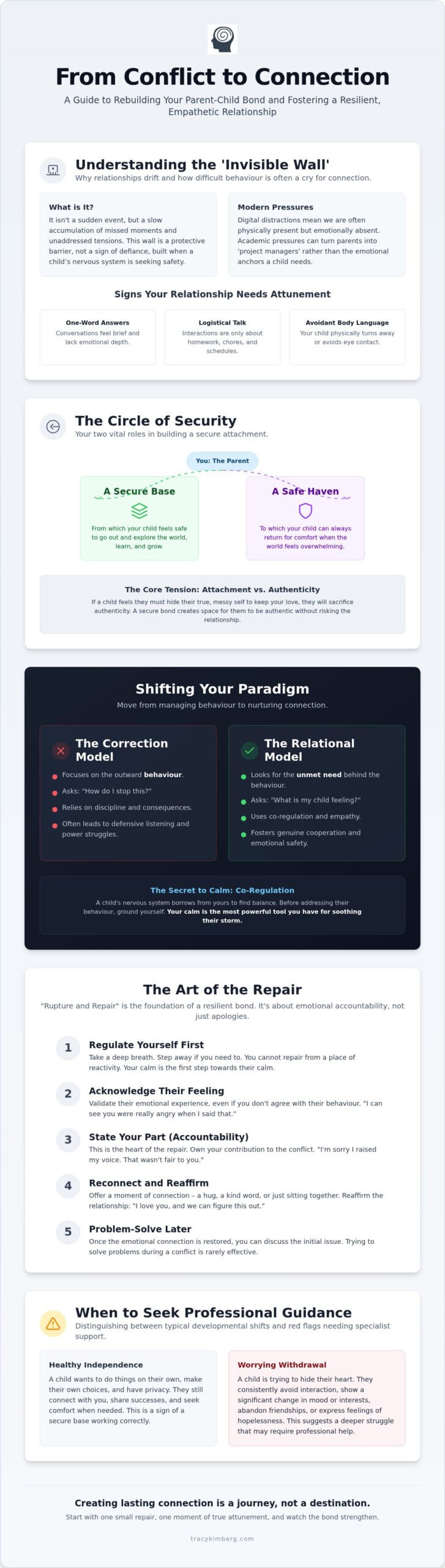
Connection vs. Correction: Shifting Your Parenting Paradigm
Many parents fall into the trap of the “Behavioural Model.” This approach treats children like problems to be solved or machines to be programmed. When we focus solely on correction, we inadvertently signal that our love is conditional on their performance. Improving parent-child relationship health requires a radical shift toward the “Relational Model.” This paradigm prioritises the bond itself, recognising that cooperation is a natural byproduct of connection, not a result of coercion.
Constant correction often triggers what psychologists call “defensive listening.” When a child or teenager feels they are under a microscope, their nervous system perceives your voice as a threat. They stop hearing your guidance and start preparing their defence. To counter this, we can apply John Gottman’s famous “5:1 Ratio.” For every one corrective or negative interaction, we need at least five positive, nourishing moments to keep the relationship’s emotional bank account in credit. This isn’t about being permissive; it’s about ensuring the foundation is strong enough to hold the weight of necessary boundaries.
One of the most effective ways to build this credit is through “Special Time.” For younger children, this is “Floor Time” where they lead the play. For teenagers, it might mean sitting in their room whilst they listen to music, offering your presence without an agenda. This playfulness and shared energy create a sense of vitality in the home. It’s about being together without the pressure of “doing” or “fixing.”
The Power of Active Listening
Active listening is the art of listening to understand rather than listening to respond. It requires us to set aside our own “rightness” to witness our child’s reality. Reflective listening is a powerful tool here. You might say, “What I’m hearing is that you felt quite lonely when I was working late; is that right?” This simple act of reflecting their experience back to them creates an immediate sense of being seen. Validating statements, such as “It makes sense that you’d feel frustrated by that,” can de-escalate a heated moment instantly by lowering their physiological arousal.
Curiosity Over Judgement
When a child’s behaviour is challenging, our instinct is to ask “Why did you do that?” This question often leads to a “shut down” because it feels like an accusation. Instead, try “Wondering.” Approach the situation with the curiosity of a researcher. When you ask “What happened?” you invite them to tell their story. This shift from judgement to curiosity preserves the bond even during conflict. Try these curiosity-based prompts:
- “I’m wondering what that was like for you?”
- “What was the hardest part of your day?”
- “I noticed you seemed upset earlier. What happened in that moment?”
- “I’m curious, how can we make this work for both of us?”
The Art of the Repair: 5 Steps to Reconnect
In any meaningful connection, rupture is inevitable. We lose our tempers, we misunderstand intentions, and we occasionally fail to show up when our children need us most. However, the strength of the bond isn’t defined by the absence of conflict, but by the presence of repair. Improving parent-child relationship dynamics relies heavily on your ability to bridge the gap after a fallout. A true repair is far more than a cursory “sorry”; it’s a profound act of taking responsibility for the emotional impact of your actions. It signals to your child that the relationship is more important than being right.
Timing is everything. Attempting to repair whilst either of you is still in a state of physiological “flooding” is often counterproductive. When the heart rate is elevated, the brain’s capacity for empathy shuts down. Respecting the cooling-off period allows both nervous systems to return to a state of safety. For teenagers, this space is particularly vital as it signals respect for their autonomy and emotional boundaries. Once the storm has passed, you can use “Repair Attempts,” such as a gentle touch or a self-deprecating joke, to signal that you’re ready to reconnect.
Step-by-Step Guide to Relational Repair
A successful repair follows a structured path of humility and witnessing. Start by managing your own physiological arousal; you cannot soothe your child if your own system is still screaming. When you’re ready, initiate with a “soft start-up.” This might look like saying, “I didn’t like how I spoke to you earlier, and I’d like to try again.”
- Step 1: Self-Soothe. Take deep breaths or a walk until you can approach the conversation without defensiveness.
- Step 2: Initiate the Repair. Offer a low-pressure invitation to talk.
- Step 3: Own Your Part. Be specific. “I was impatient and I shouted” is powerful. Avoid adding “but you were being difficult,” which cancels out the apology.
- Step 4: Listen without Defensiveness. Let them tell you how your behaviour felt. Your job is to witness their hurt, not to litigate the facts.
- Step 5: Plan for the Future. Discuss how you both might handle similar triggers differently next time.
Building the Emotional Bank Account
Think of your relationship as an emotional bank account. Daily “deposits” of kindness, interest, and validation build a reserve that protects the relationship during times of stress. These deposits are often small: sharing a funny meme, noticing a small achievement, or simply “turning towards” their bids for connection. When a child shares a thought or a look, they’re inviting you in. Consistently accepting these invitations creates a resilient foundation. Shared rituals, like a Sunday breakfast or a short evening walk, act as structural anchors that maintain this balance over time. If you feel your family’s account is approaching bankruptcy, our 12-Week Relationship Recovery Process offers a guided path to rebuilding that lost trust and intimacy.
When to Seek Professional Guidance: Reclaiming Your Family Bond
There comes a point where the tools we use at home feel insufficient against the weight of the silence or the heat of the conflict. Recognising when you need a professional guide isn’t an admission of failure; it’s an act of courageous leadership. Improving parent-child relationship dynamics often requires a neutral perspective to see the patterns we are too close to observe. Sometimes, the “invisible wall” mentioned earlier becomes so thick that even the most well-intentioned repair attempts fail to penetrate it, leaving the atmosphere in the home feeling heavy and stagnant.
Certain “red flags” suggest that your family system is under more pressure than it can handle alone. These indicators are calls for help that require a specialised response. You might notice:
- Total silence or a complete, prolonged withdrawal from family life.
- Signs of self-harm, disordered eating, or increasingly risky behaviours.
- Persistent, explosive conflict that leaves every family member feeling emotionally unsafe.
- A sudden, sharp decline in academic performance or a total loss of interest in social engagement.
The Transformational Power of Family Therapy
Therapy provides a “safe container” where words that feel too dangerous to say at home can finally be spoken. We look for systemic change; when one person in the family shifts their response, the entire dynamic must reorganise. This isn’t about blaming anyone for the rift. Instead, it’s about understanding how the system functions and where the flow of connection has been blocked. The goal is a relationship built on genuine authenticity whilst maintaining the healthy boundaries that keep everyone secure.
Next Steps with Tracy Kimberg
Tracy Kimberg offers a compassionate, research-based approach that blends the insights of Gottman and Perel with a deep understanding of modern family challenges. Her work focuses on demystifying the therapeutic process, turning it into a proactive and positive adventure for both teenagers and parents. Whether you prefer online therapy or face-to-face sessions in the UK, the focus remains on long-term emotional health and mutual respect. Book a consultation to start your family’s journey to reconnection and begin the process of healing your bond today.
Your Proactive Adventure Towards Family Healing
The journey of improving parent-child relationship dynamics isn’t about achieving a state of perfection; it’s about the courage to return to one another after a rift. By prioritising connection over correction and embracing the science of secure attachment, you transform your home into a safe haven where authenticity can flourish. Remember that every small deposit into your emotional bank account builds a resilience that can withstand even the most challenging developmental transitions.
If the “invisible wall” feels too high to climb alone, you don’t have to navigate this landscape without a map. Tracy Kimberg provides a safe, non-judgemental environment where healing becomes possible through Gottman-inspired, research-based techniques. With specialised support for teenagers and parents, you can move beyond conflict and rediscover the joy of mutual respect. Seeking guidance is a sign of proactive leadership that can shift the energy of your entire household.
Begin your journey to a deeper connection with Tracy Kimberg
You have the power to break old cycles and create a legacy of emotional health. It’s a brave step, but one that leads to a lifetime of meaningful connection for your entire family.
Frequently Asked Questions
How can I improve my relationship with my child when they won’t talk to me?
Start by making “low-stakes” bids for connection that don’t require a verbal response from them. This might mean sitting in the same room whilst they play a game or leaving a favourite snack on their desk without an agenda. Improving parent-child relationship health often begins with consistent, non-pressured presence. By showing you can be near them without demanding engagement, you slowly rebuild the safety necessary for them to eventually speak out.
Is it too late to fix a strained relationship with my teenager?
It is never too late to repair a bond, as the human brain remains plastic and capable of forming new relational patterns throughout life. Even if years of conflict have created a deep rift, the act of taking responsibility for your part in the dynamic can initiate profound healing. Teenagers are particularly responsive to parents who show genuine humility and a willingness to change their own reactive behaviours rather than just trying to “fix” the child.
What are the signs of a healthy parent-child relationship?
A healthy relationship is marked by “relational resilience,” which is the ability to repair effectively after a conflict rather than the total absence of arguments. You’ll notice your child feels safe enough to express “negative” emotions like anger or disappointment in your presence without fear of withdrawal. Other signs include mutual respect for physical and emotional boundaries, a recurring sense of playfulness, and a child who seeks your comfort as their “safe haven.”
How do I stop shouting at my child and start connecting?
Shouting is typically a sign of “physiological flooding,” so the first step is learning to recognise your own body’s early warning signs before you reach a breaking point. When you feel your chest tighten or your voice rise, take a “relational timeout” to self-soothe and regulate your nervous system before continuing the interaction. By prioritising your own calm, you can approach your child from a place of curiosity rather than defensive reactivity.
Can relationship coaching help with parent-child conflict?
Relationship coaching is highly effective because it focuses on the systemic dynamics between you rather than blaming individuals for the friction. A coach provides a neutral, safe space to explore the “unspoken” messages behind your recurring arguments. This specialised support helps parents move from a corrective model to a relational one, providing research-based tools to bridge the gap and restore a sense of overall family emotional health.
What should I do if my child rejects my attempts to connect?
If your child rejects a bid for connection, respond with “quiet availability” rather than taking the rejection personally or pushing harder for a response. Rejection is often a subconscious test of the relationship’s stability; they are checking to see if your love remains constant even when they pull away. Continue to offer small, gentle gestures of care without expecting anything in return, proving that your presence is a reliable, secure base.
How does my own childhood affect my relationship with my child?
Your own childhood serves as the primary blueprint for how you perceive and respond to emotional needs in your current family life. If your own parents were dismissive or critical of your feelings, you might find yourself feeling triggered or overwhelmed by your child’s distress. Recognising these generational patterns is a vital part of improving parent-child relationship health, as it allows you to parent from your conscious values rather than your past wounds.
What is the 5:1 ratio in parenting and does it really work?
The 5:1 ratio suggests that for every one negative interaction, you need five positive ones to maintain a stable and resilient bond. This research-based concept works by ensuring the “emotional bank account” remains in credit, which protects the relationship during times of necessary discipline or stress. Small, daily deposits like a smile, a word of validation, or shared laughter are what truly sustain a deeply empathetic and lasting connection.

Article by
Tracy Kimberg
Tracy Kimberg is a Relationship Expert, Couples Therapist and Coach with a dedicated focus on helping couples and individuals rebuild connection, trust and emotional safety in their relationships. Drawing on the research of John and Julie Gottman, the relational insights of Esther Perel, and years of hands-on therapeutic experience, Tracy offers a warm, non-judgemental and deeply compassionate approach to modern relationships.
Based in Dorset, Tracy works with couples navigating communication breakdowns, betrayal, intimacy challenges, separation, family dynamics and life transitions. Known for creating a safe and grounded therapeutic space, she combines practical tools with emotional depth to help clients move beyond survival patterns and towards meaningful, lasting change.
With a reputation for empathy, professionalism and dedication to her clients’ growth, Tracy is passionate about helping people feel seen, understood and empowered — both within their relationships and within themselves.
Disclaimer
Disclaimer:
The information shared in this article is intended for educational and informational purposes only and should not be considered a substitute for professional therapeutic, psychological, medical or legal advice. Every individual and relationship is unique, and the perspectives offered are based on general therapeutic principles, research and professional experience.
Reading this article does not establish a therapist-client relationship with Tracy Kimberg. If you are experiencing significant emotional distress, relationship crisis, trauma, or mental health concerns, it is important to seek support from a qualified professional appropriate to your individual circumstances.
All content remains the intellectual property of Tracy Kimberg and may not be reproduced or distributed without permission.