

What if the end of your marriage isn’t a sign of failure, but rather an invitation to evolve into a new, healthier form of family? While the traditional narrative of divorce focuses on destruction, the conscious uncoupling process offers a way to transition with grace. Most people facing separation carry a heavy burden of shame and anxiety, fearing the emotional trauma their children might endure or the exhausting nature of adversarial legal battles. You aren’t alone in feeling that your world is fracturing, but it’s important to recognise that your relationship’s ending doesn’t have to mean your family’s undoing.
In this guide, you’ll learn how to navigate this profound life change with emotional integrity and mutual respect. We’ll explore practical ways to foster healthy co-parenting dynamics whilst protecting your children’s well-being. By the end of this article, you’ll understand how to achieve genuine emotional closure and begin the vital work of personal reclamation, ensuring that you and your loved ones can heal and thrive in the chapters ahead.
Key Takeaways
- Reframe your separation as a mindful evolution rather than a failure, prioritising emotional awareness over legal aggression and blame.
- Discover how the conscious uncoupling process encourages radical personal responsibility, helping you rewrite the narrative of your shared story with compassion.
- Protect your family legacy by choosing collaborative dynamics that foster healthy long-term co-parenting and mutual respect.
- Gain practical tools for setting clear intentions and establishing boundaries to manage the psychological transition with integrity.
- Understand why neutral professional support is essential for maintaining a non-judgemental space during complex emotional shifts.
Defining the Conscious Uncoupling Process: Beyond the “Failed Relationship” Narrative
The end of a partnership is often treated as a wreckage. We use words like “broken home” or “failed marriage,” which carry a heavy weight of shame. But the conscious uncoupling process invites us to look at the situation through a different lens. It is a mindful, respectful way of ending a romantic partnership that prioritises emotional awareness over legal aggression and the toxic cycle of blame. Instead of viewing the end as a collapse, we can see it as a successful chapter that has reached its natural conclusion. This approach allows couples to untangle their lives, finances, and shared histories without inflicting the kind of psychological trauma that often ripples through families for generations.
Society often tells us that for a relationship to be successful, it must last until death. This is a narrow view of human connection. Many relationships are deeply successful for a season, providing growth, joy, and family before the partners eventually outgrow the container of the marriage. Uncoupling isn’t about giving up; it’s about having the courage to recognise when the current form of the relationship no longer serves the emotional health of those within it. By removing the “failure” stigma, we create space for a transition rooted in dignity rather than despair.
The Origins and Modern Meaning of Conscious Separation
Conscious uncoupling first entered the public consciousness in the UK through high-profile media stories, but it has since evolved into a profound therapeutic application. It’s no longer just a celebrity buzzword. It has become a mainstream framework for modern, empathetic couples who value integrity as much as autonomy. We’re seeing a significant cultural shift from seeing divorce as a battle to seeing separation as a transition. This evolution acknowledges that whilst the romantic bond is ending, the familial or relational bond often continues, especially amongst parents who must co-create a new future for their children.
Why “Conscious” Matters: Awareness over Reactivity
The “conscious” element is what changes the entire dynamic. In an unconscious separation, we react from a place of raw hurt, fear, and betrayal. We lash out. We use the legal system as a weapon to validate our pain. In contrast, a conscious separation requires us to act from our core values even when we’re hurting. It demands a high level of emotional intelligence to recognise our own triggers and take responsibility for our part in the relationship’s demise. Conscious uncoupling is the intentional choice to honour the shared history whilst releasing the future.
The Psychological Framework: Taking Ownership of the Shared Story
In the conscious uncoupling process, the most taxing work isn’t the division of assets, but the dismantling of the “victim versus villain” narrative. We often cling to a story where one person is the cause of the pain and the other is the casualty. As Esther Perel suggests, the story we tell about our relationship determines how we leave it. If the story is one of betrayal and failure, the exit is usually explosive. If we can rewrite the narrative to see the relationship as a shared journey that has reached its destination, we can exit with grace. This requires us to move toward a co-created understanding of why the bond changed, acknowledging that both partners played a role in the relational ecosystem.
Genuine healing also requires you to mourn the “dream” you once shared. This isn’t just about losing a partner; it’s about losing the future you imagined together. Only through this active mourning can you stop reacting from a place of trauma and begin to act from a place of clarity. A psychological perspective on uncoupling reminds us that avoiding this pain only keeps us tethered to the past. By facing the grief of the lost “forever,” you create the space needed to reclaim your individual identity and build a new, separate life.
Moving from Blame to Radical Responsibility
Drawing on the Gottman Method, we know that contempt and defensiveness are the primary architects of relational decay. When you shift toward radical responsibility, you stop looking for faults in your partner and begin to examine your own “50% contribution” to the dynamic. This isn’t about self-blame; it’s about empowerment. By owning your part, you reduce the psychological impulse for legal retaliation. If you’re struggling to find this clarity alone, exploring a Conscious Approached Divorce and separation can provide the neutral, supportive space needed to process these complex emotions without the weight of judgement.
Identifying the “Relational Dance”
Every couple has a “dance.” This is the repetitive pattern of interaction, such as the pursuer-distancer dynamic, where one partner reaches out too intensely whilst the other retreats to find safety. Over time, these steps lead to a profound disconnect. Understanding this pattern is vital for closure. It allows you to see that the relationship didn’t end because one person was “bad,” but because the dance itself became unsustainable. You aren’t identifying these patterns to fix the marriage and stay together. You’re doing it so you don’t carry the same unconscious steps into your next chapter of life.
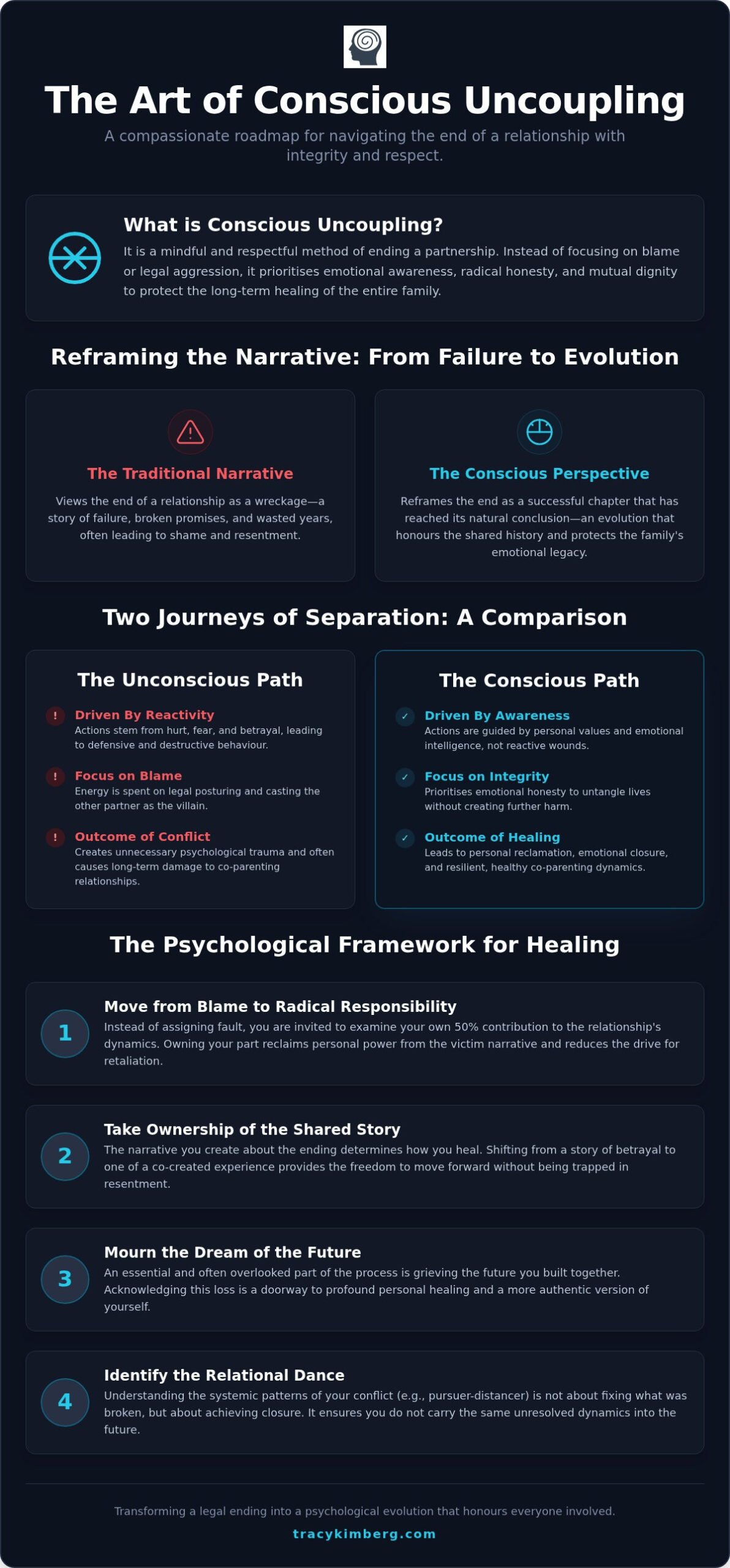
Conscious Separation vs. Traditional Divorce: A Comparison of Outcomes
When a relationship reaches its conclusion, couples generally face two distinct paths. The traditional route is often adversarial by design, rooted in a legal system that was built to resolve disputes rather than heal hearts. This path frequently incentivises partners to highlight each other’s flaws to secure a “better” settlement. In contrast, the conscious uncoupling process operates on a collaborative model. It assumes that whilst the marriage is ending, the respect and shared history do not have to. Choosing this path requires a shift in perspective. You are moving from being opponents in a courtroom to being co-creators of a new family structure.
The financial and emotional “return on investment” of a conscious approach is significant. Traditional divorces can drain life savings through protracted legal battles that leave both parties bitter and exhausted. A collaborative approach focuses on resolution rather than retribution. To understand the foundations of this shift, it helps to look at What is Conscious Uncoupling? and how it reframes the end of a partnership. Whilst solicitors are necessary to handle the “what” of a divorce-the assets and contracts, such as when coordinating with a law firm for Israeli company entering US market-a coach or therapist handles the “how.” One closes a legal chapter; the other ensures you don’t carry the weight of that chapter into your future.
The Emotional Cost of Adversarial Separation
Adversarial separations often trap couples in a “trauma loop.” Every aggressive letter from a solicitor or heated argument over property reinforces the original wounds of the relationship. This conflict doesn’t just stay between the adults; it permeates the entire household. Winning a specific point in court often feels like a hollow victory if it costs you the ability to speak civilly at a future graduation or wedding. In the context of this mindful transition, victory is defined quite simply: it is the preservation of mutual respect and the safety of the family bond.
Prioritising the Family Unit’s Long-Term Health
For parents, the stakes are even higher. Research consistently shows that it isn’t the separation itself that harms children, but the level of conflict they witness between their parents. A conscious separation acts as a vital protective factor. It allows children to see that even when things change, their world remains stable. We prefer to view this as “family evolution” rather than “family brokenness.” This is where specialised support becomes invaluable. Tracy Kimberg offers a Conscious Approached Divorce and separation that specifically addresses these dynamics. Her expertise in adolescent therapy is particularly helpful for parents navigating these transitions with teenagers, who often feel the tremors of a split most acutely. By prioritising long-term healing, you ensure that the family legacy is one of resilience rather than wreckage.
Practical Steps for Navigating the Uncoupling Process with Integrity
Moving from the psychological framework into the daily reality of separation is where the conscious uncoupling process truly takes shape. It is one thing to agree on a philosophy of respect; it is quite another to maintain that respect whilst deciding who keeps the family home or how to split the weekends. This “messy middle” requires a structured approach to keep emotions from hijacking your shared intentions. By following a clear sequence of steps, you can ensure that the transition remains a proactive evolution rather than a reactive collapse.
- Step 1: Setting the Intention. Sit down together to agree on the “why” of this approach. Document your commitment to a peaceful transition to serve as a compass during more difficult moments.
- Step 2: Establishing Boundaries. Clarity is kindness. Define new rules for your physical and emotional space, such as designated times for discussing logistics or agreeing not to check each other’s social media.
- Step 3: Communicating the Decision. Draft a shared narrative for friends, family, and colleagues. This prevents the “he-said, she-said” dynamic and protects your collective dignity.
- Step 4: The Legal Process. Bring your conscious mindset into the mediation room. View the legalities as a tool for fair reorganisation rather than a weapon for retribution.
- Step 5: Ritualising the End. Create a specific moment of closure. This might be a shared meal, a letter of gratitude for the years spent together, or a symbolic gesture that honours the past whilst releasing the future.
Communicating with Clarity and Compassion
Difficult conversations are inevitable, but they don’t have to be destructive. When discussing sensitive topics, utilise “I” statements to own your experience. For example, say, “I feel anxious when we talk about the finances without a set plan,” rather than, “You always make the finances difficult.” Avoid “kitchen-sinking,” which is the habit of bringing up every historical grievance during a current disagreement. Practice active listening by reflecting back what you’ve heard before responding. This demonstrates that whilst you are no longer partners, you still value the other person’s humanity. If these conversations feel too volatile to handle alone, engaging in Relationship Counselling and Coaching for Couples can provide the safe, structured environment needed to speak your truth without causing further harm.
Protecting Children: The Gentle Guide to Telling Them
For parents, the most daunting step is often telling the children. It is vital to present a unified front. Children and teenagers are highly sensitive to the emotional “undercurrents” between parents. Reassure them that whilst the structure of the family is changing, the foundation of love is not. Use age-appropriate language and avoid sharing adult details about why the relationship ended. Most importantly, explicitly tell them that they are not responsible for the split. Teenagers, in particular, may need more space to process their feelings, so remain available without forcing them to “choose a side” in their loyalty.
Healing through Support: The Role of Relationship Coaching
The conscious uncoupling process is rarely a journey one should take alone. Whilst friends and family provide comfort, they often carry their own biases that can inadvertently fuel conflict. A neutral professional acts as the guardian of your shared intent, helping you stay anchored in your values when the emotional waves of grief or anger feel overwhelming. This support ensures the conscious uncoupling process remains a path of growth rather than a cycle of reactivity. Unlike legal mediation, which focuses on the division of tangible assets, emotional coaching focuses on the preservation of the human spirit. It’s the difference between signing a contract and healing a heart.
Tracy Kimberg provides this specialised support through a research-based lens, drawing on the works of Gottman and Perel to guide you through the psychological transition. Whether you are working through a 12-Week Relationship Recovery Process to find clarity or seeking bespoke coaching for a conscious separation, the goal is the same: to move forward without the weight of unresolved trauma. It’s also vital to engage in individual therapy alongside any couple-based work. This allows each person to process their own triggers and history, ensuring that the uncoupling remains a clean break rather than a lingering wound.
Reclaiming Your Individual Identity Post-Separation
After years of defining yourself through the lens of a partnership, the question “Who am I now?” can feel both terrifying and exhilarating. This phase is about more than just moving on; it’s about a deep reclamation of your personal values and future goals. Many of our clients find that this transition becomes a transformational programme for their own lives, sometimes seeking spiritual clarity from Third Eye Kentucky to help navigate their soul’s new direction. It allows them to rediscover parts of themselves that were perhaps silenced or sidelined during the marriage. By working through this process consciously, you aren’t just ending a relationship. You are beginning a more authentic relationship with yourself.
Next Steps: Booking a Consultation with Tracy Kimberg
Taking the first step toward a conscious separation is an act of profound courage. A first session for Relationship Coaching for Couples: What to Expect is designed to be a safe, non-judgemental space where we explore your options and identify the path that best protects your family legacy. We’ll discuss your specific challenges, from co-parenting anxieties to the logistics of physical space, and begin building a roadmap for your evolution. Reach out today to begin this proactive adventure toward long-term emotional health. You deserve a transition that honours your past whilst securing your future well-being.
Honouring Your Past Whilst Securing Your Future
Choosing to end a partnership with dignity is one of the most courageous decisions you can make. By shifting your perspective from a “failed relationship” to a conscious transition, you protect the emotional well-being of your children and yourself. The conscious uncoupling process isn’t about avoiding the pain of separation; it’s about navigating that pain with radical responsibility and mutual respect. You’ve learned that by setting clear intentions and establishing healthy boundaries, you can rewrite the ending of your shared story into a beginning of personal reclamation.
If you’re ready to navigate this transition with expert guidance, book a consultation for professional separation support with Tracy Kimberg. As a specialist in research-based relationship dynamics, Tracy provides transformational programmes and expert support for parents and teenagers. You don’t have to face this transition in isolation. Healing is possible, and a new, healthier chapter for your family is waiting to be written.
Frequently Asked Questions
Is conscious uncoupling the same as a standard legal divorce in the UK?
No, it is a psychological and emotional framework rather than a legal procedure. Whilst a legal divorce handles the decree absolute and financial orders, this approach focuses on the relational transition and emotional closure. You still need to follow UK legal requirements for the actual dissolution of the marriage, but this methodology ensures you do so with minimal conflict and maximum integrity.
Can we consciously separate if my partner is being difficult or angry?
Yes, you can still apply these principles even if your partner is currently reactive. While the process is most effective when both individuals are willing, your personal commitment to radical responsibility can de-escalate tension. By changing your own dance steps, you often shift the entire dynamic, making it significantly harder for the other person to maintain a high-conflict stance.
How long does the conscious uncoupling process typically take?
The timeline varies based on the complexity of your relationship history and current emotional state. Some couples find clarity through a structured 12-week programme, whilst others may require several months of bespoke coaching to navigate deeper layers of grief and logistical changes. It’s an evolving experience rather than a static treatment, moving at the pace of your personal healing and readiness.
Will choosing a conscious approach affect our legal standing in a divorce?
No, choosing a mindful separation does not negatively impact your legal rights or standing in the UK. In fact, it often makes the legal process smoother and less costly by reducing the need for adversarial litigation. By reaching agreements through mutual respect, you can often present a consent order to the court that reflects your shared intentions without a judge’s intervention.
How do we handle co-parenting during the uncoupling process?
Co-parenting is handled by prioritising the children’s emotional safety over your own temporary grievances. You should aim to present a unified front and avoid discussing adult conflicts in front of children or teenagers. This approach treats the family as an evolving unit where the parental bond remains intact even as the romantic partnership dissolves, ensuring a stable environment for your children to thrive.
Is it ever too late to choose a conscious approach to our breakup?
It is never too late to shift toward a more mindful and respectful way of interacting. Even if your separation began with high conflict or legal battles, you can choose at any moment to stop the trauma loop and pursue emotional closure. This reclamation of your integrity is a powerful step toward long-term healing for everyone involved, regardless of how much time has passed since the initial split.
Do we both need to attend coaching sessions for uncoupling to work?
Whilst it is ideal for both partners to participate, the conscious uncoupling process can still be highly effective when undertaken individually. Individual coaching allows you to process your own triggers and take ownership of your part in the relationship dynamic. This personal growth often naturally improves the separation dynamic, even if your partner chooses not to engage in the therapeutic work themselves.
What is the first step we should take if we want to separate amicably?
The first step is to set a shared intention to prioritise respect and long-term healing over short-term reactivity. This involves an honest conversation where you both acknowledge that the current form of the relationship is ending, but your commitment to each other’s humanity is not. Seeking professional support early can help you establish the boundaries needed to keep this conscious uncoupling process alive during the more challenging logistical phases.

Article by
Tracy Kimberg
Tracy Kimberg is a Relationship Expert, Couples Therapist and Coach with a dedicated focus on helping couples and individuals rebuild connection, trust and emotional safety in their relationships. Drawing on the research of John and Julie Gottman, the relational insights of Esther Perel, and years of hands-on therapeutic experience, Tracy offers a warm, non-judgemental and deeply compassionate approach to modern relationships.
Based in Dorset, Tracy works with couples navigating communication breakdowns, betrayal, intimacy challenges, separation, family dynamics and life transitions. Known for creating a safe and grounded therapeutic space, she combines practical tools with emotional depth to help clients move beyond survival patterns and towards meaningful, lasting change.
With a reputation for empathy, professionalism and dedication to her clients’ growth, Tracy is passionate about helping people feel seen, understood and empowered — both within their relationships and within themselves.
Disclaimer
Disclaimer:
The information shared in this article is intended for educational and informational purposes only and should not be considered a substitute for professional therapeutic, psychological, medical or legal advice. Every individual and relationship is unique, and the perspectives offered are based on general therapeutic principles, research and professional experience.
Reading this article does not establish a therapist-client relationship with Tracy Kimberg. If you are experiencing significant emotional distress, relationship crisis, trauma, or mental health concerns, it is important to seek support from a qualified professional appropriate to your individual circumstances.
All content remains the intellectual property of Tracy Kimberg and may not be reproduced or distributed without permission.