

The goal of talking to your teen isn’t to extract information; it’s to prove that you’re a safe harbour for their heaviest emotions. You’ve likely felt that sting of being shut out, met with a sharp “I’m fine” whilst you worry about the weight of 2026’s digital pressures and intense school stress. Learning how to talk to your teenager about mental health isn’t about having a perfect script. It’s about shifting your stance from an investigator to a compassionate witness. With nearly one in three students reporting feelings of hopelessness, your role as a steady, wise presence has never been more vital for their emotional well-being.
I understand the quiet anxiety that comes with fearing you’ll miss a serious warning sign. This guide will help you move beyond those surface-level exchanges to create a truly non-judgemental space where your teenager feels heard. You’ll discover practical tools to handle “spiky” reactions with calm optimism and gain the confidence to identify exactly when professional support is needed. We’ll explore how to transform these difficult moments into a proactive adventure in healing, ultimately strengthening your emotional connection and helping your family thrive in a complex world.
Key Takeaways
- Learn why shifting from a “fixer” to a compassionate “witness” helps dissolve the “I’m fine” barrier and fosters a deeper emotional connection.
- Master practical strategies on how to talk to your teenager about mental health, including the “side-by-side” rule for more relaxed, non-confrontational conversations.
- Recognise the difference between typical adolescent behaviour and deeper mental health concerns by applying the “two-week rule” to observe intensity and frequency.
- Discover how to reframe therapy as a proactive “mental gym” or an adventure in healing, helping your teenager feel empowered rather than broken.
- Use “I” statements to share your observations with warmth, ensuring your teenager feels supported rather than interrogated.
Beyond the ‘I’m Fine’: Why Mental Health Conversations Matter in 2026
When your teenager says “I’m fine” whilst staring at their phone, it’s easy to feel a pang of helplessness. You know something is simmering beneath the surface. In 2026, the pressures on young people have reached a fever pitch. It’s no longer just about the typical growing pains of adolescence; it’s about navigating a world of constant digital performance, global uncertainty, and intense academic competition. Your anxiety as a parent is a natural response to their struggle. It’s a sign of your deep connection, even if that connection feels strained right now.
Mental health isn’t a binary state where your child is either “healthy” or “in crisis”. It’s a fluid spectrum. We all move along this line depending on our circumstances and internal resources. By learning how to talk to your teenager about mental health, you aren’t just looking for problems to solve. You’re building emotional literacy. This is a vital life skill that allows the whole family to name their feelings, understand their triggers, and move through challenges with resilience rather than repression.
The Changing Landscape of Teenage Anxiety
Why Your Teenager Might Be Guarded
Privacy is a developmental milestone. Your teen needs to pull away to find their own identity. However, they often become guarded because they fear being “managed” or judged. If they share a heavy emotion, they worry you’ll immediately try to fix it or, worse, feel disappointed in them. Sometimes our own parental ego gets in the way. We want to be the hero who has all the answers, but this desire to be “right” can accidentally shut down the conversation. They don’t always need a solution; they need to know that their internal world is a place you can inhabit without flinching.
- Privacy vs. Secrecy: Recognise that wanting space is normal, but withdrawing from life is a signal.
- The Fear of Burdening: Many teens stay silent because they don’t want to add to their parents’ stress.
- The Digital Mask: Understand that their online persona may be vastly different from their internal reality.
The Psychological Shift: Moving from ‘Fixer’ to ‘Witness’
Most guidance on how to talk to your teenager about mental health focuses on the perfect script. However, the most profound shift happens not in what you say, but in how you show up. When we see our child in pain, our biological instinct is to repair the situation immediately. In psychology, we call this the “Righting Reflex”. Whilst it comes from a place of deep love, this urge to fix often backfires. It can make a teenager feel that their heavy emotions are a problem to be solved rather than an experience to be understood. To truly connect, we must move from being a “fixer” to becoming a “witness”.
Witnessing means creating a relational container where your teenager’s feelings can exist without judgement. It involves sitting in the discomfort of their sadness or anxiety without rushing to provide a silver lining. This approach is rooted in the work of John Gottman, who distinguishes between “Emotion Coaching” and “Emotion Dismissing”. When we dismiss, even with good intentions (saying “don’t be sad” or “it’s not that bad”), we tell the child that their internal world is unreliable. By witnessing, we validate their reality. Integrating professional tips for talking about mental health can help you navigate these moments whilst maintaining your role as a steady, supportive presence.
What is Emotion Coaching?
Emotion Coaching is a research-based method to build emotional intelligence. It involves five distinct stages: becoming aware of the emotion, recognising it as an opportunity for intimacy, listening with empathy, naming the feeling, and eventually moving toward problem-solving. Neuropsychology tells us that naming a feeling “tames” the brain’s limbic system; it moves the experience from a chaotic emotional state into the logical prefrontal cortex. This simple act of labelling an emotion can significantly lower a teenager’s physiological distress.
Managing Your Own Emotional Response
The greatest challenge in witnessing is managing your own internal weather. You cannot calm a storm if you are the storm. When your teen is distressed, it often triggers your own fears about their future or your adequacy as a parent. Self-regulation is the foundation of co-regulation. By identifying your own triggers, you can remain a “calm presence” that helps settle their nervous system. This is why therapy for teenagers often involves supporting the parents too; it ensures the home remains a safe harbour rather than a theatre of shared anxiety.
- Identify your “Fixer” urges: Notice when you want to interrupt with a solution.
- Practice Active Silence: Sometimes the most powerful response is simply “I can see how hard this is for you.”
- Prioritise Presence: Your physical and emotional availability matters more than your advice.
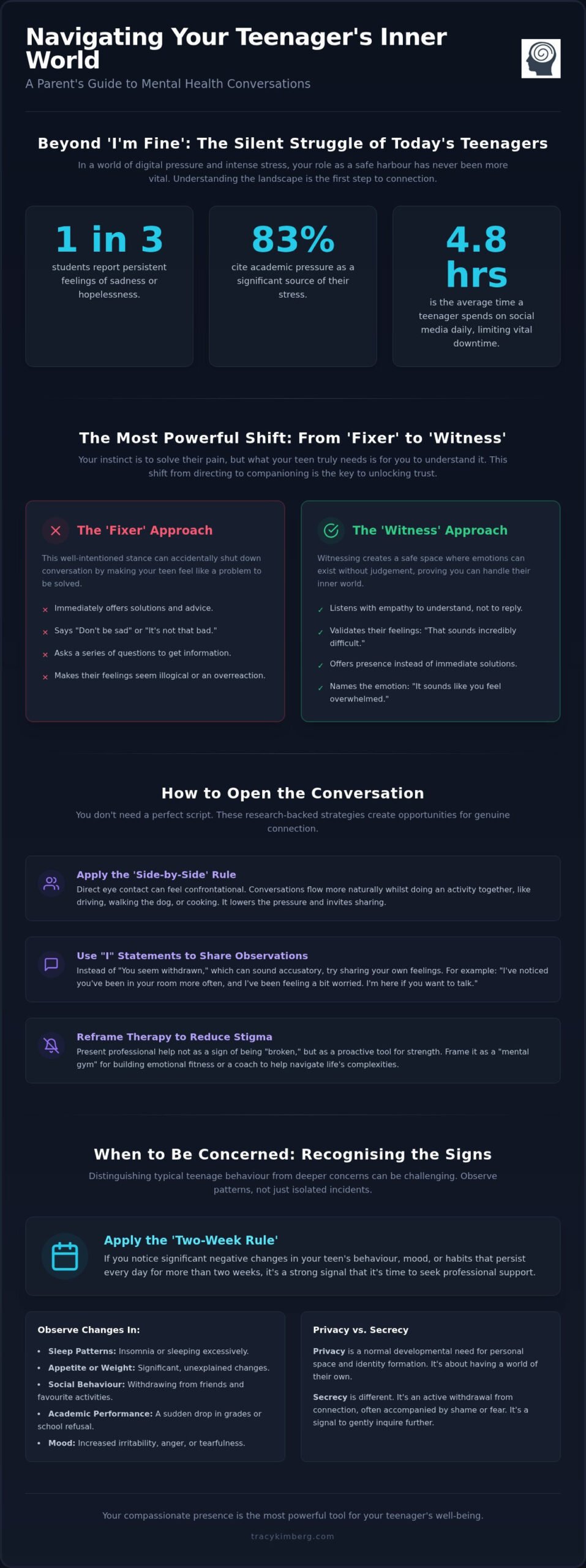
Recognising the Signs: Normal Behaviour vs. Mental Health Concerns
Distinguishing between the natural turbulence of puberty and a genuine mental health struggle is one of the most challenging tasks for any parent. Whilst we’ve discussed the importance of moving from a “fixer” to a “witness”, knowing exactly when to step in requires a clear framework. It’s helpful to view these shifts not as isolated incidents, but as patterns. In clinical practice, we often use the “two-week rule”. If a concerning behaviour, such as deep sadness or intense irritability, persists for more than fourteen days without reprieve, it’s a signal that your teenager may be struggling with more than just a bad mood.
When you are considering how to talk to your teenager about mental health, focus on two vital metrics: intensity and frequency. Every teenager will have moments of “spiky” reactions or days where they want to hide under their duvet. However, when these reactions become their primary way of relating to the world, or when they occur with a frequency that disrupts the family’s rhythm, it’s time to pay closer attention. We also look for “functional impairment”. This simply means asking: is their emotional state stopping them from living their life? If they are no longer attending school, have stopped eating with the family, or have abandoned their sleep hygiene, these are clinical indicators rather than mere teenage angst.
The Comparison: Angst vs. Crisis
To help you navigate these shadowy corners, consider these distinctions in their daily behaviour:
- Normal Privacy: Shutting the bedroom door to listen to music or chat with friends. Secretive Isolation: Refusing to leave their room for meals and cutting off all social connection, even online.
- Occasional Irritability: Snapping at a sibling after a long day of academic stress. Constant Explosive Anger: Unpredictable, volatile outbursts that feel out of proportion to the situation and happen daily.
- Changing Interests: Dropping one hobby to pick up a new one. Anhedonia: A complete loss of joy in everything they once loved, accompanied by a flat emotional tone.
When to Trust Your ‘Gut Instinct’
Whilst statistics are useful, you are the ultimate expert on your child’s baseline. You know the unique “frequency” of their personality. Trust your gut instinct when you notice subtle shifts in their tone, the way they avoid eye contact, or a lingering heaviness in their engagement. Patterns matter more than one-off events. Tracking these changes over time allows you to approach the conversation with evidence-based concern rather than just a vague feeling of unease. By identifying these patterns early, you can introduce therapy for teenagers as a proactive adventure in healing rather than a reactive crisis measure.
A Step-by-Step Guide to Opening the Conversation
Initiating a dialogue about internal struggles is often the most daunting part of the parental journey. You might worry about saying the wrong thing or triggering a defensive “Go away”. However, understanding how to talk to your teenager about mental health is as much about the physical environment as it is about the words you choose. One of the most effective strategies is the “Side-by-Side” Rule. For many young people, direct eye contact feels like an interrogation; it triggers a subtle threat response in the brain. By talking whilst driving, walking the dog, or even washing up together, you lower the intensity. The shared activity provides a psychological buffer, making it much easier for them to let their guard down.
When you do speak, lead with “I” statements rather than “You” statements. If you say, “You’ve been acting strangely,” it sounds like an accusation. Instead, try sharing your own observations with warmth: “I’ve noticed you’ve seemed a bit heavy lately, and I’ve been feeling a bit worried about you.” This invites them into your experience rather than putting them on the defensive. Couple this with open-ended questions. Instead of asking “Are you okay?”, which invites a one-word “Yes”, try “What has been the heaviest part of your week?”. This gives them the space to expand on their emotional world without feeling pressured to provide a perfect answer.
Setting the Scene for Success
Timing is everything. Avoid trying to open a deep conversation during high-stress moments, such as the morning school run or right before bed when everyone is exhausted. Choose a low-pressure moment where there is no immediate deadline. Your goal is to create a “non-judgemental zone” where nothing is off-limits. If they do start to share, resist the urge to interrupt with advice. Simply being a witness to their truth is often more healing than any solution you could offer.
Scripts for Connection
Sometimes, having a few pre-prepared phrases can help you stay grounded when the conversation feels “spiky”. If your teenager is withdrawn, a simple, “I’m here when you’re ready, no pressure,” keeps the door open without forcing them through it. If they are reacting with anger, try validating the underlying struggle: “I can see you’re really hurting right now, and I want to help us navigate this together.” Crucially, let the silence do the work. After you ask a question, wait. It might feel awkward, but giving them ten seconds of quiet allows them to process their thoughts and realise you are truly listening.
If you find that every attempt at connection ends in a shut door, it might be time to introduce a neutral third party. I offer specialised therapy for teenagers to help bridge the communication gap and provide a safe space for your child to explore their emotional world.
When Professional Support is the Next Step in Healing
Sometimes, despite our best efforts and the most compassionate “witnessing”, the weight of a teenager’s emotional world requires specialised support. It’s helpful to reframe the idea of therapy at this stage. Rather than viewing it as a “hospital for the broken”, consider it a “mental gym” or a proactive adventure in self-discovery. In 2026, the standard of care in adolescent mental health focuses heavily on shared decision-making between parents, teens, and clinicians. This collaborative approach ensures that seeking help isn’t something done to a teenager, but something done with them to navigate the unique pressures of modern life.
If you’re wondering how to talk to your teenager about mental health services when they seem reluctant, focus on the benefit of a neutral third party. A therapist serves as a bridge. In the intricate dance of the parent-teen relationship, things often get lost in translation. A neutral expert can hear what the teenager is saying beneath the “spiky” layers of anger or the heavy silence of withdrawal. They provide a confidential space where a young person can untangle complex feelings without worrying about their parents’ immediate emotional reactions. By positioning therapy as a tool for empowerment and personal growth, you lower the barrier to entry and respect their growing need for autonomy.
Finding the Right Fit for Your Teen
Whilst school counselling is a valuable resource for immediate academic stress, private specialised therapy offers a deeper, more consistent container for healing. When searching for a therapist, prioritising rapport is essential; the therapeutic relationship is the most significant predictor of a positive outcome. A teenager needs to feel that their therapist genuinely “gets” them, especially in a world where they often feel misunderstood by the adult world at large. My approach focuses on creating a safe, non-judgemental environment where young minds can explore anxiety and depression using research-based methods. We focus on movement and progress, ensuring the process feels like an evolving experience rather than a static treatment.
Taking the First Step Together
Involving your teenager in the selection process is a powerful way to build trust and agency. You might offer them the opportunity to look at a therapist’s profile or encourage them to have an initial consultation to see if they feel a sense of connection. My 12-Week Relationship Recovery Process and specialised teen sessions are designed to support the entire family dynamic. We recognise that as one person begins to heal, the whole family system starts to find its steady ground again. This is an invitation to connect and work toward a collaborative solution for your child’s long-term emotional health.
Discover how therapy can support your teenager’s mental health and help your family navigate these complex emotional landscapes with confidence and calm optimism.
Building a Bridge to Their World
Strengthening the relational container between you and your child is a profound act of repair. When you move beyond the urge to fix and instead choose to witness their discomfort, you prove that you’re a safe harbour for their heaviest emotions. Whether you’re utilising the “side-by-side” rule during a quiet drive or applying the “two-week rule” to observe patterns of distress, your steady presence is their greatest asset. Learning how to talk to your teenager about mental health isn’t about achieving a perfect outcome; it’s about showing up with curiosity and calm optimism.
If you feel stuck in a cycle of “I’m fine” and shut doors, professional guidance can offer the bridge you need. As a BACP Registered Therapist and specialist in teenager and adult mental health, I provide a research-based approach grounded in the insights of Gottman and Maté. We can transform these challenges into a proactive adventure in healing for your entire family. Book a consultation to support your teenager’s emotional well-being and let’s begin this journey together. There’s always a path back to connection, and you don’t have to find it alone.
Frequently Asked Questions
How do I know if my teenager is depressed or just being a typical teen?
You can distinguish between typical angst and depression by looking at the duration and depth of their withdrawal. Typical teenage moodiness usually lifts after a few days, but clinical depression persists for more than two weeks and significantly interferes with their daily functioning. If they are no longer attending school or have lost interest in their favourite activities, it’s a signal to seek professional guidance rather than waiting for the phase to pass.
What should I do if my teenager refuses to talk to me about their feelings?
If your teenager shuts down, resist the urge to push for answers, as this often increases their defensiveness. Instead, focus on maintaining a steady, non-demanding presence whilst using the “side-by-side” rule mentioned earlier. Simply stating, “I’m here whenever you’re ready to share, no pressure,” proves you are a safe harbour. This creates an open invitation for them to step toward you when they feel psychologically ready.
Is it okay to look at my teenager’s phone if I’m worried about their mental health?
Balancing privacy with safety is a delicate dance in the digital age. Whilst teenagers need autonomy to develop their identity, your role as a protector takes precedence if you suspect they are in immediate danger. If you must check their phone, try to be transparent about your concerns first. Explain that your actions come from a place of deep care and a desire to keep them safe amongst 2026’s complex digital pressures.
How can I tell the difference between normal anxiety and an anxiety disorder?
Normal anxiety is usually situational, such as feeling nervous before a school presentation or a sports match. In contrast, an anxiety disorder feels pervasive and often occurs without an obvious trigger, stopping them from participating in normal life. When you are learning how to talk to your teenager about mental health, pay attention to whether their worries are proportionate to the situation or if they are becoming stuck in a loop of irrational fear.
What are the first steps to take if my teenager mentions self-harm?
If your teenager mentions self-harm, stay as calm as possible and take their words with absolute seriousness. Avoid reacting with shock or judgement, as this can cause them to retreat further into secrecy. Your first step should be to acknowledge their pain and immediately contact a mental health professional or a GP. Ensuring their physical safety is the priority whilst you begin the process of finding specialised therapeutic support.
How do I bring up the idea of therapy without making them feel ‘crazy’?
Reframe therapy as a proactive “mental gym” or an adventure in healing rather than a punishment for bad behaviour. You might say, “I’ve noticed life feels heavy lately, and I’d like us to find a neutral person who can help you navigate these feelings.” By positioning the therapist as a specialised consultant for their well-being, you remove the stigma of being “broken” and offer them a tool for personal empowerment.
Can social media actually cause mental health issues in teenagers?
Social media significantly impacts adolescent mental health, with research indicating that spending over three hours daily on these platforms doubles the risk of poor outcomes. It often forces teenagers to maintain a digital mask, leading to a profound disconnect between their online persona and their internal reality. This constant performance can exacerbate feelings of inadequacy, making it even more vital to understand how to talk to your teenager about mental health in a grounded, offline space.
Whilst waiting for professional support, focus on the fundamentals of co-regulation and physical well-being. Ensure they are getting enough sleep and maintaining a balanced diet, as these are the biological foundations of emotional resilience. Because stress often presents as physical discomfort, you might visit Gut-Directed Hypnotherapy to find out how specialised online sessions can support teenagers struggling with IBS symptoms. Be the “calm presence” in their life by managing your own reactions and providing a steady, non-judgemental environment. Small, consistent acts of connection, like a shared meal or a walk, can provide immediate comfort during the transition into therapy.
Whilst waiting for professional support, focus on the fundamentals of co-regulation and physical well-being. Ensure they are getting enough sleep and maintaining a balanced diet, as these are the biological foundations of emotional resilience. Be the “calm presence” in their life by managing your own reactions and providing a steady, non-judgemental environment. Small, consistent acts of connection, like a shared meal or a walk, can provide immediate comfort during the transition into therapy.

Article by
Tracy Kimberg
Tracy Kimberg is a Relationship Expert, Couples Therapist and Coach with a dedicated focus on helping couples and individuals rebuild connection, trust and emotional safety in their relationships. Drawing on the research of John and Julie Gottman, the relational insights of Esther Perel, and years of hands-on therapeutic experience, Tracy offers a warm, non-judgemental and deeply compassionate approach to modern relationships.
Based in Dorset, Tracy works with couples navigating communication breakdowns, betrayal, intimacy challenges, separation, family dynamics and life transitions. Known for creating a safe and grounded therapeutic space, she combines practical tools with emotional depth to help clients move beyond survival patterns and towards meaningful, lasting change.
With a reputation for empathy, professionalism and dedication to her clients’ growth, Tracy is passionate about helping people feel seen, understood and empowered — both within their relationships and within themselves.
Disclaimer
Disclaimer:
The information shared in this article is intended for educational and informational purposes only and should not be considered a substitute for professional therapeutic, psychological, medical or legal advice. Every individual and relationship is unique, and the perspectives offered are based on general therapeutic principles, research and professional experience.
Reading this article does not establish a therapist-client relationship with Tracy Kimberg. If you are experiencing significant emotional distress, relationship crisis, trauma, or mental health concerns, it is important to seek support from a qualified professional appropriate to your individual circumstances.
All content remains the intellectual property of Tracy Kimberg and may not be reproduced or distributed without permission.