

What if the most courageous step you take this year isn’t “fixing” your partner, but choosing to walk through a door together with your defences down? It’s completely normal to feel a sense of trepidation as you wonder how to prepare for couples counselling. You might fear being ganged up on by a professional or worry that revisiting old wounds will only deepen the divide. Perhaps you’re even questioning if the connection is too far gone to be saved. These feelings don’t mean your partnership is failing; they simply mean you care deeply about the outcome.
I understand that the space between deciding to seek help and actually sitting on that sofa can feel fraught with tension. This guide will help you transform that anxiety into a sense of purposeful readiness. We’ll explore a compassionate, research-backed framework designed to help you organise your thoughts and lower the emotional temperature at home. By the time you finish reading, you’ll have a clear set of goals and the tools to ensure your first session is the beginning of a powerful, restorative adventure rather than a source of further conflict.
Key Takeaways
- Shift your perspective from a courtroom battle to a collaborative discovery, allowing your therapist to act as a wise guide through your shared history.
- Discover why individual reflection on your own emotional blueprint is the secret weapon for creating meaningful change within your partnership.
- Learn exactly how to prepare for couples counselling by organising key relationship milestones and understanding the benefits of research-backed methods.
- Establish healthy pre-session boundaries to reduce tension and ensure your initial conversations about therapy don’t trigger further conflict.
- Explore how a structured 12-Week Relationship Recovery Process can provide the safety and momentum needed to turn your therapeutic journey into a proactive adventure.
The Mindset Shift: From Courtroom to Discovery
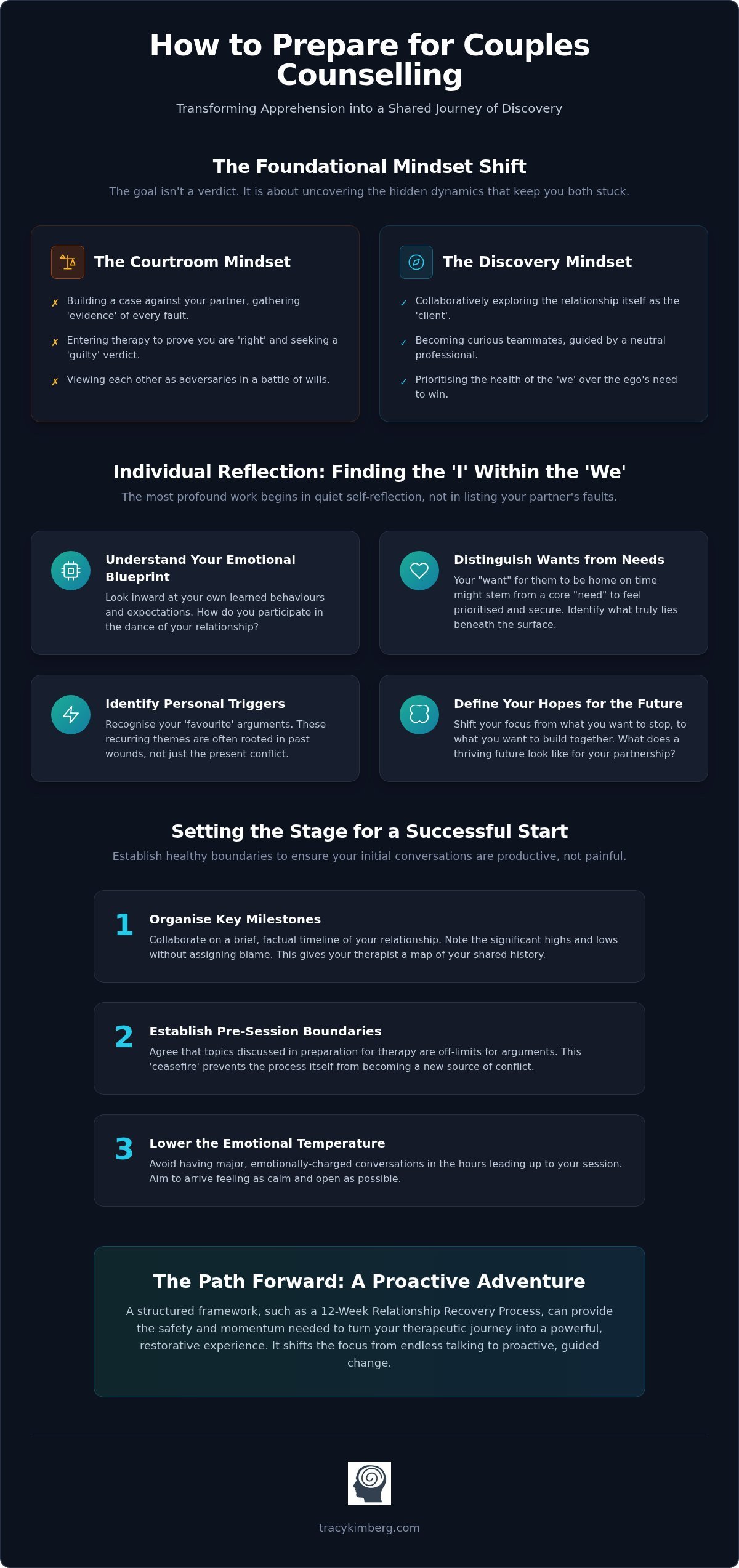
Many couples arrive at their first session feeling as though they are heading into a legal deposition. They have spent weeks, or perhaps years, building a case against their partner; gathering evidence of every forgotten chore, every sharp word, and every missed connection. This courtroom mindset is the greatest barrier to healing. To truly understand how to prepare for couples counselling, you must first recognise that the goal isn’t a verdict. It’s a discovery. Couples therapy is not about finding a winner or a loser. It is about uncovering the hidden dynamics that keep you both stuck in the same painful loops.
I often describe my role as that of a Wise Guide. Whilst I hold the map and manage the process to ensure safety, you and your partner are the ones who must provide the honesty. It’s a collaborative exploration where we look at the “between” space. We aren’t just looking at you or your partner; we are looking at the relationship itself as the client. This shift allows you to stop being adversaries and start being teammates again. You manage the vulnerability; I manage the architecture of the conversation.
You might feel a lingering anxiety about opening “Pandora’s Box.” There is a common fear that by naming the hidden hurts or the “elephant in the room,” you will somehow make the situation worse. However, when we leave these things in the dark, they grow. Bringing them into the light of a professional setting allows us to tame them together. Relational readiness is the quiet, radical willingness to prioritise the health of the “we” over the ego’s need to be “right.”
Relinquishing the Need to be ‘Right’
When we are stuck in a cycle of blame, progress stalls. This “blame game” isn’t just exhausting; it’s a defensive mechanism that prevents intimacy. Preparation involves shifting your focus from your partner’s flaws to the negative cycle that exists between you. By cultivating “compassionate curiosity” about your own triggers and behaviours, you begin to see that your reactions are often just as much a part of the problem as your partner’s actions. The moment you stop trying to win the argument is the moment you start winning back your relationship.
Understanding the Safe Environment
A modern therapeutic setting is a non-judgemental space where both voices carry equal weight. I am here to ensure that the conversation remains productive and that no one feels “ganged up on” by the therapist. It is natural to worry that things might feel worse before they feel better. This is a natural part of the healing arc. Like cleaning a wound, the process of honesty can be uncomfortable, but it is necessary for genuine, long-term recovery and emotional health.
Individual Reflection: Finding the ‘I’ Within the ‘We’
Whilst the session involves two people, the most profound work often begins in the quiet moments of self-reflection. Many people view therapy as a platform to finally list their partner’s faults. However, the secret weapon of successful outcomes is individual preparation. By looking inward, you begin to understand your “emotional blueprint”; the set of learned behaviours and expectations that you bring into the partnership. This internal audit is a vital part of how to prepare for couples counselling, as it shifts the focus from what your partner is doing wrong to how you are both participating in the dance.
It’s helpful to distinguish between your surface “wants” and your core “needs.” You might “want” your partner to stop working late, but your core “need” is to feel prioritised and secure. Approaching the first session with this level of radical candour about your own contributions to the dynamic transforms the experience from a blame-fest into a healing process. When you show up ready to own your part, you give your partner the permission to do the same.
Identifying Your Personal Triggers
We all have “favourite” arguments. These are the recurring themes that seem to play on a loop, regardless of the initial spark. Often, these aren’t about the laundry or the finances; they are about the “ghosts” of past experiences. Drawing on the trauma-informed perspectives of Gabor Maté, we can see that our most intense reactions are frequently rooted in childhood wounds rather than the present moment. Communicating with your partner about these personal insights requires vulnerability, but it sets a tone of mutual discovery before you even enter the room.
Defining Your Hopes for the Future
Instead of focusing on what you want to stop happening, try to visualise what a “recovered” relationship actually feels like. Move beyond the desire for them to change and towards a vision of how you want the “us” to feel. Consider setting two or three personal goals for your own growth within the therapy process. This might include learning to listen without immediately becoming defensive or finding ways to express your needs clearly rather than using sarcasm. This proactive approach ensures you aren’t just waiting for a fix, but actively participating in a Relationship Counselling and Coaching for Couples journey that honours both of your experiences.
Practical Logistics: Setting the Stage for Success
Preparing for your first session isn’t just about emotional readiness; it’s also about the architecture of the work itself. When considering how to prepare for couples counselling, it helps to organise your shared history into a coherent narrative. You don’t need a detailed script, but having a mental map of your key milestones, major stressors, and significant turning points allows us to hit the ground running. This logistical clarity provides a stable foundation whilst we explore the more complex emotional layers we discussed in the previous sections.
Choosing the right format is equally vital for your comfort and consistency. Whether you opt for Online Therapy for its convenience or prefer the physical presence of Face-to-Face Therapy, the level of commitment remains the same. Consistency is the heartbeat of progress. Be prepared to discuss the “business” of our work early on; including how often we meet, the duration of each session, and the long-term commitment required to see genuine change.
A Scientific Approach: The Gottman Influence
Research-based therapy offers a more predictable path to recovery than traditional, unstructured talk therapy. By using the “Sound Relationship House” framework, we can assess the structural integrity of your partnership, from how you manage conflict to how you create shared meaning. This data-driven approach takes the guesswork out of relationship coaching. It allows us to identify specific strengths and vulnerabilities with clinical precision, ensuring our time together is both purposeful and effective. We move beyond “he-said-she-said” and into the realm of proven relational health.
Managing the Practicalities in the UK
In the UK, finding a specialist who understands the specific nuances of relational breakdown or the trauma of infidelity is crucial. When you arrive for your first session, you might choose to bring a journal or a few notes to help you stay focused, but your most important asset is an open mind. If you find the idea of open-ended therapy daunting, you might prefer the structure of a signature 12-Week Relationship Recovery Process. This programme provides a clear beginning, middle, and end, offering the safety and momentum that many couples need to navigate their way back to one another in a proactive, time-bound adventure.
Communicating with Your Partner Before the Session
The lead-up to your first appointment can often feel like walking on eggshells. You might be tempted to use the upcoming session as a threat during a disagreement or, conversely, avoid talking about it altogether to prevent a fresh argument. To truly understand how to prepare for couples counselling, you must learn to protect the relational space before you even arrive. This involves establishing “pre-session boundaries.” Agree to hit the pause button on major conflicts for a few days, allowing the therapist to provide the containment you both need. By deciding to enter the room as a united front, even if you’re currently disconnected, you signal to one another that the partnership is a priority worth the shared effort.
Validating your partner’s anxieties is a vital part of this process. It’s natural for one or both of you to feel exposed or defensive. Instead of dismissing these fears, acknowledge the courage it takes to sit with a stranger and discuss your private world. When you show up with a commitment to listen as much as you speak, you transform the first hour of therapy from a potential battleground into a shared discovery.
The ‘Softened Start-up’ for Therapy Talk
Borrowing from the Gottman Method, a “softened start-up” is essential when discussing your expectations. Instead of presenting a laundry list of your partner’s failures, focus on your own hopes and vulnerabilities. Use “I” statements to lower the emotional temperature. A calm pre-therapy check-in might sound like this: “I’m feeling a bit nervous about Thursday, but I’m really hopeful that having a professional guide will help us find our way back to each other. I’m looking forward to us both feeling heard.” This approach invites your partner into a collaborative space rather than forcing them into a defensive crouch.
What to Do if Your Partner is Hesitant
If your partner is reluctant, they may fear being “ganged up on” or worry that therapy is simply the first step towards a “conscious approached divorce and separation.” Help them see the therapist as a neutral Wise Guide, not a judge. Frame the sessions as a safe harbour where the goal is to understand the “why” behind the “what.” If the idea of open-ended therapy feels too daunting or like a never-ending commitment, you might suggest a more structured path. Propose starting with a 12-Week Relationship Recovery Process, which offers a clear roadmap and a sense of momentum that can make the therapeutic journey feel like a proactive adventure rather than a clinical necessity.
The 12-Week Relationship Recovery: A Proactive Adventure
Once you understand how to prepare for couples counselling through mindset shifts and logistical planning, the question becomes: what happens next? Traditional therapy can sometimes feel like an open-ended sea of conversation where couples drift without a clear destination. This is why I offer a signature 12-Week Relationship Recovery Process. It is designed to be a transformational journey with a defined beginning, middle, and end. By providing a structured container, this process offers the safety and momentum that standard sessions often lack, ensuring that your investment in your relationship leads to tangible, lasting change.
This approach is particularly effective for those navigating the aftermath of infidelity or a deep emotional disconnect. We move beyond merely surviving the week and focus on active trust rebuilding and the restoration of emotional intimacy. We look at the healthy dynamics you want to build, rather than just the ones you want to escape. It is an invitation to view your recovery not as a clinical necessity, but as a proactive adventure in rediscovering one another.
The Power of a Structured Path
Breaking down the recovery process into manageable stages allows you to heal without feeling overwhelmed. Each week has a specific focus, which prevents the “drifting” that often occurs when sessions are dictated solely by the crisis of the day. This structure is supported by masterclasses and targeted exercises to complete between our meetings. These tools accelerate your progress, allowing you to practice new communication behaviours in the comfort of your own home. It ensures that the insights we uncover together are immediately integrated into your daily life.
Taking the First Step with Tracy Kimberg
Transitioning from the initial preparation stage to your first session is a profound act of hope. When you work with a specialist who blends coaching and therapeutic perspectives, you receive a unique balance of deep psychological insight and practical, goal-oriented guidance. I am here to help you navigate the complexities of your partnership with compassion and clinical expertise. If you are ready to move from anxiety to action, I invite you to book your initial consultation for the 12-Week Relationship Recovery Process today. Together, we can begin the work of taming the elephants in the room and building a relationship that feels safe, vibrant, and deeply connected.
Embracing the Path to Reconnection
Walking through the door of therapy is an act of profound hope. It signifies a vital shift from the exhaustion of the “blame game” toward the “compassionate curiosity” needed to heal. By understanding how to prepare for couples counselling, you have already taken the first step in dismantling the negative cycles that have kept you apart. You now possess the tools to move beyond surface-level arguments and begin exploring the deeper emotional blueprints that shape your partnership.
Whether you choose to meet face-to-face in the UK or prefer the convenience of our online sessions, you will find a safe, non-judgemental space grounded in the research-based methods of Gottman and Perel. For those seeking deep transformation rather than open-ended talk, my structured programme offers the momentum you need to rebuild trust and intimacy. I invite you to start your 12-Week Relationship Recovery journey with Tracy Kimberg and turn this period of uncertainty into a proactive adventure. Your relationship is a living entity; with the right guidance, it can flourish once more.
Frequently Asked Questions
How do I know if we are ready for couples counselling?
You are ready when the desire for a healthier connection outweighs the fear of the process. If you find yourselves stuck in the same “favourite” arguments or feeling a persistent sense of disconnect, seeking a professional guide is a proactive choice. Readiness isn’t about having all the answers; it’s about a mutual willingness to prioritise the “we” over the need to be right.
What should we do if my partner refuses to attend?
You can still begin the work individually by exploring your own emotional blueprint and relational patterns. Often, when one person in a partnership changes their responses and behaviours, the entire dynamic of the “we” begins to shift. This individual growth can sometimes lower the emotional temperature enough to invite a hesitant partner into the safe harbour of a shared session later on.
Is it normal to feel nervous or anxious before the first session?
It is entirely normal to feel a sense of trepidation as you wonder how to prepare for couples counselling. This anxiety usually stems from a deep care for the relationship and a fear of being vulnerable or ganged up on. Acknowledging these feelings is actually the first step toward a productive discovery, as it shows you are both invested in the outcome.
Will the therapist take sides during our arguments?
No, a professional therapist views the relationship itself as the client, not one individual over the other. My role is to act as a neutral Wise Guide, ensuring both voices carry equal weight in the room. Instead of declaring a winner or loser, we focus on the negative cycle that exists between you, helping you both step out of the courtroom mindset.
How many sessions does it usually take to see a difference?
Whilst every partnership is unique, many couples report a shift in their communication and a reduction in tension after three or four consistent sessions. For those navigating deep disconnect or infidelity, a structured 12-Week Relationship Recovery Process provides the necessary momentum and safety. This time-bound approach ensures you aren’t just drifting but are actively moving toward tangible goals and trust rebuilding.
Can couples counselling work if there has been infidelity?
Yes, infidelity can be a profound trauma, but it can also be a catalyst for building a more honest and resilient partnership. By using research-based methods from Gottman and Perel, we create a non-judgemental environment to explore the “why” behind the “what.” The focus remains on healing the wound and creating a new, more transparent foundation for the future.
What is the difference between relationship coaching and traditional therapy?
Traditional therapy often focuses on healing past trauma and childhood roots, whilst relationship coaching is typically more goal-oriented and focused on future behaviours. My approach blends both perspectives, providing the clinical expertise to handle complex emotional landscapes whilst offering the proactive adventure of coaching. This ensures you understand your history whilst actively building the healthy dynamics you desire.
How do we prepare for an online counselling session versus face-to-face?
For online sessions, your primary task is to ensure you have a private, quiet space where you won’t be interrupted, as this creates the necessary “containment” for the work. When considering how to prepare for couples counselling face-to-face, the focus is often on the physical transition into a neutral, professional environment. Both formats require a stable commitment to honesty and a shared agreement to keep the peace before the session begins.

Article by
Tracy Kimberg
Tracy Kimberg is a Relationship Expert, Couples Therapist and Coach with a dedicated focus on helping couples and individuals rebuild connection, trust and emotional safety in their relationships. Drawing on the research of John and Julie Gottman, the relational insights of Esther Perel, and years of hands-on therapeutic experience, Tracy offers a warm, non-judgemental and deeply compassionate approach to modern relationships.
Based in Dorset, Tracy works with couples navigating communication breakdowns, betrayal, intimacy challenges, separation, family dynamics and life transitions. Known for creating a safe and grounded therapeutic space, she combines practical tools with emotional depth to help clients move beyond survival patterns and towards meaningful, lasting change.
With a reputation for empathy, professionalism and dedication to her clients’ growth, Tracy is passionate about helping people feel seen, understood and empowered — both within their relationships and within themselves.
Disclaimer
Disclaimer:
The information shared in this article is intended for educational and informational purposes only and should not be considered a substitute for professional therapeutic, psychological, medical or legal advice. Every individual and relationship is unique, and the perspectives offered are based on general therapeutic principles, research and professional experience.
Reading this article does not establish a therapist-client relationship with Tracy Kimberg. If you are experiencing significant emotional distress, relationship crisis, trauma, or mental health concerns, it is important to seek support from a qualified professional appropriate to your individual circumstances.
All content remains the intellectual property of Tracy Kimberg and may not be reproduced or distributed without permission.