

You’ve just sent a simple text, and the few minutes it takes for your partner to reply feels like an eternity. Your mind starts to spiral, wondering if you’ve said something wrong or if their affection is suddenly cooling. It’s an exhausting way to live, always waiting for the other shoe to drop whilst your intuition feels like a broken compass. If you find yourself over-analysing every shift in tone, seeking professional counselling for relationship anxiety can help you understand that this silent guest in your partnership is often a vital signal from your attachment system rather than a defect in your character.
I believe you can move from a state of constant worry to a place of deep, research-based relational security. This guide explores how we can transform these anxious signals into lasting emotional stability. We will look at practical ways to foster a secure attachment and build confidence in your relationship’s future, moving away from protest behaviour and towards a partnership where you finally feel safe, grounded, and truly seen.
Key Takeaways
- Recognise your “silent guest” by understanding how early attachment blueprints influence your adult expectations and emotional reactions.
- Learn to distinguish between the frantic noise of anxiety and the steady voice of intuition to reclaim trust in your own perceptions.
- Discover how specialised counselling for relationship anxiety uses research-based frameworks like the Gottman Method to build a foundation of lasting security.
- Implement structured communication tools, such as the “State of the Union” meeting, to express your needs whilst fostering a deeper sense of safety.
- Shift from a cycle of “protest behaviour” to a transformational 12-week recovery process designed to build a resilient and connected relational future.
The Silent Guest: Understanding the Nature of Relationship Anxiety
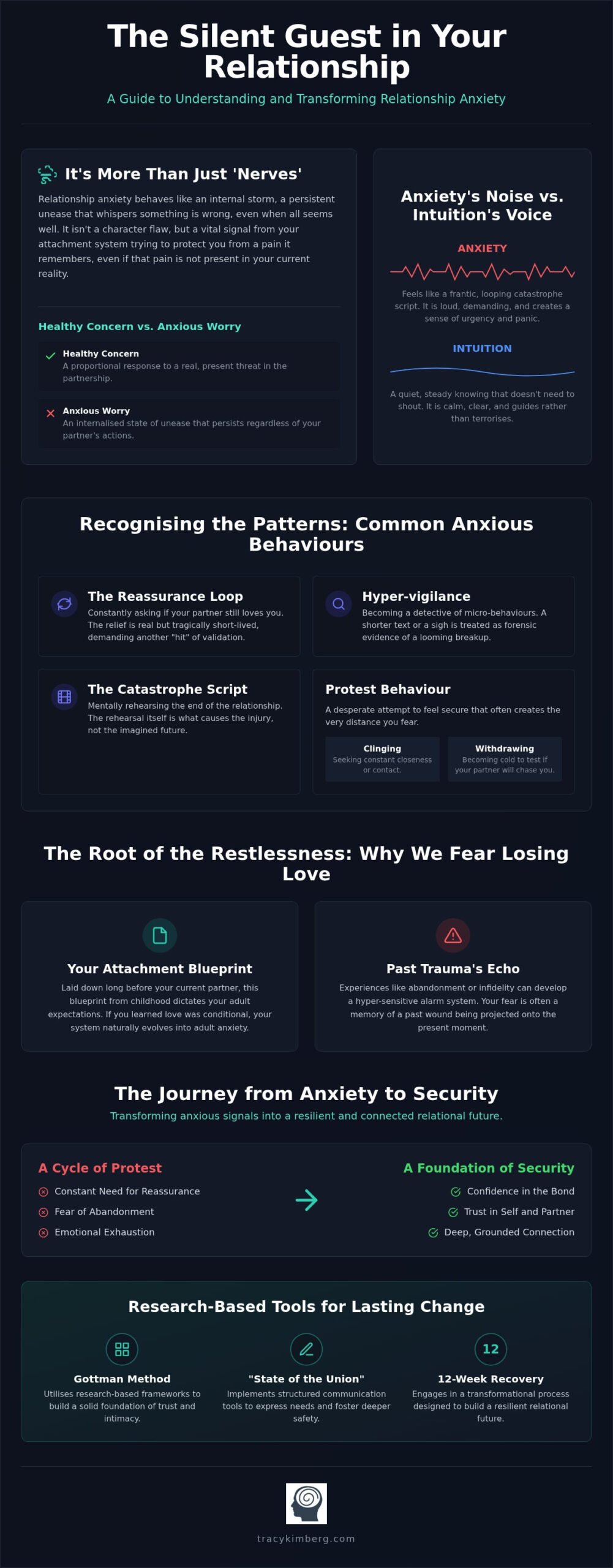
Relationship anxiety behaves like internal weather. It doesn’t matter if the sun is shining on your partnership or if your partner is being exceptionally kind; if there’s a storm brewing inside you, the entire world feels dark. This anxiety often acts as a silent guest in the room. It sits between you at dinner, scrutinising the way your partner holds their fork or the exact second they take to respond to a simple question. It’s a persistent, nagging unease that whispers that something is wrong, even when every external sign suggests you are safe.
When you seek counselling for relationship anxiety, we begin by distinguishing between healthy concern and this paralysing unease. Healthy concern is a response to a real threat. Clinical relationship anxiety, however, is an internalised state that persists regardless of your partner’s actions. It’s not a monster to be slain, but a messenger to be understood. This anxiety is often your system’s way of trying to protect you from a pain it remembers from long ago, even if that pain isn’t present in your current kitchen or bedroom.
Common Signs You Are Experiencing More Than Just ‘Nerves’
Recognising the patterns is the first step toward change. You might find yourself trapped in the ‘Reassurance Loop’, where you constantly ask your partner if they still love you. The relief you feel from their answer is real, but it’s tragically short-lived. Within minutes, the doubt returns, demanding another hit of validation like a drug that has lost its potency.
- Hyper-vigilance: You become a detective of micro-behaviours. A slightly shorter text message, a sigh, or a change in vocal pitch is treated as forensic evidence of a looming breakup.
- The Catastrophe Script: You mentally rehearse the end of the relationship whilst your partner is simply washing the dishes. You are preparing for the fall so it won’t hurt as much when it happens, but the rehearsal itself is what’s causing the injury.
The Impact on the Partnership Dynamic
This internal struggle doesn’t stay internal for long. Attachment theory explains that when we feel our primary bond is under threat, we often engage in ‘protest behaviour’. You might cling tighter, or perhaps you withdraw and become cold to test if your partner will chase you. Both reactions are desperate attempts to feel secure, but they often create the very distance you are terrified of.
Over time, this creates a profound sense of exhaustion for both parties. Your partner may feel they are being suffocated or that they are constantly failing a test they didn’t know they were taking. The spontaneity and joy that once defined your connection begin to erode, replaced by a rigid need for certainty that no human relationship can truly provide. Through specialised counselling for relationship anxiety, we work to soften these edges and return to a place where intimacy feels like a gift rather than a battlefield.
The Root of the Restlessness: Why We Fear Losing Love
Your current restlessness isn’t a random occurrence. It’s often the result of an ‘Attachment Blueprint’ laid down long before you met your current partner. Gabor Maté reminds us that children will always choose attachment over authenticity because survival depends on it. If you learned that love was conditional or that you had to be ‘perfect’ to be kept, that childhood adaptation naturally evolves into adult anxiety. Specialised counselling for relationship anxiety helps you deconstruct this blueprint and understand why your heart races when your partner is simply being quiet.
Past trauma plays a significant role here too. If you’ve experienced sudden abandonment or infidelity, your brain develops a hyper-sensitive alarm system. You might find it helpful to recognise and manage relationship anxiety by acknowledging that your fear is often a ‘memory’ of a past wound being projected onto the present. Esther Perel highlights that we all crave security whilst simultaneously fearing the loss of our autonomy. When these two needs collide, the resulting friction often manifests as a deep-seated fear of losing the person who provides our sense of home.
Anxious, Avoidant, and Secure: The Attachment Dance
The Anxious-Preoccupied style is characterised by a high-definition radar for disconnection. You might notice a partner’s slight withdrawal before they even realise it themselves. Many people find themselves in an ‘Anxious-Avoidant’ trap, where they are subconsciously drawn to partners who trigger their deepest fears of neglect. This cycle is exhausting, but it isn’t permanent. Through dedicated relationship counselling, you can move toward ‘Earned Security’. This is a state where you learn to trust the bond despite the inevitable ebbs and flows of partnership.
The Biology of Fear: Your Nervous System in Love
When you feel a threat to your relationship, your body undergoes a process called ‘flooding’. Your amygdala, the brain’s emotional centre, perceives a cold shoulder or a late reply as a physical danger. Adrenaline spikes and your heart rate climbs. In this state, your prefrontal cortex, the logical part of your brain, essentially goes offline. You can’t simply ‘think’ your way out of a panic because your system is in a state of survival. Recognising that this is a physiological event is a cornerstone of effective counselling for relationship anxiety, as it allows us to work with the body to restore calm before we even attempt to solve the relational conflict.
Anxiety or Intuition? Navigating the Difference with Clarity
One of the most persistent challenges in a partnership is discerning whether you are listening to your “gut” or your fear. When you are caught in a cycle of worry, every feeling can seem like a warning. However, there is a fundamental difference in the quality of these internal voices. Anxiety is almost always loud, frantic, and repetitive. It thrives in the future, obsessively asking “What if?” and demanding immediate reassurance to quiet the noise. Intuition, on the other hand, is a quiet, steady, and grounded presence. It focuses on “What is”—the observable reality of your partnership in the present moment.
This confusion often leads to a painful cycle of “Self-Gaslighting”. You might find yourself ignoring genuine red flags or a partner’s poor behaviour because you’ve convinced yourself that you’re “just being anxious” again. You stop trusting your own perceptions, which creates a deep sense of internal instability. Seeking professional counselling for relationship anxiety acts as an objective mirror, helping you untangle these threads. A specialist helps you identify which feelings are rooted in past trauma and which are legitimate responses to your current relational environment.
The ‘Red Flag’ vs. ‘Anxious Projection’ Framework
To navigate this landscape, we look for the signature of the thought. Anxious Noise is typically fear-based and circular; it feels like a record skipping on the same distressing note. Intuitive Signal feels like a calm realisation, even if the truth it presents is difficult to hear. Counselling for relationship anxiety helps you “tune the radio” of your mind so you can hear the clear frequency of your intuition amongst the static of your fears.
- Anxious Noise: “What if they realise I’m not enough and leave me tomorrow?” (Future-focused and frantic).
- Intuitive Signal: “I notice that I feel lonely even when we are sitting in the same room.” (Present-focused and grounded).
Preserving Individuality whilst Amongst the ‘We’
A significant driver of anxiety is the fear of losing your identity within the “we” of the couple. When your entire sense of worth is fused with the partnership, the threat of the relationship ending feels like an existential crisis. This is why maintaining a “Third Space”—interests, hobbies, and friendships that belong only to you—is essential for relational health. It provides the breathing room that allows for both desire and security to coexist. Engaging in individual therapy for adults can bolster the self-esteem necessary to stand firmly on your own two feet, which paradoxically makes you a more secure and connected partner.
Transforming the Dance: Practical Tools and Counselling Techniques
Understanding the roots of your restlessness is a vital first step, but real change requires new choreography. In my work, I often utilise the Gottman Method’s ‘Sound Relationship House’ as a blueprint for security. This framework suggests that a lasting partnership is built on a foundation of friendship, positive perspective, and shared meaning. When you engage in counselling for relationship anxiety, we don’t just talk about your fears; we build the structural integrity of your relationship so those fears no longer have room to grow.
One of the most effective tools for an anxious partnership is the ‘State of the Union’ meeting. This is a structured, weekly check-in where both partners can express their needs without triggering the usual cycle of defensiveness. It provides a dedicated container for difficult conversations, which helps the anxious partner feel heard and the avoidant partner feel less blindsided. By using a ‘Softened Start-up’—beginning a complaint with a gentle “I feel…” rather than an accusatory “You always…”—you can raise concerns without sounding an alarm bell in your partner’s nervous system.
Gottman-Inspired Strategies for De-escalation
When conflict arises, it’s easy to become ‘flooded’, a state where your heart rate exceeds 100 beats per minute and logic vanishes. The ’20-Minute Break’ rule is a non-negotiable tool here. You must step away to self-soothe, allowing your body to return to a state of physiological calm before continuing the discussion. This prevents the ‘protest behaviour’ that often damages the bond. We also focus on building ‘Love Maps’, which involves deeply knowing your partner’s inner world—their dreams, stresses, and daily triumphs. This knowledge acts as a buffer; when you truly understand your partner’s internal weather, their external moods feel far less threatening.
- Turning Towards: Recognising small ‘bids for connection’, like a shared glance or a comment about the weather, and responding with interest.
- The Trust Bank: Every time you turn towards your partner, you make a deposit in your relational trust account.
Esther Perel’s Approach to Relational Intelligence
Esther Perel teaches us that love is an inherent risk. Part of the work in counselling for relationship anxiety is learning to tolerate the uncertainty that comes with intimacy. We shift the focus from the exhausting question of “Why don’t you love me enough?” to the proactive question of “How do we create more connection today?”. By establishing ‘Rituals of Connection’—simple, repeated acts of togetherness—you ground your partnership in the here and now. If you’re ready to move beyond the cycle of worry and implement these research-based tools, my 12-Week Relationship Recovery Process offers a structured path from chaos to calm.
Finding Your Way Back: The Tracy Kimberg Approach to Relationship Recovery
Healing relationship anxiety isn’t about finding a quick fix; it’s about a fundamental shift in how you relate to yourself and your partner. Whilst traditional talk therapy has its place, the anxious heart often craves more than just a space to vent. You need a map. My 12-Week Relationship Recovery Process is designed as that map, providing a structured path that moves you from the exhausting chaos of insecurity to a state of profound relational calm. By focusing on a transformational programme rather than open-ended sessions, we target the root causes of your distress with precision and care.
Life in the UK is fast-paced, and I understand that finding time for deep emotional work can be a challenge. This is why I offer Online Therapy, allowing you to access specialised support from the comfort of your own home. Whether you are navigating the complexities of adult partnership or seeking a safe, non-judgemental space for Teenagers struggling with their own attachment hurdles, my approach remains grounded in empathy and clinical excellence. I’ve seen how this specialised counselling for relationship anxiety can transform a partnership from a source of dread into a foundation of strength.
Why a Structured 12-Week Programme Works
Many couples find themselves stuck in a loop of “crisis management”, only seeking help when the fire is already burning. This programme shifts the focus toward long-term relational health. Through weekly accountability and expert-led insights, we build the skills necessary to sustain a secure bond long after our time together concludes. This structured approach demystifies the therapeutic journey for the anxious mind, providing a predictable framework that reduces the very uncertainty that fuels your anxiety.
Taking the First Step Toward Relational Security
Choosing to seek counselling for relationship anxiety is an act of courage. It’s essential to work with a specialist who understands the intricate layers of emotional disconnect, infidelity, and the unique pressure points of modern life. As a Wise Guide, I help you navigate these terrains with a blend of research-based methods and deep human connection. You can book a consultation to explore how this approach fits your specific needs and begin the process of reclaiming your peace. You deserve a relationship that feels like a sanctuary, not a source of stress.
Reclaiming Your Peace: The Path to Relational Security
You don’t have to stay trapped in a cycle of constant reassurance-seeking and hyper-vigilance. By understanding your unique attachment blueprint and learning to distinguish frantic noise from intuitive signals, you can transform your partnership into the sanctuary you’ve always desired. Specialised counselling for relationship anxiety isn’t just about managing symptoms; it’s about building a foundation of earned security that withstands the inevitable ebbs and flows of life together.
My compassionate, research-based approach integrates the profound insights of the Gottman and Perel methodologies to help you move from a state of disconnect to one of deep, lasting connection. This transformational 12-week structured programme provides you with the emotional stability and confidence needed to trust in your relationship’s future. It’s time to quiet the silent guest and rediscover the joy of presence.
If you’re ready to step out of the shadows of doubt, I invite you to begin your journey to security with the 12-Week Relationship Recovery Process. You deserve a love that feels grounded, safe, and truly certain.
Frequently Asked Questions
Is relationship anxiety a sign that we should break up?
Relationship anxiety is rarely a definitive sign that a breakup is necessary. It often represents an internalised struggle with attachment rather than a fatal flaw in the partnership itself. If you feel safe and respected, the anxiety is likely a “silent guest” born from your personal history. Seeking counselling for relationship anxiety allows you to see the partnership clearly, helping you decide if the restlessness belongs to your past or your current reality.
How can counselling help if my partner refuses to attend?
You can absolutely benefit from therapy even if your partner chooses not to attend. Relationships are systems; when one person changes their “steps” in the dance, the entire dynamic is forced to shift. By working on your own emotional regulation and boundaries, you reduce the pressure on the partnership. Individual work often provides the clarity needed to communicate your needs more effectively, which frequently encourages a hesitant partner to join later.
How long does it typically take to overcome relationship anxiety?
The timeline for healing is deeply personal, but many people experience a significant shift within three to four months. My 12-week Relationship Recovery Process is specifically designed to move you from crisis to stability within this timeframe. Whilst deep-seated attachment patterns take time to fully rewire, you can expect to feel more grounded and less reactive as you implement research-based tools and gain psychological insight into your specific triggers.
Can relationship anxiety be cured, or will I always feel this way?
Relationship anxiety isn’t a terminal condition, but rather a signal from your nervous system that can be transformed into “earned security.” You won’t always feel this level of frantic unease. Through consistent work in counselling for relationship anxiety, the “volume” of the fear turns down, allowing your intuition to take the lead. You’ll learn to recognise the physical sensations of anxiety before they spiral, giving you the power to choose connection over protest behaviour.
What is the difference between relationship coaching and traditional counselling?
Relationship coaching typically focuses on future goals and practical skill-building, whereas traditional counselling explores the psychological “why” behind your current patterns. My approach blends both, providing the clinical depth to understand your attachment history whilst offering the structured, action-oriented tools of a transformational programme. This combination ensures you aren’t just talking about the problem, but actively building a more secure and vibrant relational future through tangible, daily changes.
Is online therapy as effective as face-to-face sessions for anxiety?
Online therapy is proven to be just as effective as face-to-face sessions for managing anxiety and relational distress. Many clients find that being in their own comfortable environment allows them to open up more quickly and honestly. It also removes the stress of travel, making it easier to maintain the consistency required for real change. Whether we meet via a screen or in person, the therapeutic connection remains the primary catalyst for your healing.
How do I tell my partner that I’m struggling with relationship anxiety without sounding ‘clingy’?
Frame the conversation around your internal experience rather than your partner’s actions to avoid sounding “clingy.” You might say, “I’ve noticed I’m struggling with some internal anxiety lately, and I’m working on understanding it so I can show up better for us.” This shifts the focus from a demand for reassurance to a proactive commitment to your shared emotional health. Using this “softened start-up” invites your partner into a collaborative team rather than a defensive position.
Can teenagers experience relationship anxiety, and do you offer support for them?
Teenagers frequently experience relationship anxiety as they navigate the intense emotions of their first significant bonds. Their developing brains are particularly sensitive to social cues and the fear of rejection. I provide a safe, non-judgemental environment for teenagers to explore these feelings and build healthy attachment habits early on. Supporting them now prevents these anxious patterns from becoming the blueprint for their adult partnerships, fostering long-term emotional resilience and self-esteem.

Article by
Tracy Kimberg
Tracy Kimberg is a Relationship Expert, Couples Therapist and Coach with a dedicated focus on helping couples and individuals rebuild connection, trust and emotional safety in their relationships. Drawing on the research of John and Julie Gottman, the relational insights of Esther Perel, and years of hands-on therapeutic experience, Tracy offers a warm, non-judgemental and deeply compassionate approach to modern relationships.
Based in Dorset, Tracy works with couples navigating communication breakdowns, betrayal, intimacy challenges, separation, family dynamics and life transitions. Known for creating a safe and grounded therapeutic space, she combines practical tools with emotional depth to help clients move beyond survival patterns and towards meaningful, lasting change.
With a reputation for empathy, professionalism and dedication to her clients’ growth, Tracy is passionate about helping people feel seen, understood and empowered — both within their relationships and within themselves.
Disclaimer
Disclaimer:
The information shared in this article is intended for educational and informational purposes only and should not be considered a substitute for professional therapeutic, psychological, medical or legal advice. Every individual and relationship is unique, and the perspectives offered are based on general therapeutic principles, research and professional experience.
Reading this article does not establish a therapist-client relationship with Tracy Kimberg. If you are experiencing significant emotional distress, relationship crisis, trauma, or mental health concerns, it is important to seek support from a qualified professional appropriate to your individual circumstances.
All content remains the intellectual property of Tracy Kimberg and may not be reproduced or distributed without permission.