

What if the slamming door isn’t a sign of your teenager’s disrespect, but a clumsy, desperate cry for a different kind of closeness? It’s deeply painful to feel the child you once knew slip away, replaced by a wall of silence or sharp words that leave you feeling invisible. You’re likely searching for parenting support for teenagers because the old ways of command and control are no longer working, whilst the underlying fear of their anxiety or depression keeps you awake at night.
I recognise that you want a home with less shouting and more genuine conversation. You deserve to feel confident that your teen is developing the emotional resilience they need to thrive in an increasingly complex world. This guide will show you how to transform your relationship by moving beyond conflict and building a lasting bond based on mutual respect. We’ll explore how to trade your role as a manager for the role of a consultant, ensuring your connection remains strong and healthy well into their adulthood.
Key Takeaways
- Understand the biological shift in the teenage brain to help you view challenging behaviour as a developmental milestone rather than a personal slight.
- Master the art of ‘invitational’ communication to replace tension-filled interrogations with moments of genuine emotional connection.
- Learn how to swap rigid control for meaningful influence, creating a collaborative home environment built on mutual respect.
- Explore how your own childhood triggers impact your parenting and why self-regulation is your most powerful tool for healing.
- Recognise the specific ‘red flags’ that indicate when to seek professional parenting support for teenagers to protect their long-term mental health.
Understanding the Teenage Brain: Why Behaviour Changes
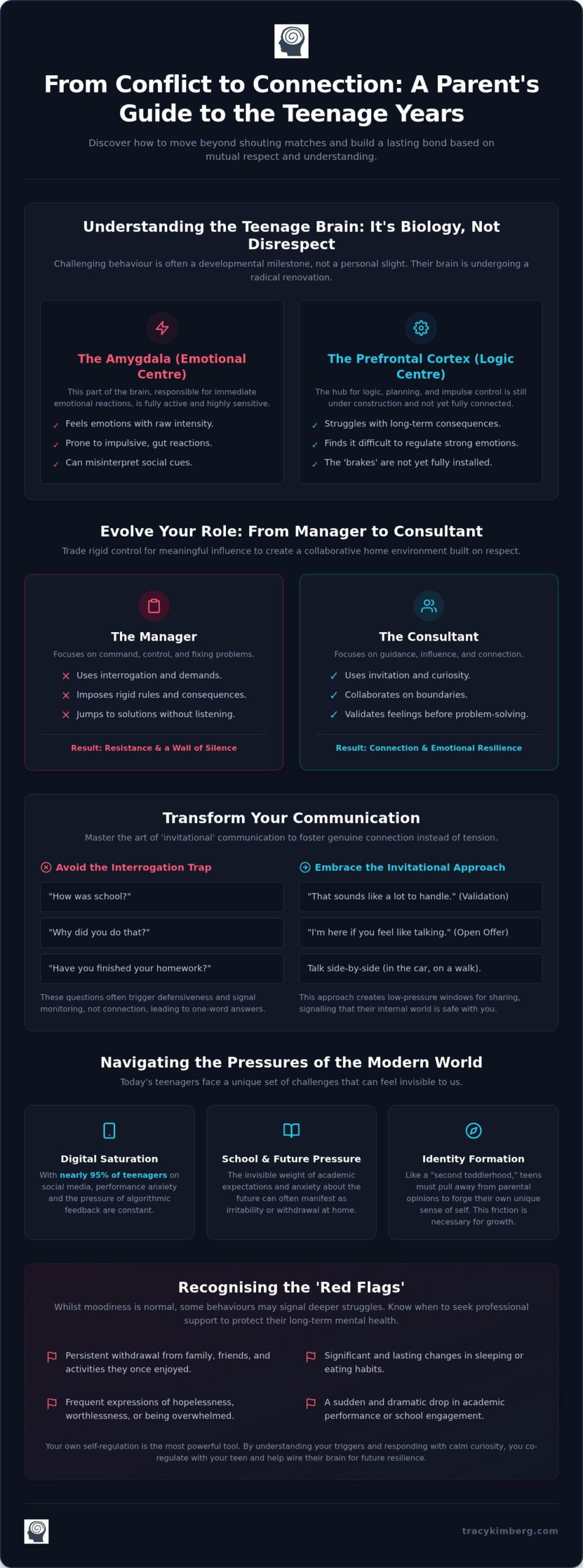
To understand why your once-gentle child now greets your questions with eye-rolls or icy silence, we must look beneath the surface at the profound architecture of teenage brain development. During these years, the brain undergoes a radical renovation. The amygdala, responsible for immediate emotional reactions, is fully active, whilst the prefrontal cortex, the centre for logic and impulse control, is still under construction. This biological mismatch creates a “teenage storm” where feelings are felt with raw intensity, but the brakes to regulate them aren’t yet fully installed. Finding the right parenting support for teenagers starts with decoding the biology behind the rebellion.
What we often misinterpret as calculated disrespect is frequently a clumsy, instinctive attempt at establishing independence. Your teen isn’t trying to push you away; they’re trying to find out where they end and you begin. This period of neuroplasticity in 2026 represents a critical window for emotional support. Because their brains are so sensitive to environmental cues, the way you respond to their outbursts can literally help wire their capacity for future resilience. Reframing their “defiance” as a developmental necessity allows you to move from a place of personal hurt to a position of compassionate curiosity.
The Shift from Child to Individual
Adolescence is often described as a “second toddlerhood.” Just as a two-year-old learns to say “no” to assert their existence, a teenager must pull away from family traditions and parental opinions to forge a unique identity. This search for autonomy naturally creates tension within the home. However, this friction isn’t a sign that the relationship is failing. Adolescence is a period of necessary friction for healthy growth. By allowing space for this individualisation, you ensure that the eventual bridge back to connection is built on a foundation of mutual respect rather than forced compliance.
Modern Stressors in 2026
The landscape of 2026 brings unique pressures that previous generations didn’t face. Digital saturation means your teen’s emotional regulation is constantly tested by algorithmic feedback loops. With nearly 95% of teenagers using social media, the shift from physical to digital socialisation has made “performance anxiety” a standard experience amongst UK students. Recent legislative discussions, such as the Parental Approval for Youth Social Media Act introduced in August 2026, highlight the growing concern over how these platforms impact mental health. When you see your teen withdrawn or irritable, it’s often a reaction to the invisible weight of school-related pressure and the relentless digital noise that follows them into their bedroom.
Communication Strategies: Moving from Interrogation to Invitation
Most parents unwittingly step into the role of a detective, hoping that a series of questions will unlock the mystery of their child’s day. We ask “How was school?” and receive a monosyllabic “Fine.” We ask about their friends and get “I don’t know.” This is the interrogation trap. When we approach our teenagers with a list of questions, we inadvertently signal that we are monitoring them rather than connecting with them. Effective parenting support for teenagers requires a fundamental shift from interrogation to invitation.
John Gottman’s research emphasises the importance of “turning towards” emotional bids. In the teenage years, these bids are often disguised as a grumble about a teacher or a sigh over a difficult homework assignment. If we respond by trying to “fix” the problem immediately, we shut down the conversation. Your teen stops listening when you move straight to a solution because they don’t feel heard. They need validation before they need a plan. By simply saying, “That sounds like a lot to handle,” you signal that their internal world is safe with you. For parents looking for more structured ways to build these habits, resources like the CDC’s Essentials for Parenting Teens offer excellent evidence-based guidance on fostering positive interactions.
Creating “low-pressure” windows is another essential strategy. Direct eye contact can feel confrontational to a brain that is already on high alert. Talking whilst driving, washing the dishes, or walking the dog allows for a “side-by-side” connection. These moments feel less like an interview and more like a shared experience. If you find that the wall between you and your child feels insurmountable, engaging in specialised therapy for teenagers can help bridge that gap in a safe, professional environment.
The Art of the Open-Ended Question
The secret to deeper connection lies in the structure of your curiosity. Replace “Why” questions, which often trigger defensiveness and a need for justification, with “What” or “How” questions. Instead of “Why were you late?”, try “What happened that made it hard to get back on time?” Curiosity acts as an antidote to conflict by moving the focus from blame to understanding. It invites your teen to narrate their own experience, which builds their cognitive ability to reflect on their own behaviour.
Decoding Non-Verbal Signals
Silence, eye-rolling, and withdrawal are rarely about you; they are often communications of overwhelm or a defence against vulnerability. When you meet an “I don’t know,” try to resist the urge to push. Sometimes, they truly don’t have the words yet. Maintaining a calm, open body language communicates that you are a steady anchor in their storm. By remaining non-judgemental in the face of their withdrawal, you keep the door open for the moment they are finally ready to step through it.
Boundaries and Conflict: Navigating the Middle Ground
Many parents mistake rigid control for safety. We often tighten our grip when we feel our teenagers pulling away, yet this impulse usually backfires. Control is a tool of the “Manager” role, and it’s designed to keep a child compliant. Influence, however, is the currency of the “Consultant” role. It’s earned through consistency and respect. When you focus on influence rather than control, you’re building a relationship that can withstand the friction of the teenage years. Providing effective parenting support for teenagers means helping you move from being the person who makes every decision to the person your teen actually wants to talk to when things go wrong.
In 2026, the primary battlegrounds are often the “Big Three”: screen time, sleep, and socialising. These are not just chores or rules; they are the arenas where your teen is trying to manage their own nervous system. Instead of imposing arbitrary limits, try collaborative problem-solving. Sit down together and ask, “How can we make sure you’re getting enough sleep whilst still having time for your friends online?” When teens are involved in the “house rules” process, they are far more likely to respect the boundaries. For practical frameworks on these discussions, CDC’s Essentials for Parenting Teens offers evidence-based strategies for encouraging independence whilst maintaining safety.
There is a profound difference between natural consequences and arbitrary punishments. A punishment, like taking a phone away for a week because of a messy room, is a power move that breeds resentment. A natural consequence, such as not having clean football kit because it wasn’t put in the wash, teaches responsibility through experience. One breaks the connection; the other builds the brain.
The Consultant Parent Model
As your child enters their late teens, your role must shift. You’re no longer the CEO of their life. If you continue to lecture, they’ll simply stop sharing their internal world with you. A consultant offers expertise only when the client is ready to hear it. Try asking, “Do you want me to just listen, or are you looking for my perspective?” This simple shift respects their autonomy and makes them more likely to seek your guidance in the future. In a British cultural context, where we often value “getting on with things,” this verbal invitation to connect is a powerful tool for intimacy.
De-escalating Heated Arguments
When an argument turns into a shouty match, both of your brains have likely “flipped their lids.” The 90-second rule suggests that it takes about a minute and a half for the chemical surge of anger to dissipate through your body. If the conflict is still escalating after that, you’re just feeding the fire. Call a “timeout” not as a punishment, but as a relational reset. The goal isn’t to win the fight, but to protect the bond. A Gottman-inspired “Repair Attempt,” like a small joke or a soft touch, can de-escalate a situation before it becomes toxic. Focus on the “we” in the conflict. It isn’t you versus your teen; it’s both of you versus the problem.
The Parent’s Journey: Why Self-Regulation is Your Best Tool
We often think we are responding to our teenager’s behaviour, but frequently, we are responding to our own past. Gabor Maté suggests that our most intense reactions to our children are often echoes of our own unhealed childhood wounds. If you were raised in a home where obedience was the only currency, a teenager’s “no” can feel like a direct threat to your safety. Seeking parenting support for teenagers isn’t just about “fixing” the child; it’s about supporting the adult who holds the emotional space for them. When you feel that heat rising in your chest, it’s often a sign that a trigger has been pulled.
This is what we call the “Mirror Effect.” Anxiety is remarkably contagious. If you are vibrating with fear about your teen’s future or their mental health, they will unconsciously pick up on that frequency and reflect it back to you through their own agitation or withdrawal. Practising self-compassion is your first step toward breaking this cycle. Forgiving yourself for “losing it” allows you to move toward repair rather than staying stuck in a loop of parental guilt. Your emotional health is the foundation upon which their resilience is built; you cannot pour from an empty cup.
Identifying Your Triggers
To move from reacting to responding, you must first identify what pulls your strings. Reflect on which of these behaviours provoke your strongest emotional “flooding”:
- A disrespectful tone: Does this trigger a fear of being undervalued or losing authority?
- Silence and withdrawal: Does this trigger an old fear of abandonment or being “left out”?
- Academic struggles: Are you projecting your own fears of failure or social judgement onto their grades?
- Risk-taking: Is your urge to “protect” actually an attempt to control an unpredictable world?
Understanding the difference between protecting your teen and projecting your own unprocessed fears is vital for a healthy Improving Parent-Child Relationship Dynamics. A parent’s calm presence acts as a biological regulator for a teenager’s dysregulated nervous system, providing the external scaffolding their developing brain currently lacks.
The Power of Modelling
Your teenager is watching how you handle stress far more closely than they are listening to your advice. When you make a mistake and own it, you are building a bridge of trust. Saying, “I’m sorry I shouted, I was feeling overwhelmed and I didn’t handle that well,” demonstrates healthy emotional regulation in real-time. It shows them that vulnerability isn’t a weakness, but a path to connection. If you find yourself constantly triggered and unable to find that calm centre, my 12-Week Relationship Recovery Process offers a structured framework to help you reclaim your emotional balance and lead your family with confidence.
When to Seek Professional Parenting Support for Teenagers
Knowing where normal adolescent moodiness ends and a clinical concern begins is one of the most challenging aspects of modern parenting. As of 2026, more than one in three teenagers report experiencing prolonged sadness or hopelessness. Whilst some degree of withdrawal is a developmental necessity, certain “red flags” suggest that your teen’s internal world has become too heavy for them to navigate alone. These include persistent changes in sleep or appetite, a sharp decline in academic performance, or a total withdrawal from hobbies they once loved. Seeking professional parenting support for teenagers is not a sign of failure; it is a proactive step toward protecting your child’s future.
Individual therapy for teenagers provides a safe, non-judgemental space where they can unpack the pressures of digital saturation and performance anxiety without fear of upsetting their parents. However, if your teen refuses direct therapy, family-focused coaching can often bridge the gap. My approach is fundamentally relational. By utilising Gottman-inspired research and Esther Perel’s insights into intimacy and distance, I help you decode the behaviour that feels like a personal attack. We move from the weight of the problem to the possibility of healing, framing the journey as a collaborative adventure rather than a clinical necessity.
Therapeutic Options for 2026
In the fast-paced world of 2026, flexibility is essential. I offer both online therapy and face-to-face sessions in the UK to suit your family’s rhythm. For some teens, the digital space feels more comfortable and less confrontational, whilst others thrive on the physical presence of a safe adult. Central to my work is the 12-Week Relationship Recovery Process. This structured framework is designed to heal family bonds by addressing the systemic triggers we explored in the previous sections, ensuring that the progress you make is sustainable for the long term.
Taking the First Step
Suggesting therapy to your child requires a delicate touch. Avoid framing it as something to “fix” them. Instead, position it as a gift of space. You might say, “I can see how much pressure you’re under, and I’d like to give you a place where you can talk to someone who isn’t me.” In our first session, we focus on building an alliance. It’s a chance for your teen to feel seen and for you to feel supported as the wise guide of your home. If you are ready to move from conflict to connection, you can Book a discovery call to discuss support for your teenager and begin the process of reclaiming your relationship.
Reclaiming Your Connection and Leading with Love
The bridge from control to connection isn’t built overnight; it’s constructed through small, consistent acts of curiosity and repair. By understanding the biological renovation occurring in your teen’s brain and trading the role of manager for that of a consultant, you create the safety they need to return to you. Your own self-regulation remains the most powerful tool for calming their storm. When you lead with validation instead of interrogation, those slamming doors slowly begin to open.
If you feel the distance between you is becoming insurmountable, professional parenting support for teenagers can provide the structured framework needed for reconciliation. I utilise a blend of clinical expertise in the Gottman Method and systemic therapy to help families decode their dynamics. With online sessions available for UK-wide support, I offer a safe, confidential environment where both you and your teenager can feel truly seen.
Healing is a proactive adventure, and it’s entirely possible to move beyond conflict into a relationship that lasts a lifetime. You don’t have to navigate this transition alone. I am here to help you turn these years of friction into a foundation for lasting intimacy.
Start your family’s healing journey with a compassionate expert; book a session with Tracy today
Frequently Asked Questions
What are the first signs that my teenager needs professional support?
Persistent shifts in their baseline behaviour are usually the most reliable indicators that a teenager is struggling. Look for prolonged sadness, a sudden drop in academic performance, or a total withdrawal from activities they once loved. Whilst mood swings are expected, a clinical concern often manifests as a loss of interest in socialising or significant changes in sleep and appetite that last longer than two weeks.
How can I get my teenager to talk to me when they’ve completely shut down?
Moving from eye-to-eye confrontation to side-by-side connection is often the most effective way to break a silence. Try talking whilst driving or walking the dog, as the lack of direct eye contact reduces the pressure on their nervous system. Start by validating their right to silence; sometimes saying “I’m here when you’re ready” is more powerful than asking a string of interrogative questions.
Is it normal for my teen to prefer their friends over their family?
Preferring peers over parents is a healthy and necessary developmental milestone for identity formation. During adolescence, the brain is wired to prioritise social connection with friends to help them navigate the world outside the family unit. It’s not a rejection of your love; it’s a clumsy but essential step toward becoming an independent adult who can navigate complex social landscapes with confidence.
How do I set boundaries for social media without causing a massive argument?
Successful boundaries are built through collaborative problem solving rather than unilateral decrees. Instead of simply taking the phone, discuss the biological need for sleep and the impact of digital saturation on their developing brain. When you involve them in setting the “house rules,” you move from being a manager to a consultant, which significantly reduces the need for rebellion and builds mutual respect.
Will therapy for my teenager involve me as a parent?
Relational healing almost always involves the parent because you are the primary architect of your child’s emotional environment. Whilst your teen needs a private space to explore their thoughts, systemic therapy often includes parent sessions to help you decode their behaviour. This approach ensures that the progress made in the therapy room translates into a calmer, more connected home life for the whole family.
How do I know if my teen is just being a ‘normal teen’ or if it’s anxiety?
The key difference lies in the intensity and the impact on their daily functioning. Normal teen moodiness is usually fleeting and linked to specific events, whilst anxiety often feels pervasive and prevents them from engaging in school or social life. If their worry is constant or they’re experiencing physical symptoms like heart palpitations, seeking parenting support for teenagers can help you differentiate between the two.
What should I do if my teenager refuses to go to therapy?
If your teen refuses direct support, you can still change the family dynamic by engaging in parent coaching yourself. Since relationships are systemic, when you change how you respond to their triggers, the entire interaction must shift. Focus on your own self-regulation and communication strategies. Often, when a teen sees a parent changing their approach, they eventually become more open to the therapeutic process themselves.
How long does it typically take to see an improvement in our relationship?
Relational shifts often happen in small, quiet increments rather than overnight transformations. Many families begin to notice a decrease in daily shouting matches within the first month of consistent work. Programmes like the 12-Week Relationship Recovery Process provide a structured timeline, but the real pace depends on the frequency of your “repair attempts” and your commitment to practising new ways of connecting.

Article by
Tracy Kimberg
Tracy Kimberg is a Relationship Expert, Couples Therapist and Coach with a dedicated focus on helping couples and individuals rebuild connection, trust and emotional safety in their relationships. Drawing on the research of John and Julie Gottman, the relational insights of Esther Perel, and years of hands-on therapeutic experience, Tracy offers a warm, non-judgemental and deeply compassionate approach to modern relationships.
Based in Dorset, Tracy works with couples navigating communication breakdowns, betrayal, intimacy challenges, separation, family dynamics and life transitions. Known for creating a safe and grounded therapeutic space, she combines practical tools with emotional depth to help clients move beyond survival patterns and towards meaningful, lasting change.
With a reputation for empathy, professionalism and dedication to her clients’ growth, Tracy is passionate about helping people feel seen, understood and empowered — both within their relationships and within themselves.
Disclaimer
Disclaimer:
The information shared in this article is intended for educational and informational purposes only and should not be considered a substitute for professional therapeutic, psychological, medical or legal advice. Every individual and relationship is unique, and the perspectives offered are based on general therapeutic principles, research and professional experience.
Reading this article does not establish a therapist-client relationship with Tracy Kimberg. If you are experiencing significant emotional distress, relationship crisis, trauma, or mental health concerns, it is important to seek support from a qualified professional appropriate to your individual circumstances.
All content remains the intellectual property of Tracy Kimberg and may not be reproduced or distributed without permission.