

What if the quiet distance growing between you isn’t a sign that your love is fading, but a signal that your original “blueprint” for the relationship has simply been outgrown? Many couples eventually find themselves drifting into a state of functional co-existence, behaving more like polite flatmates than intimate partners. It’s exhausting to feel like you’re constantly negotiating conflicting priorities or, worse, losing the very essence of who you are whilst trying to keep the relationship afloat. Creating a shared vision as a couple is the essential first step to reclaiming that lost spark and moving towards a secure-functioning partnership.
We understand that you want more than just a peaceful household; you want a life that feels deeply purposeful. Research in the Journal of Marriage and Family suggests that couples who set goals together report 30% greater relationship satisfaction, yet many struggle to begin that vital conversation. This article will show you how to build a psychological and emotional architecture that honours your personal dreams whilst strengthening your life together. We’ll explore how to move from co-existing to co-creating, providing you with the clarity and communication tools needed to build a future that excites you both.
Key Takeaways
- Move beyond the domestic to-do list by establishing a “psychological canopy” that protects your bond from the common “roommate phase”.
- Explore the delicate balance between personal autonomy and relational security, ensuring your partnership honours your individual dreams whilst building a life together.
- Master the practical steps of creating a shared vision as a couple, from setting aside sacred space to conducting an honest “dream audit”.
- Uncover the hidden psychological barriers, such as childhood survival strategies, that may be preventing you from dreaming boldly with your partner.
- Learn to recognise when professional support can help you bridge the gap between co-existing and truly co-constructing your future.
Defining the Shared Vision: Beyond the Domestic To-Do List
When we speak about creating a shared vision as a couple, we aren’t talking about your five-year plan for a mortgage or a holiday schedule. Those are logistics. Instead, think of a shared vision as a psychological canopy that stretches over your relationship. It’s the existential “why” that makes the “how” of daily life feel worth the effort. Without it, couples often slip into the “roommate phase”, where they coexist efficiently but lose the emotional vibrancy that first brought them together. A vision is about the feeling of the life you’re building, whereas goals are simply the transactional steps you take to get there.
In the Gottman Method, “Shared Meaning” is the highest level of the Sound Relationship House. It’s the layer where you move beyond simple conflict management and into the territory of legacy and purpose. Understanding the foundations of interpersonal relationships helps us see that intimacy isn’t just about physical closeness; it’s about this deep, shared disclosure of our inner worlds. When you stop dreaming together, the narrative of “Us” is quickly replaced by the heavy logistics of life, leading to a quiet, painful drift.
The Architecture of Shared Meaning
Shared Meaning isn’t just a nice idea; it’s a structural necessity for long-term health. It involves creating rituals, like a Sunday morning walk without phones or a specific way you celebrate small wins. These aren’t just habits; they’re the bricks of your relational culture. Relational culture is the unique language and values a couple develops over time. This culture provides a sense of belonging that protects you when external transitions, like a career change or a move, threaten to shake your foundation. A shared vision acts as a compass during these times of crisis, reminding you that you’re a team with a shared destination rather than two individuals fighting separate storms.
Why ‘Drifting’ is the Silent Relationship Killer
The silent killer of intimacy isn’t always a big argument; it’s the slow, quiet drift. We see this manifest as “parallel play”, a term often used for toddlers but deeply relevant to adults. It’s the experience of being physically present in the same room but emotionally miles apart. This often stems from an erosion of curiosity. When you stop asking your partner about their evolving dreams because you assume you already know them, the relationship begins to feel like a duty rather than a choice. Without a “North Star” to guide you, creating a shared vision as a couple becomes impossible. The psychological cost of this lack of direction is high, often resulting in a loss of individual identity as you both become submerged in the mundane tasks of survival.
The Paradox of Belonging: Balancing Individual Dreams with Partnership
Esther Perel famously observes that we seek two conflicting needs in our relationships: the need for security and the need for adventure. We want the comfort of the “Us”, yet we crave the freedom of the “Me”. When creating a shared vision as a couple, the goal isn’t to merge into a single, indistinguishable entity. Instead, you’re building a structure large enough to house two whole, autonomous individuals. A vision is a container, not a cage. If the “Us” becomes too small, one or both partners will eventually feel the need to break out to breathe.
There’s a pervasive myth that partnership requires one person to “shrink” so the other can grow. This “Sacrifice Myth” is toxic. If one partner feels they must abandon their North Star for the sake of the union, resentment will eventually corrode the foundation. True partnership involves radical honouring of each other’s separate paths. When you navigate non-negotiables with empathy rather than defensiveness, you transform a potential threat into an opportunity for deeper intimacy. You can find more practical advice on this in a step-by-step guide to aligning your goals, which explores how to find common ground without losing yourself.
Honouring the ‘I’ within the ‘We’
Before you can merge visions, you must identify your “Core Longings”. What are the non-negotiables of your soul? Supporting a partner’s individual dream is actually the highest form of relational security. It says, “I love you enough to want you to be fully yourself.” This is the essence of “Differentiated Togetherness”, staying deeply connected whilst pursuing separate passions. When both partners feel their individual identity is safe, the collective vision becomes much stronger.
Navigating Conflicting Desires with Compassion
When desires clash, it’s easy to fall into a “My way vs Your way” mentality. To move toward “Our way”, you must find what John Gottman calls the “dream within the conflict”. Often, a disagreement about where to live or how to spend money is actually a conversation about underlying values like freedom, safety, or legacy. Conflict over the future is often a sign of deep investment, not incompatibility. It shows that you both still care enough to fight for the life you want. If you find yourselves stuck in these cycles, my Relationship Counselling and Coaching for Couples can help you translate these conflicts into a shared language of hope and understanding.
By creating a shared vision as a couple that respects individual autonomy, you move from a model of obligation to one of genuine choice. This shift is what allows a relationship to remain vibrant over decades rather than just years.
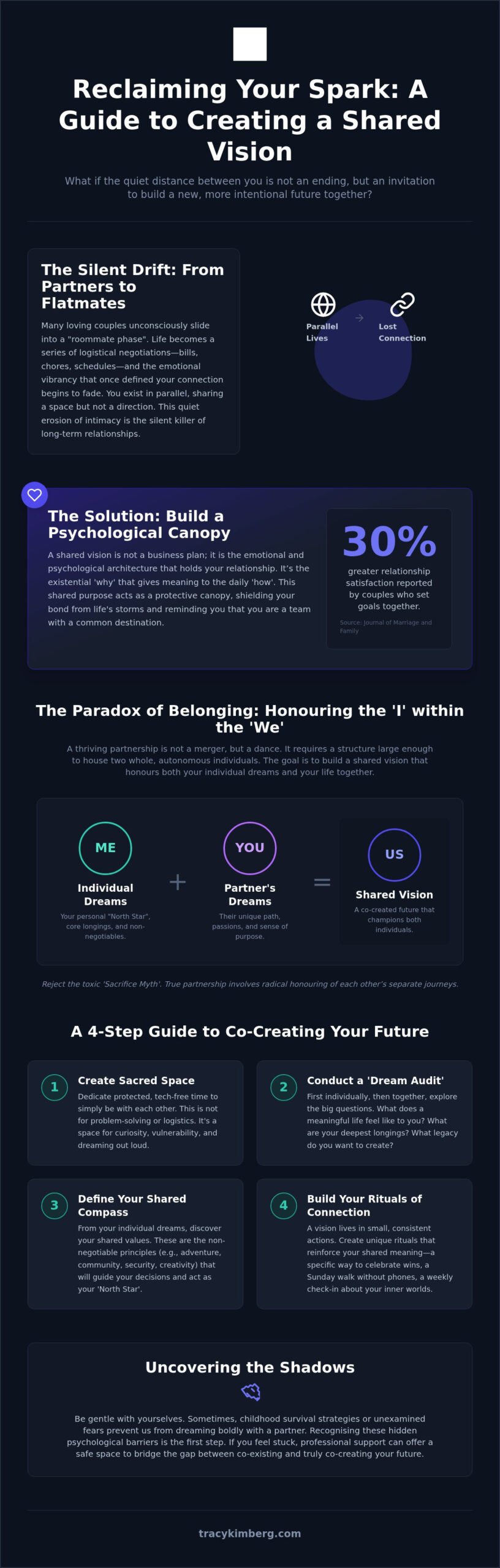
A Step-by-Step Guide to Co-Creating Your Future Architecture
Moving from the abstract idea of a partnership to the concrete reality of a shared future requires more than just good intentions. It demands a structured approach. To begin creating a shared vision as a couple, you must first step out of the “logistical noise” of your daily lives. This is a process of co-construction, where you act as both the architects and the builders of your relational home. By following these steps, you can ensure that your future is built on a foundation of mutual respect and deep emotional insight.
- Step 1: Create a ‘Sacred Space’. Set a specific time and location that feels distinct from your daily chores. This isn’t a conversation for the dinner table whilst you’re worrying about the washing up. Choose a neutral, inspiring environment where you both feel relaxed and open.
- Step 2: The Individual Dream Audit. Before coming together, spend time journaling individually. What are your “North Stars”? Consider what you need to feel fulfilled as an individual, separate from your role as a partner or parent.
- Step 3: The ‘Appreciative Inquiry’ Phase. Share your dreams whilst your partner listens without judgement. This is not the time for “Yes, but” or logistical critiques. It’s a time for “Tell me more” and “What does that dream mean to you?”.
- Step 4: Identifying the ‘Golden Thread’. Look for the values that connect your disparate goals. If one of you wants to travel and the other wants to start a garden, the golden thread might be a shared desire for “sensory richness” or “tranquillity”.
- Step 5: Drafting the Vision Statement. Write a short, emotive paragraph that describes your life in the present tense. For example: “We live in a home filled with light and laughter, where we both feel supported to pursue our passions whilst remaining deeply anchored in our love.”
The Three-Tiered Vision Exercise
To ensure your vision is robust, you need to look at three distinct layers of your life together. Tier 1 covers the practical and logistical, such as where you live and how you manage your finances. Tier 2 moves into the relational and emotional, defining how you handle conflict and how you show affection. Finally, Tier 3 addresses the existential and legacy, asking what you want to be remembered for. Integrating The Gottman Institute’s research on shared meaning into this exercise helps you see that these existential goals are what truly sustain a relationship through the decades.
Turning Dreams into ‘Rituals of Connection’
A grand vision is only as strong as the small habits that support it. You must translate your big dreams into daily “rituals of connection”. This could be a ten-minute morning coffee without phones or a specific way you greet each other after work. To keep the architecture of your relationship current, establish a “Vision Review”. This is a monthly check-in to see if your shared vision still fits who you are becoming. If you feel the need for more immediate guidance, you might find it helpful to explore specific exercises for couples to reconnect today to help bridge the gap between your current reality and your future dreams.
Identifying the Shadows: Why We Struggle to Dream Together
If the process of creating a shared vision as a couple feels heavy or even impossible, it is rarely due to a lack of imagination. More often, it is because you have encountered “the shadows” of your individual and collective histories. Gabor Maté frequently highlights how childhood survival strategies manifest as adult blocks. If you grew up in an environment where expressing desires led to disappointment or conflict, your brain may have developed a protective mechanism that shuts down your ability to dream. For many, refusing to envision a future is a subconscious attempt to avoid the pain of a potential failure.
This resistance is often compounded by relational baggage, such as past infidelity or broken promises. When trust has been fractured, the future no longer feels like a playground; it feels like a minefield. You might also find yourselves stuck in a “Cynic vs Dreamer” dynamic. One partner plays the role of the visionary whilst the other acts as the “realist” who shoots down ideas to prevent perceived catastrophe. This polarity creates a stalemate where the relationship stops moving forward, leaving both partners feeling lonely and misunderstood.
How Past Baggage Sabotages Future Plans
Trauma often disguises itself as personality traits. Hyper-independence, for instance, is frequently a trauma response that rejects the vulnerability required for creating a shared vision as a couple. If you feel that you can only rely on yourself, the idea of a shared future feels like a threat to your safety. Similarly, financial trauma from your past can make long-term planning feel terrifying, leading to a scarcity mindset that blocks any discussion of lifestyle changes or investments. Resistance to a shared vision is usually a plea for safety, not a lack of love. Understanding this allows you to approach your partner’s hesitation with compassion rather than frustration.
Moving from Defensive Reactivity to Open Curiosity
To move past these shadows, you must transition from defensive reactivity to open curiosity. This begins with what John Gottman calls a “softened start-up”. Instead of saying, “You never want to talk about our future,” try, “I feel anxious when we don’t have a plan, and I’d love to dream with you.” It is also vital to recognise when you or your partner are “flooded”. When the heart rate rises and the “fight or flight” response takes over, the creative centres of the brain shut down. Taking a twenty-minute break allows your nervous systems to settle. In these moments, your role is to be a non-judgemental witness to each other’s fears. If you find that these shadows are too deep to navigate alone, my 12-Week Relationship Recovery Process provides a structured, safe environment to unblock these survival strategies and begin co-creating again.
Sustaining the Spark: Professional Support for Your Relational Journey
Sometimes, despite our best intentions, the gap between where we are and where we want to be feels too wide to bridge alone. It is a brave and optimistic act to admit when the “drift” has become a deep disconnect. Research from Grow Therapy in June 2026 indicates that 71% of people who attend couples therapy report a noticeable improvement in their relationship. This suggests that creating a shared vision as a couple is not just a personal endeavour but a process that thrives under professional guidance. A neutral third party acts as a relational architect, helping you navigate the “Paradox of Belonging” without the conversation collapsing into old patterns of defensiveness or blame.
Utilising research-based methods, such as the Gottman Method and systemic therapy, provides a scientific foundation for what often feels like an emotional storm. These frameworks help demystify why we get stuck. They offer a structured way to rebuild trust and curiosity. When you work with a specialist, you aren’t just “fixing” what is broken. You are actively designing a future that honours both your individual growth and your collective legacy. Over 75% of couples report relationship improvement after therapy according to data from the American Association for Marriage and Family Therapy, proving that a professional “reset” is a powerful tool for long-term health.
When to Seek a Relationship Coach or Therapist
Recognising the signs that you need external support is the first step toward healing. It’s often better to seek help proactively rather than as a last resort. Consider reaching out if you recognise these indicators:
- Indicator 1: Conversations about the future consistently end in a fight. If every attempt to plan leads to “flooding” or withdrawal, you need a safe container to hold the conversation.
- Indicator 2: You feel you have lost your sense of self. If the relationship feels like it requires you to shrink your individual dreams to survive, professional support can help re-establish healthy boundaries.
- Indicator 3: You have a vision but no “Rituals of Connection”. You might agree on the big goals, but you lack the daily habits and emotional language to make that vision a living reality.
The 12-Week Relationship Recovery: A Roadmap to ‘Us’
The 12-Week Relationship Recovery Process is designed to move you beyond surface-level compromises and into deep, transformational change. This structured programme focuses on uncovering the emotional disconnects that have blocked your progress. We move from the heavy work of resolving past baggage to the inspiring work of co-construction. By the end of the process, creating a shared vision as a couple becomes a natural, joyful part of your partnership rather than a source of anxiety. You will leave with a clear roadmap for your future and the communication tools to sustain it. If you are ready to move from co-existing to co-creating, I invite you to Book a discovery call for the 12-Week Relationship Recovery Process and begin your proactive adventure toward a more intimate, purposeful life together.
Designing Your Shared Legacy
Transitioning from the daily grind to a life of shared meaning is one of the most profound shifts a couple can make. We’ve explored how creating a shared vision as a couple involves more than just aligning calendars; it requires a radical honouring of each partner’s individual dreams whilst building a secure emotional canopy together. By identifying the psychological shadows that block your progress and establishing small, daily rituals of connection, you can move from a state of functional co-existence into a partnership defined by deep purpose and curiosity.
If you’re ready to bridge the gap between where you are and the life you both desire, I’m here to guide you. My research-based approach, rooted in the work of Gottman and Perel, offers a specialised path through even the most complex relational breakdowns. You don’t have to navigate this transition alone. Through a structured, transformational framework, we can unblock the survival strategies of the past and start building your future. Start your journey to a shared future with my 12-Week Relationship Recovery Process. Healing is possible, and your life together is waiting to be co-created.
Frequently Asked Questions
Is it normal for couples to have completely different visions for the future?
It is entirely normal for partners to have divergent visions. We enter relationships as two distinct individuals with unique histories and core longings. The goal of creating a shared vision as a couple isn’t to force a perfect overlap; it’s to build a bridge between your separate worlds. By exploring the values behind your different dreams, you can often find a middle ground that honours both of your needs.
How do we start a conversation about a shared vision without it feeling like a chore?
Avoid framing this as a logistical meeting or a heavy relationship talk. Instead, treat it as an exercise in curiosity. You might start whilst on a long walk or over a relaxed dinner, asking open-ended questions like, “What does a perfect Tuesday look like for you in five years?” By keeping the atmosphere light and focusing on dreams rather than duties, you prevent the process from feeling like another household task.
What happens if our individual dreams are fundamentally incompatible?
Incompatibility is often a matter of perspective rather than reality. When dreams clash, look beneath the surface at the underlying emotional need. If one wants to travel and the other wants a stable home, the shared value might be “adventure” or “security”. If you find yourselves truly deadlocked, professional guidance can help you navigate these conflicting individual visions whilst maintaining your connection.
Can a shared vision help save a relationship after infidelity?
Rebuilding after infidelity requires more than just healing the past; it requires co-constructing a new future. creating a shared vision as a couple acts as a vital part of the recovery process, providing a sense of renewed purpose and hope. It helps you move away from the trauma of the betrayal and toward a relationship that is consciously designed to be more intimate and resilient than the one before.
How often should we review or update our shared vision?
Think of your vision as a living architecture that needs regular maintenance. A monthly or quarterly “state of the union” check-in is ideal. People evolve, and your dreams at thirty will likely look different at forty. These reviews ensure that you’re still dreaming together rather than slipping back into parallel play. It’s a chance to adjust your “North Star” as your life circumstances and personal priorities change.
What is the difference between a shared vision and a relationship contract?
A relationship contract is typically a logistical agreement about behaviours and boundaries, such as how you share chores or manage finances. A shared vision is far more expansive and existential. It’s the psychological canopy that covers the “why” of your life together. Whilst a contract focuses on the rules of engagement, a vision focuses on the shared meaning and legacy you want to create as a team.
How do we involve our children in our shared vision without losing our couple identity?
It’s important to differentiate between your family goals and your couple vision. You can involve children by discussing shared family values or holiday traditions, but the “inner sanctum” of your partnership must remain distinct. Protecting your couple identity ensures that you’re a secure-functioning team. This foundation actually provides more stability for your children, as they see a model of a healthy, purposeful relationship that exists beyond just parenting.
Why do I feel anxious when my partner talks about our long-term future?
This anxiety is often a survival strategy rooted in your past. If you grew up in an environment where your autonomy was threatened or where plans frequently fell through, talking about the future can feel like a trap. It’s a plea for safety. Recognising this as a trauma response allows you to approach the conversation more slowly, focusing on emotional safety before diving into the logistical details of the long-term future.

Article by
Tracy Kimberg
Tracy Kimberg is a Relationship Expert, Couples Therapist and Coach with a dedicated focus on helping couples and individuals rebuild connection, trust and emotional safety in their relationships. Drawing on the research of John and Julie Gottman, the relational insights of Esther Perel, and years of hands-on therapeutic experience, Tracy offers a warm, non-judgemental and deeply compassionate approach to modern relationships.
Based in Dorset, Tracy works with couples navigating communication breakdowns, betrayal, intimacy challenges, separation, family dynamics and life transitions. Known for creating a safe and grounded therapeutic space, she combines practical tools with emotional depth to help clients move beyond survival patterns and towards meaningful, lasting change.
With a reputation for empathy, professionalism and dedication to her clients’ growth, Tracy is passionate about helping people feel seen, understood and empowered — both within their relationships and within themselves.
Disclaimer
Disclaimer:
The information shared in this article is intended for educational and informational purposes only and should not be considered a substitute for professional therapeutic, psychological, medical or legal advice. Every individual and relationship is unique, and the perspectives offered are based on general therapeutic principles, research and professional experience.
Reading this article does not establish a therapist-client relationship with Tracy Kimberg. If you are experiencing significant emotional distress, relationship crisis, trauma, or mental health concerns, it is important to seek support from a qualified professional appropriate to your individual circumstances.
All content remains the intellectual property of Tracy Kimberg and may not be reproduced or distributed without permission.