

Have you ever sat on the sofa right next to your partner, yet felt as though you were miles apart? It’s a heavy, quiet kind of loneliness that often signals you’ve drifted into the “roommate phase,” where conversations revolve around domestic logistics rather than your inner worlds. You might worry the spark has permanently vanished or feel a nagging anxiety that being truly vulnerable will only lead to rejection. Learning how to build emotional intimacy is rarely about grand gestures; it’s about the courage to be seen in your most honest, unmasked moments.
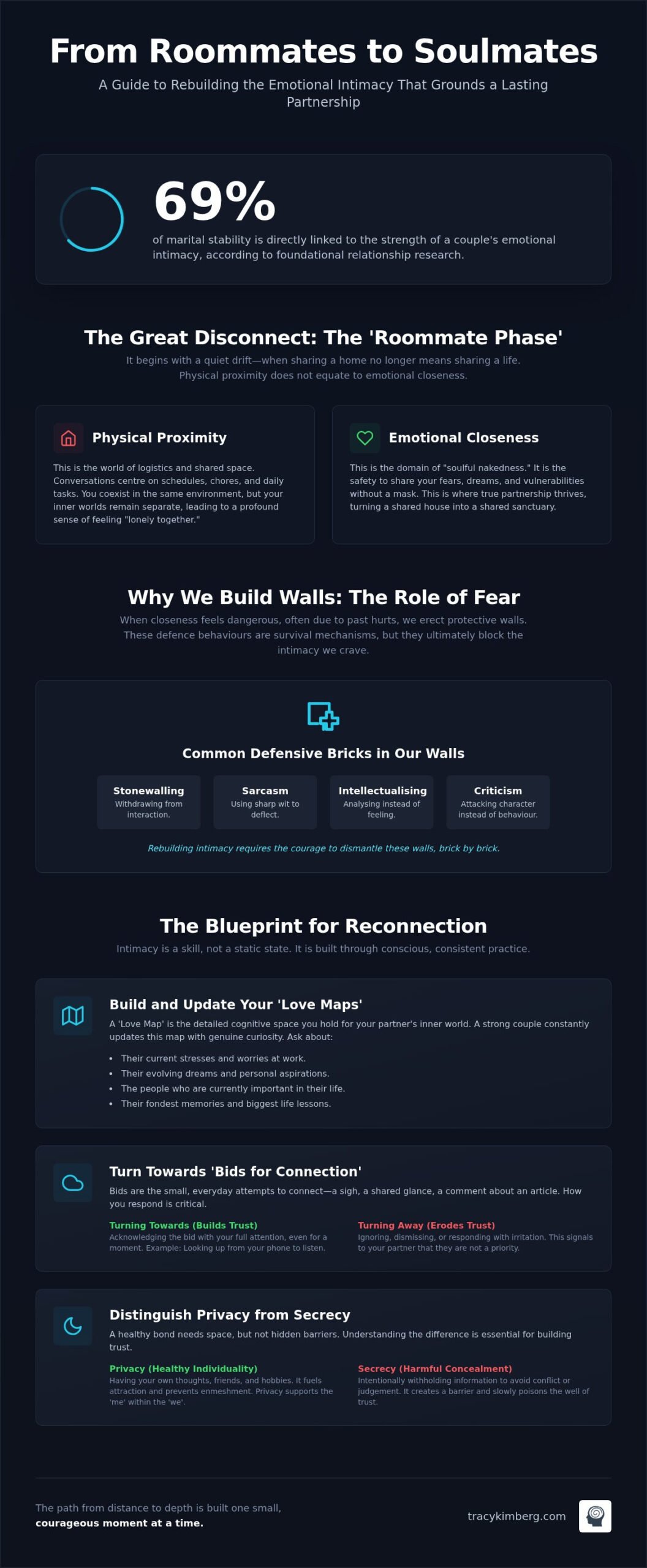
We understand that this distance feels daunting, but it’s important to recognise that intimacy is a skill rather than a static state. Research indicates that emotional intimacy scores account for 69% of marital stability, making this work essential for your long-term health. This guide explores the psychological foundations and practical rituals required to foster a resilient, soulful bond once again. We’ll demystify the “why” behind your emotional distance whilst providing you with the tools to create a sense of lasting psychological safety. By the end of this article, you’ll have a clear roadmap to move from shared living spaces to a deeply connected partnership that feels both secure and alive.
Key Takeaways
- Understand why emotional intimacy is the “soulful nakedness” required to bridge the gap between physical proximity and true psychological closeness.
- Learn how to build emotional intimacy by creating “Love Maps” that allow you to navigate your partner’s evolving internal world with curiosity and care.
- Discover how to transition from the “roommate phase” to a state of conscious presence; this shifts your focus from daily logistics to meaningful emotional exchange.
- Reframe conflict as an opportunity for connection by mastering repair attempts and viewing disagreements as a window into your partner’s unmet needs.
- Recognise when a structured, research-based recovery process is the necessary catalyst to move beyond stagnant relationship dynamics and achieve transformational healing.
What is Emotional Intimacy and Why Does it Fade?
Emotional intimacy is much more than the absence of conflict or the presence of physical touch. It is a state of “soulful nakedness,” where you allow your partner to see your internal world, fears, and aspirations without the protective mask of your social persona. This level of being truly seen is the bedrock of a secure bond. However, many couples find themselves “lonely together,” where they occupy the same physical space but remain emotionally stranded. This happens because physical proximity does not equate to emotional closeness. You might share a bed, but if you no longer share your inner landscape, the relationship begins to feel hollow.
Our brains are hard-wired for this connection. From a neurobiological perspective, emotional distance is perceived as a genuine threat to our survival. When we feel disconnected, the amygdala signals an alarm, often resulting in anxiety or a desperate need to withdraw. This is why learning how to build emotional intimacy is so critical; it calms the nervous system and creates a sanctuary of safety. Unfortunately, most couples fall victim to “the drift.” This isn’t a sudden break, but a slow erosion caused by the endless logistics of modern life. Between career demands and domestic chores, the emotional centre of the partnership is often sacrificed at the altar of efficiency.
The Difference Between Privacy and Secrecy
A common misconception is that intimacy requires a total loss of individuality, or what psychologists call enmeshment. In reality, a healthy bond requires a balance. As Esther Perel often notes, intimacy needs space to breathe. Privacy is healthy; it involves having thoughts, hobbies, or moments that belong only to you, which actually helps maintain a “sense of mystery” that fuels attraction. Secrecy, however, is a different beast. Secrecy involves intentionally withholding information to avoid conflict or judgement, which slowly poisons the well of trust. Whilst privacy supports the individual, secrecy creates a barrier that makes it impossible to know how to build emotional intimacy effectively.
Why We Build Walls: The Role of Fear and Protection
When closeness feels dangerous, we build walls. These “defence behaviours,” such as stonewalling, sharp sarcasm, or intellectualising emotions, are actually survival mechanisms. Many of these reactions are rooted in what Gabor Maté describes as “attachment injuries,” wounds from our past where being vulnerable led to pain or neglect. We carry these protective layers into our adult partnerships, often without realising it. Building deep intimacy is rarely about learning new tricks; it’s about the courageous act of unlearning these defences. It requires dismantling the bricks we once laid for protection so that our partner can finally reach the person behind the wall.
The Pillars of Psychological Safety and Vulnerability
To understand how to build emotional intimacy, we must first look at the foundation upon which it rests. John Gottman’s “Sound Relationship House” framework provides a vital blueprint for this. At its base, we find the essential need for psychological safety. Without a sense that we’re safe from judgement or attack, our nervous systems remain in a state of high alert, making true connection impossible. We simply can’t be open when we’re busy defending ourselves.
A significant part of this safety is built through what Gottman calls “Bids for Connection.” These are the small, often mundane moments where one partner reaches out for attention, affirmation, or affection. It could be a simple sigh, a comment about a news headline, or a brief physical touch. The health of your bond depends on whether you “turn towards” these bids or “turn away.” Consistently turning towards your partner builds a reservoir of trust that acts as a buffer during times of stress.
However, safety isn’t just about being pleasant. It involves what Gabor Maté describes as the tension between “Authenticity and Attachment.” Often, we sacrifice our authentic selves to maintain the attachment to our partner, fearing that our true feelings might cause a rupture. True intimacy requires the courage to be real even when it feels risky. Choosing authenticity over a false sense of peace is the only way to foster a bond that is genuinely soulful rather than just functional.
Building Your Love Maps
Love Maps are the cognitive spaces you hold for your partner’s history, dreams, and current stresses. In 2026, these maps require constant updating because our internal worlds are shifting faster than ever amongst digital saturation and changing life transitions. You might know your partner’s favourite film, but do you know their current greatest fear at work or their latest unfulfilled dream? Love Maps are the essential prerequisite for navigating any crisis together because they ensure you’re actually speaking to the person your partner is today, not the version of them you knew years ago.
The Courage to be Vulnerable
We often mistake vulnerability for weakness, but in the context of a partnership, it’s your greatest strength. It’s the act of showing up and being seen when you can’t control the outcome. After sharing something deep, you might experience a “vulnerability hangover,” a sense of exposed raw nerves and sudden regret. Supporting a partner through this requires deep empathy and a non-judgemental presence. For those who find this unmasking particularly difficult, engaging in a 12-Week Relationship Recovery Process provides a structured, safe container to practice these skills under expert guidance.
Breaking the “Roommate Phase”: Practical Reconnection Rituals
It’s incredibly easy for couples to slip into a state of domestic autopilot. You become efficient co-managers of a household, experts in the logistics of childcare, finances, and the weekly shop, yet you lose sight of the partner sitting across the table. This “roommate phase” is a common plateau in long-term relationships. To move beyond it, we must intentionally shift from “doing” to “being” together. This transition is rooted in the concept of Conscious Presence, which means setting aside the mental checklist to fully engage with your partner in the present moment.
One of the most effective ways to foster this presence is through “rituals of departure and return.” These are small, intentional moments that bookend your day. For instance, a genuine six-second kiss before leaving for work or a focused ten-minute check-in when you reunite in the evening can act as a powerful emotional anchor. These exercises for couples to reconnect, such as sharing one specific thing you appreciated about each other that day, require minimal time but offer significant emotional returns. Learning how to build emotional intimacy is often about these small, consistent deposits into your relationship’s emotional bank account.
The Daily Stress-Reducing Conversation
A primary intimacy killer in many relationships is the urge to “fix” our partner’s problems. When one person shares a struggle, the other often jumps in with advice, which can inadvertently lead to the speaker feeling unheard or dismissed. Instead, practice the art of listening without fixing. We recommend a “20-minute rule” for decompression; allow each other twenty minutes of quiet time after work before diving into domestic tasks or emotional discussions. When you do speak, use “softened start-ups” to express your needs. Instead of saying “You never listen,” try “I’m feeling a bit overwhelmed and would love some focused time to talk.”
Weekly “State of the Union” Meetings
Whilst daily rituals maintain the spark, weekly check-ins provide the structure for long-term growth. A “State of the Union” meeting is a dedicated time to focus on the relationship rather than the “to-do” list. To keep this productive and non-confrontational, focus on three core questions: What went well this week? Where did we miss each other? How can I love you better next week? Always lead with appreciation and use “I” statements to own your feelings. This prevents your partner from feeling attacked and keeps the conversation focused on collaborative solutions rather than blame.
Navigating Conflict as a Gateway to Closeness
Conflict is not a sign that your relationship is failing. It’s actually an “information-gathering” exercise that reveals unmet needs and hidden desires. When we argue, we’re often just trying to find our way back to each other, but we get lost in the “Four Horsemen” of Criticism, Contempt, Defensiveness, and Stonewalling. These behaviours act as roadblocks to the very connection we crave. For example, sarcasm, which is a common British conversational trait, can quickly slip into Contempt; this is the single greatest predictor of relationship dissolution because it conveys moral superiority rather than empathy.
Learning how to build emotional intimacy involves recognising when you’re “flooded” and needing to self-soothe before a rupture becomes permanent. If your heart rate is elevated, you’ve lost the ability to process information creatively. Taking a twenty-minute break to calm your nervous system allows you to return to the conversation with curiosity rather than armour. This pause isn’t an act of avoidance; it’s an act of care for the bond you’re trying to protect.
The Art of the Repair Attempt
A repair attempt is the secret weapon of emotionally intimate couples. It is any statement or action, silly or serious, that prevents negativity from escalating out of control. In a British context, this might look like:
- Using self-deprecating humour: “I’m being a bit of a nightmare right now, aren’t I?”
- A gentle, lingering touch on the arm whilst the other is speaking.
- A simple, “I’m sorry, I didn’t mean to snap. Can we try that again?”
Crucially, the success of a repair depends entirely on the reception. If your partner reaches out with an olive branch, you must be willing to accept it. This mutual de-escalation is what separates resilient couples from those who remain stuck in a cycle of resentment.
Finding the Dream within the Conflict
Deep-seated, repetitive arguments often hide a “hidden dream” or a core value that feels threatened. If you’re fighting about the household budget, it might actually be an argument about security or freedom. To uncover this, ask questions like: “What is the story behind your position on this?” or “What do you fear would happen if we didn’t do it this way?” This Gottman method therapy UK approach transforms a battle of wills into a shared discovery of each other’s inner worlds. If you’re tired of the same circular arguments, our Relationship Counselling and Coaching for Couples can help you turn your conflicts into a bridge for deeper connection.
The Path Forward: Cultivating a Lifetime of Connection
Building deep closeness isn’t a one-time event or a destination you reach and then ignore. It’s a living, breathing rhythm. Think of it as a muscle that requires consistent, intentional exercise to remain strong. If you’ve been wondering how to build emotional intimacy in a way that lasts decades rather than days, it’s vital to accept that the work never truly ends; it simply becomes a more natural, rewarding part of your shared life. Progress isn’t always linear, but with the right tools, the periods of distance become shorter and the repairs become swifter.
When to Seek Professional Support
Sometimes, despite your best intentions, you might find yourselves stuck in repetitive cycles where every attempt at connection feels like hitting a brick wall. If you’re experiencing a sense of emotional numbness or if the silence in your home has become heavy, it may be time to invite an external Wise Guide into your process. A neutral, safe environment allows you to explore difficult truths that feel too risky to voice at the dinner table. Whilst coaching is often forward-looking, focusing on skills and goals, counselling provides the space for healing the past injuries that keep you guarded. Both are powerful tools for transformational change.
Your 12-Week Transformation
For couples who want more than just temporary tips, the 12-Week Relationship Recovery Process offers a structured, research-based journey. Rooted in the profound insights of experts like Gottman and Perel, this programme guides you through an intentional arc from crisis management to deep, soulful reconnection. We move beyond surface-level fixes to address the systemic patterns and attachment needs that define your bond. It’s an invitation to turn your relationship into a proactive adventure rather than a clinical necessity, ensuring you have the support of a specialised authority in interpersonal dynamics.
Healing is possible. No matter how many years you’ve spent in the roommate phase or how many attachment injuries you carry, the capacity for renewal is always present. You can rediscover the person you fell in love with and build a partnership that feels both secure and vibrantly alive. If you’re ready to begin this transformational chapter, we invite you to book a discovery call today to see how we can support your journey toward lasting closeness and emotional health.
Reclaiming the Heart of Your Partnership
Emotional closeness isn’t a stroke of luck; it’s a series of conscious choices you make every single day. By understanding the psychological foundations of vulnerability and mastering the art of the repair attempt, you can move beyond the quiet isolation of the “roommate phase.” You’ve learned that how to build emotional intimacy is less about grand gestures and more about the steady, intentional work of “turning towards” your partner in small, mundane moments. This shift from “doing” to “being” is what creates a resilient, soulful bond that can withstand the pressures of modern life.
If you’re ready to move from surviving to thriving, I’m here to act as your Wise Guide. With over 15 years of experience in transformational therapy, I offer a research-led approach inspired by the pioneering work of Gottman and Perel. I provide compassionate, non-judgemental support for UK couples who are ready to rediscover the spark they thought was lost. You don’t have to navigate this complex emotional landscape alone. Begin your journey with the 12-Week Relationship Recovery Process today. Healing is a proactive adventure, and it’s never too late to start.
Frequently Asked Questions
How long does it take to build emotional intimacy?
It depends on your starting point, but visible shifts usually occur within 12 weeks of consistent effort. Intimacy isn’t a destination but a practice. Significant research shows that couples who attend therapy report noticeable improvements in 71% of cases. The process involves daily rituals of connection and the slow unlearning of defensive behaviours. It’s a marathon, not a sprint, requiring patience and the willingness to be seen in your rawest state.
Can emotional intimacy be restored after infidelity or a major betrayal?
Yes, it’s possible to rebuild, though it requires a structured process of transparency and atonement. Betrayal shatters the “Sound Relationship House,” but the foundation can be reconstructed through radical honesty and professional guidance. It involves understanding the “why” behind the breach without justifying it. This journey often leads to a “new” relationship that is more conscious and emotionally honest than the one that existed before the crisis.
What if my partner is not interested in building emotional intimacy?
You can begin the work individually by changing your own patterns of vulnerability and response. When one partner shifts from a defensive stance to an open one, the systemic dynamic of the relationship often changes as a result. Focus on your own “bids for connection” and model the behaviour you wish to see. However, long-term transformational change usually requires a mutual commitment to learning how to build emotional intimacy together.
Is emotional intimacy possible in a long-distance relationship?
Emotional closeness is entirely possible across distances and often becomes the primary strength of such bonds. Since physical touch is absent, couples must rely heavily on verbal vulnerability and shared “Love Maps.” Daily conversations about your internal worlds are essential. In 2026, technology allows for parallel experiences, but the key remains the quality of your presence and the courage to share your feelings whilst physically apart from one another.
What is the “roommate phase” and how do I know if we are in it?
The “roommate phase” occurs when a couple becomes efficient co-managers of life but stops being emotional confidants. You might recognise it if you feel lonely whilst sitting in the same room or if your conversations are strictly limited to domestic logistics. It’s a state where the “spark” feels gone because you’ve prioritised efficiency over intimacy. Identifying this drift is the first step toward reclaiming your soulful connection and moving back toward closeness.
How do I start a conversation about intimacy without sounding critical?
Use “softened start-ups” that focus on your own feelings and needs rather than your partner’s perceived failures. Instead of saying “You never talk to me,” try “I’ve been feeling a bit lonely lately and I’d love to spend some quiet time just catching up with you.” Lead with an “I” statement and an appreciation. This reduces the likelihood of defensiveness and invites your partner into a collaborative, supportive conversation.
What are the best emotional connection exercises for busy couples?
The most effective exercises are small, daily rituals that fit into a hectic schedule. A six-second kiss during departure or a ten-minute “stress-reducing conversation” in the evening can make a profound difference. You don’t need hours; you need focused, undistracted presence. Understanding how to build emotional intimacy in short bursts ensures that your relationship remains a priority amongst the demands of career and family life.
Can individual therapy help my relationship if my partner won’t attend?
Individual therapy is a powerful tool for relationship change because it helps you understand your own attachment style and defensive patterns. By healing your own “attachment injuries,” you change how you show up in the partnership. This often creates a ripple effect that encourages your partner to respond differently. Whilst it isn’t a substitute for couples work, it provides you with the internal resources to foster a healthier and more resilient dynamic.

Article by
Tracy Kimberg
Tracy Kimberg is a Relationship Expert, Couples Therapist and Coach with a dedicated focus on helping couples and individuals rebuild connection, trust and emotional safety in their relationships. Drawing on the research of John and Julie Gottman, the relational insights of Esther Perel, and years of hands-on therapeutic experience, Tracy offers a warm, non-judgemental and deeply compassionate approach to modern relationships.
Based in Dorset, Tracy works with couples navigating communication breakdowns, betrayal, intimacy challenges, separation, family dynamics and life transitions. Known for creating a safe and grounded therapeutic space, she combines practical tools with emotional depth to help clients move beyond survival patterns and towards meaningful, lasting change.
With a reputation for empathy, professionalism and dedication to her clients’ growth, Tracy is passionate about helping people feel seen, understood and empowered — both within their relationships and within themselves.
Disclaimer
Disclaimer:
The information shared in this article is intended for educational and informational purposes only and should not be considered a substitute for professional therapeutic, psychological, medical or legal advice. Every individual and relationship is unique, and the perspectives offered are based on general therapeutic principles, research and professional experience.
Reading this article does not establish a therapist-client relationship with Tracy Kimberg. If you are experiencing significant emotional distress, relationship crisis, trauma, or mental health concerns, it is important to seek support from a qualified professional appropriate to your individual circumstances.
All content remains the intellectual property of Tracy Kimberg and may not be reproduced or distributed without permission.