

What if the conversation you dread most is actually the first step toward your child’s long-term resilience? Right now, the weight of knowing how to tell kids about separation likely feels like an impossible burden. You might be lying awake at night, rehearsing sentences in your mind whilst fearing the tears, anger, or the look of confusion on their faces. It’s natural to feel a profound sense of guilt, as if you’re disrupting the very foundation of their world.
I understand that you want to protect their sense of safety above all else. This guide offers a compassionate framework to help you navigate this transition whilst protecting your children’s emotional security and sense of belonging. We’ll move beyond the initial anxiety to provide you with a clear, actionable plan for the conversation. You’ll discover practical tools to manage your child’s grief and find a path toward a hopeful, healthy new family dynamic that honours everyone’s needs. By approaching this change with intention, you can ensure that your children feel held, heard, and loved throughout the process.
Key Takeaways
- Learn how to establish a united front to provide your child with a secure emotional container. This preserves their sense of safety whilst you navigate the initial transition.
- Discover a gentle, research-backed script on how to tell kids about separation using a “Safety Sandwich” approach to anchor the conversation in love.
- Gain age-specific guidance to ensure your vocabulary and level of honesty align perfectly with your child’s developmental stage and emotional capacity.
- Prepare for the “emotional ripple effect” by learning how to support delayed reactions and create a safe space for your child to express their grief.
- Shift your perspective toward a Conscious Separation. Focus on relational intelligence to ensure your family’s long-term emotional health and recovery.
Emotional Preparation: Finding Your “We” Before the Conversation
Before you sit down to speak, you must find a place of internal stillness. This isn’t about ignoring the complex legal and social aspects of divorce; it’s about prioritising your child’s nervous system. When you’re figuring out how to tell kids about separation, your non-verbal cues carry as much weight as your words. If you’re vibrating with anger or collapsing in grief, your children will naturally mirror that instability. You need to be the “container” for their emotions, which means you must first manage your own emotional overflow.
Creating a no-fault narrative is essential for their long-term health. This story shouldn’t include “who started it” or “who wanted it.” Instead, it’s a shared explanation that protects the integrity of both parents. Children need to know that their foundation is changing shape, not being destroyed. By agreeing on this narrative beforehand, you prevent the child from feeling they must choose a side or hold a secret for one parent against the other.
The Internal Work: Regulating Your Own Anxiety
You can’t lead a child through a storm if you’re drowning in it. Your calm is the most important script you bring to the table. If you feel overwhelmed, consider practising the conversation with a therapist to desensitise your emotional triggers. This allows you to vent your resentment in a safe space so it doesn’t leak into the family room. A united front is a shared commitment to your child’s emotional security that intentionally sits above any personal grievances or adult conflicts.
Logistics of the Conversation
Planning is an act of love. Choose a neutral, private space where you won’t be interrupted. Weekends are generally better than school nights because they provide the necessary processing time before the routine of the week resumes. It’s vital to follow the “one room, two parents” rule. Telling them together reinforces the reality that, whilst the partnership is ending, the parenting team remains intact. The logistics of how to tell kids about separation involve more than just words; they involve timing and presence.
Think about the immediate next hour after the news is broken. Don’t plan any errands or social visits. Your children might want to ask a hundred questions, or they might want to sit in silence and play. Simply being present and available during that first hour creates an immediate sense of continuity and safety in the face of big change.
Crafting the Narrative: A Step-by-Step Script for the Conversation
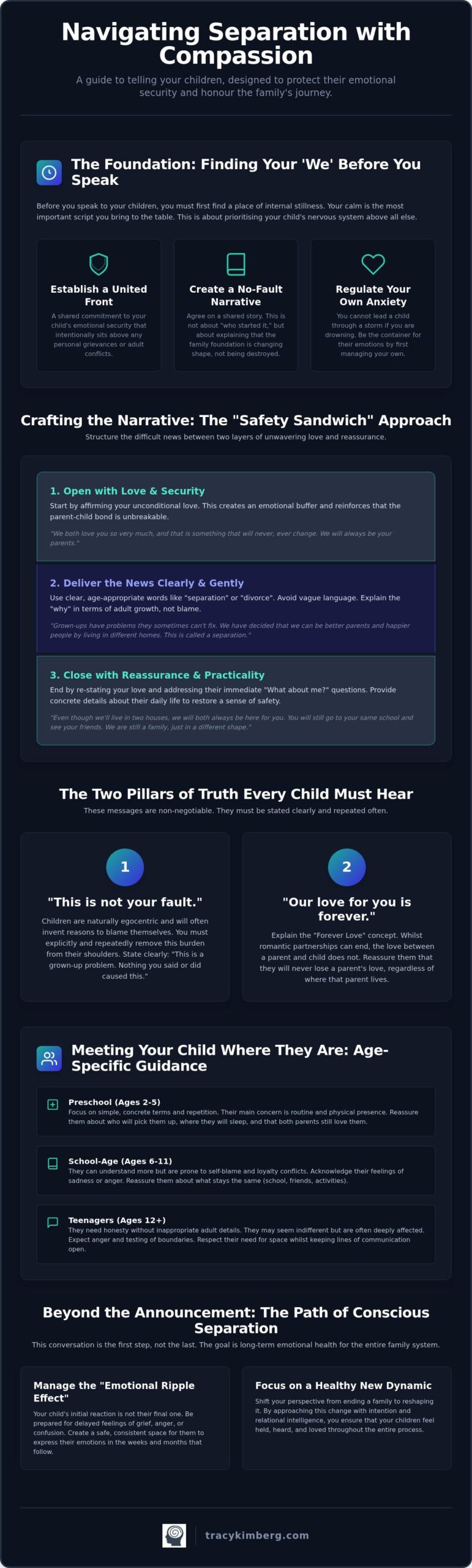
When you are ready to speak, use a “Safety Sandwich” to structure the news. This means you open and close the conversation with the absolute certainty that your children are loved and safe. By anchoring the difficult news between layers of reassurance, you provide an emotional buffer. Knowing how to tell kids about separation requires a delicate balance of honesty and protection. You aren’t just giving them information; you’re helping them build a new internal map of their world.
Precision in your language is vital. Avoid vague phrases like “Daddy is going away for a bit” or “Mummy needs a break,” which can lead to confusion or false hope of a quick return. Use the words “separation” or “divorce” clearly. This provides the clarity they need to begin processing the reality of the change. For more clinical insights on the impact of these words, you can find expert tips for how to talk to kids about divorce that highlight the importance of developmental honesty.
Explain the “why” without sharing the “gory details.” Children don’t need to know about adult betrayals or complex intimacy issues. Instead, focus on adult growth. You might say that you’ve both tried hard to fix the problems in your relationship but have realised you can be better parents and happier people living in different homes. Address the “What about me?” questions immediately. Tell them where they will sleep, who will take them to school, and where the pets will live. These practical details are the scaffolding of their daily security.
The Essential Truths to Include
There are two pillars of truth every child must hear. First, explicitly state: “This is not your fault and nothing you did caused this.” Children are naturally ego-centric and often invent reasons why they are to blame. Second, introduce the “Forever Love” concept. Explain that whilst parents may stop being partners, they never stop being parents. The family is changing its shape, but it is not disappearing. If you find yourself struggling to find the right words, exploring a conscious approach to separation can provide the structure you need.
A Template for the First Conversation
- Step 1: Start with a gentle opening, affirming your shared love for them.
- Step 2: Make a clear, neutral statement about the change in your adult relationship.
- Step 3: Provide specific reassurances about what will stay the same in their daily routine.
- Step 4: Invite their questions and give them explicit permission to feel angry, sad, or even silent.
Age-Specific Guidance: Meeting Your Child Where They Are
Children don’t just hear your words; they filter them through their current developmental lens. When you are navigating how to tell kids about separation, you must speak to their specific level of understanding regarding time, permanence, and interpersonal dynamics. Whilst a teenager might worry about the impact on their social standing, a toddler simply needs to know who is putting them to bed tonight. Your goal is to provide a narrative that is honest yet tailored to their cognitive capacity.
If you have children of different ages, it’s usually best to share the news with everyone together first. This ensures a consistent family story and prevents siblings from feeling left out or burdened with secrets. Afterwards, you can have individual follow-up conversations to address age-specific concerns. This tiered approach honours the family unit whilst respecting each child’s unique emotional needs.
Toddlers and Pre-schoolers (Ages 2–5)
For this age group, the concept of “forever” is largely abstract. They live in the “now,” so focus on concrete, sensory changes. You might say, “Daddy will have a new house with a blue bed for you.” Use picture books or play with dolls to illustrate the transition. It’s common to see temporary regressions, such as accidents in potty training or new sleep anxieties. These aren’t signs of “bad behaviour”; they are a young child’s way of processing an internal shift they can’t yet put into words.
Primary School Children (Ages 6–12)
Children in this bracket are deeply concerned with fairness and logic. They might ask, “Why can’t you just try harder?” or look for someone to blame. Help them visualise the new routine by using a shared wall calendar. This reduces the cognitive load of uncertainty by showing them exactly when they will be with each parent. Be vigilant about “parentification,” where a child tries to “fix” your sadness or take on adult chores. Remind them that the adult problems are for the adults to solve, which allows them to stay in their role as a child.
Teenagers (Ages 13–18)
Adolescents often respond with intense anger or a sudden need for withdrawal. Respect their need for autonomy whilst remaining a steady, reliable presence. When deciding how to tell kids about separation at this stage, avoid the trap of over-sharing adult details to justify your choice. They don’t need to be your confidant; they need you to be their parent. Validate their concerns about how this affects their social life, school stability, or their own future relationships. They need to see that your commitment to their well-being remains the absolute priority.
Managing the Emotional Ripple Effect: What to Expect Next
The initial conversation is rarely where the emotional work ends; it’s simply where the processing begins. Gabor Maté often reminds us that trauma isn’t what happens to a person, but what happens inside them as a result. When you’re learning how to tell kids about separation, you must prepare for the “Delayed Reaction.” Some children appear remarkably resilient or even indifferent in the first few weeks. This isn’t always a sign of “fine”; it’s often the brain’s way of pacing the delivery of a reality that feels too heavy to carry all at once.
Your role now is to create a “Feeling Space.” This means allowing all emotions to exist without the pressure to “fix” them or cheer the child up. If they are angry, let them be angry. If they are silent, sit in that silence with them. Grounding rituals are your best ally during this time of flux. Maintaining your Friday film nights or Sunday roasts provides a sense of continuity. These predictable anchors signal to the child’s nervous system that whilst the family structure is changing, their world is not collapsing.
Be on the lookout for the “Four Horsemen” of childhood grief: anger, sadness, fear, and guilt. Guilt is particularly common. Children often search for a reason for the split and, in their limited logic, may conclude that their own behaviour was the cause. Constant, gentle reassurance that this is an adult decision is the only antidote to this internalised blame.
Responding to Difficult Questions
You will likely face questions that feel like a punch to the gut. If they ask, “Do you still love each other?”, answer with integrity. You might say, “We will always have a special kind of love for each other because we are your parents, but we aren’t ‘in love’ as a couple anymore.” If they ask if you can try to be a family again, be honest but gentle about the permanence of the decision to avoid giving false hope. Honesty does not mean full disclosure; it means providing the truth in a way the child can carry.
Spotting When Professional Help is Needed
Whilst some struggle is expected, watch for signs that the emotional load has become too heavy. School refusal, prolonged anxiety, or a significant shift in personality are signals that the child needs more support. For older children, individual therapy for teenagers can provide a neutral, safe outlet where they can vent their frustrations without worrying about hurting their parents’ feelings. Normalising therapy as a “check-up for the heart” during a big life change reduces stigma and promotes long-term healing.
If you find the emotional weight of this transition difficult to manage on your own, I invite you to reach out for Relationship Counselling and Coaching for Couples to help you navigate this path with clarity and compassion.
Beyond the Announcement: The Path of Conscious Separation
The conversation is a threshold, not a destination. Whilst your focus has likely been on the immediate hurdle of how to tell kids about separation, the true work of healing lies in the months and years that follow. We call this path Conscious Separation. It is a proactive, empathetic choice to prioritise the family’s long-term emotional health over individual grievances. By choosing this approach, you are acknowledging that whilst the romantic partnership has concluded, the family unit is simply evolving into a new, functional form.
Your ongoing relational intelligence will be the primary factor in your child’s recovery. Children are incredibly sensitive to the “emotional weather” between their parents. Even if you live in separate homes, they observe how you speak to each other, how you manage transitions, and how you honour each other’s role in their lives. Moving from “partners” to “co-parents” is a psychological shift that often requires professional guidance. Utilising Conscious Divorce and Separation Support allows you to build a framework for communication that reduces conflict and centres the child’s needs.
The Long-Term Family Narrative
As time passes, the story you tell about your separation becomes part of your child’s history. You have the power to reframe the split as a brave choice for peace rather than a failure of love. This narrative is reinforced during birthdays, holidays, and school milestones. When parents can navigate these events with grace, it gives children permission to enjoy their lives without feeling they must manage their parents’ discomfort. For those struggling to find their footing, the 12-Week Relationship Recovery Process serves as a structured tool to help individuals heal their own hearts so they can show up fully for their children.
Taking the Next Step with Tracy Kimberg
Navigating the psychological complexities of a family transition is a heavy task to carry alone. Specialised coaching provides you with a safe, non-judgemental environment to explore these challenges. Online sessions are particularly beneficial for co-parents who need a neutral space to discuss logistics and emotional boundaries from the comfort of their own homes. This process isn’t about erasing the past; it’s about consciously co-creating a future where everyone can thrive. You don’t have to walk this path alone. There is a way through the pain toward a dynamic of calm optimism and renewed connection.
Nurturing Your Family’s New Chapter
Choosing to evolve your relationship is one of the most profound decisions you will ever make. By focusing on internal regulation and crafting a narrative anchored in safety, you are transforming a moment of potential trauma into a lasting lesson in resilience. You now have a compassionate framework for how to tell kids about separation whilst protecting their fundamental sense of belonging. Your children don’t need you to be perfect; they simply need you to be a steady, honest container for their experience.
If the path ahead feels daunting, remember that support is available. I offer a specialised 12-Week Relationship Recovery Process and Gottman-inspired coaching to help you navigate these psychological complexities with clarity. My approach provides a safe, non-judgemental environment for you to transition from partners to healthy co-parents. I invite you to Book a Conscious Separation Discovery Session with Tracy Kimberg to explore how we can co-create a functional future for your family. You are capable of leading your children through this change with grace and calm optimism.
Frequently Asked Questions
How much detail should I give about the reasons for the separation?
Keep it general and age-appropriate, focusing on adult growth rather than specific conflicts or betrayals. Explain that the relationship has changed and you can no longer live together as a couple. Avoid sharing “gory details” that might force the child to take sides. The goal is to provide a truthful narrative that preserves the integrity of both parents whilst ensuring the child feels secure and loved.
What if my child blames themselves for the split?
You must explicitly and repeatedly state that the separation is an adult decision and is not their fault. Children often use “magical thinking” to link their behaviour to family changes. Reassure them that nothing they said or did caused this shift. When considering how to tell kids about separation, emphasise that your love for them is constant and separate from the adult relationship between you and your partner.
Should we tell all our children at the same time?
Yes, it’s generally best to tell all siblings together to ensure they receive the same information and feel supported as a unit. This prevents one child from feeling burdened by a secret or left out of the family narrative. After the shared conversation, you can offer individual time to each child. This allows you to address their specific developmental concerns or emotional reactions in a more private, tailored setting.
How do I handle it if my partner starts crying during the conversation?
Crying is a natural human response and doesn’t need to be hidden, but it should remain manageable. If one parent becomes overwhelmed, the other should step in to lead the conversation. You can explain to the children that you are sad because this is a big change, but reassure them that you are still okay and capable of looking after them. This models healthy emotional expression without making the child feel responsible for your comfort.
What if my child asks if we will ever get back together?
Give an honest, gentle answer that avoids creating false hope. If the decision is final, it’s kinder to say, “We have decided that living apart is the best way for us to be happy and good parents.” Using clear terms like “separation” or “divorce” helps them process the reality. Whilst it’s difficult to see them struggle, providing clarity now prevents the prolonged pain of waiting for a reconciliation that won’t happen.
How soon after we decide to separate should we tell the kids?
Tell them once the decision is firm and you have a concrete plan for the immediate future, such as living arrangements. Ideally, this should be about two to three weeks before a parent moves out. This timeframe provides enough space for them to ask questions and process the initial shock whilst preventing a long, anxious period of uncertainty. Timing is a crucial part of how to tell kids about separation effectively.
What are the signs that my child is not coping well with the news?
Watch for significant changes in their baseline behaviour or physical health. Common red flags include:
- Prolonged sleep disturbances or frequent nightmares.
- Sudden academic decline or school refusal.
- Physical symptoms like stomach aches or headaches without a medical cause.
- Regressive behaviours, such as bedwetting in older children.
If these symptoms persist for more than a few weeks, seeking professional support can help them navigate their grief safely.
How can I support my teenager who is acting out after the news?
Validate their anger and provide them with extra space whilst maintaining consistent boundaries. Teenagers often use “acting out” as a shield for deep vulnerability or fear about their future. Avoid taking their outbursts personally. Instead, offer them a neutral outlet, such as therapy, where they can express their frustrations without fear of hurting you. Let them know that whilst their world is changing, your commitment to their stability remains absolute.

Article by
Tracy Kimberg
Tracy Kimberg is a Relationship Expert, Couples Therapist and Coach with a dedicated focus on helping couples and individuals rebuild connection, trust and emotional safety in their relationships. Drawing on the research of John and Julie Gottman, the relational insights of Esther Perel, and years of hands-on therapeutic experience, Tracy offers a warm, non-judgemental and deeply compassionate approach to modern relationships.
Based in Dorset, Tracy works with couples navigating communication breakdowns, betrayal, intimacy challenges, separation, family dynamics and life transitions. Known for creating a safe and grounded therapeutic space, she combines practical tools with emotional depth to help clients move beyond survival patterns and towards meaningful, lasting change.
With a reputation for empathy, professionalism and dedication to her clients’ growth, Tracy is passionate about helping people feel seen, understood and empowered — both within their relationships and within themselves.
Disclaimer
Disclaimer:
The information shared in this article is intended for educational and informational purposes only and should not be considered a substitute for professional therapeutic, psychological, medical or legal advice. Every individual and relationship is unique, and the perspectives offered are based on general therapeutic principles, research and professional experience.
Reading this article does not establish a therapist-client relationship with Tracy Kimberg. If you are experiencing significant emotional distress, relationship crisis, trauma, or mental health concerns, it is important to seek support from a qualified professional appropriate to your individual circumstances.
All content remains the intellectual property of Tracy Kimberg and may not be reproduced or distributed without permission.