

You sit across from each other at dinner, the silence heavy with things unsaid, feeling more like polite roommates than the lovers you once were. It’s exhausting to live in a cycle of arguments that never reach resolution or to carry the weight of resentment that lingers long after a betrayal. You aren’t alone in feeling that the spark has dimmed, leaving only a quiet sense of obligation in its place.
I understand that the prospect of healing can feel overwhelming when you’re stuck in the thick of it. However, a structured 12 week relationship recovery process offers a manageable, powerful path back to one another. By moving through an intentional, research-based journey, you can transform that emotional disconnect into a resilient, loving partnership that feels safe and vibrant again.
This guide explores how we can dismantle those old patterns and replace them with clear communication frameworks that actually work. We’ll look at the specific steps required to restore intimacy and build a shared future filled with genuine hope, turning your relationship into a proactive adventure of rediscovery rather than a constant source of stress.
Key Takeaways
- Understand the subtle mechanics of the “roommate phase” and how to recognise the emotional neglect that leads to a slow erosion of intimacy.
- Discover why a structured 12 week relationship recovery programme provides the momentum needed to create lasting change whilst offering a clear alternative to open-ended therapy.
- Learn to navigate the physiological triggers of contempt and resentment that often shut down empathy and keep couples trapped in cyclical arguments.
- Identify the practical milestones of success, from establishing baseline emotional safety to reclaiming the “erotic intelligence” that brings vibrancy back to your bond.
- Determine if a time-bound, structured approach is the most effective path for your partnership’s unique history and current emotional landscape.
The Anatomy of Relational Breakdown: Why We Drift
Drifting apart rarely happens in a single, catastrophic moment. Instead, it’s often a quiet, corrosive process that begins long before a couple seeks a 12 week relationship recovery programme. This “slow fade” can be more disorienting than a sudden crisis because it lacks a clear starting point. You wake up one morning and realise the person sleeping next to you feels like a stranger. The anxiety you feel in this moment is valid; it’s the psyche’s way of signalling that the foundation is cracking.
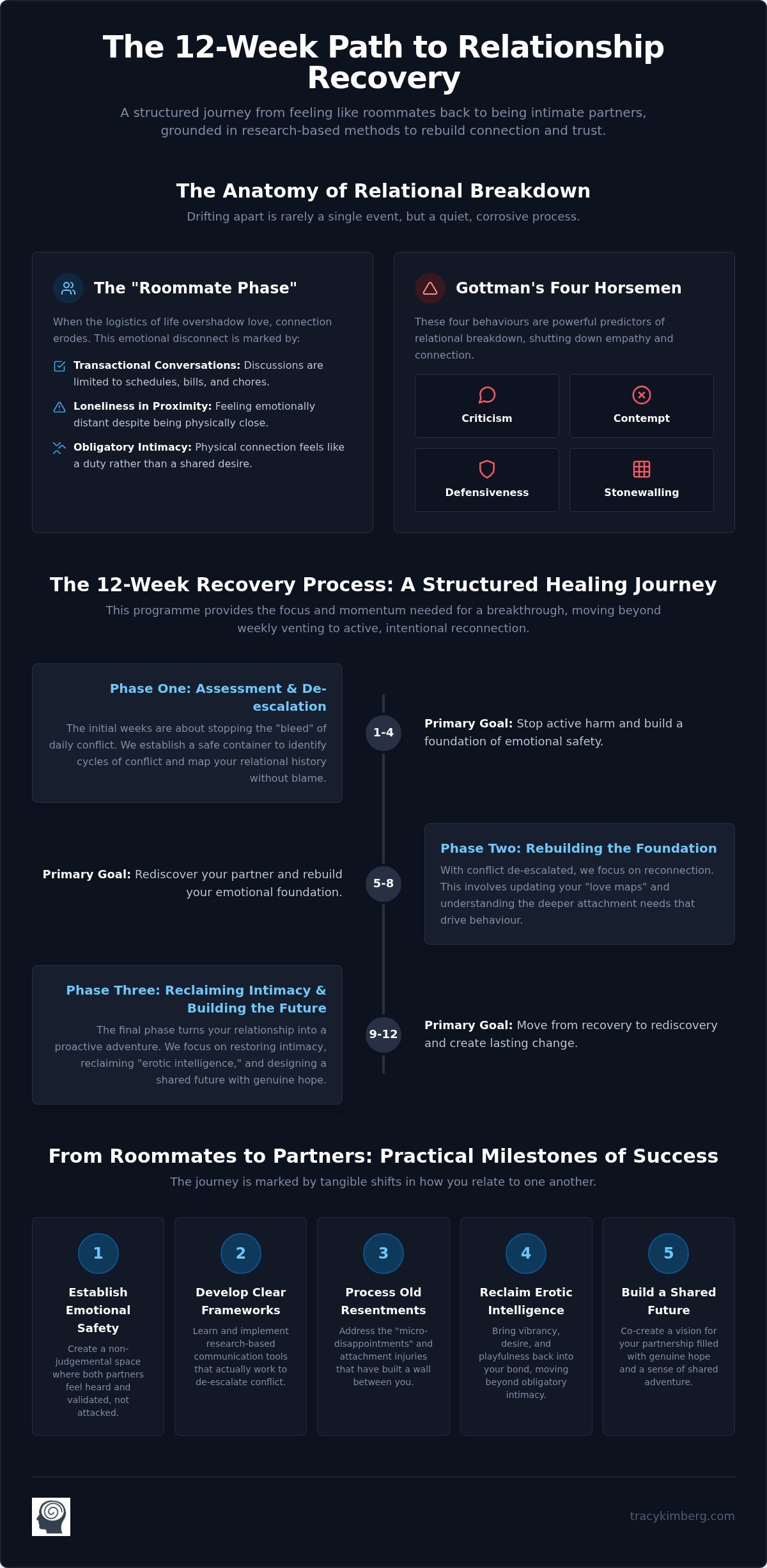
The nature of intimate relationships requires constant emotional nourishment to survive the friction of shared life. When that nourishment stops, the bond doesn’t just stay static; it begins to erode through emotional neglect. John Gottman’s research identifies four specific behaviours, known as the “four horsemen,” that predict the end of a partnership: criticism, contempt, defensiveness, and stonewalling. Contempt is particularly toxic, as it involves looking down on your partner, which effectively shuts down the possibility of empathy and connection.
The “Roommate Phase” and Emotional Disconnect
The “roommate phase” occurs when the logistics of life, such as mortgages, school runs, and meal planning, become the only points of contact. You’ve become efficient co-administrators of a household, but you’ve ceased being lovers. Signs that you’ve shifted into this space include purely transactional conversations and a sense that physical intimacy has become an obligation rather than a desire. The psychological impact of feeling lonely whilst in a relationship is profound. It creates a unique type of heartache that comes from being physically close yet emotionally miles apart.
The Role of Unresolved Resentment
Resentment is the residue of “micro-disappointments” that were never properly processed. It’s the ignored request for help or the recurring argument that never reaches a conclusion. These small hurts accumulate into a wall that feels impossible to climb. Without a structured 12 week relationship recovery framework, simply “talking about it” often leads to more conflict. This is because most couples lack the tools to identify the unspoken needs hidden beneath the anger. To heal, you must move beyond the surface arguments and address the underlying attachment injuries that keep you stuck in defensive loops.
The 12-Week Recovery Process: A Deep Dive into Structured Healing
Open-ended therapy often lacks the urgency required to save a partnership in crisis. Whilst traditional talk therapy has its place, it can sometimes feel like treading water without a shore in sight. The 12 week relationship recovery programme is designed as a “Goldilocks” duration. It’s long enough to dismantle years of ingrained habits and rewire your emotional responses, yet short enough to maintain the intense focus and momentum needed for a true breakthrough. By creating a “safe container,” I guide couples through their pain with a blend of clinical purpose and warm, accessible support.
My approach is grounded in the clinical foundations of the Gottman Method and Systemic Therapy. This means we don’t just look at individual flaws; we examine the entire “system” of your relationship. We look at how your history, your biology, and your environment interact. This structured path is far more effective than “years of traditional therapy” because it’s proactive. It’s not just a weekly venting session. It’s an evolving experience that requires active participation and a commitment to new ways of being together.
Phase One: Assessment and De-escalation
The first four weeks are about stopping the “bleed” of daily conflict. We use research-based tools to map your triggers and relational history. This isn’t about assigning blame. Instead, it’s about breaking the cycle of contempt and defensiveness that may have come to define your interactions. In this non-judgemental environment, both partners finally have the space to feel heard. We identify the specific cycles of conflict that keep you stuck, providing immediate frameworks to de-escalate tension before it spirals out of control.
Phase Two: Rebuilding the Foundation
Once the immediate crisis has subsided, weeks five to eight focus on emotional reconnection. We use Gottman’s concept of “love maps” to help you rediscover who your partner is today, rather than who they were a decade ago. This phase is deeply influenced by trauma-informed perspectives, such as those championed by Gabor Maté. We explore the “why” behind your behaviours, helping you understand if you’re reacting to your partner or to an old, unhealed wound. This is where we nurture fondness and admiration, turning the relationship back into a source of comfort. If you feel ready to move from surviving to thriving, engaging in a structured recovery process can provide the clarity you need to move forward.
Breaking the Cycle of Contempt and Resentment
Many couples arrive at my door feeling as though they’re carrying the weight of a thousand small betrayals. They often ask if it’s even possible to heal when there’s “too much history” or when resentment has become the primary language of the home. This feeling of being beyond repair is usually the result of a physiological shutdown. Contempt is the most corrosive of the behaviours we study because it creates a sense of moral superiority. When you look down on your partner, your brain’s empathy circuits actually go dark. You can’t feel for someone you’ve effectively dehumanised in your mind, which is why arguments feel so cold and clinical.
It’s vital to learn the difference between a complaint and contempt. A complaint is about a specific action, such as “I felt hurt when you didn’t help with the chores.” Contempt is an attack on the person’s character, such as “You’re so lazy, you never think of anyone else.” As Esther Perel often notes, resentment is the ultimate killer of desire. You cannot maintain an erotic spark with someone you’ve spent the day mentally demeaning. Reclaiming that spark starts with clearing the emotional debris through a 12 week relationship recovery process that prioritises safety over speed.
The Antidotes to Contempt
Shifting the emotional climate of your home requires a conscious effort to replace venom with appreciation. We focus on practical milestones for rebuilding intimacy by learning to express needs without attacking your partner’s character. This involves “catching” contemptuous thoughts before they are spoken and choosing to focus on what is working, however small. It’s about moving from a culture of criticism to a culture of gratitude, which softens the heart and allows for genuine connection once again.
Healing from Infidelity and Betrayal
When a relationship has been fractured by infidelity, the path back can feel like walking through a minefield. The 12 week relationship recovery structure provides a vital roadmap for this chaos. We move through the stages of recovery with expert guidance, ensuring that transparency and accountability are non-negotiable. This isn’t about simply “moving on”; it’s about understanding the systemic issues that allowed the breach to happen. If you’re struggling to find your way back to trust, I offer Relationship Counselling and Coaching for Couples that provides the “safe container” needed for these difficult conversations.
From Roommates to Romantic Partners: Practical Milestones
Success at the end of a 12 week relationship recovery process isn’t measured by the total absence of conflict. Instead, it’s defined by the resilience of your connection. It’s the ability to move through a disagreement and find your way back to each other without a wall of silence lasting for days. One of the most beautiful milestones we observe is the return of genuine curiosity. You stop assuming you know exactly what your partner will say and begin to wonder about their internal world again. This shift from “knowing” to “wondering” is the first step in moving from co-habitants back to being lovers.
Research into Emotionally Focused Therapy (EFT) suggests that most couples move from distress to lasting recovery in 12 to 20 weekly sessions. By committing to this structured path, you’re giving your partnership the dedicated time it needs to heal. Maintaining this progress long-term requires a shift in how you view the relationship. It’s no longer a static thing that just “is”; it becomes a proactive adventure that you both choose to participate in every day. If you’re ready to start this journey, you can explore the 12-Week Relationship Recovery Process to see how it can help your specific situation.
Reclaiming Intimacy and Desire
Esther Perel often speaks about the challenge of reconciling the domestic and the erotic. The household thrives on predictability, chores, and routines, but desire requires mystery and a bit of distance. To move beyond the roommate phase, you must prioritise the “couple” over the “household”. This means creating space for longing. It’s about seeing your partner as an individual with their own depth, rather than just the person who forgot to take the bins out. We work on practical steps to bring that sense of “otherness” back, which is essential for reigniting the erotic spark alongside emotional safety.
Mastering Conscious Communication
In the heat of a moment, it’s easy to fall back into old, defensive patterns. Conscious communication is the art of moving from “reacting” to “responding”. It’s a skill that takes practice, but it’s vital for preventing new resentment from taking root. One of the most effective rituals we introduce is the “State of the Union” meeting. This is a weekly, 20-minute ritual where you check in on the relationship health. You discuss what went well, express appreciation, and address any small hurts before they become major grievances. Repairing quickly after a fight is the hallmark of a secure, healthy partnership.
Is the 12-Week Programme Right for Your Partnership?
Deciding to enter a structured programme is a significant step that requires a shift from passive hoping to active engagement. A 12 week relationship recovery process is specifically designed for couples who feel they’ve reached a plateau or are reeling from a specific crisis, such as the betrayals discussed earlier. Whilst individual therapy is vital for personal growth, it often fails to address the systemic “dance” between two people. If your goal is to change the way you relate to one another, the focus must stay on the partnership itself. This time-bound approach is often more effective than years of traditional therapy because it maintains a high level of momentum and focuses on specific, measurable milestones.
Many people worry about a partner who is hesitant or outright skeptical. If your partner is resistant, try reframing the invitation. Instead of suggesting they need to be “fixed,” invite them into a proactive adventure to see if a different way of living is possible. I offer a dual approach that respects the modern need for flexibility; you can engage in Online Therapy or visit me face-to-face in the UK. This accessibility ensures that the work fits into your life, rather than becoming another source of stress or logistical burden.
Preparing for the Journey
Change of this magnitude requires a genuine emotional commitment. It isn’t always easy to look at the parts of ourselves that contribute to a relational breakdown. during your initial consultation, we’ll discuss your history and current pain points to ensure this path is the right fit for you. My work is deeply adaptable, taking into account the nuances of neurodiversity and the impact of past trauma. We don’t use a one-size-fits-all template. Instead, we use a research-based framework that respects your unique story and the specific challenges you face together.
Your Next Steps Toward Healing
The transition from crisis management to a proactive, thriving partnership begins with a single conversation. I invite you to book a discovery call where we can discuss your specific relational needs in a safe, non-judgemental space. This is your opportunity to ask questions and see if my approach as a Wise Guide resonates with you both. Healing is entirely possible when you have the right map and a compassionate expert to help you navigate the terrain. You’ve lived in the “roommate phase” long enough; it’s time to rediscover the love that brought you together in the first place.
Reigniting the Spark of Your Partnership
The drift into a “roommate phase” often feels like a slow, inevitable loss of the connection you once cherished. However, this disconnect is frequently just a signal that your relationship’s “dance” needs a new rhythm. By moving through a 12 week relationship recovery, you don’t just stop the cycle of conflict; you begin to build a foundation of emotional safety that allows curiosity and desire to return. You’ve seen how practical milestones, such as mastering conscious communication and reclaiming erotic intelligence, can turn a strained co-existence into a vibrant, proactive adventure.
Healing is a collaborative process that requires the right map and a safe, non-judgemental environment. With my expertise in Gottman and Perel methods, I provide a specialised, UK-based practice dedicated to your long-term emotional health. It’s time to move beyond survival and start thriving together again. Book your discovery call with Tracy Kimberg to start your 12-week recovery journey and take the first step toward a resilient, loving future. Your partnership is worth the investment, and a shared future full of hope is entirely within your reach.
Frequently Asked Questions
What is the success rate of a 12-week relationship recovery programme?
Research into Emotionally Focused Therapy (EFT), which informs the 12 week relationship recovery process, shows that approximately 70% of couples reach recovery whilst around 90% show meaningful improvement. Success depends on the commitment of both partners to engage with the structured framework. By focusing on specific milestones rather than open-ended venting, couples often achieve more in three months than they would in years of traditional talk therapy.
Can one person start the 12-week process if their partner is reluctant?
You can certainly begin the journey individually if your partner isn’t ready to commit yet. In systemic therapy, we understand that when one part of the relationship system changes, the entire dynamic must shift in response. By working on your own triggers and communication styles, you often create a safer environment that naturally invites your partner to join. However, the full transformational power of the programme is best realised when both partners participate together.
How does this programme differ from traditional marriage counselling?
The primary difference lies in the structured, proactive nature of the 12-week process compared to traditional, open-ended counselling. Traditional sessions often focus on the “crisis of the week,” which can lead to treading water without making real progress. This programme follows a research-based roadmap designed to move you through assessment, de-escalation, and reconnection. It’s a proactive adventure that prioritises long-term emotional health over short-term venting, ensuring you have clear tools for the future.
Is 12 weeks really enough time to fix years of relationship problems?
Twelve weeks is the “Goldilocks” duration because it provides enough time to break old patterns whilst maintaining the urgency needed for change. Studies on EFT indicate that most couples move from distress to lasting recovery within 12 to 20 weekly sessions. Whilst you won’t erase years of history in three months, you will gain the communication frameworks and emotional safety needed to handle that history differently. It’s about building a sustainable, resilient path forward.
Does the 12-week recovery process work for couples dealing with infidelity?
The 12 week relationship recovery programme is specifically designed to handle the complex trauma of infidelity and betrayal. We use a structured roadmap that prioritises transparency, accountability, and the rebuilding of baseline safety. By moving through specific phases of recovery, couples can understand the systemic issues that led to the breach. This process doesn’t just “patch things up”; it helps you build a new partnership that is often more honest and resilient than before.
What happens after the 12 weeks are over?
After the initial 12 weeks, the focus shifts from crisis management to maintaining your new, healthy rituals. Many couples choose to transition into less frequent “check-in” sessions to ensure their progress remains steady. You’ll leave the programme with a personalised “State of the Union” ritual and a toolkit of conscious communication skills. The goal is to ensure you feel empowered to act as your own Wise Guides, navigating future challenges without falling back into old traps.
Is the programme available online for couples outside of London?
Yes, I offer both online therapy and face-to-face sessions to ensure the programme is accessible regardless of your location. The structured 12-week framework is just as effective via video call, providing the same level of clinical expertise and emotional support. This flexibility allows you to engage in the work from the comfort of your own home, which can often help couples feel more relaxed whilst discussing sensitive interpersonal dynamics and their desire for closeness.
How do I know if we should separate instead of trying a recovery programme?
Determining whether to stay or go is a core part of the initial assessment phase. If there is ongoing abuse, a total lack of willingness to engage from one partner, or if the relationship has reached a point where conscious separation is the healthiest path, we address that honestly. The 12-week process provides the clarity you need to make an informed decision. Whether you choose to rebuild or separate, the programme ensures you do so with intentionality and maturity.

Article by
Tracy Kimberg
Tracy Kimberg is a Relationship Expert, Couples Therapist and Coach with a dedicated focus on helping couples and individuals rebuild connection, trust and emotional safety in their relationships. Drawing on the research of John and Julie Gottman, the relational insights of Esther Perel, and years of hands-on therapeutic experience, Tracy offers a warm, non-judgemental and deeply compassionate approach to modern relationships.
Based in Dorset, Tracy works with couples navigating communication breakdowns, betrayal, intimacy challenges, separation, family dynamics and life transitions. Known for creating a safe and grounded therapeutic space, she combines practical tools with emotional depth to help clients move beyond survival patterns and towards meaningful, lasting change.
With a reputation for empathy, professionalism and dedication to her clients’ growth, Tracy is passionate about helping people feel seen, understood and empowered — both within their relationships and within themselves.
Disclaimer
Disclaimer:
The information shared in this article is intended for educational and informational purposes only and should not be considered a substitute for professional therapeutic, psychological, medical or legal advice. Every individual and relationship is unique, and the perspectives offered are based on general therapeutic principles, research and professional experience.
Reading this article does not establish a therapist-client relationship with Tracy Kimberg. If you are experiencing significant emotional distress, relationship crisis, trauma, or mental health concerns, it is important to seek support from a qualified professional appropriate to your individual circumstances.
All content remains the intellectual property of Tracy Kimberg and may not be reproduced or distributed without permission.