

Infidelity isn’t just a breach of trust; it’s a violent rewriting of your entire history that leaves you questioning every memory you once held dear. When the foundation of your relationship shifts, the ground beneath your feet feels permanently unstable. You might find yourself trapped in a cycle of intrusive thoughts and “detective behaviour,” obsessively searching for a truth that feels increasingly elusive. This emotional weight is even heavier when you’re forced to maintain a high-functioning professional life in the city, masking your agony beneath a veneer of competence. Accessing expert infidelity counselling London provides the safe, non-judgemental space needed to stop the spiralling and start the process of sense-making.
We understand that you’re currently facing one of life’s most profound transitions. This article will show you how to navigate this complex emotional landscape, offering tools to reduce acute distress and gain much-needed clarity on whether to stay or go. We’ll examine a structured path toward forgiveness or a conscious separation, helping you move from the chaos of betrayal toward a more conscious, intentional future. Whether you eventually choose to rebuild your partnership or part ways, you don’t have to carry this burden alone.
Key Takeaways
- Understand why betrayal trauma creates a “shattered narrative” and how specialised systemic therapy helps you reorganise your shared history.
- Explore how the unique pressures of a professional London lifestyle contribute to the “Commuter Disconnect” and impact relational intimacy.
- Discover the benefits of a structured 12-Week Relationship Recovery Process as a proactive and manageable alternative to open-ended infidelity counselling London.
- Access a practical “Triage Guide” for emotional regulation and physical safety during the volatile first 48 hours following the discovery of betrayal.
- Learn how to distinguish between general marriage therapy and specialised trauma-informed support to ensure you find the right guide for your healing journey.
What is Infidelity Counselling and Why is it Essential Now?
Infidelity isn’t just a breach of a contract; it’s a shattering of the story you’ve told yourself about your life. Specialised infidelity counselling London focuses on this “shattered narrative,” acknowledging that the discovery of betrayal doesn’t just threaten your future; it retroactively changes your past. Every holiday, every “I love you,” and every shared milestone is suddenly cast in a different, painful light. When the narrative of your life is rewritten without your consent, the psychological impact is profound.
This form of systemic therapy addresses betrayal trauma, which often presents with symptoms similar to PTSD: hyper-vigilance, flashbacks, and acute emotional distress. General marriage counselling often fails in these early stages because it attempts to fix communication patterns before the trauma has been stabilised. You can’t build a house on a foundation that’s still on fire. As your therapist, I act as a “Wise Guide,” providing a neutral, non-judgemental anchor whilst we perform a “relational autopsy” to understand the vulnerabilities that led to this crisis.
The Difference Between Individual and Couples Support
Healing isn’t a linear process, and it doesn’t always happen at the same pace for both partners. The injured partner often requires a dedicated, safe space to process their trauma without the pressure of protecting the unfaithful partner’s feelings. This is where my Therapy for Adults provides essential containment, allowing for raw expression that might be too volatile for joint sessions. Couples work then serves as a controlled environment where difficult truths are spoken safely. By integrating individual support into the broader infidelity counselling London process, we ensure both the relationship and the individuals within it are supported through the recovery.
Beyond the Physical: Understanding Emotional Affairs
Many people wonder what is infidelity in a digital age where the lines are increasingly blurred. In high-pressure London environments, the “Commuter Disconnect” often leads to emotional affairs, where intimacy is diverted to a colleague or a digital contact. These betrayals can be harder to heal than physical ones because they involve a theft of the “inner life” that belongs to the partnership. Whether it’s “micro-cheating” via social media or a deep emotional bond disguised as a work friendship, the impact on trust remains devastating. We must address these modern complexities to build a more conscious, transparent future together.
The Relational Landscape: Why Infidelity Occurs in High-Pressure Environments
London’s relentless pace creates a unique strain on intimacy. I often see couples where the “work self” and “home self” have become entirely bifurcated. This “Commuter Disconnect” means the best parts of your personality, your wit, your patience, and your problem-solving skills, are reserved for the office. You return home with only the exhausted remains for your partner. High-stress professional environments don’t just drain your time; they erode the emotional bandwidth required for deep connection.
To understand why this happens, we can look to Gabor Maté’s perspective on coping mechanisms. Often, an affair isn’t about the third party at all. It’s a desperate, albeit destructive, attempt to soothe internal pain or meet childhood needs that have been neglected. By viewing the relationship as a systemic whole, infidelity counselling London helps us move past the “victim versus villain” narrative. We look at the cracks in the structure rather than just the person who fell through them. It’s about understanding the “why” so we can decide on the “what next.”
The Anatomy of a London Betrayal
London’s professional culture often blurs the lines between work and social life. Late nights at the office and frequent networking drinks create fertile ground for boundaries to thin. Status anxiety also plays a role. When your worth is tied to professional output, seeking validation from a new source can feel like a powerful, if temporary, antidote to the daily grind. London’s vast, impersonal nature makes it easy for a person to build a parallel existence without ever crossing paths with their shared reality.
John Gottman’s “Four Horsemen” and Infidelity
Long before a betrayal occurs, John Gottman’s “Four Horsemen”, criticism, contempt, defensiveness, and stonewalling, usually take up residence in the home. Contempt, in particular, is the greatest predictor of relationship failure. A “Secret Second Life” is frequently a misguided attempt to find the appreciation that has vanished from the primary partnership. Through a research-based approach, we can identify exactly where your “Sound Relationship House” began to lean. If you feel your foundation shifting, exploring Relationship Counselling and Coaching for Couples can help identify these warning signs before they lead to a total collapse.
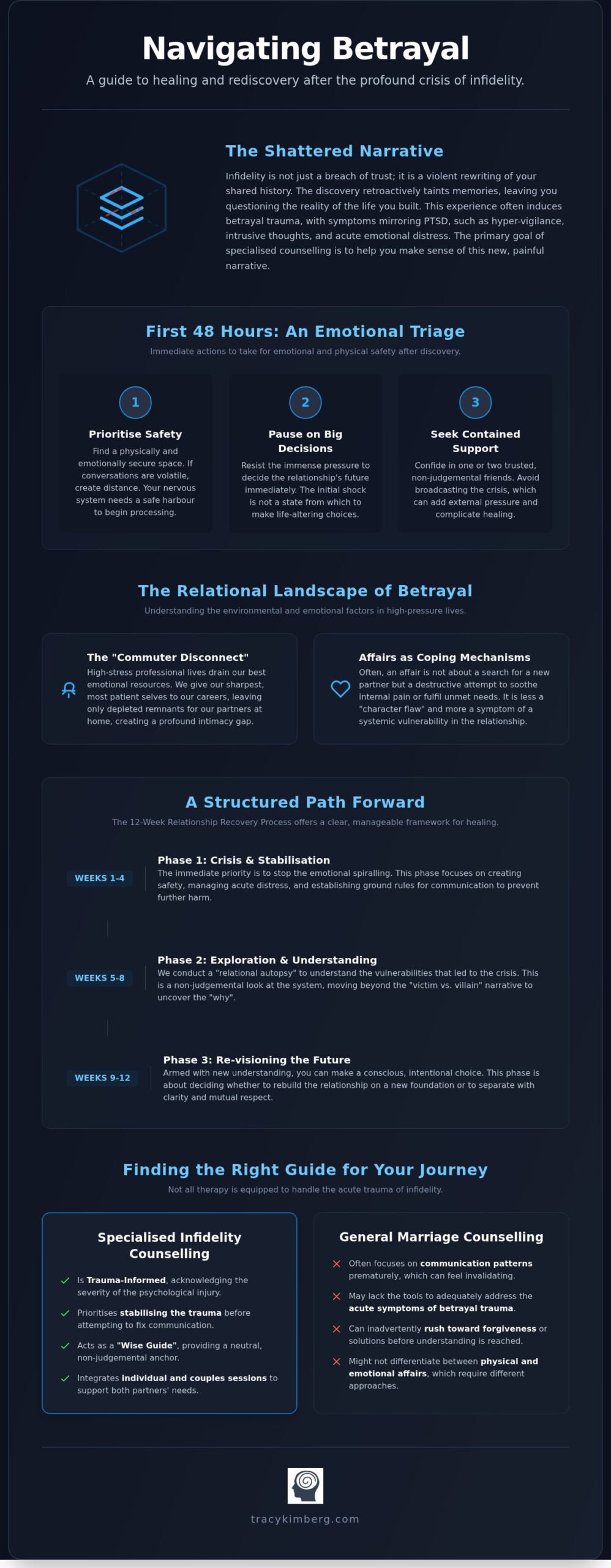
The 12-Week Relationship Recovery Process: A Structured Path to Healing
Traditional therapy can sometimes feel like wandering through a fog without a compass. My signature 12-Week Relationship Recovery Process is designed specifically for those who need a clear, time-bound roadmap through the chaos. This isn’t about endless sessions that dwell only on the pain; it’s a transformational journey from crisis to clarity. By providing a structured environment, we reduce the acute anxiety that defines the early days of betrayal, ensuring you have a professional, non-judgemental space to process your reality. Engaging in this work isn’t just a clinical necessity; it’s a proactive and positive adventure toward reclaiming your long-term emotional health.
Phase 1: Stabilisation and Safety
Discovery is a psychological earthquake. In this first phase, we focus on emotional stabilisation. We establish “Crisis Ground Rules” to ensure that your home remains a place of relative safety, preventing arguments from escalating into further trauma. We also address the “detective phase.” Whilst the need for information is natural, we work together to ensure your search for the truth doesn’t destroy the very possibility of future trust. This stage of infidelity counselling London is about stopping the bleeding so we can eventually heal the wound.
Phase 2: The Relational Autopsy
Once the initial shock subsides, we move into the “Relational Autopsy.” This isn’t a trial to determine guilt; it’s a deep dive into the “why.” Drawing on Esther Perel’s insights, we explore the meaning of the affair. Was it an exit sign, a cry for help, or a misguided attempt to reclaim a lost part of the self? We identify the relational gaps that existed long before the betrayal occurred, looking at the systemic health of your partnership without resorting to blame. Understanding the context of the betrayal is essential for genuine insight.
Phase 3: Rebuilding or Conscious Uncoupling
The final phase is about the future. You’ll decide whether to build “Marriage 2.0,” a new relationship with the same partner based on radical honesty and conscious effort. Alternatively, if the relationship has reached its natural end, we facilitate a Conscious Approached Divorce and separation. This process ensures that even if you part ways, you do so with dignity and clarity. Whether you stay or go, you’ll leave with a new contract for your life, built on the foundations of self-awareness and truth.
Immediate Steps: What to Do After the Discovery
The first 48 hours after discovering betrayal are often a blur of physiological shock. Your heart races, your sleep vanishes, and your brain struggles to process the new reality. In this “triage” phase, your only goal is emotional regulation and physical safety. Don’t rush into life-altering decisions like filing for divorce or moving house whilst you’re in this state of acute trauma. Instead, focus on basic needs: eat, hydrate, and find a professional anchor. Seeking infidelity counselling London early provides a containment vessel for the explosion of emotions, preventing you from making choices you might later regret.
When you feel the urge for an “Information Dump,” be incredibly selective. There’s a natural, almost primal drive to ask for every sordid detail, but these often become intrusive images that haunt your recovery for years. Focus on “investigative” questions about the meaning and context of the affair rather than “detective” questions about the specific logistics of the acts. This distinction, often emphasised by experts like Esther Perel, is vital for your long-term healing and mental health.
Managing the “Trauma Loop”
Intrusive thoughts can feel like a record player stuck in a scratch. When you find yourself spiralling, use grounding techniques to return to the present moment. Most importantly, avoid the “midnight polygraph.” Exhaustion and trauma are a volatile mix; interrogating your partner at 3 AM only leads to further damage and emotional exhaustion. Instead, write your questions down. Organising your thoughts in a journal allows you to bring them into the structured environment of a therapy session where they can be addressed safely and constructively.
Communication Protocols for Couples in Crisis
If you’ve decided to remain in the same home, especially if children are present, you must establish a “safe zone.” Children are incredibly sensitive to relational tension; maintaining a sense of routine is essential for their well-being. When you do talk, use “I” statements to express your pain. Saying “I feel devastated when I think about the secrets” is more likely to be heard than a direct attack. Implement a “20-minute rule” for discussing the betrayal. Once the timer goes off, the topic is closed for the evening. This prevents physiological flooding and ensures you don’t spend every waking second trapped in the past. If you’re ready to move from crisis to recovery, exploring Relationship Counselling and Coaching for Couples can provide the professional structure you need to navigate these volatile early steps.
Finding the Right Infidelity Counsellor in London
Choosing a therapist when your world has been turned upside down is a daunting task. You don’t just need a sympathetic listener; you need a specialist in betrayal trauma who understands the intricate architecture of trust. General marriage counselling often focuses on surface-level communication, but infidelity requires a deeper, systemic understanding of how narratives are shattered and rebuilt. Look for practitioners who utilise research-based methods like the Gottman Method or systemic coaching, as these provide the clinical depth necessary for complex recovery. Tracy Kimberg positions herself as a specialised authority in infidelity counselling London, blending profound psychological insight with a warm, accessible approach that makes the therapeutic process feel manageable rather than overwhelming.
Face-to-Face vs. Online: Choosing Your Space
For many professionals in the city, infidelity counselling London provides a vital “neutral ground.” Stepping into a professional office away from the home where the betrayal occurred can create a psychological boundary, allowing for more intense emotional work. This physical separation often helps partners speak more freely, knowing they can leave the intensity of the session behind when they walk out the door. Conversely, Online Therapy offers a sense of “home-base” comfort and essential flexibility for those with demanding schedules or childcare commitments. Tracy provides high-quality support in both formats, ensuring that the container for your healing is as stable and reliable as the guidance itself.
Taking the First Step: The Consultation
Your first step toward recovery is the initial consultation. This is your opportunity to find your “Wise Guide.” You’re looking for a balance of empathy, authority, and a complete lack of bias. It’s essential that your therapist doesn’t take sides but instead focuses on the health of the relationship and the individuals within it. Research consistently shows that the “click,” or the therapeutic alliance between you and your therapist, is the single biggest predictor of a positive outcome. You need to feel that your guide is genuinely invested in your long-term emotional health, whether you’re working toward rebuilding “Marriage 2.0” or navigating a conscious separation.
This process is an active, evolving experience. By choosing a specialist who understands the unique pressures of London life and the clinical reality of betrayal trauma, you’re giving your relationship the best possible chance at a conscious future. Don’t let the weight of the problem prevent you from seeking the specialised care you deserve. Healing is possible when you have the right support by your side.
Book your initial consultation with Tracy Kimberg today
Reclaiming Your Future After Betrayal
Betrayal changes the story of your past, but it doesn’t have to dictate the trajectory of your future. We’ve explored how the high-pressure landscape of city life can strain intimacy and why a “relational autopsy” is essential for true insight. By moving beyond the initial shock and stabilising your emotional environment, you can begin to see a path through the fog. Whether you eventually choose to build a new partnership with your current partner or pursue a conscious separation, you deserve a space that is both clinically rigorous and deeply human.
Accessing expert infidelity counselling London allows you to move from the chaos of discovery into a structured, manageable recovery. My practice provides a safe, non-judgemental environment, utilising research-based methods from Gottman and Perel to guide your healing. This process isn’t just about surviving; it’s about evolving into a more conscious version of yourself. You don’t have to carry this burden alone, and you don’t have to stay stuck in the pain.
Start your 12-Week Relationship Recovery journey with Tracy Kimberg and begin rebuilding your narrative today. There is hope for a more intentional, honest future.
Frequently Asked Questions
Can a relationship ever truly recover after an affair?
Yes, many partnerships find a way through the trauma to build what we call “Marriage 2.0.” Research indicates that 74% of couples who pursued structured therapy after betrayal successfully recovered. This process isn’t about forgetting the past or returning to an old version of the relationship. Instead, it involves a thorough relational autopsy to understand the vulnerabilities that existed and building a new foundation based on radical honesty and conscious effort.
How long does infidelity counselling usually take to show results?
Initial emotional stabilisation often occurs within the first few sessions; however, deep healing is a longer journey. My signature 12-Week Relationship Recovery Process provides a structured roadmap that helps you move from acute crisis to meaningful insight within three months. Whilst every situation is unique, having a time-bound framework reduces the anxiety of open-ended therapy. It ensures you’re making measurable progress toward either reconciliation or a conscious separation.
Should we tell our children about the infidelity?
Deciding what to share depends on your children’s ages and the specific circumstances, but maintaining their sense of safety is the priority. You don’t need to share sordid details to be honest about the fact that the relationship is facing challenges. Children are highly intuitive and often sense tension. Acknowledging that “Mum and Dad are working on things with a helper” often reduces their anxiety more than silence or hiding the truth.
What is the difference between relationship coaching and traditional therapy?
Relationship coaching is typically proactive and future-oriented, focusing on specific goals and actionable strategies for change. Traditional therapy often spends more time exploring the childhood origins of behaviour. My approach to infidelity counselling London blends both; we look at the systemic roots of the betrayal whilst providing a structured, results-driven framework. This ensures you understand the “why” whilst actively building the “how” for your future together or apart.
Is it possible to heal if the “unfaithful” partner is still in contact with the other person?
Healing is extremely difficult whilst the third party remains a presence in the relational field. Establishing safety requires the unfaithful partner to cease all contact with the outside person to allow the couple to focus entirely on their repair. Without this firm boundary, the injured partner remains in a state of constant hyper-vigilance and trauma. We establish these non-negotiable safety protocols during the stabilisation phase of our work together.
How much does infidelity counselling in London typically cost?
Fees for specialised support in the capital vary based on the practitioner’s experience and the specific structure of the recovery programme. Rather than viewing this as a standard expense, many professionals in London view it as a vital investment in their long-term emotional health and the stability of their family’s future. Investing in a structured, research-based framework ensures you’re working with a specialist who understands the unique complexities of betrayal trauma.
What if one partner wants to save the relationship but the other is unsure?
This “mixed-agenda” scenario is very common and is exactly what the initial phases of therapy are designed to address. We don’t start by deciding to stay together; we start by deciding to explore the possibility. The goal is to move from reactive shock to a place of clarity. Whether you choose to rebuild or pursue a Conscious Approached Divorce and separation, the process ensures that your final decision is intentional.
Can online counselling be as effective as face-to-face sessions for infidelity?
Yes, online sessions are highly effective and offer a unique sense of comfort for many couples. Whilst face-to-face infidelity counselling London provides a neutral ground in the city, digital sessions allow you to process intense emotions from a space where you already feel safe. The quality of the therapeutic alliance and the use of research-based methods are the true predictors of success, regardless of whether the conversation happens in person or via a screen.</p

Article by
Tracy Kimberg
Tracy Kimberg is a Relationship Expert, Couples Therapist and Coach with a dedicated focus on helping couples and individuals rebuild connection, trust and emotional safety in their relationships. Drawing on the research of John and Julie Gottman, the relational insights of Esther Perel, and years of hands-on therapeutic experience, Tracy offers a warm, non-judgemental and deeply compassionate approach to modern relationships.
Based in Dorset, Tracy works with couples navigating communication breakdowns, betrayal, intimacy challenges, separation, family dynamics and life transitions. Known for creating a safe and grounded therapeutic space, she combines practical tools with emotional depth to help clients move beyond survival patterns and towards meaningful, lasting change.
With a reputation for empathy, professionalism and dedication to her clients’ growth, Tracy is passionate about helping people feel seen, understood and empowered — both within their relationships and within themselves.
Disclaimer
Disclaimer:
The information shared in this article is intended for educational and informational purposes only and should not be considered a substitute for professional therapeutic, psychological, medical or legal advice. Every individual and relationship is unique, and the perspectives offered are based on general therapeutic principles, research and professional experience.
Reading this article does not establish a therapist-client relationship with Tracy Kimberg. If you are experiencing significant emotional distress, relationship crisis, trauma, or mental health concerns, it is important to seek support from a qualified professional appropriate to your individual circumstances.
All content remains the intellectual property of Tracy Kimberg and may not be reproduced or distributed without permission.